Not really sure why the author chose to have two stories. Alice is a 40ish woman in Austin, Texas, who has been unable to have children. An adoption has just fallen through. So she and her husband are stuck, out of money, and with a hole their potential child leaves behind. As Alice grieves for this loss, she and her husband drift apart. She ends up mentoring a troubled teenage girl who has little to no parental supervision and is likely to face a life of bad choices and an inability to escape her upbringing.
Carla is a 10 year old girl in Honduras with her grandmother and twin brothers. Her mother is in Texas, sending money and clothes and gifts while she can, as well as saving up money for smugglers to bring her children over the border. As time passes, one of her brothers is successfully smuggled to the US, leaving Carla with her other brother Junior and their grandmother who is in fragile health.
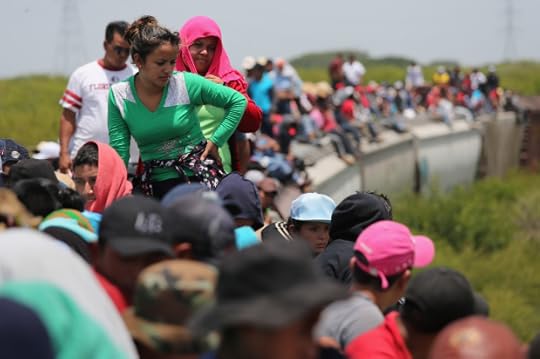
Thus we see two very different stories that will come together only at the very end. Carla decides, after the death of her grandmother, that she and Junior must leave Honduras, especially in the wake of increasing gang violence. In a journey faced with long, exhausting walks, violence, theft, rape, Carla and Junior make their way towards the United States in the hopes for a better life.
Meanwhile, Alice is facing trying to mentor Evian, and is totally under prepared for dealing with a troubled teenager. Throw in the fact that her sister Jane is pregnant and that a magazine wants to a spread on Alice and husband Jake's amazing BBQ restaurant and it is quite messy.
Like what many reviewers have said, Carla's story is the much stronger and poignant one. The book jacket clearly notes the author spoke to immigrant children and it clear she did her research to write this story. Alice's tale becomes increasingly tedious--while I felt for her at first, her story got old rather fast. Her husband seemed to be right: his wife was trying to fill the emptiness with Evian and perhaps animals too. And I just found I couldn't relate to her more and more as the story went on.
I also didn't particularly like how Alice seemed to have issues with boundaries: she brings home Evian to sleep on the couch, which Jake is not happy with (I wouldn't be happy with some random stranger on my couch either!). Alice insists on visiting her sister Jane in Colorado despite being told by Jane's husband that right now Jane doesn't need visitors, just family ("I am family!" Alice replies and tells him she'll see him soon). While the husband might not be a very nice man anyway (and strictly speaking she is family), this just totally rubbed me the wrong way. Especially as in the end, it all seems to rather conveniently work out.
This goes for Carla too. Her life seems to significantly improve once she reaches the US, despite not speaking a word of English (or very, very little). Which is not to say that does not happen, but some significant plot points that happen along the way either end up very conveniently solved (which ties hers and Alice's story together) or somehow get completely swept away. That's it? It seemed rather unbelievable as a development and I couldn't quite understand the point, unless the author was trying to underscore what happens to families that try to make the trip together.
I had a *very* hard time understanding how both Carla and her mother (and Carlos) seemed to accept this particular event, and the author seems to brush this and other developments as "God's will," "it's what God wants," and other very similar sentiments. It was too easy to wipe away things with that. I respect that both Alice and Carla are from religious families and religious areas. But the fact that God is spoken in about repeatedly in the *exact* same manner, whether in Texas, Colorado, Mexico or Honduras, it's just sloppy, lazy and obnoxious.
The book is written in alternating views, but I would say it's actually completely possible to just read Carla's chapters. Without giving too much away, Alice's story really isn't affected by Carla's (and vice versa) and I think this would have been *much* better if the author had actually just written about Carla, and left Alice as a secondary character. I actually wonder if Alice is a character that would somehow help bring the book to a wider audience (middle-aged woman unable to conceive) vs. the story of a young immigrant girl who is trying to cross the border illegally. Because the more I think on it, the more I think it really should have been just Carla's story.
A MUCH better book about immigration, family and more with a similar structure (except told in multiple viewpoints instead of two, and not all the vignettes are tied together with some more than others) would be The Book of Unknown Americans: A novel by Cristina Henríquez
Skip this one.


 >
>