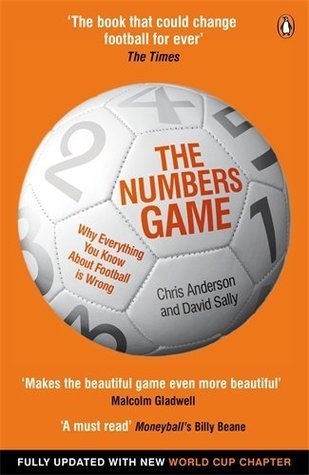
Fascinating book about numbers and statistics in football. Here are the best bits:
This also means that possession requires a collective, rather than individual, effort. It is a measure of team competence, not a specific player's brilliance. To see this more conclusively, we can look at data analysed by Jason Rosenfeld of StatDNA. Rosenfeld was interested in working out how much a player's pass completion percentage is determined by skill - something the player has control over - rather than the situation he finds himself in when making a pass. Rosenfeld's hunch was that pass completion percentage had less to do with the foot skill of passing the ball and more to do with the difficulty of a pass the player was attempting in the first place. It was not, he thought, so much what you did as where you were. To test his intuition, Rosenfeld turned to the numbers: specifically, 100,000 passes from StatDNA's Brazilian Serie A data. To assess a player's passing skill, he had to adjust pass completion by the difficulty of the pass being attempted. Surely passes in the final third of the field and under defensive pressure were more difficult than passes between two central defenders with no opponent in sight. Once he had taken into account things like pass distance, defensive pressure, where on the field the pass was attempted, in what direction (forward or not), and how (in the air, by head, and one touch), a curious result emerged: 'after adjusting for difficulty, pass completion percentage is nearly equal among all players and teams. Said another way, the skill in executing a pass is almost equal across all players and teams, as pass difficulty and pass completion percentage is nearly completely correlated.' Think about what this means. It is virtually impossible to differentiate among players' passing skills when it comes to executing any given pass (at least at the level of play in the Brazilian top flight). Everyone can complete a pass and avoid a turnover in an advantageous position on the pitch if they are without pressure or playing the ball over only a short distance. As a result, at the elite level, the particular situation the passer finds himself in determines a player's completion percentage, not his foot skills. While their passing skills may be highly similar, this doesn't mean that players have identical possession skills. The data do not describe what happens before the ball arrives. As Rosenfeld observes: Is Xavi an "excellent passer" because he can place a pass on a dime or is it more his ability to find pockets of space where no defensive pressure exists to receive the ball, with his ball control allowing him to continue to avoid pressure and hit higher value passes for an equal level of difficulty? Many play-duput themselves in difficult passing situations because they dwell on the ball too long and upon receiving the ball are not ale to reposition their bodies in a way that opens up the field. Possession football, in other words, is more than just being able to pass the ball - at the very top of the professional football pyramid, it has relatively little to do with that: it is mostly about being in the right place to receive it, helping a teammate position himself in the right place in the right way, and helping him get rid of the ball in order to maintain control for the team. As countless coaches have yelled to many a struggling player, you don't pass with your feet, you pass with your eyes and your brain. Football is a game played with the head. A good team, when further up the pitch, manages to create and find space for both the passer of the ball and his intended target, making the passing situation easier. A poor team, in the same place, would not create as much space, so the passing situation would be harder. Good teams are not better at passing than bad ones. They simply engineer more easy passes in better locations, and therefore limit their turnovers
Sunderland, Brentford, Brighton, Stoke, Liverpool, Millwall and many others all have owners who do not place a bet or invest a penny without examining the numbers first.
That is the true power of data: to change our relationship with the game.
In the game, the ball changes his hands 400 times says Chelsea‘s Mike Forde
When Liverpool signed Stewart Downing and Jordan Henderson in the summer of 20II, more than sixty years after Reep first took pencil from pocket and set his system to work, the pair's final third regain' percentage was one of the key statistics used to assess their worth; Barcelona and Spain have based much of their recent success on the pressing game.
Zlatan Ibrahimović the player in question is a serial title winner. Between 2003 and 2011 the giant Swedish striker won ague championship every single year, wherever he prayed.
That's eight straight titles, including one in Holland, one in Spain and six in Serie A. He is more than just a good-luck charm: only once did he fail to score more than fourteen goals in a league season. Ibrahimovic is not a passenger, along for the ride; he is a difference-maker.
During penalty shootouts: scientists have found that the more anxious a player is, the more likely he is to look at the goalkeeper - something that is there - rather than the space around him. 16 Players who are told not to shoot within the keeper's reach are even more likely to look at him, an effect known as an ironic process of mental control, when the effort not to do something makes doing it even more likely. This bias towards seeing what is there and ignoring what is not makes valuing defence difficult. Attacking has one simple best outcome: a goal. But defending is quite the opposite: there, the best outcome is a goal that is not conceded, an event that does not actually happen.
Opta sports collect such a stat to denote teams winning control possession though the term for them is recoveries. Over the past three seasons of the Premier League, Opta's data show that teams gained possession in this way about 100 times in a typical match, for a match total of around
200. So on the conservative end, teams have at least 100 possessions of more than just a transient touch of the ball - a number similar to that of basketball teams.
In the course of one football match, nobody plays ninety minutes of football. According to Opta Sports, the ball was in play for between sixty and sixty-five minutes in a typical match across the four top European leagues in 2010/II. In the Premier League, the average was 62.39 minutes." Yet for matches involving Stoke the average amount of time that the ball was in play that season was 58.52 minutes.
It's these managers who have given us all of football's great innovations: the W-M - reportedly invented by Arsenal manager Herbert Chapman after losing 7-0 at Newcastle - catenaccio, zonal marking, the long-ball game. They are all attempts to upend convention and surprise the opposition. Knowing more, knowing better, knowing something new and knowing something different can help engineer wins or avert defeats. Aside from talent, hard work and swift feet, intelligence and innovation - on the pitch and off it - are key ingredients in success.
Kremer's original article from 1993 was called 'The O-Ring Theory of Economic Development'. The name originates from the rings of high-tech rubber that were designed to seal the tiny gaps between the stages of the booster rockets that would lift the Space Shuttle Challenger into the sky in 1986. The rings, though, froze in the cold overnight temperatures at NASA's Kennedy Space Center at Cape Canaveral, Florida, and failed, allowing hot gases to escape and strike the enormous external fuel tank, eventually causing an explosion and the demolition of the entire vehicle, as well as the deaths of all seven crew on board. The failure of that one small part caused a sophisticated, complex, multimillion-dollar machine to malfunction. The O-ring was the weakest link in a system whose components and sub-processes were all integrated.
Lobanovskyi was a trained engineer, and a pioneer of the numbers game. Early in his coaching career he brought Dr Ana-toliy Zelentsov to his side in order to collaborate on a scientific, systematic approach to football. Lobanovskyi had studied cybernetics, a field whose central concept is circularity, and which deals with problems of control and regulation in dynamic systems. He and Zelentsov viewed a football match as an interaction between two sub-systems of eleven elements (players), whose outcome depended upon which sub-system had fewer flaws and more effective integration. The key characteristic of a team is that the efficiency of the sub-system is greater than the sum of the efficiencies of the elements that comprise it? 16 In another interview Zelentsov said, Every team has players which link "coalitions", every team has players which destroy them. The first are called to create on the field, the latter - to destroy the team actions of [the] opponent." Using different concepts, this describes an O-ring production process.
As David Goldblatt explains in his authoritative history, The Ball Is Round, catenaccio as a system of play was first developed by the Austrian-born coach Karl Rappan at Servette in the 1930s. His innovation was to withdraw a player from his forward line and play him behind his three centre backs. He had no direct opponent to mark; instead, he would protect space.
Through a very simple series of tests performed on members of the Berlin rowing club, Köhler had demonstrated that teamwork could produce significant gains in motivation. First, he tested how long each standing rower could, while holding and curling a bar connected to a weight of forty-one kilograms, keep the weight from touching the floor. Then he doubled the weight, paired the rowers and tested how long they could curl the heavier bar together. This is a weak-link task because the weight was too great for any single person to hold up: the eighty-two kilograms would hit the floor when the weaker partner's biceps gave out. Köhler found that weaker rowers would endure significantly longer when they were paired than when they were solo. In doing so he had isolated one of the key characteristics of psychology: the gain in enthusiasm and effort and perseverance that comes from being on a team.
It is better to have a team of all 70 per cent players than it is to have a team where two players are 100 per cent, the majority are 7os and then there is one bumbling 50 per cent and one dreadful 30 per cent. Strong links don't win matches. Weak links lose them.
Football, as a more complex team game without a form of real possession, is largely about triangles. One such triangle might be the player currently touching the ball, the one about to receive it, and the off-ball player currently causing the great est deformation in the defence's shape. Triangles might replace ball events as the key unit of football analysis. The use of networks to construct interacting webs of players and formations is already infiltrating the sport.
English players play football the same way the best Argentines do, then recruiting in Buenos Aires may sound glamorous but may not be particularly cost-effective compared to recruiting in Bristol, Leicester, or Preston. The sport in England and across the globe has settled into a competitive equilibrium.
Perhaps the most obvious manifestation of this is the way teams work together to produce wins, draws and losses. In basketball one superstar is 20 per cent of the starting team; football's giants make up a much more meager 9.1 per cent of the total team. This means that the door is wide open for the team's poorest players and its most tenuous on-field relationships - the weakest links - to play a decisive role in determining a team's fortunes.
Finally, unlike American baseball teams - in a league with guaranteed membership and stable revenues - football clubs face a purer capitalist system: relegation and the shadow of bankruptcy and administration. This kind of downside risk makes most decision-makers more conservative and less likely to try new ideas.