Presented here for the first time in English is a remarkable screenplay about the apostle Paul by Pier Paolo Pasolini, legendary filmmaker, novelist, poet, and radical intellectual activist. Written between the appearance of his renowned film Teorema and the shocking, controversial Salò, or the 120 Days of Sodom, St Paul was deemed too risky for investors. At once a political intervention and cinematic breakthrough, the script forces a revolutionary transformation on the contemporary legacy of Paul. In Pasolini’s kaleidoscope, we encounter fascistic movements, resistance fighters, and faltering revolutions, each of which reflects on aspects of the Pauline teachings. From Jerusalem to Wall Street and Greenwich Village, from the rise of SS troops to the death of Martin Luther King, Jr, here—as Alain Badiou writes in the foreword—‘Paul’s text crosses all these circumstances intact, as if it had foreseen them all’. This is a key addition to the growing debate around St Paul and to the proliferation of literature centred on the current turn to religion in philosophy and critical theory, which embraces contemporary figures such as Alain Badiou, Slavoj Žižek and Giorgio Agamben.
Italian poet, novelist, critic, essayst, journalist, translator, dramatist, film director, screenwriter and philosopher, often regarded as one of the greatest minds of XX century, was murdered violently in Rome in 1975 in circumstances not yet been clarified. Pasolini is best known outside Italy for his films, many of which were based on literary sources - The Gospel According to Saint Matthew, The Decameron, The Canterbury Tales...
Pasolini referred himself as a 'Catholic Marxist' and often used shocking juxtapositions of imagery to expose the vapidity of values in modern society. His essays and newspaper articles often critized the capitalistic omologation and also often contributed to public controversies which had made him many enemies. In the weeks leading up to his murder he had condemned Italy's political class for its corruption, for neo-fascist terrorist conspiracy and for collusion with the Mafia and the infamous "Propaganda 2" masonic lodge of Licio Gelli and Eugenio Cefis.
His friend, the writer Alberto Moravia, considered him "the major Italian poet" of the second half of the 20th century.
Pasolini, discreet, infiltrated, marginalized, among the little people. The one who is there and whom we cannot see. The one we sense, then feel, discover, and then finally kill.
The book is a film project, which one could compare, as Marc Rombaut does in his essay Pier Paolo Pasolini (Lieux de l'écrit) to the life of the author, whose similarities with that of St Paul of Tarsus are, in my opinion, not out of place.
Written in the spring of 1968, this draft scenario was seriously considered by film producers in 1974 but the required budget finally frightened them, and the film was never made.
It is a shame.
This life of St Paul, Pasolini transcribes it in the Paris of the Nazi occupation, in Vichy, in fascist and post-war Italy, before taking it to the New York of the sixties, that of Ginsberg, of public readings, in Martin Luther King’s America.
New York, where Paul will be trialled, and where this saint will be savagely murdered, in a slum, in a timeless place.
“The Church, as Pasolini evokes it in this book – an institution increasingly intolerant and corrupt as its power extends – is indeed the one that Paul founded with all his will and all his enthusiasm, but in the ignorance of what his message and his action will mean in the future. »
In a world driven by death, Pasolini wants to find and show the lost Reality, the sacred meaning, and the sacred nature of Humanity, to show the true world hidden behind this new world of false permissiveness and dummy idols. In his works he will use the image of the “Ragazzis” to give shape to eternal myths.
Paul of Tarsus, model and mirror of life for Pasolini, who will also be savagely assassinated in a timeless place, in Ostia, in the very place where the souls embark for Purgatory in the second Canto of Dante's Purgatory.
“And I, who then turned my steps towards the sandy shore, Where Tiber’s water becomes salty, I was kindly received by him. He now raises its wings towards the river mouth, As it is always there that he gathers All such as not to Archeron descend.”
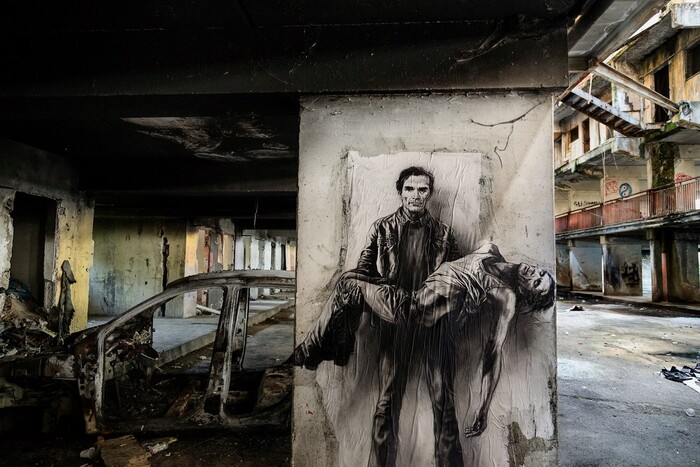
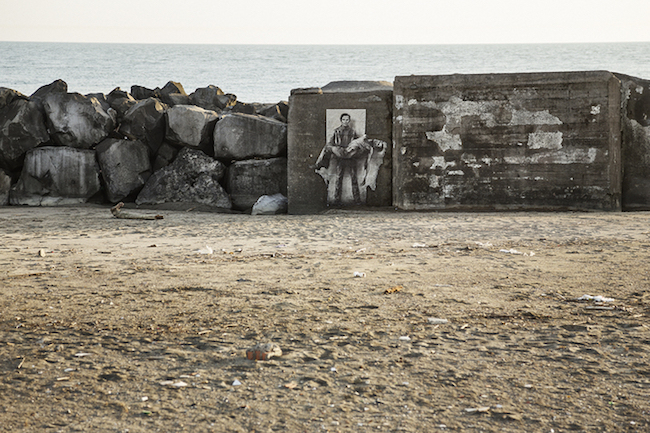
(Urban Art by Ernest Pignon-Ernest, homage to Pasolini Paris - Ostia 2015)
Interesting to read this after watching Il Vangelo secondo Matteo. And then compare Pasolini's resistance-version of Paul to Badiou's communist version of the same. Similarities, but also some striking differences. San Paolo would have been such an important poetico-political film, if PPP had found an adventurous producer with a budget (because a lot of travels and extra's were needed, many more than for the Gospel)..
Saint Paul as a misunderstood radical militant in contemporary Europe and America. Great social commentary but I have to reread this to get through all the religious implications. Seriously, this should have been made into a movie rather than Salo.
Very grateful for the introduction by translator, Elizabeth A Castelli, since my familiarity with PPP comes primarily from The Hits, and my theological study begins with the first four years of schooling (where we sang semi-secular hymns and did the Lord's prayer in assembly, and RE consisted of child-friendly Bible stories before they introduced the concepts of Hinduism and Sikhism once our brains were developed enoigh) and ends with the PM Dawn record I had on while reading this at work.
The star rating relates not to the quality of the contents — Badiou's word-salad foreword, occluding rather than illuminating as much such writing does — but cos the unfinished nature of the project can only be wrung for so much pleasure/transcendence. V charmed by the "TK TK TK" parts of the full treatment, including the hand wave of "we'll figure out how to depict the abduction to the third heaven of Paul later — 'perhaps with a photographic trick, etc'"!
How successful is P³ at analogising the story for the then-contemporary setting? Hard to say; it's not finished, and he himself cops to the fact that in the finished film, he'd be trusting the audience to accept certain leaps and obfuscation. In terms of reconciling the contradictions of narrative and logic from the original story, something he did with all his adaptations and which parallel the similar tensions in his own moral, personal and intellectual life, it's innervating to watch it happen on the page — if less so than if it were on that big shiny screen.
Insieme a Il padre selvaggio la più famosa sceneggiatura mai realizzata di Pasolini. Questa sceneggiatura nasce probabilmente dal fascino subito dai due viaggi americani di Pasolini, dove vide in prima persona la situazione degli Stati Uniti e quella che lui stesso definì "la migliore sinistra esistente al mondo attualmente". Il San Paolo di Pasolini vive nell'attualità e di base è un giovane contestatore un po' beat un po' hippie, non molto diverso da quelli europei e americani del dopoguerra che vagabondavano predicando valori scomodi e fastidiosi per il mondo perbenista liberal-conservatore dell'epoca. Un profeta dell'amore che trasferitosi nella terra delle opportunità si troverà a fronteggiare anche un sistema discriminatorio e un sistema carcerario mostruoso. Nelle ultime sequenze sembra quasi di assistere al processo dei sette di Chicago che vennero accusati di sommossa e associazione a delinquere solo per le loro idee. Mi chiedo quanto più sarebbe cambiata la reputazione di Pasolini con questo film, pensando a come sarebbe stato recepito, non solo all'estero ma anche in Italia.
Filmmaker Pier Paolo Pasolini's most ambitious screenplay is the one he never finished. Reading St. Paul was an interesting experience, and it's a shame Pasolini couldn't get it made; the core concept of taking a Biblical character and inserting their story into modern times (in this case St. Paul, in the forties) to show how those stories are still applicable millennia later is very interesting. I'm definitely noticing that not having read the Bible prior to this is a major handicap though, as Pasolini clearly assumes that the reader has certain knowledge - not a negative, but something that limited my understanding of this screenplay. Had I come in with more knowledge, then this might have seemed a lot less preachy as well, which I think it really suffers from in the latter half, in addition to a lot of nuances that went way above my head. As far as I can gather, Pasolini eventually gave up on this screenplay, and made Salò, or the 120 Days of Sodom instead, and although I wish we got to see both films in their finished form, I think he probably made the right call in which film he chose to realize.
verlegung der paulus handlung zwischen 1938 und 1968 nach vichy-frankreich rom new york und mlk hotel, dialog bleibt aber orignal bibeltreu. pasolini spaltet paulus in zwei; befreiungstheologe und kirchendepp. nebenbei arbeitet evangelist lukas mit mephisto an der errichtung der kirche. perfekte vorlage.
La idea es excelente, y si bien es un poco frustrante leer esto en formato guión porque habría sido una película fantástica como todas las de PPP, de todas formas me gusta que tenga marcadas las referencias bíblicas, así se puede hacer una lectura multidireccional con el evangelio al lado :)
A very confused, scattered, imperfect, but fascinating modern day reimagining of the early church. Part of me would like to have seen a film version of this, but part of me is happy that it exists as it is because it feels like an interesting window into pasolini's creative process. A little confused at the hostility towards St. Luke - what did Luke ever do for Pasolini to blame him for all of the crimes of the Catholic church lmao
Would have been a cool movie, but my one question to those “marxists” like Pasolini and the private school kids: how do we become a force to reckon with, without becoming a force to reckon with?