Shelley's father made her life unbearableWhen Shelley's domineering father, Charles, sent her to Avala on business, she thought he had finally acknowledged her independence.Then handsome island entrepreneur Vargen Gilev pointed out that Shelley was being followed. Charles's spy was proof that Shelley was still under her father's thumb.But Vargen offered a means of permanent escape. All it would cost Shelley was six months of her new freedom--six months of marriage to Vargen!
The hero? Heroine slapped him several times. The heroine? Hero brutally kissed her. She was kidnapped. The kidnappers? Heroine knocked out the driver cold and injured the "OW." The heroine's father? Hero punched him to the ground.
As you can probably tell this is a slapstick romance. The characters interact with each other with actions not words. Since that is the first rule of daycare - "use your words" - everyone comes off looking immature and slightly ridiculous.
The plot? Well, it's flimsy logic at best. First act: Hero vows revenge on the heroine's father so he's been watching the heroine for a year or so. When she comes to his island to buy a hotel for her father, he decides he'll buy the hotel from underneath her and then ??? Who knows. He decides he'll marry her and take her away from her evil father. Heroine agrees to marry him in a marriage of convenience to get away from dear old dad.
Evil father is angry to lose his hotel and punching bag. He returns in the third act with kidnappers but is thwarted by both the heroine and hero.
Second act? H/h's marriage and honeymoon - squaring off like animals who know they must mate but really aren't enjoying it. Sorry - bad description but accurate for this less-than-romantic couple.
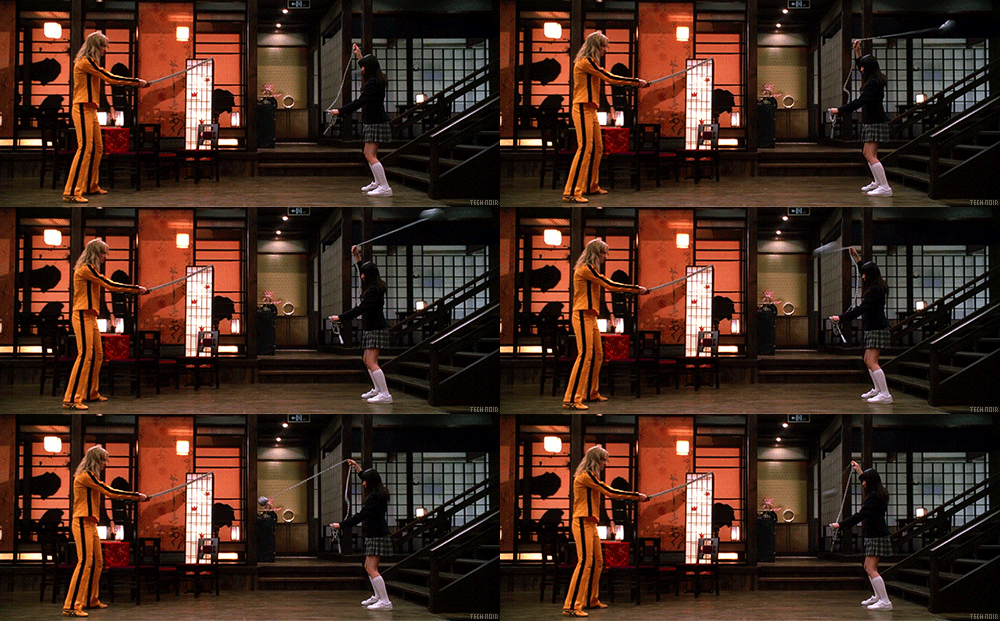
I will remember this only for the EPIC catfight between the heroine and her OW captor, which was worthy of Joan Collins and Linda Evans! Or maybe even Kill Bill! LoL
This entire review has been hidden because of spoilers.
3 1/2 Stars ~ Shelley became motherless when she was six and then was raised by her controlling and abusive father who did not hide his disappointment that she had not been born a son. She'd learnt bitter and hard lessons from him, and came to realize that the one she needed love from the most had none to give her. At 23, Shelley had thought her father was ready to accept her independence and trust her abilities. She's travelled to the beautiful Montenegro island of Avala to purchase an hotel for her father that was up auction, the hotel that is owned by her uncle. Her orders were simple, arrive and stay in a different hotel under an assumed name, keep a low profile, attend the auction and succeed in the purchase. She's disconcerted when she meets Vargen, the owner of the hotel she's staying in, who informs her that her father has people spying on her every move and that he knows her purpose for being on the island. Vargen had expected his enemy's daughter to be cold and calculating, but Shelley appears to be vulnerable and she has an air of innocence that he finds appealing. His original plan was to blackmail Shelley into a marriage and thus enact his revenge on the man who purposely stole the woman he had once loved. Realizing that Shelley is a victim of her father's abuses, forces him to examine his motives. So he informs her that he has privately purchased her uncle's hotel and that he shall turn over title to her if she enters into a marriage for six months. In order to escape her controlling father, Shelley agrees. She trusts Vargen to keep his word that the marriage shall be in name only, but she finds his unemotional and extremely polite demeanor to be frustrating. He's like a robot and something in her wants to shake him up. When she realizes that she's fallen in love with him, she becomes determined to play the same game, she'll be a cool customer too. Only his polite and calm attitude frustrates her, and she decides to provoke a reaction.
Vargen is a man of deep passions that he refuses to acknowledge and keeps under a tight control. He has a reputation of being a dangerous man. Shelley's vulnerability touches him and he finds he can't use her for his revenge but he can help her escape her father's abusive hold. He admits to her that he admires her bravery. Shelley has been deprived of love and her unexpected desire for Vargen totally overwhelms her. While she's not totally naive, she is inexperienced, and her decision to provoke him to any reaction unleashes a response she was not prepared for. Ms. Wibberley shows Shelley as a smart young woman in one instance and then makes her totally immature in the next when she has tantrums and repeatedly slaps Vargen. In this book, I think Ms. Wibberley used the slaps as a means to show that Vargen would never strike her back and that he could be trusted to protect her, so while I disliked the slapping it did show Vargen in a gentler light. This was a different type of romance, with a man whose hard as stone wall crumbles when he faces a young woman's brave struggle for survival from her evil controlling father.
I’m not all about the sex. I’m not. Don’t believe me?
I’m reading The Romance Revolution: Erotic Novels for Women and the Quest for a New Sexual Identity by Carol Thurston (1987).
Reading The Romance Revolution, it occurs to me just how smart women had to be in the academy in the 80s to be taken seriously. This book is rich with research and insight. Each chapter is a book unto itself by today’s standards.
My favorite analysis of popular romance, until now, was Janice Radway’s Reading the Romance. But I prefer Thurston’s methodology. Both Radway and Thurston explore readers’ responses to romance, but Thurston’s methods include a comprehensive analysis of plot and character, the texts themselves. Where Radway’s work is an ethnography, Thurston’s is a discourse analysis, one that takes the reader beyond the often self-referential textual analysis of New Criticism.
I suppose I should be grateful that at my age, I’m still thrilled by academic discovery. But this discovery would have been more helpful when I was a critic. Not just scanning for sex scenes…
So back to that.
Thurston in her opening chapter “The Romance Novel as Popular Culture” outlines her erotic romance data set. The Harlequin Romance line, of which I have been reviewing in my last posts, is not included. That’s what I’ve been saying about this line. No sex.
Thurston reports that, “With a few notable exceptions…the character of male-female relationships portrayed in [this] line remains…the incomprehensible/cruel hero and the insecure/masochistic heroine”.
That’s it. Utterly incomprehensible. I’m relieved to know it’s not just me.
It’s not just the frustrating absence of erotica that excludes this collection of books from Thurston’s analysis. She reports that critics of popular romance as a rule disregard these “classic” romances and cites a Romantic Times (1985) writer: “One wonders when Harlequin will realize that this is not romance at all.”
I can’t agree or disagree. Romance is too subjective a notion to disregard anything outright as not romance. Instead, I’ll argue it either scratches your itch, or it doesn’t.
Take Vargen Gilev.
Yes, ladies. Vargen Gilev. It bears repeating.
Vargen is the “handsome island entrepreneur” who is Mary Wibberley’s incomprehensible hero in Dangerous Marriage. He is a “hard-eyed, hard-faced stranger,” alpha all the way. In spite of the Marimekko shirt he’s wearing on the cover.
The heroine, Shelley, has arrived on Avala to buy a hotel. Her domineering father has demanded that she do so. Vargen also wants the hotel – has actually already purchased it – but more than that, he requires the respectability a marriage will give him. He persuades Shelley to marry him.
Hey, wait! We have a marriage plot. It’s the first I’ve read in this line, and I was optimistic. Sex! There could be sex because they’re married. And I was RIGHT.
Shelley could have been a vindicated heroine, the trope described in Kiss of a Tyrant. But the reader is offered no feeling of vindication. Although Vargen is incomprehensible, he is not cruel.
True, he consummates their marriage while she’s still groggy from too much Russian vodka he’s made her throw up fifteen minutes before. But the author Wibberley has more cruelty than Vargen. Vargen by my account is a hottie, and I’ve been duly revved. But their consummation is oblique.
She felt the hard bed beneath her and was aware of having been lifted and placed there, and she lifted her arms to him, to pull him down to her, to hold him as she had never held anyone before…There was only darkness, and movement, and two bodies that became as one… Only darkness? Only movement? What about his penis?
The plot’s twists are a self-righteous yoga pose designed to explain the hero’s actions for the previous 180 pages. It’ll just confuse us both if I try to recap.
Shelly, after a lifetime of emotional and psychological abuse by her father, is skittish. When Vargen grabs her to keep her from falling over the balcony, she rages. The typical fist flailing against his hard, broad chest. Shelley almost falls off two balconies, cuts her foot, almost drowns, suffers alcohol poisoning, and is kidnapped.
Through it all, Vargen’s face is impassive, hard. Incomprehensible.
Until the final scene, when he rescues her from her kidnapper and melts.
‘I love you Shelley, I love you very much…,’ he groaned. ‘Oh, my dearest…’ And more like that. Some darlings. Some my loves. I prefer my reserved heroes to remain reserved. His softening at the end of a book feels like a betrayal. He can love her but still look mean. That’s the point.
I’m so done with this line. Where the hell is Avala?
Up next…Harlequin Temptations. I remember stealing these from my mother and hiding them under my bed. They’re included in Thurston’s analysis of erotic romance, and a box has just arrived on my front porch – an accidental pregnancy after a few tipsy minutes on Ebay. Yeehaw.
She struggled so much with emotions, love, hate, desire, fear, it was hard to see why H falls for her. She does redeem herself fighting off the kidnappers, by far the best part of the book.
If there's ever a contest for the most bat crap Harlequin, this one would most definitely be a finalist, if not the winner!
I didn't like any of the characters but especially the h, who had to be the most spoiled, self-centered narcissistic one ever! Every time she got into one of her frequent messes, I found myself wishing she'd croak, and I really meant it!
I didn't bother to read until the end, because that whole kidnapping by her (equally narcissistic) father was just too ridiculous, particularly the h fending off her captors with a comb????? And the stupid H was coming to rescue her, when he should have considered himself lucky to be rid of her!
Not that I liked him, either. He seems to only want to hit the sheets when either he or the h is incapacitated in one way or another. Well, they're both mentally incapacitated as far as I'm concerned, so I guess they're a perfect match!
I only hope he has no swimmers and she has defective eggs, so they can't make more of each other! If they do, they should be arrested for a crime against humanity!
Skip this mess, unless you have a toilet paper emergency!
When Shelley's domineering father, Charles, sent her to Avala on business, she thought he had finally acknowledged her independence.
Then handsome island entrepreneur Vargen Gilev pointed out that Shelley was being followed. Charles's spy was proof that Shelley was still under her father's thumb.
But Vargen offered a means of permanent escape. All it would cost Shelley was six months of her new freedom--six months of marriage to Vargen!
it's embarrassing that I read these things. I love some old Harlequins; they have a certain charm. this one didn't. it reminded me of the movie Intolerable Cruelty. the characters were just MEAN to each other. the requisite happy ending didn't really feel right. if you're going to waste your time reading old Harlequins, find a different one.
3 1/2 stars. I can't help that I like to read these old Harlequins. I bought a bunch for just pennies. Even though I wouldn't call this a good book I did enjoy reading it.