In recent years, there have been major outbreaks of whooping cough among children in California, mumps in New York, and measles in Ohio's Amish country -- despite the fact that these are all vaccine-preventable diseases. Although America is the most medically advanced place in the world, many people disregard modern medicine in favor of using their faith to fight life threatening illnesses. Christian Scientists pray for healing instead of going to the doctor, Jehovah's Witnesses refuse blood transfusions, and ultra-Orthodox Jewish mohels spread herpes by using a primitive ritual to clean the wound. Tragically, children suffer and die every year from treatable diseases, and in most states it is legal for parents to deny their children care for religious reasons. In twenty-first century America, how could this be happening? In Bad Faith, acclaimed physician and author Dr. Paul Offit gives readers a never-before-seen look into the minds of those who choose to medically martyr themselves, or their children, in the name of religion. Offit chronicles the stories of these faithful and their children, whose devastating experiences highlight the tangled relationship between religion and medicine in America. Religious or not, this issue reaches everyone -- whether you are seeking treatment at a Catholic hospital or trying to keep your kids safe from diseases spread by their unvaccinated peers. Replete with vivid storytelling and complex, compelling characters, Bad Faith makes a strenuous case that denying medicine to children in the name of religion isn't't just unwise and immoral, but a rejection of the very best aspects of what belief itself has to offer.
If you have been following my reviews at all, even say... the last five, then you'd know that I'm not a religious person. Up until right now, and with few exceptions, I would say that I'm tolerant of others' beliefs... but I've found my line in the sand, it seems. That would be where some people or religions, like Christian Science for example, choose to use belief or prayer as their only method of healthcare, and it causes people to suffer and die needlessly. This, to clarify, since it was pointed out to me that I did a poor job of it originally, is not the rule when it comes to religion or faith or a belief system. It's definitely more common than I would like, but it's certainly not the majority by any means.
This book was fucking heartbreaking and appalling and horrifying. At the beginning of the book, I really wasn't sure where it was going. Offit mentions that he's not anti-religion, and that in fact, in researching this book, he had actually come to appreciate religion even more, and that the answer to the problems he would soon outline would be found therein. Which was something I found a little suspect, to be honest. If some religious faith is the impetus for avoiding medical care, how exactly is that going to do an about-face and suddenly embrace it?
It could be that he was trying to draw a line separating "religion" from "faith", or between religion and these types of cults, and was imploring organized religions to intercede and change their doctrine to allow for modern medicine to have a place in addition to faith... but honestly I don't see that happening. Some of these beliefs carry the weight of thousands of years of tradition, or at least text which can be interpreted to mean the same thing, and even when they don't have the eons of time behind them, like Christian Science, they continue to exist simply because people believe in them. Faith requires no proof or logic.
It's an almost flawless system for the church/religion or cult, really. They aren't accountable for failure. If your faith is true and pure in whatever the doctrine they specify, you, or the one you're praying for, will be healed. If not, it's because you, or the sick one, or someone, somewhere, lacked faith. Or maybe it was just God's will. There's no way of knowing. Better luck next time.
This book broke my heart a dozen times over. At one point, I literally was so shocked and horrified and angered by one of the stories told in this book that it was either shout "Are you fucking SERIOUS??!" or just start angry crying. And as I was driving at the time, I figured the former was the better option.
I just don't understand how or why someone could sit by and watch their child(ren) die slowly and painfully by inches, and do nothing. I'm sorry, but praying doesn't cut it. Time after time, these parents had time to seek actual help that would be much more effective than speaking words into empty air, and they chose to do the latter. Sure, to them, the air wasn't empty... yet for all the good it did, I see no reason to call it anything but.
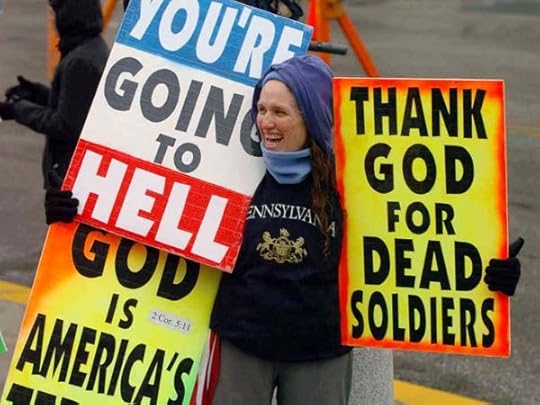
This book covered a lot of ground that I thought was interesting, from Biblical stories to historical mistreatment of children to infectious disease outbreaks caused by failure to vaccinate (for religious reasons here though, not because of Jenny McCarthy's autism nonsense), to abortion, placebo effect (briefly), to legal battles over First Amendment rights and where to draw the line between a person's right to practice their religion and protecting society and innocent children who are being treated as pawns in this tug of war. Or, as the book claims, "martyrs". It talks about cults and the Westboro Baptist nutjobs and the ACLU, and corporations as "religious entities" when it comes to providing certain healthcare options, and it shows how this religious freedom from medicine thing is much more widespread than people would think. (I seem to remember a Law & Order episode where a Jehovah's Witness needed a blood transfusion, and it was a big deal... but otherwise, this really isn't something that you hear about in the news.) This book even went into the Jerry Sandusky trial, and at the same time as he was being brought up on charges for sexual assault on children and teens, another case going on here in PA was ensuring that parents who choose to allow their children to die by withholding medical care for religious reasons will not be prosecuted. I live here in PA, and I definitely heard about the one case, and definitely nothing on the other.
I will say that bits of this were repetitive, and I think it could be a bit more organized as far as the layout. Perhaps it was due to my listening to this on audio, but it felt like it jumped around a bit more than I would like. I would also have liked, and maybe this exists in the print edition, a bibliography and resource index. There were a few other books mentioned that I would be interested in reading, and I would love if there were resources for people looking to help or seek help for someone else.
Otherwise, as much as this book was a major downer, I did find it interesting and fascinating and horrifying and heartbreaking. It just amazes me that in this day and age, in some ways, we're still stuck in the fucking dark ages.
I don't always finish a nonfiction book in one day, but when I do, it's really good.
Fair warning though: this is an emotionally difficult read. Lots of descriptions of children dying awful, painful, totally preventable deaths. But if you can handle it, it's an extremely important issue to get yourself informed about, and Offit is a very compassionate and engaging writer.
He also changed my mind about the usefulness of laws. I went into this thinking that there's no way it would work to simply make it illegal to withhold medical care from children for religious reasons, that people would do it anyway. But Offit offers compelling evidence that these laws would actually work, because they've been tried in some places.
Everyone go to jail, please. No really. Christian Science “practitioners”, politicians, faith healers, parents who allow their children to suffer unspeakable abuses, and everyone who enables this bullshit in the name of religious and personal freedom. One chapter near the end describes the discovery of cemeteries of dead children connected to a sect that espouses faith healing and mentions that Canada, where allowing your child to die because of religious beliefs is a jail-able offense, has had two such deaths, the UK with similar laws has had none. The US has cemeteries (plural) of dead children, and that’s the tip of this nightmare iceberg. This is embarrassing for us.
It’s very well written, understandable for the layperson (even some more complex medical topics were broken down so well, I was really impressed), and his arguments weaving in Jesus-approved messages in support of science, medicine, and not killing your kids are so smart and eloquent. This topic is one that should be widely known because egads, there is some heinous stuff going on.
(Also I want to read everything by him now. His other titles sound fascinating and he must be full-on apoplectic over the current vaccine skepticism. What a world!)
BAD FAITH: WHEN RELIGIOUS BELIEF UNDERMINES MODERN MEDICINE Written by Paul A. Offit, M.D. 2015; Basic Books (272 Pages) Genre: nonfiction, medicine, religion, science
Rating: ★★★★
I was just going to read the Introduction of this book before I turned to my current read (legal thriller); and the next thing I knew I was halfway through the book and a little past my bedtime. I had work in the afternoon so I was able to finish the book just before lunch. Bad Faith is a hard book to rate…it is well written and the subject matter is fascinating but at times can be quite difficult. Offit uses real life cases and those of young children to illustrate his point. Parents who believe that healing through religion is the only salvation and cure for their children usually have given them a death sentence. I liked that Offit didn’t blame religion or mistreat it in this book as it gave more credence to his argument. It is the way in which religion is used and how it allows treatable illness to be ignored. I didn’t know the origins of Christian Science – which Offit points out is not very “Christian or Science”- and is something I would like to read more on. It seems like it’s creator allowed a lot of exceptions to getting “medical help” if it served her purpose. And, it was interesting in what people thought “medical help” meant. Going into this book one must keep in mind that it is not a “what is wrong with religion” diatribe but how can we make people see that modern medicine is not the enemy or downfall of mankind in regards to disobeying God. There was a great point made in the book that it is God who has given us the ability to think and create new things like medicine so why wouldn’t he want us to partake of it? While the subject matter of young children dying of treatable illness is tough, the way the book is written is very easy to understand as Offit explains but doesn’t provide too much medical jargon. Read the introduction and see if you can put the book down!
3.5 stars but not rounded up. I guess that's an awkward way of saying 3.5 stars rounded down to 3.
I like Dr. Offit's work a great deal and appreciate that he goes head on against thorny issues (the anti-vaccine crowd, faith healing and alternative medicine). He's a man of science, and in the field of medicine that's paramount.
I'm not sure why but I'm beating around the bush in saying why I liked this book but didn't love it. The scientific backing is there, as it always is, so that's not the issue. He's very respectful of religion and the historical record so that's a plus too. Parts of it were classic Offit at his best:
"Faith-healing parents often reject medical advances because they’re a product of man, not God—a position that is not only illogical, but inconsistent. Let’s assume the following. One: God created man in His image. Two: that image includes a brain. Three: the human brain is responsible for scientific and medical advances. The New Testament was written about eighteen hundred years before antibiotics, clotting factors, and insulin were discovered; that’s why these therapies are never mentioned. Other scientific advances also aren’t mentioned. For example, centuries passed before refrigeration and pasteurization were found to reduce contamination of food and beverages; or before high-powered lenses allowed people to see distant stars or low-powered ones to read books; or before it was understood that water—if it was to be safe—had to be separated from sewage. And although all of these inventions were a product of man, the Swans, Parkers, Mudds, and Beagleys embraced them. They didn’t pray for toilets or refrigerators or safe water or eyeglasses; they paid for them. But when it came time to save their children’s lives, they demurred. “I do not feel obliged to believe that the same God who has endowed us with sense, reason, and intellect,” wrote Galileo, “has intended us to forgo their use.”"
And this:
"Despite their abhorrence of blood transfusions, Jehovah’s Witnesses aren’t faith healers. When they’re sick, they go to the doctor. But when it comes to blood transfusions, they share one thing in common with all faith healers: a remarkable capacity to live with their own inconsistencies. Although Jehovah’s Witnesses don’t accept transfusions of whole blood, they do accept transfusions of fractioned blood. The logic here is obscure. Acts was written well before doctors knew that blood could be divided into a solid fraction, containing red blood cells, and a soluble fraction containing albumin, clotting factors, and nutrients. It’s hard to claim Divine Will as a reason to embrace one blood component over another."
I think part of the problem for me is the inconsistency of the book. The medical stories are completely absorbing and when Offit adds his perspective there's nothing else I want to read. Unfortunately there's a mixture of history that, while good, doesn't fascinate me like the stories of faith healing gone bad. The history portions reminded me of Offit's book "Vaccinated" which was good, never bad, but never great.
Also, the last chapter and the epilogue were okay but felt like they were written by a different author. Someone who was in a bit of a rush and didn't make an effort to coordinate those parts with the earlier material.
I feel a little guilty not rating this book a star higher because the message is very important. I can't ignore the inconsistencies in style though.
All in all, this book sets out to do what it aims to: highlight the dangers of following faith-healing practices over sound medical advice. The examples highlighted in this book are both harrowing and heartbreaking. They provide insight into an important and often overlooked topic.
Yet, in several places, Offit's arguments "jump the shark." Especially in Chapter 8, where he seems to be specifically addressing/speaking to the faith healing crowd. His analyses of the Biblical stories of Job and Abraham/Isaac are particularly problematic. Furthermore, Offit's non-overlapping magisteria argument at the beginning of Chapter 9 - along with yet another attempt to convince faith healers to come around to his viewpoint by using Biblical scriptures - is equally flawed.
Bad Faith also fails to address the root of the problem: religion itself. Not just the cults that Offit calls out are guilty: major religions are also complicit. Yes, Offit briefly wags a finger at Catholicism and Judaism for their negative medical practices (ex: exorcisms and Metzitzah b'peh), but he falls short of actually calling out religion as a whole for perpetuating Bronze Age superstitious practices.
While I admire Offit's struggles to balance just criticism with compassion for those being criticized, if he had spent less time placating the religious audiences he was worried about offending, I suspect this would've been a stronger book.
Nevertheless, Bad Faith was a moving and interesting read.
If you want to feel some serious outrage, grab this book. It’s a scathing look at the relationship between religion and medical care, encompassing everything from Christian Scientists who let their children die of preventable illnesses because they fear medical care to anti-vaccine movements among some fundamentalist Christian groups. Offit attempts to be somewhat fair to the earnestness of the beliefs that would allow parents to essentially murder their children in their own homes in the name of religion. But, he also makes it clear that he finds the prevalence of these deaths in this country both appalling and in need of greater state oversight and/or legislative intervention. I feel like Bad Faith was maybe rushed to publication in the wake of the recent Disneyland measles outbreak because it could have used more fleshing out in certain areas. He spends a lot of time on faith healing, for example, but less time on other, equally important medical issues. The anti-vaccine portion of the book, for example, would have benefited from a methodical study of the current state of affairs and how our children’s future could be affected by this persistent pseudoscience bullshit. I mean, “belief system.”
This was surprisingly well done. Not very deep, or always extremely accurate, theologically, but given the groups he focuses on, it is sufficient. This book is mostly made up of the stories of children who suffered and died unnecessarily because of the “faith” of their parents, and it should be required reading for anyone engaged in discussions of religious freedom. It perfectly illustrates the necessity for prudence as we consider just how far ignorance and superstition should be allowed to undermine not only doctrine, but also human rights, human dignity, and common sense. There is an excellent chapter on religious anti-vaxxers that is well worth reading (Chapter 7).
Bad Faith: When Religious Belief Undermines Modern Medicine is not an easy book to read unless you can stomach the idea of parents helplessly standing around spouting religious platitudes while watching their children suffer and die from a treatable illness. Christian Scientists, Jehovah’s Witnesses, the Catholic Church (through their opposition to abortion even where the life of the mother is at stake) and faith healers of every stripe reject some form of modern scientific medicine to instead put their faith in religious superstition. It would be tragic enough if an individual lost their life because of a personal decision to rely on prayer instead of medical treatment. Unfortunately its usually a child, too young to make medical decisions for themselves, that suffers for the fanatical beliefs of the parents.
The book was written by Paul Offit, the Chief of the Division of Infectious Diseases and the Director of the Vaccine Education Center at the Children’s Hospital of Philadelphia. He witnessed the effects of this topic first hand in 1991 when a measles epidemic broke out in schools operated by the Faith Tabernacle Congregation and the First Century Gospel Church (fundamentalist organizations that rely on prayer, rather than medical care, to cure disease). None of the children at the schools were vaccinated and hundreds were sickened and nine died unnecessarily as a result.
Rather than rant at the senselessness of it all, Offit lets the horrors speak for themselves. He then goes on to patiently demonstrate that faith healing is not founded on early Christian doctrine, but developed later through the biblical interpretation of its adherents. As a medical professional his goal isn’t to bash religion, but to remove an obstacle that stands in the way of a patient to receiving medical treatment. As a result, I found his approach to the subject to be sensitive, sympathetic and professional. Whether the information will get into the hands of those who need it, however, remains to be seen.
Here’s the thing … while religious traditions around the world believe in healing through prayer, the fact is that it simply doesn’t work. Though anecdotal claims can be found in abundance, absolutely no concrete data of any kind exists of its efficacy. If there were, one would have to wonder why God hates amputees since no documented human cases of spontaneous limb regeneration have ever been observed. In the absence of evidence it can be conclusively concluded that faith healing is just a form of magical thinking. Contrast this with medical science which, despite its shortcomings, has a proven track record of positive health outcomes for many forms of illness.
Finally, it should be noted that the fastest growing ‘religious’ group in the US are those who claim no religious affiliation (aka the ‘nones’). As the influence of religion wanes it can be assumed that its pernicious effects will diminish as well.
In the introduction Dr. Offit begins with many stories that will break your heart and make you grind your teeth. He ends this introduction stating that this book is about using faith and religion as a source of information to convince the reader to seek a medical professional and not just prayer alone. This grinded my gears at first. Then I realized this book isn't for me. I don't need convincing that science based medicine is the best alternative to woo woo. This book is for those that are religious and on the fence about accepting science based medicine over alternative (and often dangerous) methods. If this book can convince even one person of faith to go see a doctor when they (or their children) are truly ill, then this book has served its purpose.
Some of the chapters are difficult to get through, reading about the suffering and death of children from parents who are being misled. The end of the book is shocking, discussing how states have exemptions to child abuse laws letting parents who let children die of treatable illness get away with murder. This book does a good job of bringing to light the abuse people are having on their own children when they treat meningitis with prayer and not medicine. It's a short book but gets right to the point and hopefully inform more people about the plague of not treating people, especially children.
This is a book about compassion. It's also a chronicle of how well meaning people can loose sight of compassion. It covers the dire consequences of and legal battle around faith healing. That is, neglecting medicine for religious reasons. Many of the cases involve cults. Worst offenders are members of the so-called "Christian Science" who's practices are neither Christian nor scientific. Offit writes with compassion for both the victims and perpetrators of medical neglect.
He doesn't vilify religion. Though in a book like this it would be like shooting fish in a barrel. Instead, he reminds the reader that not caring for people, especially children, is unsupported by the teachings of all the world's religions. It's a commendable effort though a bit of wishful thinking. My take away from this book is that all systems of belief not based in the real world can have negative consequences therein.
The author definitely engaged in cherry picking at times. For example, he used bits of information about circumcision while ignoring other bits that were just as important include if one is to provide a balanced and critical argument. However, I have to say, this book was so good, that I don't even care about some cherry picking here or there. I was blown away by almost every story.
This author did a great job of relating the details of the events (what illness did each child have and what actions did the parents take or refuse to take), detailing the history of child abuse laws as they relate to faith healing, and a history of the religions themselves. Some of his arguments were fantastic.
I enjoyed this book from start to finish and couldn't put it down.
Don’t read this if you don’t want to be so angry that it’s hard for you to fall asleep. Paul A. Offit’s book have this effect on me and yet I’ve read three of them already and plan to read more. He approaches everything trying to understand the motivations, presuming innocence of everyone involved to then build the case against some of them basing his arguments on science, and in case of this book, on the Bible and history of Christianity (which is what all cases in the book, with one exception, are connected to). It allows the reader to also find understanding for some of the parents in the book, even if what they did is unforgivable. I am also grateful to know the amazingly sad and yet inspiring story of Rita Swan, a champion of children’s rights in USA.
I am however taking away one star for the slight chaos in how the stories are described, repeating sometimes, with no apparent reason. And I would really like the book to either be more clear it will basically only be about Christianity or to cover more religions. Still though, a very good read.
Two things I've always said you just don't discuss on social media is politics and religion and now I read a book that has a religious theme. The author states at the beginning of this book that that in beginning this book he would have assumed that in uncovering the stories of medical neglect that he would find religion illogical and potentially harmful but states instead that he found himself embracing religion. I really didn't see that part of the book. He does impart his findings in an engaging way, he made me rage for some of the children and women that he featured in this book. He writes in a way that is very readable and relate-able and I actually wished there were more to each story he tells.
This being said, I'm not really religious but I am interested in what makes people follow each religion. What makes a parent turn to a preacher to pray for their child when medicine could very easily save them? What makes a large group of people follow leaders who for the rest of us are bat-stuff crazy? I still really don't know some of those answers. I do wonder sometimes about whether I'm any worse for not being religious (and I live in the Bible belt and it's unheard of)....or being like a co-worker of mine? He is super religious and comes across as this very nice man, until you cross him. Then you see a whole different person. And it's ugly.
This book covers so much and I wanted to highlight it all but it's pretty impossible and not write a ten page review. Some that I found fascinating though were the fact that some Jewish practitioners believe in the practice of metzitzah in which a newborn's circumcision is done and the blood "spit on the earth." Several children have died from herpes due to such. Oral Roberts and several other "celebrity" pastors and their "faith healing" practices. Abortion rules for some religions. Christian Scientist who knew something was horribly wrong with their child and instead of seeking medical help just changed practitioners. This book will enrage some readers (I think I popped several extra gray hairs reading it) and then enrage others because it dares to examine some religious practices. One thing I thought about it was it does make you think.
What I have learned is that to be truly religious is to be humane; to find that greater part of ourselves; something that causes us to do extraordinary acts of love and kindness; that allows us to see ourselves as part of a larger community. In the name of religion, people have counseled the addicted, ministered to the downtrodden, fed the poor, housed the homeless, helped tsunami victims, and served as beacons in the fight against slavery and for civil rights. But religion has also been used to justify some of humankind's most unconscionable acts.
My friend Becky read this book and I sorta stalked her while she was..her review is fascinating and I could not wait to read this book.
Full of real life stories. The author doesn’t present any arguments, the book is about what is happening and guessing why it is happening. A good read overall
I found this book to be historically interesting and to raise several thought-provoking questions. Paul Offit explores the consequences of a faith that does not allow for medical intervention. He focuses mostly on Christian Science and faith healing, although he also talks briefly about cults as well. Offit's point seems to be that when the practice of one's religion places others in harm's way due to the exclusion of medical care, a person should be held responsible for the consequences.
He looks at many examples of parents refusing medical care for their children and choosing prayer instead, and also discusses the consequences of refusing vaccination.
I wouldn't say this is a comprehensive or even scholarly discussion of the topic (by scholarly I mean an attempt to examine the topic from various angles to draw a balanced conclusion). Instead, he focuses on the most extreme examples of medical neglect. I found it interesting, for sure, but I wished he had taken more time to talk about less extreme, but more common (and still harmful), viewpoints.
Still, the book left me considering an important question: Where does the right to religious freedom intersect with other rights? For example, where does the parent's right to practice religion the way they see fit intersect with a child's right to life and medical care? At what point does one person's religious exercise violate someone else's right to choose their own healthcare (Offit uses the example of Hobby Lobby: does the owner's right to practice religion - and therefore to provide only certain types of birth control - supersede an employee's right to choose their own care. As Offit points out, we are not talking about abortion here; we're talking about particularly types of birth control).
I was also left asking the question: if the court's have the power to mandate a lifesaving medical treatment such as a child receiving insulin or antibiotics, how quickly could that spiral into mandated vaccines?
Offit does not address these questions - I wish he had delved into them more and examined the ramifications of various outcomes. Still, I found it a thought-provoking book - worth reading for the historical context of state-mandated medical intervention, as well as the true stories of parents allowing their children to die for the sake of religious practice. These are things Christians must wrestle with - not just what we want in our particular circumstances (which, we generally argue, are fair and reasonable), but also how laws could be applied in more extreme cases, and how that will affect the vulnerable.
No religious belief can exempt a parent from providing medical care for a child. None. Not any. Never. No. Nu-uh.
Children are people, not property, and parents are only stewards for a developing human life, for which they are 100% responsible to nurture and protect. If a child is injured, maimed, or dies in the "care" of parents negligent enough to pray for miracles when doctors and medicine are available, then I vote to prosecute the parents beyond the fullest extent of the law for criminal neglect and murder.
Okay, thatʻs probably pretty clear. So, yes, parents, I am calling your bluff. Your claims to priority and special knowledge by virtue of your accidental (usually) status as parent are wholly (pun on "holy" here, acceptable) BS. Five drunken minutes in the dark (if youʻre lucky--am I right, ladies?) do not give you a moral, ethical, or intellectual advantage over those of us who see your ignorance in child-rearing every day.
As a former child myself, admittedly decades ago, but the memories are clear, I am appalled at the number and detail of these stories of parents killing their children in the name of god, and this book rekindled some formerly banked embers.
As many have said, and few have noticed, yes, you can believe whatever batsh*t crazy doctrine promulgated by idiots disseminating the gospels of ghosts, goblins, demons, aliens, witches, past lives, afterlives, and possessions, but WHAT YOU CANNOT DO is act on that crap, and force your children to live and die by your gullibility and stupidity, and expect the rest of us to "respect" your self-anointed sanctity as an exemption from civil and criminal punishment.
I urge everyone to read this book and get as angry as I am, and then, at least, to do one thing: check your current state law concerning whether religious exemptions are available to shield parents from liability and prosecution when they purposely execute their children by means of prayer, and if they are, start lobbying your representatives and senators now and relentlessly to stop religious zealots from destroying the innocent lives OF THEIR OWN CHILDREN in the name of non-existent gods and fears of hells, which, because those hot pits also donʻt exist, the parents that so richly deserve such a subterranean sojourn will never see.
Disappointing. Despite Offit's obvious knowledge and passion, this book is overtaken by his need to tell stories rather than the ability to develop an argument. If you're looking for a list of tragic, faith-motivated deaths and superficial philosophical digressions,then this will do, but it's not a rigorous analysis or argument on the topic.
A thoughtful, sympathetic book that seeks to understand the beliefs of those who deny their children medical care in the name of religion while still demanding that children be protected and given a chance to live.
Very good, extremely readable. Because this book is 10 years old, I spent a lot of time thinking about how this issue has gotten worse, not better, over the past decade.
Dr. Offit tells the stories of family after family who count on faith to heal their children. The children die. It does not shake their faith. The damage can extend beyond the children unlucky enough to be born to parents who count on Jesus for medical care. A measles epidemic in Philadelphia in the early 1990's was centered in the members of two churches, killing 6 children in those congregations. Measles also killed 3 children who were not members. If not for the large reservoir of unvaccinated children, the disease would have died out and children too young for vaccinations or with health issues that prevented vaccination would have been spared.
Offit uses all arguments for getting rid of laws that give people the right to choose death for their children as long as they are religiously sincere about it. That includes religious arguments. He gives examples of religious people who work for laws that require parents to seek medical care for their children's obvious serious illnesses.
Interesting factiod: Bob Haldeman and John Ehrilichman, powerful men in the Nixon administration who were convicted of Watergate crimes were both Christian Scientists. They were responsible for getting religious exemptions added to the Child Abuse Protection and Treatment Act which severely limited the government's ability to protect children if their parents have sincere beliefs that treating disease is wrong.
As a Pennsylvanian, if I drive drunk with a child in the car, I can be sent to prison. If I can show a "serious" religious belief in the power of faith "healing," however, then I could watch a child of my own die slowly in agonizing pain from a treatable illness, and be confident that I will avoid prosecution. This does happen, and the cases make for extremely uncomfortable reading. Most states have religious exemptions to child abuse and child neglect laws, in fact (partly another terrible legacy of convicted subverters of democracy Haldeman and Ehrlichman, it turns out). Two countries have refused to ratify the UN's Convention on the Rights of the Child: Somalia, and the US. In the face of this, this book takes a remarkably generous stance toward religion, giving great credit for example to Jesus and then the Christian emperor Constantine for founding the very idea that children have rights, and are not property to be used or disposed of (and in Jesus's case also, unlike the vengeful God of the Old Testament, that sickness is not a mark of sin). It also makes a very powerful argument for setting limits on religious rights, however--and that watching children suffer and die needlessly cannot reasonably be considered doing God's work.
This is probably not an easy book for most people to get through. I already knew many of these stories. But the way it is compiled here makes it a MUST READ.
This is an incredibly good book and a necessary book. I am so grateful this book was written. And I am so glad a documentary is currently being made about it too.
-------
Updating my review:
This book is chock full of stories that most people I know probably have never heard of.
It is time for America to WAKE UP and realize that "Freedom of Religion" is ensuring that parents can do what they like, and kill their children in the name of religion. And this DENIES THE RIGHTS of the children to a life to live!
Parents who refuse medical care to their children in the name of religion need to be prosecuted! Please read this book.
I know our country was founded on the idea of "Freedom of Religion." What about the Right to Life by a child who needed protecting by their parents, teachers, church, family, community? They often can't speak up for themselves. We as a country need to speak up for the defenseless.
I really love this author, although there wasn't a lot in this particular book I didn't already know. I guess I've read a fair bit about cults and the like, lol. I loved the first book I read from Offit regarding vaccines. I still think this is a great book too, although it's unlikely that anyone who doesn't already share his views on this one would read it, so it's mainly preaching to the choir. Still, an interesting read, well researched and points well made, as I have come to expect from Offit. I look forward to reading his other books!
Very difficult to read the stories of children who's parents refused medical treatment in favor of prayer. Offit casts his net too wide, though; he tried to venture off into abortion and it really doesn't fit with the rest of the book. I found his portrayal of St. Bernadette extraordinarily dishonest and really wish he had taken the time to consult a bishop or a group like the NCBC regarding abortion/Catholicism bit (because he's demonstrably wrong in his claims) b
This book was not at all what I was expecting. I was expecting a book that scrutinized religion and was information-heavy. Dr. Offit, however, wrote a book that was extremely easy to read and separated harmful religious traditions, such as faith healing, from the benign. I give this book my highest recommendation for non-fiction.
Dr. Offit has written at length about the anti-vaccination movement. Interesting anecdotes about families that refuse medical treatment, but no solutions offered. Was a bit thin at book-length. Probably would have been better as an article.
This book was rather good, simple to read and interesting case studies spoken about. The content wasn't new for me however, so can't be higher than 3 stars.
Wow, I really hated this book. I dreaded reading it, but since I was chipping away at it while waiting for clinic and other appointments, I felt like it'd be a waste to just abandon it.
Essentially this was written by someone who is anti-religion, and their attempts at supporting their views seemed extremely lazy. I was surprised to notice that they were a doctor, because a lot of the flaws I picked up on were because of my neuroscience and medical background.
Examples: 1) Claiming that highly religious people who rejected medical science would fit DSM criteria for dependent and narcissistic personality disorder as well as psychosis, but didn't mention delusional disorder even though that diagnosis seems much more likely. 2) Comparing the placebo effect/endorphins to Parkinson's, by explicitly stating that people with Parkinson's could learn to release their own dopamine. 3) Talking about someone with placenta previa needing an in-utero transfusion to their baby....Of course some aspects of these examples could have been true and just poorly explained, but it seemed a more than a little fishy to me. It took away any remaining credibility I might be willing to award this book because even just in my scope of knowledge, there were several glaring misrepresentations.
This book would have been great if it was just an account of instances where religion interfered with medical care, but instead I had to sift through the author trying to make the same point over and over again.
Basically, read this if you're an atheist and you're looking for someone to repeatedly make the same argument to reaffirm your disbelief in God.