"The Path of Least Regret is a welcome guide. It offers what so many of us need: a way to move forward that honors our values, quiets the second-guessing, and brings peace." — Dr. Alia Crum, Director, Stanford University Mind and Body Lab
Clarity doesn’t require certainty—just intention.
Life’s most important decisions rarely come with clear answers. Whether you’re navigating career changes, health challenges, difficult relationships, or shifting priorities, the weight of uncertainty can feel overwhelming—and the fear of making the “wrong” choice can leave you stuck.
In The Path of Least Regret, author Parul Somani shows you how to navigate change with intention and resilience. Drawing on her own journey through hardship, her work coaching high-achieving professionals, and research in psychology and neuroscience, she introduces the Path of Least Regret® framework—a practical, repeatable process that transforms regret from a backward-looking burden into a forward-looking compass for peace of mind.
Through relatable stories, reflective prompts, and actionable strategies, you’ll learn how to
• Navigate setbacks and move past inertia • Overcome perfectionism and overthinking • Clarify your values and align choices with what matters most • Make grounded, confident decisions in both everyday life and defining moments • Build the confidence to trust your choices—even in uncertainty
Whether you are at a major crossroads or seeking more alignment in daily life, The Path of Least Regret gives you the tools to choose with clarity, act with confidence, and live with conviction.
I didn’t know I needed this book. I didn’t have any major decisions looming, so I went in with an open mind, ready to learn, but not necessarily expecting it to change anything in my immediate life. What I found was a digestible, down-to-earth read grounded in real wisdom. I appreciated how the narrative storytelling wove seamlessly with science and insights from many experts I admire. It felt both personal and practical.
If life is consistent in one thing, though, it’s throwing curveballs that put our values to the test! Just a month and a half after I finished the book, my mom was diagnosed with an aggressive cancer. Suddenly, I was faced with dozens of unexpected decisions about how to show up for her while balancing work and raising young kids. The framework from this book became more than an interesting idea, it became a guide.
I am incredibly grateful for how it helped me navigate those choices and arrive at a path that feels right for me and my family this year. No regrets.
In an Age of Burnout and Reinvention, “The Path of Least Regret” Offers a More Human Way to Decide What Comes Next By Demetris Papadimitropoulos | February 20th, 2026
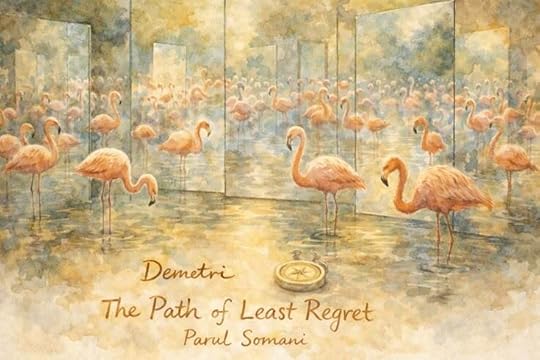
Watercolor Piece by Demetris Papadimitropoulos
Parul Somani’s “The Path of Least Regret” is a self-help book with the emotional architecture of a memoir and the managerial instincts of a strategy deck, which sounds, on paper, like a collision of genres. In practice, it becomes the book’s distinguishing strength. Somani writes as someone who has lived in multiple registers at once – Bain and boardrooms, hospital rooms and children’s bedrooms, keynote stages and kitchen-table conversations – and she uses that layered life to argue for a deceptively simple proposition: regret is most useful not as punishment for what has already happened, but as a compass for what we choose next.
The result is not a book of grand reinvention fantasies. It is a book of calibration. Somani is less interested in dramatic “before and after” narratives than in the quieter, harder work of learning how to hear yourself amid fear, urgency, duty, ambition, and noise. Again and again, she returns to the same central question in different forms: Which choice will give me the most peace of mind? In a culture that rewards optimization, performance, and certainty, that question can sound almost suspiciously gentle. Somani’s achievement is that she makes it feel rigorous.
She does this partly through structure. “The Path of Least Regret” is built like a journey narrative – starting point, barriers, compass, travel companions, scenic viewpoints, embarkation – and while the travel motif could have turned trite in lesser hands, Somani mostly keeps it grounded through specificity. Her best chapters are not abstract frameworks with decorative anecdotes attached. They are lived scenes that generate the framework from within: her cancer diagnosis and its aftershocks, her family’s caregiving realities, her daughters’ school decisions, clients navigating pivots, founders stalled between ego and vision, and friends trying to rebuild adulthood companionship around the wreckage of schedules.
What separates Somani from many contemporary motivational writers is that she is not allergic to vulnerability, but neither is she sentimental about it. She is very good on the emotional mechanics of decision-making – what fear feels like in the body, how self-doubt dresses itself up as prudence, how high achievers can become trapped not by a lack of options but by attachment to old identities. In the earlier chapters, especially those on mental roadblocks and defining a personal North Star, she names recurring patterns with a coach’s precision: negativity bias, imposter syndrome, role-attachment, externalized control. Yet she rarely lets the vocabulary become the point. The terms serve the reader, not the other way around.
One of the book’s most compelling through lines is Somani’s insistence that resilience is not stoicism. She argues, persuasively, that people do not become more resilient by bypassing feeling, but by moving through it – awareness first, then naming, then meaning-making, then action. This is where the book carries a clear kinship with works like “Emotional Agility” and “The Gifts of Imperfection,” but Somani’s tone is distinctively her own: less therapeutic in cadence, more operational; less confessional than Brené Brown, more executive in its pacing. She writes like someone who has had to make decisions while still in motion.
That sense of motion becomes especially vivid in Part III, the strongest section of the book. In “Travel Companions,” Somani turns adult friendship into a subject of both emotional and practical seriousness. Her story of founding the TWONTW group – “To Work or Not to Work,” a recurring dinner circle for women in professional transition – is one of the book’s best examples of her method. What begins as a memory of a J.Lo concert becomes a broader argument about intentional community, accountability, and the myth that meaningful friendship in adulthood is supposed to happen spontaneously. Somani’s flamingo anecdote from a Brazilian bird sanctuary, with mirrors placed to help captive birds feel part of a larger flock, risks whimsy and then lands cleanly as metaphor. Human beings, she suggests, also need reflection to remain oriented. We need to feel seen in order to keep moving.
Her practical framework in that chapter – T.I.P.S.: Time, Initiative, Prioritization, Support – is straightforward in the best way. It is not revolutionary, and she does not pretend it is. Its value lies in how she elaborates it with behavioral realism: the “default yes” approach to nourishing invitations, the social courage of being a convener, the necessity of protecting friendship on the calendar rather than in aspiration, the “good intentions” mindset that keeps small misunderstandings from calcifying into distance. In an era of chronic busyness, social thinning, and what she aptly calls “friendship deserts,” the chapter reads as both diagnosis and antidote.
If “Travel Companions” shows Somani at her most sociological, “Silver Linings” shows her at her most philosophically assured. Here she takes on one of the slipperiest themes in the self-improvement canon – finding meaning in suffering – and mostly avoids the common traps of glib uplift. The chapter opens with one of the book’s most memorable stories: Somani’s cancer journey unexpectedly leading to a reexamination of her father’s long-standing hearing loss, a corrected diagnosis of otosclerosis after decades of misdiagnosis, and a successful surgery that restores not only his hearing but a changed family dynamic. It is a story that, in another book, might have been framed as cosmic neatness. Somani is more careful. She allows the grief inside the grace, the “what could have been” inside the gratitude.
From there, she sharpens a useful distinction between passively “finding” silver linings and actively creating them. This is one of the book’s most valuable conceptual moves. Somani’s “grounded hope” – a phrase she borrows and extends – rejects both denial and despair. It asks readers to face the brutal facts and still participate in shaping what comes next. Her invocation of the Stockdale paradox from “Good to Great” could feel familiar, even overused, but she integrates it well, applying it not to corporate mythology but to the private labor of surviving illness, grief, disappointment, and derailed plans. The chapter’s case studies, especially Drasti’s dance performance postponed by injury and later rebuilt into a stronger work, make Somani’s point with emotional clarity: resilience is not merely endurance, it is revision.
By the time she arrives at “Scenic Viewpoints,” a chapter about savoring, gratitude, and celebration, Somani has earned the right to speak about joy without sounding ornamental. This chapter is often where books like this start to feel dutiful – a late-stage “don’t forget gratitude” add-on – but Somani roots it in narrative force, beginning with a surprise birthday celebration after cancer treatment that becomes a meditation on how rarely we let ourselves stop and absorb what we have survived. Her use of the Japanese concept of ichigo ichie – the uniqueness and unrepeatability of each gathering – is handled with respect rather than trend-chasing. It becomes a lens through which she examines a familiar modern reflex: we achieve, then immediately move on.
She is particularly strong here on the psychology of skipped celebration. Somani’s explanations of the hedonic treadmill, negativity bias, and what she calls “Better-Than-Now” bias are lucid and recognizably contemporary without becoming jargon thickets. Her larger point is persuasive and timely: many ambitious adults are not failing to make progress, they are failing to metabolize progress. They are accumulating achievement without memory. That diagnosis feels especially acute now, when professional life is increasingly organized around dashboards, metrics, and the next deliverable. In Somani’s framing, celebration is not indulgence but emotional encoding. It teaches the nervous system that effort can produce not only depletion but meaning.
The chapter’s practical suggestions – gratitude letters, a wins jar, repeatable rituals, communal celebration – are not groundbreaking on their own, but Somani’s gift is in showing how they reinforce identity. When she writes about a founder celebrating a major retail launch not only with a party but with a deliberate team off-site, she clarifies something many leadership books miss: celebration is culture-making. It tells people what counts. It marks a milestone as part of a shared story, not just an isolated result.
The final chapter, “Embark,” works less as a crescendo than as a consolidation. Somani turns from memoir and case study toward application, revisiting the framework across career, health, caregiving, parenting, and relationships. This is where the book’s coaching DNA is most visible, and readers will vary in their tolerance for its directness. Somani is openly invitational here, urging readers to begin now, ask one honest question, take one small step, share the framework with their families and teams. At moments, the tone approaches workshop language. But even there, she is saved by conviction. She has built enough trust by this point that the exhortation feels earned.
There are, to be sure, limits to the book. Somani’s prose, while warm and often elegant, can occasionally over-clarify a point already made. The same is true of the book’s architecture: the repeated “Get Your Bearings” summaries and checkpoint questions are useful for many readers, but they do flatten the literary texture at regular intervals. One can feel the speaker and coach standing just behind the writer, ensuring that every insight becomes actionable. That is clearly part of the project, and it will be a feature for the audience she most directly serves. Still, a more ruthless edit might have trusted the reader to sit in ambiguity longer in a few places.
Likewise, the case studies are uniformly well-behaved. Even when the setbacks are real and painful, the narrative arc tends toward legibility. This is not exactly a flaw – the book is, after all, designed as a guide – but it does mean that some of life’s messier irresolutions sit just outside the frame. Somani is strongest when she is writing from the edge of uncertainty, and occasionally the retrospective neatness of a client vignette blunts that edge.
Even so, what lingers after reading “The Path of Least Regret” is not its polish but its generosity. Somani is not selling toughness. She is offering orientation. In that sense, the book belongs in conversation with “The Good Life,” “Option B,” “Designing Your Life,” and “The How of Happiness,” but it also carries traces of something more intimate and contemporary: the post-pandemic recognition that many of us are overfunctioning and under-connected; the burnout-era suspicion that achievement alone cannot organize a life; the AI-and-uncertainty moment in which external scripts feel less stable, and inner clarity matters more. Somani never turns the book into a manifesto about the age, yet the age is everywhere in it – in the career pivots, the caregiving load, the friendship deserts, the need to build intentional communities rather than inherit them.
The back matter reinforces this impression of Somani as both author and ecosystem-builder. The acknowledgments are unusually revealing, not only because they are heartfelt, but because they map the real infrastructure behind a book like this: family, friends, early readers, speaking audiences, coaching clients, professional champions, accountability circles. It is a reminder that “intentional living,” in Somani’s telling, is not a solitary purity project. It is relational work. Even her resource pages, with worksheets and QR codes, feel less like marketing appendages than extensions of the book’s core thesis: clarity is a practice, and practices need tools.
What makes the book finally persuasive is that Somani does not present “least regret” as a guarantee against pain. She knows better. Her own life narrative prevents that fantasy. Instead, she proposes a way to move through pain without abandoning agency, a way to make decisions that may still hurt, but hurt cleanly. That distinction is the book’s moral intelligence. It recognizes that peace of mind is not the same thing as ease, and that a meaningful life is often built not from certainty but from repeated acts of honest alignment.
If I were placing it on the shelf of recent life-and-leadership books, I would call “The Path of Least Regret” an 87 out of 100: deeply useful, emotionally intelligent, and genuinely resonant, even when its coaching infrastructure occasionally presses too hard against its literary ambitions. Its best passages do what the best books in this genre do – they make you feel less alone in your confusion while also making you a little less willing to stay there.
And that, in the end, is Somani’s quiet triumph. She writes not as a guru standing at the summit, but as a traveler who has learned to stop at the scenic viewpoints, name the weather honestly, and keep walking with intention.
The Path of Least Regret is not really about everyday decision-making in the narrow, tactical sense. It is about a more consequential class of choices: the ones where something in you suspects the safer or more comfortable path may not in fact be the right one. The moments where inertia, fear, convention, or simple exhaustion can quietly masquerade as prudence. And where the real cost of a decision may only become visible much later, in the form of regret.
What Parul does so well is invert the framework many of us instinctively use. Too often, we evaluate decisions based primarily on the path immediately in front of us—what is available, defensible, sensible, or least disruptive in the short term. This book asks you to place real weight on the unlived alternative: the path not taken, the harder conversation not had, the braver move not made, the life left unexplored. That is a powerful shift. It forces a more honest reckoning with the possibility that what feels most comfortable now may be precisely what creates the deepest regret later.
What makes the book compelling is that this is not presented as vague philosophy or recycled self-help. There is real rigor underneath it. The ideas are grounded in psychology, behavioral science, and decision theory, but translated into something practical and usable rather than abstract. It gives structure to a category of decisions that many people feel deeply but struggle to articulate.
What stayed with me most is how readily the framework travels into real life. This is not a book you read, admire, and leave on the shelf. It has already affected how I think about a number of decisions in my own life, both personal and professional, and I have found myself integrating aspects of the framework into how I weigh trade-offs and future consequences. Not in some grand or performative way—just in a more honest one.
The writing also strikes a balance that is harder to pull off than it may seem. It is measured, intelligent, and deeply human without becoming self-indulgent. And the book is filled with examples—drawn from both Parul’s own life and the lives she has touched—that give the framework texture and credibility. You see not just the theory, but its application, and more importantly, its impact.
I also appreciated that the book does not promise certainty, which would have made it far less believable. It is not about eliminating doubt. It is about learning how to navigate the kinds of decisions where doubt is inevitable, comfort can be misleading, and the stakes are often larger than they first appear.
Overall, it is a thoughtful, sophisticated, and quietly resonant book about how to confront the harder choices more honestly. It offers a clearer way to think, a braver way to choose, and ultimately, a more considered way to live.
I highly recommend this book to anyone navigating decisions big or small. It is engaging and easy to read, yet still deeply thoughtful. Parul Somani has a remarkable ability to pull the reader in emotionally by naming and validating the wide range of intense feelings that surround change. And then she skillfully shifts into logic, guiding the reader step by step through the process of working through those emotions and making forward progress. The result is a book that feels both relatable and actionable.
Personally, ambiguous decisions have always been difficult - I especially despise situations where people say, "well, it sounds like you can't go wrong either way" because I am always worried that in fact I could go 'less correctly' in at least one of the ways. This fear of regret can be so strong for me that I can sometimes avoid the decision altogether. The fact that Somani helps the reader harness the possibility of regret instead of fearing it felt very empowering!
Additionally, I’ve encountered many different decision-making frameworks over the years - through business school, the companies I’ve worked at, and leadership trainings. While each framework has merit, the sheer variety can feel overwhelming. One of the things I appreciated most about this book is how Somani thoughtfully selects some of the strongest frameworks and demonstrates how they can work together—showing the sequence, context, and reasoning behind using them in combination.
Lastly, the checkpoints were my favorite part of the book. They encouraged me to pause, internalize each section, and apply the ideas directly to my own life. While reflective exercises appear in many self-help books, these checkpoints were especially approachable and never felt cumbersome or forced before moving forward. Instead, they reinforced the lessons in a natural way. Somani guides the reader through the process so smoothly that I know I'll be referencing this book many times over as I navigate decisions in my life.
We all face high-stakes decisions in our lives & careers. Strategic pivots, leadership calls, personal crossroads. And yet, I've rarely encountered a framework as elegant and genuinely useful as the one Parul Somani lays out in The Path of Least Regret.
What makes this book stand apart is that it doesn't pretend decisions come with clean answers. Parul reframes regret entirely — not as a backward-looking source of shame, but as a forward-looking compass. Her central insight is disarmingly simple yet profound: you can't control outcomes, but you can make peace with your choices by anchoring them in your values and priorities at the time you make them. For anyone who has ever sat in a difficult meeting, or at a difficult kitchen table, wondering "am I making the right call?" — this book is a gift.
Parul's credibility comes not just from her MIT and Harvard Business School pedigree or her years coaching Fortune 100 executives, but from lived experience that is raw and real. Diagnosed with aggressive breast cancer at 31, days after the birth of her second child, she didn't just survive — she forged a framework from the crucible. That authenticity runs through every page. This is not a book written from a distance. It is written from the inside.
As someone who also cares for an elderly parent, raises three young kids, and leads a company tackling one of the most emotionally complex conditions in medicine — dementia — I found The Path of Least Regret surprisingly personal. It gave me language and structure for decisions I've been navigating on instinct. The reflective prompts alone are worth the read.
Parul Somani has written something rare: a book that is equally at home on an executive's desk and on a nightstand. Practical, warm, courageous, and wise. Highly recommend to anyone at a crossroads — or simply trying to live a more intentional life.
I was blown away by the power of this book! Parul's wisdom is both insightful and accessible. I applied learnings immediately to some challenging work decisions that are in front of me at the moment. I already pre-ordered another copy of the book to send to a colleague who is navigating a challenging personal circumstance.
A couple things that really stood out to me. First, the author did such a nice job of sharing learned best practices without coming across as preachy. Parul grounded every concept, every insight, in lived experience. Speaking of experience, I LOVED how beautifully Parul wove the thread of her personal stories through the chapters. The transitions felt so natural, and I marveled at how every theory married so well to a poignant experience.
The author's model for minimizing regret is so insightful, and on Friday I literally found relief in applying a learning from one of the chapters.
I highly recommend this book to anyone navigating important personal and professional decisions, or eager to build stronger resiliency and satisfaction through life's ups and downs. Parul is truly an inspiration in how she transformed a traumatic experience with cancer into this tremendous gift for the world at large. Parul "walks the talk" like no other - the author's commitment to applying best practices in cognitive science, psychology and medicine is not only a fascinating read but also a model for us all. Parul helped me to reframe the value and potential that is available in even the most challenging life moments.
Like most people balancing career, family, and ambition, I regularly make consequential decisions with limited data and real time pressure. In The Path of Least Regret, Parul Somani offers a simple but powerful lens that meaningfully simplifies that process: choose the option you’ll regret least based on what you know and value right now. It’s practical, immediately actionable, and broadly applicable. I’ve found myself using it often since reading the book.
Somani brings a fresh perspective to decision-making by blending her lived experience with client stories and research in psychology and behavioral science. That combination creates a rare overlap of credibility and relatability. The ideas feel grounded, not theoretical—and that makes them stick. The book doesn't promise certainty; it provides a way to move forward with intention.
The framework—and the many other insights throughout the book—apply across career, health, parenting, and relationships. In a world where we control inputs more than outcomes, having a clean, values-aligned process for choosing those inputs matters. This book provides exactly that. I’d recommend it to anyone facing a tough decision—or anyone who wants a better way to approach the next one.
The Path of Least Regret is one of those rare books that manages to feel both deeply thoughtful and incredibly practical. Parul Somani offers a simple but powerful way to think about life’s decisions: instead of chasing the “perfect” choice, focus on the one that aligns most honestly with your values and the life you want to build. What makes the book especially compelling is how she blends lived experience with coaching insight and behavioral science, grounding big ideas in real situations - career crossroads, family responsibilities, friendships, and moments of unexpected challenge.
What stayed with me after reading it is how approachable the framework feels. Parul doesn’t present life as something that can be neatly optimized; she acknowledges that many of our biggest choices happen while we’re still in motion, with imperfect information and competing priorities. The book offers a calm, thoughtful way to navigate that reality - encouraging reflection, perspective, and intentionality without ever feeling heavy-handed. It’s the kind of book that gently shifts how you think about decisions, and leaves you feeling a little more steady the next time you’re standing at a crossroads.
Sometimes a book finds you at exactly the right moment…and that was precisely my experience reading The Path of Least Regret. My family was in the middle of an important family decision with feelings all over the place and everyone on their own rollercoaster of emotions. Using the book’s framework, we anchored ourselves in the values that matter most and moved forward with a clarity and confidence that we hadn’t expected to find. Minimizing regret was truly the most direct and effective path to maximizing our peace of mind - a huge unlock and extraordinarily liberating!
I found Parul Somani to be a natural writer and gifted guide, weaving personal stories, client examples, and academic research together so fluidly you barely notice you're being handed a practical toolkit for reflection and action. Since finishing the book, I've found myself often bringing up the idea of The Path of Least Regret with friends navigating career changes and colleagues at crossroads. It resonates and shifts the perspective in each conversation, every time.
The Path of Least Regret is a book that I'll return to again and again. Simple wisdom, beautifully written, and a way of thinking that will change you forever. You won't regret reading it!
Parul Somani does an exceptional job of blending together a powerful personal narrative with science back research to create simple but powerful framework that can be used for decision making in just about every aspect of your life. I not only enjoyed the book (and left in awe of what she went through) but learned a framework that I know I will reference almost daily. I am an indecisive person and have long marveled at the thought that it's interesting that we are never "taught" how to make tough decisions. Instead you are just expected to learn through experience. I now finally have a way to guide my thinking and guide me through my most indecisive moments. I have read other self help books and typically find them lacking in either personal narrative OR scientifically backed research. It is great to finally have a book that blends both so seamlessly. The last section of the book (the final 3 chapters) were my favorite - there is so much wisdom about everything from making friendships in adulthood to creating your own silver linings. Parul is clearly a very positive person and I highly recommend this book. There is something in here for everyone.
What I found so powerful about this book is how it reframes regret—not as something to fear or avoid, but as a tool for clarity and self-trust. Reading the book felt like a conversation that I was having with a thoughtful, steady guide—someone who has lived the hard questions and is offering a framework that is both humane and empowering. The blend of personal vulnerability, research-backed insight, and practical reflection makes the work resonate on multiple levels. I came away feeling calmer, clearer, and more trusting of my own decision-making process, which is a rare and meaningful gift for a book to give.
I’ve been in a season of making some really hard decisions, and I found myself going in circles, overthinking, second-guessing, waiting to feel completely sure before moving forward.
The Path of Least Regret genuinely helped me shift that pattern. It gave me a calmer, more grounded way to think things through. It didn’t take away the unknowns, but it helped me move forward without feeling paralyzed by them.
I’ve used the approach from this book in real time, and it’s made a meaningful difference. I’d recommend this book to anyone who feels stuck or wants to feel more confident in their own judgment. I’ll return to this one again and again!
The Path of Least Regret stayed with me long after I finished it. What resonated most was how Parul Somani weaves real-life stories throughout — seeing how different people applied the framework to their own complex, varied situations made it feel concrete and usable, not just conceptual. The examples are thoughtful and human, and they show how the approach works across career decisions, personal crossroads, and everything in between. I came away with a clearer way to think through hard choices and a greater sense of confidence in moving forward. It’s especially meaningful for anyone navigating change or trying to make a decision they can stand behind.
The Path of Least Regret offers practical insights that truly resonated with both my wife and me. We especially appreciated the honesty and depth in Parul's personal journey-her ability to navigate challenges and emerge with a renewed sense of purpose is both relatable and inspiring.
The book provides a thoughtful and empowering perspective for anyone navigating life's challenges or facing difficult decisions. It's a meaningful reminder that growth is possible even during challenging times.
We highly recommend this book to anyone looking for thoughtful guidance, strength, and inspiration.
This book was absolutely fantastic! I found myself highlighting and making notes on almost every page. It's definitely one of those reads that sticks with you long after you've finished it. I can already tell I'll be revisiting this one again soon. There's just so much great information packed in there. I'm really looking forward to a second read to catch all the things I might have missed the first time around. Highly recommend this to anyone looking for a truly insightful experience. It's a gem, for sure!
I was so grateful to be given access to this book before its release. It's a book that truly found me in a time of my life when I needed it. This book takes you through a personal journey, with each moment of reflection allowing you to take a step back and truly think about what is important and valuable to you as you make any kind of decision in your life.
This was such a powerful and insightful read, and I can see myself going back to this book in the future because it's so fitting at any stage in life. 5/5 read!
This book offers a fresh perspective on navigating life’s transitions. It explores how regret drives our lives and decisions — and encourages us to use it as fuel instead of fear.
I’ve heard Parul Somani speak before and I’m thankful The Path of Least Regret is now in written form to review and reflect upon whenever it’s needed!
It is a must read for anyone facing a health challenge, career evolution, a twist in the road, or just wants to live a more authentic life.
The Path of Least Regret is a practical way to think about decisions when there’s no clear answer—which is most of the time. Parul brings structure to uncertainty without overcomplicating it.
It’s easy to use and holds up when the stakes are high. A solid read for anyone navigating change!
The Path of Least Regret: Decide with Clarity. Move Forward with Confidence by Parul Somani
This book is for anyone who has ever felt stuck at a crossroads, afraid of making the “wrong” decision. The Path of Least Regret gently shifts the focus away from perfection and certainty‑chasing and toward something far more attainable: peace of mind. As Somani reminds readers, “One of the most compassionate things we can do is grant ourselves permission to feel,” setting the tone for a thoughtful, human approach to decision‑making.
Parul Somani introduces her Path of Least Regret® framework, built around one powerful question: Which choice will I regret the least, given what I know and value right now? Drawing from a background in strategy and behavioral science—and personal experience navigating a cancer diagnosis shortly after becoming a mother—her guidance feels grounded, empathetic, and practical. She acknowledges that life’s biggest decisions rarely come with certainty but reassures readers that “a life of fewer regrets and greater peace is in sight” when choices are rooted in intention rather than fear.
Throughout the book, Somani blends research with real‑life examples, reflective prompts, and helpful sections at the end of the chapters like Get Your Bearings and Checkpoints, encouraging readers to pause and apply what they’re learning. The message is clear and reassuring: good decisions aren’t about perfect outcomes, but about acting with honesty and alignment. We’re called to “pursue your intentions with purposeful actions.” For anyone seeking clarity, confidence, and a calmer way forward, this book delivers exactly that.
★★★★☆
I received a copy of this title from NetGalley and the publisher for review purposes. This is my honest opinion.