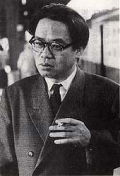
Seicho Matsumoto (松本清張, Matsumoto Seichō), December 21, 1909 – August 4, 1992) was a Japanese writer.
Matsumoto's works created a new tradition of Japanese crime fiction. Dispensing with formulaic plot devices such as puzzles, Matsumoto incorporated elements of human psychology and ordinary life into his crime fiction. In particular, his works often reflect a wider social context and postwar nihilism that expanded the scope and further darkened the atmosphere of the genre. His exposé of corruption among police officials as well as criminals was a new addition to the field. The subject of investigation was not just the crime but also the society in which the crime was committed.
The self-educated Matsumoto did not see his first book in print until he was in his forties. He was a prolific author, he wrote until his death in 1992, producing in four decades more than 450 works. Matsumoto's mystery and detective fiction solidified his reputation as a writer at home and abroad. He wrote historical novels and nonfiction in addition to mystery/detective fiction.
He was awarded the Akutagawa Prize in 1952 and the Kikuchi Kan Prize in 1970, as well as the Mystery Writers of Japan Award in 1957. He chaired the president of Mystery Writers of Japan from 1963 to 1971.
Credited with popularizing the genre among readers in his country, Matsumoto became his nation's best-selling and highest earning author in the 1960s. His most acclaimed detective novels, including Ten to sen (1958; Points and Lines, 1970); Suna no utsuwa (1961; Inspector Imanishi Investigates, 1989) and Kiri no hata (1961; Pro Bono, 2012), have been translated into a number of languages, including English.
He collaborated with film director Yoshitarō Nomura on adaptations of eight of his novels to film, including Castle of Sand.
This is first of a multi-volume series of Matsumoto Seicho's short stories, curated by Miyuki Miyabe, a popular Japanese crime fiction writer. The series would be best enjoyed by newbie Matsumoto fans who have yet to read the master's most notable works while occasionally enjoying the lesser known gems.
My ratings of individual stories From ch.1, "The Origins of the Master": - "The Legend of the Kokura Diary" 「或る『小倉日記』伝」: 5/5 stars. The 1952 Akutagawa Prize winner. Despite all the specificities in the story---the son's disability and the lost diary of Mori Ōgai---any reader who can feel anything can relate to the protagonist's emotional ups and downs as he tries to trace the footprints of his literary idol. The project will have become personal to the reader that by the time you get to the last line of story. - "The Blackmailer [my translation]"「恐喝者」: 2/5 stars. Forgettable.
From ch.2, "[Miyuki Miyabe's] Favorites": - "Wait a Year and a Half" 「一年半待て」: 3/5 stars. A crime fiction that uses double jeopardy as a device. - "The Woman Who Took the Local Paper"「地方紙を買う女」: 4/5 stars. A stalker accidentally solves a murder. - "An Unnatural Phenomenon [my translation]"「理外の理」: 4/5 stars. Reminded me of "The Dancing Dwarf" (踊る一寸法師) by Edogawa Rampo. - "Restoration of Deletion [my translation]"「削除の復元」: 6/5 stars. Another story that deals with Mori Ōgai's time in Kokura but traffics in a completely different set of questions. I'm glad that I was able to read this story in the same collection with "The Legend of the Kokura Diary."
From ch.3, "Hearing the Music, Seeing the Picture": - "Beyond All Suspicion" 「捜索圏外の条件」: 4/5 stars. It probably wasn't meant to be funny, but I chuckled at the ending. - "The Forest of Real and Fake [my translation]" 「真贋の森」: 7/5 stars. The story itself is interesting---a downtrodden art scholar plots to throw the art academia into chaos by training a painter to paint a forgery to get it appraised by his more successful but untalented former colleagues---but I was more fascinated by the shady aspects of Japanese painting market.
From ch.4, "Has the Black Fog over Japan Been Lifted?" - "February 26 incident: from Unearthing the Showa Period" : unrated. I couldn't rate this chapter properly because this section is an assembly of excerpts from the original and did not read as a coherent, stand-alone piece. I assume Miyabe was facing page number restrictions and couldn't put in everything she wanted to, but her introduction could have covered some of the critical prerequisite knowledge such as the difference and the makeup of the military factions.
- "Banishment and the Red Purge: from The Black Fog Over Japan" : 3/5 stars. The title refers to the two waves of personnel purges orderd by the General Headquarters during the US occupation of Japan, one that targeted the right-wing faction that supported and orchestrated Japan's military expansion into Asia and the other directed at communists and socialists, the very people who opposed the first group.