Few people are familiar with the name William Sydney Porter (1862-1910), but, just as many remember Mark Twain and not Samuel L. Clemens, Porter is well known by the pen name O. Henry. And O. Henry became known as a master of surprise, with witty short stories that trade on wordplay and surprise twist endings that have become standard fare in the century following his death.
O. Henry was living the routine life of a young pharmacist who dazzled people with his artistic drawing ability, creativity that successfully translated into literature. At first, O. Henry combined his writing and drawing for satire in The Rolling Stone , a failed venture, but his work helped him get notice around Texas. From there, his witty short stories were nearly as creative as his life, which saw him flee the country before getting arrested and imprisoned for embezzlement, leading to stories being written in settings as different as Honduras and a federal penitentiary. Using a pseudonym to hide the fact he was a prisoner, O. Henry became his best known name, and he used it for hundreds of short stories written between 1902-1910 , when he died of cirrhosis of the liver due to heavy drinking.
Such volumes as Cabbages and Kings (1904) and The Four Million (1906) collect short stories, noted for their often surprising endings, of American writer William Sydney Porter, who used the pen name O. Henry.
His biography shows where he found inspiration for his characters. His era produced their voices and his language.
Mother of three-year-old Porter died from tuberculosis. He left school at fifteen years of age and worked for five years in drugstore of his uncle and then for two years at a Texas sheep ranch.
In 1884, he went to Austin, where he worked in a real estate office and a church choir and spent four years as a draftsman in the general land office. His wife and firstborn died, but daughter Margaret survived him.
He failed to establish a small humorous weekly and afterward worked in poorly-run bank. When its accounts balanced not, people blamed and fired him.
In Houston, he worked for a few years until, ordered to stand trial for embezzlement, he fled to New Orleans and thence Honduras.
Two years later, he returned on account of illness of his wife. Apprehended, Porter served a few months more than three years in a penitentiary in Columbus, Ohio. During his incarceration, he composed ten short stories, including A Blackjack Bargainer, The Enchanted Kiss, and The Duplicity of Hargraves.
In Pittsburgh, Pennsylvania, he sent manuscripts to New York editors. In the spring of 1902, Ainslee's Magazine offered him a regular income if he moved to New York.
People rewarded other persons financially more. A Retrieved Reformation about the safe-cracker Jimmy Valentine got $250; six years later, $500 for dramatic rights, which gave over $100,000 royalties for playwright Paul Armstrong. Many stories have been made into films.
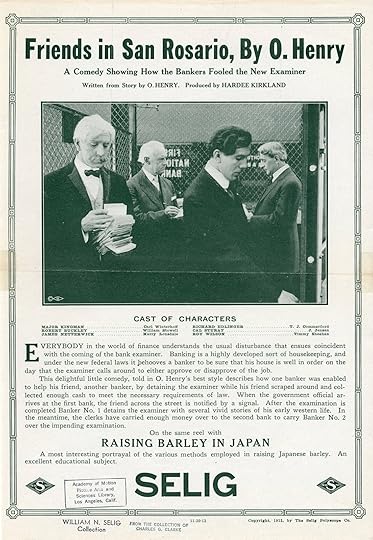
O. Henry's "Friends in San Rosario" is a short story about a Western bank and an unfriendly unknown bank Examiner. I kind of thought the ending would be in the direction it was headed for but with some interesting other details unknown.
Story in short-First National and the Stockmen’s National are under close examination and the numbers are not adding up but looking like an arrest will come soon.
➖➖➖➖➖➖➖➖➖➖➖➖➖➖➖➖➖➖➖➖➖➖➖➖➖➖➖➖➖➖➖➖➖➖➖
Highlight (Yellow) | Location 16584 THE WEST-BOUND TRAIN stopped at San Rosario on time at 8.20 a.m. A man with a thick black-leather wallet under his arm left the train and walked rapidly up the main street of the town. There were other passengers who also got off at San Rosario, but they either slouched limberly over to the railroad eating-house or the Silver Dollar saloon, or Highlight (Yellow) | Location 16588 joined the groups of idlers about the station. Indecision had no part in the movements of the man with the wallet. He was short in stature, but strongly built, with very light, closely-trimmed hair, smooth, determined face, and aggressive, gold-rimmed nose glasses. He was well dressed in the prevailing Eastern style. His air denoted a quiet but conscious reserve force, if not actual authority. After walking a distance of three squares he came to the centre of the Highlight (Yellow) | Location 16591 town’s business area. Here another street of importance crossed the main one, forming the hub of San Rosario’s life and commerce. Upon one corner stood the post-office. Upon another Rubensky’s Clothing Emporium. The other two diagonally opposing corners were occupied by the town’s two banks, the First National and the Stockmen’s National. Into the First National Bank of San Rosario the newcomer walked, never slowing his brisk step until he stood at the cashier’s window. The bank opened for business at nine, and the working force was already assembled, each member preparing his department for the day’s business. The cashier was examining the mail when he noticed the stranger standing at his window. “Bank doesn’t open ‘til nine,” he remarked curtly, but without feeling. He had had to make that statement so often to early birds since San Rosario adopted city banking hours.
Highlight (Yellow) | Location 16598 “I am well aware of that,” said the other man, in cool, brittle tones. “Will you kindly receive my card?” The cashier drew the small, spotless parallelogram inside the bars of his wicket, and read: J. F. C. Nettlewick National Bank Examiner Highlight (Yellow) | Location 16605 “I was kind of expecting Sam Turner round again, pretty soon,” said Mr. Edlinger. “Sam’s been examining us now, for about four years. I guess you’ll find us all right, though, considering the tightness in business. Not overly much money Highlight (Yellow) | Location 16606 on hand, but able to stand the storms, sir, stand the storms.” “Mr. Turner and I have been ordered by the Comptroller to exchange districts,” said the examiner, in his decisive, formal tones. “He is covering my old territory in Southern Illinois and Indiana. I will take the cash first, please.” Perry Dorsey, the teller, was already arranging his cash on the counter for the examiner’s inspection. He knew it was right to a cent, and he had nothing to fear, but he was nervous and flustered. So Highlight (Yellow) | Location 16610 was every man in the bank. There was something so icy and swift, so impersonal and uncompromising about this man that his very presence seemed an accusation. He looked to be a man who would never make nor overlook an error. Highlight (Yellow) | Location 16619 This newly-imported examiner was so different from Sam Turner. It had been Sam’s way to enter the bank with a shout, pass the cigars, and tell the latest stories he had picked up on his rounds. His customary greeting to Dorsey had been, “Hello, Perry! Haven’t skipped out with the boodle yet, I see.” Turner’s way of counting the cash had been different, too. He would Highlight (Yellow) | Location 16621 finger the packages of bills in a tired kind of way, and then go into the vault and kick over a few sacks of silver, and the thing was done. Halves and quarters and dimes? Not for Sam Turner. “No chicken feed for me,” he would say when they were set before him. “I’m not in the agricultural department.” But, then, Turner was a Texan, an old friend of the bank’s president, and had known Dorsey since he was a baby. Highlight (Yellow) | Location 16628 Earlier, a little incident had occurred that even the sharp eyes of the examiner had failed to notice. When he had begun his work at the cash counter, Mr. Edlinger had winked significantly at Roy Wilson,
Highlight (Yellow) | Location 16629 the youthful bank messenger, and nodded his head slightly toward the front door. Roy understood, got his hat, and walked leisurely out, with his collector’s book under his arm. Once outside, he made a bee-line for the Stockmen’s National. That bank was also getting ready to open. No customers had, as yet, presented themselves. “Say, you people!” cried Roy, with the familiarity of youth and long acquaintance, “you want to get a move on you. There’s a new bank examiner over at the First, and he’s a Highlight (Yellow) | Location 16633 stem-winder. He’s counting nickles on Perry, and he’s got the whole outfit bluffed. Mr. Edlinger gave me the tip to let you know.” Mr. Buckley, president of the Stockmen’s National — a stout, elderly man, looking like a farmer dressed for Sunday — heard Roy from his private office at the rear and called him. “Has Major Kingman come down to the bank yet?” he asked of the boy. “Yes, sir, he was just driving up as I left,” said Roy.
A note is passed to Major Kingman to help keep the new Examiner with him, so he tells Nettlewick that his books are wrong but the Major wants to explain why because his friend is the one in trouble and helped him in the past, tells the old true story. Kingman tells of how money is missing and it seems his friend Bob, who he keeps on house arrest stole it but in reality he confessed to keep Kingman out of trouble, for he did not know he was sleep walking when the money was taken by Kingman and hid, unknown by the sleep walker himself. After he is done Nettlewick looks to close the bank down but the Major tells him his books are correct after he sees the shade at the other bank giving the signal that the money is there to have a good account. Nettlewick knew he was bamboozled but his hands were tied to do anything.
J.F.C. Nettlewick, the National Bank Examiner arrives in San Rosario and inspects the First National Bank 's records. He proceeds to meticulously examine the bank's cash, counting it and weighing the silver. He then moves on to the bank's records, questioning the bookkeepers and examining the loans. Finally, he confronts the bank's president, Major Tom Kingman, about missing securities. The bank president, Major Tom Kingman, confesses to taking the missing securities to help a friend in need.
Amazing how one can sometimes be duped Only by delay. And though this is an elaborate character construction for such a pity ending, some might be a bit perturbed... but not me; these stories are very well constructed and a pleasure to read.