

What do you think?
Ethnographic Studies in Subjectivity
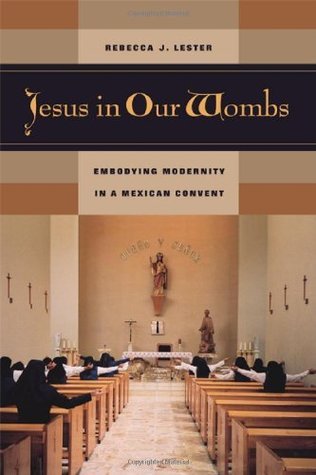
Jesus in Our Wombs: Embodying Modernity in a Mexican Convent (Ethnographic Studies in Subjectivity)
In Jesus in Our Wombs, Rebecca J. Lester takes us behind the walls of a Roman Catholic convent in central Mexico to explore the lives, training, and experiences of a group of postulants―young women in the first stage of religious training as nuns. Lester, who conducted eighteen months of fieldwork in the convent, provides a rich ethnography of these young women's journeys as they wrestle with doubts, fears, ambitions, and setbacks in their struggle to follow what they believe to be the will of God. Gracefully written, finely textured, and theoretically rigorous, this book considers how these aspiring nuns learn to experience God by cultivating an altered experience of their own female bodies, a transformation they view as a political stance against modernity.
Lester explains that the Postulants work toward what they see as an "authentic" femininity―one that has been eclipsed by the values of modern society. The outcome of this process has political as well as personal consequences. The Sisters learn to understand their very intimate experiences of "the Call"―and their choices in answering it―as politically relevant declarations of self. Readers become intimately acquainted with the personalities, family backgrounds, friendships, and aspirations of the Postulants as Lester relates the practices and experiences of their daily lives. Combining compassionate, engaged ethnography with an incisive and provocative theoretical analysis of embodied selves, Jesus in Our Wombs delivers a profound analysis of what Lester calls the convent's "technology of embodiment" on multiple levels―from the phenomenological to the political.
Lester explains that the Postulants work toward what they see as an "authentic" femininity―one that has been eclipsed by the values of modern society. The outcome of this process has political as well as personal consequences. The Sisters learn to understand their very intimate experiences of "the Call"―and their choices in answering it―as politically relevant declarations of self. Readers become intimately acquainted with the personalities, family backgrounds, friendships, and aspirations of the Postulants as Lester relates the practices and experiences of their daily lives. Combining compassionate, engaged ethnography with an incisive and provocative theoretical analysis of embodied selves, Jesus in Our Wombs delivers a profound analysis of what Lester calls the convent's "technology of embodiment" on multiple levels―from the phenomenological to the political.
360 pages, Paperback
First published March 5, 2005
Ratings & Reviews
Friends & Following
Create a free account to discover what your friends think of this book!
Community Reviews
Displaying 1 - 4 of 4 reviews

May 3, 2013
This is one of the best books I have read on religion, subjectivity, and the body. It is ethnographically rich and accessible, detailing the everyday lives of postulants (aspiring nuns) in a Mexican convent as they remake their selves to embody divinity. This would be a compelling and interesting narrative in itself, involving layers of emotion, self-reflection, somatic attention, prayer, sociality and sacrifice, which Lester captures beautifully in the words and actions of the young women. However, the book is getting at much larger questions of the relationship between subjectivity and the body and its implications for how we think about religious experience. Lester's psychodynamic perspective, strongly influenced by Kohut's ideas on recognition and transference and Jessica Benjamin's work on gender and intersubjectivity, allows her to deftly navigate between the Scylla of self as the seat of being, and the Charybdis of self as "illusion of interiority." By rethinking transformation as an embodied process of developing a new sense of interiority and aligning that sense with a way of becoming 'visible' in the world, Lester convincingly shows the power of religious practice to change the consciousness of oneself and the world.
As a professor of anthropology, I have used this book several times with undergraduates, and although it has some challenging passages for those with little background in psychology or anthropology, my students have always rated it among their favorite parts of the class. They can relate, in some ways, to the young women in the convent, their disappointments with modern gender roles, their struggles with faith and doubt, their desires for belonging and personal growth. They like the clear structure and focus of the book and always learn something new about Catholicism.
I've used T.M. Luhrmann's "When God Talks Back" as well, and there is considerable overlap, making them fun to compare in discussion. I've also used other texts on gender and asceticism in Buddhism and Hinduism (and even the film Dhamma Brothers) to show how we can apply Lester's framework in other settings. It works great.
As a professor of anthropology, I have used this book several times with undergraduates, and although it has some challenging passages for those with little background in psychology or anthropology, my students have always rated it among their favorite parts of the class. They can relate, in some ways, to the young women in the convent, their disappointments with modern gender roles, their struggles with faith and doubt, their desires for belonging and personal growth. They like the clear structure and focus of the book and always learn something new about Catholicism.
I've used T.M. Luhrmann's "When God Talks Back" as well, and there is considerable overlap, making them fun to compare in discussion. I've also used other texts on gender and asceticism in Buddhism and Hinduism (and even the film Dhamma Brothers) to show how we can apply Lester's framework in other settings. It works great.

May 18, 2022
Informative, but not much more. I'd hoped for a bit more narrative, but the book seemed like one long introduction that never took off. Lots of detail, almost superfluous amounts, about the layout of the building, the uniforms, etc. scattered here and there with quotes and short anecdotes. The book could really use some editing; one chapter is an adaptation of an article Lester wrote before the book, which uses a story we'd already heard chapters before. There's a theme. There's information. There's affirmation that nuns lead a dull life.

September 13, 2025
Amazing analysis of religious formation,, examining how political and social contexts of Mexico inform views on femininity, and the how the role of women has transformed to meet the country’s needs
October 22, 2012
Skimmed chapters 5, 6, 8, 9 and 12.
Displaying 1 - 4 of 4 reviews