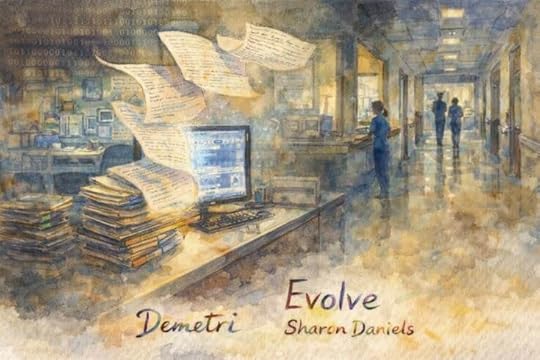
Many people fear that robots are coming. Spoiler they’re already here! Technology has brought innovations to our world for decades and is now moving faster than ever. By demystifying artificial intelligence and shedding light on how technology can empower people to do more and be more, we understand that as technology advances, humanity also advances. The key is to embrace change, not fear it.
Using the history of language as a backdrop, CEO of Arria NLG, Sharon Daniels, offers readers a greater understanding of how technology and humans have a symbiotic relationship that can empower us—if we let it.
For the first time in human history, the Power of Language, the very thing that defines humanity, has now been captured in software—has been digitized, moving it outside of the human mind to the machine—to the digital mind. The technology powering this revolution in communication is known as Natural Language Generation (NLG), a form of Artificial Intelligence specializing in extracting insights from complex data sources and communicating that information in natural language.
In Evolve, Daniels brings together 30+ years of global strategic business development and her understanding of natural language technologies to shed light on the future of technology. She provides readers with an understanding of how bringing human (Hu) knowledge and skills together with artificial intelligence’s (AI) speed and scale offers us “superhuman” capabilities.
Humanity is defined by language. By understanding language’s role in human history, we can better understand how the intersection of language and technology holds the potential to aid human evolution. Daniels’ vision is to ensure, through natural language technologies, that humanity remains at the heart of AI. Evolve shares a fresh perspective on how adding the Power of Language to the datasphere can ignite a global revolution in communication—freeing us to dream, think, create, discover, build, heal, help, relax, live and love.
If you’re interested in a book all about Arria, this is the book for you. If you are looking for a book that thoroughly discusses the history of technology and AI’s place in that history, this is not that book, though the author tries by obviously using AI to fill in the book.
“Evolve” Argues the Missing Layer in AI Isn’t Another Model – It’s Language: Why the Next Tech Revolution Will Be Conversation, Not Code By Demetris Papadimitropoulos | February 9th, 2026
Watercolor Piece by Demetris Papadimitropoulos
Sharon Daniels’s “Evolve” begins with a sound – the burly accountant at her parents’ kitchen table, bag unpacked, adding machine whirring, the little percussion of calculation (“dat dat dat thrum”) imprinting itself on a child’s attention the way a pop song does. Daniels treats that machine as a miniature miracle: what would have taken hours could be done in one, and the reclaimed time could be spent on the human part of work – listening, advising, helping someone make sense of a business and a life. It is a domestic seed for a book that wants to scale from kitchen-table arithmetic to a species-level theory of mind.
Daniels has lived inside the rooms where the future becomes normal. Her professional biography sketches a recognizable arc of modern corporate tech, narrated from the inside: early comfort with computers in the mail-order boom of the 1980s; the ride at PaperDirect as it grew into a nine-figure enterprise; the leap into software-as-a-service at Diligent Corporation, which helped popularize the board portal; and, finally, the current act at Arria, a natural language generation company with roots in the University of Aberdeen’s computer science lab. Throughout, she returns to a moment that feels like her private conversion experience: being told that “a spreadsheet is just a capture of data, and data is a language.” If you cannot speak it, you cannot access what it knows. If you cannot access what it knows, you are locked out of your own world.
That hybrid identity – marketer and founder, artist and data evangelist, self-help coach and enterprise executive – shapes the book’s architecture. Chapters are punctuated with “Digging Deeper” sidebars, quick principles, and testimonial interludes labeled “Notes from an Unwavering Believer.” The tone is part manifesto, part case study, part coaching workbook: pragmatic enough to talk about adoption curves and change management, lyrical enough to treat language as sacred infrastructure. Her endnotes are omnivorous, moving from Joseph Campbell to Carl Jung to McKinsey to Our World in Data, as if the proper evidence for a technological era must also be mythic, psychological, economic, and statistical all at once.
The broad argument is straightforward: technology is not a foreign force acting on humanity; it is humanity’s own story, an extension of our self-organization. Daniels organizes innovation as a repeating cycle – disruption, discovery, universal – and she urges innovators to plan for the human truth that unfamiliarity breeds fear. Even harmless tools arrive as threats. The adding machine looked suspicious until it felt indispensable; the smartphone looked frivolous until it became an organ we carry. To build the future, she suggests, you must develop the stomach for being doubted, and the humility to see doubt as part of the sequence rather than as sabotage.
From that psychological base she moves to her central thesis: language is infrastructure. We have spent decades learning to trust dashboards, charts, and key performance indicators, yet those tools remain mute about meaning. A graph can dazzle, but it cannot reassure you, accuse you, persuade you, or invite you into a shared understanding. Words can. Daniels argues that we have moved from tabulation to visualization to automation, and now the next hinge is narration – the ability to translate data into contextualized language that does not require an interpreter standing beside the screen.
In the book’s strongest chapters, Daniels makes that inflection point feel less like hype and more like an everyday relief. She is not interested in the mathematics of models; she is interested in the friction of ordinary work. You stare at a dashboard. You ask a question. The dashboard offers you more dashboards. You drill down again, and then again, and the day disappears into the labyrinth of filters and pivot tables. Daniels’s promised alternative is conversational access to structured data that preserves context and anticipates intent, the way a good analyst or a good colleague does. The achievement she wants the reader to feel is not “AI that writes,” but “AI that explains.”
Her flagship example is Arria Answers, a platform she describes as combining natural language generation with insight analytics to produce narratives and then talk about them. The pitch is intentionally unromantic. No coding required. Configurable length. Narratives that explain not only what happened but what drove it. The point is to reduce drill downs, reduce analysis time, and reduce inconsistency. In Daniels’s telling, narrative is not poetry stapled onto a chart – it is a decision instrument. Even if you have never led a data team, you recognize the appeal: fewer hours lost to searching, fewer meetings wasted on “what are we looking at,” fewer opportunities for a tired human being to transpose a digit and then spend the next week cleaning up the consequences.
Daniels’s favorite proof of concept is the failure of brittle, single-turn “smart” tools to behave like conversation partners. She offers a familiar exchange – you ask a voice assistant for the temperature in Chicago, then ask what it will be tomorrow, and the assistant answers for your current GPS location as if memory were an optional accessory. The anecdote is small, but the ambition behind it is large: intelligence, for Daniels, is continuity. It is the ability to carry context forward, infer what remains constant, and respond in a way that feels less like retrieving a fact and more like participating in meaning.
When she extends that idea into her vision of the “digital mind” – language sitting on top of the datasphere as a communicative layer, a host organism capable of holding collective expertise – the prose turns mythic. The internet becomes an “internet of intelligence.” Arria becomes the missing layer that lets the stack speak. It is stirring, and it is also where a reader may wish for more abrasion. What does accountability look like when a narrative is wrong but persuasive? Who audits the “why” in an explanation that sounds authoritative? What happens when an organization comes to prefer the calm of an automated narrative to the messy, dissenting friction of human debate? Daniels hints at these questions, but the book’s temperament is to pivot quickly back toward possibility.
Her endnotes nod to an ecosystem that could have supplied that abrasion: Pew research on digital disruption, BBC experiments with automated reporting, Asimov’s essay “The Relativity of Wrong” as a defense of nuance, and Alan Kay’s reminder that creativity is often born from people who know more than one field. Daniels clearly wants to recruit that ecosystem into a practical argument for diversity of thought. The citations, however, also reveal a tension she does not always confront head-on: narration is not merely a translation layer. It is a power layer. Whoever controls the narrative controls what gets emphasized, what gets omitted, what counts as “important,” and what is framed as noise.
In that sense, the book’s own evidentiary style is part of its argument. Daniels cites widely and with genuine appetite – academic work, think-tank reports, newspaper pieces, corporate research, institutional databases. The range gives the prose momentum, and it helps anchor a reader in the feeling that this is not merely a start-up myth but a long arc of human inquiry. Yet the same range can also blur the hierarchy of proof. “Evolve” sometimes moves from a hard statistic to an inspirational inference in a single breath, as if certainty were contagious. That quickness is part of her charisma on the page, but it is also where a more skeptical reader may start wanting footnotes to slow the music down.
This is also a book written from the enterprise vantage point, and its confidence is partly the confidence of that world: the belief that if a system can be operationalized, it can be improved. Daniels repeatedly insists that removing “human error” from analysis will make organizations calmer and decisions cleaner. It is a seductive promise, especially for executives exhausted by variance, politics, and blame. But it is also where the reader may hear the faint hum of another kind of error – not arithmetic error, but interpretive error, ethical error, incentive error. A system can be consistent and still be wrong about what it optimizes. It can be fluent and still be misleading. It can be “unbiased” in a narrow technical sense while still inheriting the worldview of whoever designed the questions worth answering.
Daniels’s prose keeps returning to paradox as a way of holding these tensions: believers and doubters, competitors and collaborators, binary machines and nonbinary humans, fear and possibility. At its best, the technique feels like an invitation to widen your own aperture, to turn the dial until you can see a more useful angle. At its weakest, it risks becoming a rhetorical solvent that dissolves conflict too quickly. The world is not only paradoxical; it is contested. Language, which Daniels treats as the bridge to understanding, is also the tool by which misunderstanding can be scaled. The book’s optimism depends on the idea that explanation leads to clarity. Recent history suggests explanation can also be weaponized.
Daniels’s larger moral claim is that language equals access, and access equals equality. If expert reasoning can be captured and replicated in words, it can travel broader and faster. It can break down silos inside organizations. It can standardize interpretation. It can offer non-specialists a kind of borrowed competence: the touch-of-a-finger consultation that previously required a budget, a gatekeeper, and a meeting. This is the book’s utopian edge. “Insights are great, but answers are better,” she writes, and you can feel her longing for a world in which knowledge flows like a public utility rather than like a private club.
Yet the same philosophical breadth that gives “Evolve” its reach also gives it its slipperiness. Daniels frequently describes machine-generated narratives as “objective,” “without personal agenda,” “without bias or judgment,” and she implies that such neutrality can rebuild trust in data and even in institutions. It is an attractive premise, especially in an era thick with manipulated media and exhausted audiences. But it is also where her optimism outruns her own best insights. “Objectivity” is never a feature that exists in isolation. It is a relationship between a system, its inputs, its goals, and the humans who decide what counts as success. A narrative engine can be remarkably accurate about a set of numbers and still be highly political in what it chooses to foreground.
The timing helps the book’s urgency. Read in the afterglow of the generative-AI boom – when chat interfaces became workplace tools, newsrooms debated automation, schools rewrote honor codes, and regulators began sketching new rules for systems that can speak – Daniels’s insistence that communication is the real bottleneck lands with force. Even her most promotional moments carry a recognizable anxiety: that we will flood ourselves with intelligence we cannot interpret, and then mistake the flood for wisdom.
The Kodak analogy, which Daniels returns to with relish, captures the seduction and the blind spot at once. She argues that business is Kodak and language automation is the digital camera: a missing layer that will make expertise effortless and cheap, the way digitization made photography effortless and cheap. The parable is partly correct. When photographs became free, we got abundance. But we also got new choke points – attention economies, surveillance systems, and platforms that control distribution. “Evolve” wants the reader to focus on the democratization of expertise; it spends less time acknowledging how quickly democratization can be followed by re-centralization, as the tools of access become the tools of gatekeeping in new hands.
Another tension is categorical. Arria’s lineage is deterministic natural language generation – structured, consistent, verifiable – while the generative systems that have recently made conversation with machines mainstream are probabilistic and, at times, spectacularly prone to confident error. Daniels sometimes slides across that gap as if it were merely the next rung on the same ladder of narration. She wants the reader to feel that talking to your data is inherently a path to accuracy. In practice, the trade-offs are more jagged: fluency can outpace verification; helpfulness can outpace truth. Daniels knows this in her bones – she repeatedly stresses trust and control – but the book’s tone is so eager to persuade that it occasionally smooths the edges it should linger on.
Still, it would be a mistake to dismiss the book as a brochure. Daniels has a leader’s instinct for the emotional weather inside organizations and an artist’s instinct for metaphor. Her chapter on collaboration reads like a coaching session with the self: choose your words during disruptions; get focused; embrace your humanity; honor the individual and empower the team; double-check your motivations. She introduces Arria’s culture through five pillars – “WE are ONE,” “REAL,” “DYNAMIC,” “SPIRIT,” and “LOVE” – and while the corporate liturgy may invite an eye-roll, it also signals what she is trying to build: not merely a product, but a moral stance about how language should be handled when it becomes software.
The book is also at its most persuasive when it treats performance as a living variable rather than a static formula. Daniels’s mentor figure, the Olympian Barbara Kendall, appears as embodied proof that evolution is the point: each competition is different because you are different, and because the environment is fluid. The lesson becomes a bridge between windsurfing and business, between athletic training and executive decision-making. “Know thyself,” Daniels urges, framing self-awareness not as wellness jargon but as the only stable anchor in a volatile world. It is here that her self-help tendencies feel less like ornament and more like an honest confrontation with what change does to people: it fractures attention, multiplies insecurity, and tempts us to cling to outdated routines.
Where the book feels thinnest is where it is most sweeping. In the conclusion, Daniels offers a sunny statistical portrait of modernity – declines in war deaths, rising life expectancy, the emergence of a leisure class – and she urges the reader to “crank the dial” of perspective away from doom. It is a useful reminder that despair can become its own kind of blindness. But it is also the sort of macro-optimism that can sound like a comfort story when read from the sharp edges of change. The book’s insistence that “technology will empower humans” is inspiring; it is also incomplete without a fuller reckoning with who gets empowered first, who pays the transitional costs, and how power behaves when it discovers it can speak in a thousand voices at once.
Placed on the shelf, “Evolve” belongs with optimistic tech humanism – the confident futurism of “The Sentient Machine” and the brisk provocation of “Zero to One” – while occasionally glancing toward darker companions like “Weapons of Math Destruction,” “The Age of Surveillance Capitalism,” and “The Innovator’s Dilemma” without fully entering their rooms. Daniels is less interested in warning than in welcoming. She writes as if the next great renaissance is already underway and language is the engine that will bring it to scale. Her rhetorical style – the quick turns toward paradox, the spiritual sheen, the recurring insistence that love must sit at the heart of technology – is not subtle, but it is unmistakably hers.
Even a reader who does not share her certainty may finish with a useful discomfort: the sense that our relationship to information has been too visual, too static, too performative, and that the future will belong to those who can translate numbers into meaning without turning meaning into propaganda. The heart of “Evolve” is not its claim that machines will speak. Machines already speak. It is its insistence that we remain responsible for what the speaking is for, who it serves, and what kind of human world it helps build.
This was an enjoyable book about the future, well actually, the present - because the future is now and we are in danger of it leaving us behind. It makes a good case for the existence and usefulness of generative AI, but I don’t think it’s going to change many minds because it is, at its heart, so pro-AI that it can’t helped but be seriously biased. All that to say, I learned a lot about business and leadership from this book as well as about generative AI. If you can get past the obvious sales pitch for Arria, it can be a fun ride.