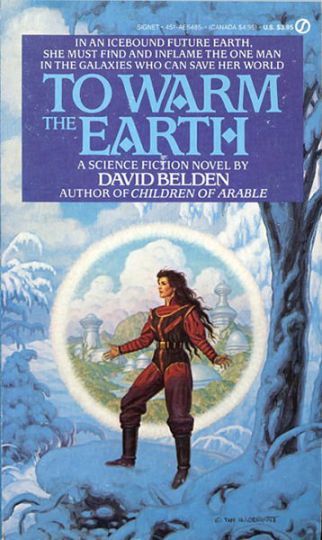
I discovered recently that goodreads lets you sort books on your shelves by number of ratings, so I selected this, which had a whopping five.
Summary:
Reads almost as a companion piece to Brenda Gates Smith's Secrets of the Ancient Goddess, concerned with the same themes of neo-pagan feminism, but from the opposite end of imagined human history. There's a utopian and dystopian element to both, and a desire to find some synthesis between the two for human flourishing. But Secrets was in large part a romance story, while To Warm the Earth is not. Love is a theme and a driving force for its characters, but except in a few scenes has not much focus on the page. The conditions of the world and society form an equal part along with the feelings and inner lives of its characters.
Both the post-apocalyptic Earth and the space station life of the Collectivity get focus and exploration, though only the first third takes place on Earth. It echoes forward in the actions of Mana and the changes she manages to make to Terra Station. It has utopian elements in the relations of men and women, but its primitive state means life is difficult. By contrast, the Collectivity experiences no hardships, and indeed allows none. The relations of men and women are solved by forcibly suppressing all difference between them. Neither society is perfect, but the book makes the point that the straitjacket was at one point a necessity for human survival, one that is now clung to out of fear, and can provide a measure of relief from the pains of life. The author shows a clear preference for one over the other, but he doesn't need to excessively demonize it to show its undesirability.
That sort of even-handedness extends to the characters. They form a pleasing variety of types. Serious, jokers, outgoing, closed-off, analytic, impulsive. Some of their trajectories really surprised me. . Their variety allows for a high degree of subtlety in determining the course of the story. There isn't always a "right way" clearly presented, making it harder to guess which choices are the right ones, and which characters are making them (at least most of them, anyway). The religious feelings of the characters find many different expressions as well, and Mana feels at various times very differently about things. Whether she is moving toward or drifting away from her true self and her purpose, or whether those things are even the same thing, remains a mystery to her much of the time. This variety and ambiguity prevents a feeling of monotony, even in the middle portion when little seems to be "happening", at least externally.
The plotting has a telescoping quality. It takes nearly 100 pages before Mana's quest even becomes clear, then some time after that for her to make any progress, but near the end things accelerate quickly, and the last 50 pages are moving a mile a minute. I'm torn between feeling that the speed of the narrative lends it a climactic quality all its own, or whether some decompression and added context for the final section would have improved things. The story ends right at the climax, with the goal of the title, if not actually accomplished, implied to be as good as done.
However, there are many elements that imply a sequel was intended. Govind's character is left conspicuously incomplete. He would obviously gain a great deal of power in the Collectivity as the years go by, knows where Earth is and the significance it has to his spiritual quest. It seems likely he would eventually try and bring it into his fold, in opposition to Starlight. Starlight is presented as a true utopia, combining the emotional openness and honesty of Earth with the technological might of the Collectivity, but it receives little direct focus. The origins of the parallel society of the wraiths, and their closer integration with humanity on Starlight, goes unexplored. Other points, such as a follower of Govind who is implied to want his role as leader, and the Collectivity's obsession with non-existent aliens, also suggest future developments. The author bio says he was working on another novel, but it was never published. The only evidence that a sequel was intended is that a re-issue of Children of Arable calls the books a "trilogy". (This is actually a sequel to that book, but I didn't realize until part-way through. It works as a standalone novel.) Where the story might have gone is a mystery.