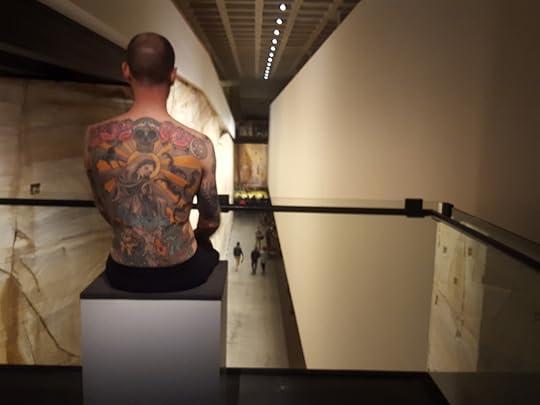
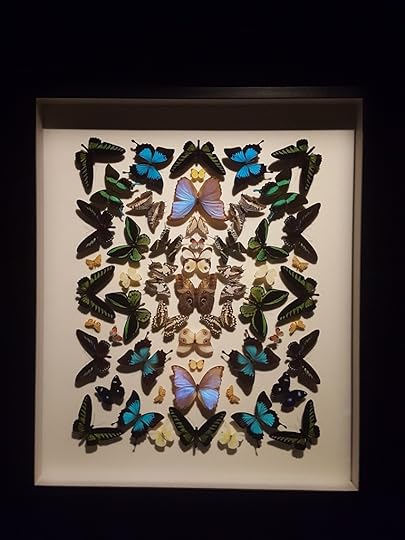
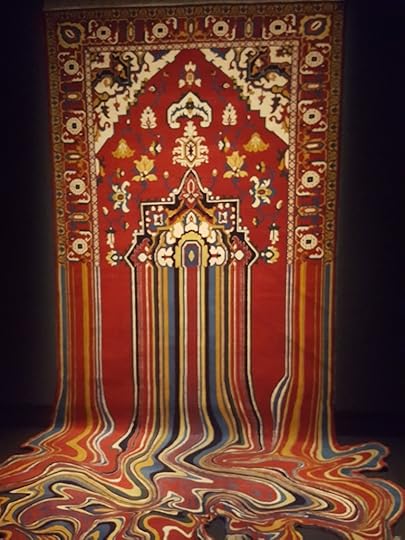
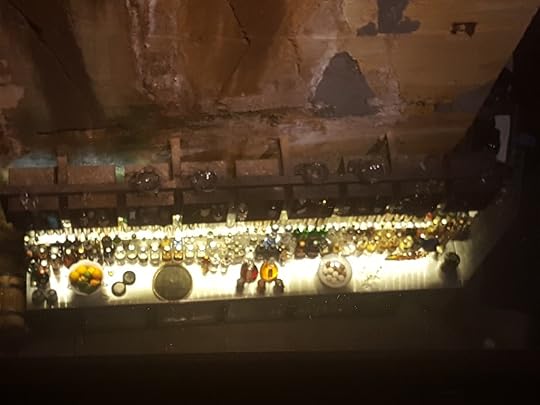
In January 2011, MONA was officially opened to the public. It was lauded as the most extraordinary cultural event for Australia since the opening of the Sydney Opera House. David Walsh was a largely mysterious art collector who had made a fortune gambling. He had collected ancient coins and antiquities and established a small museum of antiquities on his Moorilla estate but subsequently he became interested in art of all periods. In 2006, Walsh was the anonymous winning bidder of John Brack's The Bar, which the NGV had so publicly declared it was going to purchase. It was a move that kept the media and art circles guessing for some time and was, in its way, classic Walsh behaviour.
Over several years he bought a huge number of works and he started thinking about a gallery space in which to house them. But a conventional museum wasn't what Walsh was after. He wanted to transform the viewer's experience of art. There began the earliest ideas for MONA, a museum of old and new art.
Adrian Franklin, professor of sociology at the University of Tasmania, has pieced together the story of the creation of MONA, from how it came to be on the banks of the Derwent River, to the design and building process, the collection and branding and, crucially, designing the experience and effect that MONA has on its many millions of visitors.
Adrian S. Franklin (born 19 December 1955) is a British-born Australian sociologist, who is a professor of sociology at the University of Tasmania and a television and radio presenter for the Australian Broadcasting Corporation. He was worked on several ABC radio and television programs as By Design on ABC Radio National and the television series Collectors where, with Gordon Brown and Claudia Chan Shaw, he was one of the panel of experts.
Franklin was born in Canterbury, England and holds a Master of Arts in Sociology from the University of Kent, and was awarded his PhD in Sociology from the University of Bristol in 1989 for his thesis Privatism, the Home and Working Class Culture. He held professorships at Bristol and the University of Oslo, before emigrating to Australia as a reader of sociology at the University of Tasmania.
MONA is the Museum of Old and New Art. It’s located in a formerly working class suburb of Hobart in the island state of Tasmania.
You could argue that it is the best art museum in the world. However, what’s even more certain is that it deserves to be called the best anti-museum in the world.
White Cubes and Wall Labels
MONA dispenses with two features that have been regarded as essential to conventional museums: the white cubic space and the wall labels.
As a result, it comes across as a subversive museum:
“MONA’s subversiveness lies not with the art, but with the fact that it gives the finger to the pretensions upon which the contemporary art world is built.”
Some have described it as a “subversive adult Disneyland.”
MONA also uses lighting to create a dark intimacy around the work of art itself. (See my review of Thomas Pynchon’s "Against the Day" for a parallel discussion of light versus darkness.) Not only are wall labels eschewed, but signage is as well. Thus, the viewer is encouraged to wander (and wonder) spontaneously, free of institutional direction, didacticism and dictation.
The vast bulk of the museum is built underground. It’s a subterranean wonderland. Some have even likened it to “Alice’s Adventures in Wonderland”, suggesting that the mirrored entrance on the surface is “a portal into a parallel world below.”
Because most of the building is beneath the surface, the museum doesn’t present as an imposing edifice. We must be inside before we can experience it. Nothing external intimidates us or dictates our response to the interior.
This is a still photo of the inside of a kinetic sculpture ("Artifact" by Gregory Barsamian) at MONA, Hobart, January, 2014 (It shows the inside of a mind through a window in the skull. An internal strobe light flashed on and off rapidly, so I was very lucky to get such a clear picture.)
Juxtaposition
MONA avoids a taxonomical or thematic approach to curating exhibitions. Instead, it seeks to “challenge the visitors’ pre-conceived notions of art through the juxtaposition of seemingly contradictory elements.”
“[The owner, David Walsh,] is keen on juxtaposition’s power to disorder and detach things that have been assembled into orders and groups. Disordering things can produce new associations and thoughts, new relationships: it jars the senses and forces us to see things in new ways.”
Thus, MONA breaks down boundaries and contravenes conventional definitions of what art is supposed to be and how it should be exhibited.
Don’t Dictate (To Me)
It’s a fundamental philosophy and aesthetic of MONA that “We will not be dictated to.” Equally, it will not dictate to the viewer. The audience is free to shape and define its own experience of the art and its environment:
“David Walsh wanted his art to inspire and transform. That meant he had to design a new experience, not based on the transfer of information primarily but on creating a space where people were made more receptive to challenge and change. This was achieved partly by the art itself, by its transformative intent and exuberance, but also by MONA’s Dionysian vineyard setting, with its temple-like precinct and approach, and from the satirical, festive and radical traditions of carnival that it captured and recreated.
“Being at MONA is like being at the centre of an audacious carnival parade, or in the strange, liminal world of the American funfair or burlesque. There’s art, yes, but it brings release and abandonment.”
Walsh describes the atmosphere as “loud and unruly”:
“In the absence of a single voice of authority in MONA’s writing and branding, it’s various voices are cheeky and mocking of the art and artists. It’s particularly scathing of their social elevation, pretentious language and airs and graces - anything that needlessly creates a culture of art apart. As with the carnival spirit anywhere, MONA seeks to build a community of experience built around the people, around popular culture: to flatten any sense of social hierarchy. Figures of authority are taken off their pedestals and brought down to earth through good-natured laughter and teasing: a form of subversion that carries the crowd, and even its targets, along with it. It heralds a new truth: that the art world doesn’t need to be a mystery and need not be the preserve of a social elite.”
MONA doesn’t oppose excellence or merit, but it does question the pedestalisation of art and the construction of boundaries around art that deny people access to it. There is something anti-authoritarian about Walsh that pervades his museum. It’s also quintessentially Australian, as is his refusal to accept government funding and interference with MONA’s agenda and offering:
“It’s about the recovery of art for popular culture, for one and all; it’s about enjoying art as it once was and should always have been - as a pleasure, as a life-affirming meditation and a means of confronting our demons.
“Walsh was going to summon up the intoxicating forces of the people’s long- dormant Second Life. He was going to unleash the excessive, outrageous, exuberant and triumphant spirit of Carnival inside the museum. It was going to be like lighting fireworks in church.”
Private Collections and Wunderkammer
MONA started with the private collection of David Walsh:
“He doesn’t see himself as an obsessive, trainspotterish type; for him, collecting objects has been a significant and pleasurable way of making connections to the world. Such collectors have an excitement and passion for objects that is missing, or not allowed to be expressed, in the curatorial practices of conventional museums.”
Walsh’s objects were a “source of wonderment”, which he wanted to pass on to the public:
“Collecting and restoring objects, then displaying them in collections, became what theorist Walter Benjamin described as a form of memory unique to the modern era. A person’s collections can be a method of preserving former ways of life, or of remembering a period or moment in their own lives (or others’ lives) through objects that evoke it, such as music, books or art - which in some way the collector may inhabit.”
In the time before museums and galleries, collectors displayed their objects in a Wunderkammer (a wonder cabinet or a cabinet of curiosities). This tradition defines MONA’s contemporary approach:
“To give free reign to curiosity and experience, wonderment [is] valuable in itself.”
Carnivalesque Transgression and Wonderment
Wonderment comes from a private experience of both collector and viewer. However, MONA strives to achieve a more public carnivalesque experience in the spirit identified by the critic Mikhail Bakhtin:
“Carnival had a special language. It was vulgar in the extreme, it contravened most accepted forms of everyday speaking, it was rarely serious and it mocked authority in the most biting manner.”
Walsh granted MONA’s staff a licence to "deploy ridicule, mockery and laughter." Like fools or clowns, they assumed a great licence to mock and ridicule authority figures:
“They felt that art had been hijacked and set on a pedestal. They found all that pomposity and stiffness highly amusing, and the more they mocked it, the more they inadvertently found themselves restoring art as a form of popular culture. MONA gave them a rather big stage, and they turned art into a theatre production that people rather liked.”
“The banishment of seriousness, and the follies of human pretension that Carnival reveals, enable everyone to see the world slightly differently, through different lenses - with a more open mind...They could suspend disbelief in the magic of theatre and performance; they were most likely drunk; their individuality dissolved into the crowd and was therefore most open to new suggestion.”
“Like all carnivals, MONA would look closely and bravely at the human condition via the human body, as one of the most important things that unites us socially. Because the body has always been used as a metaphor for humanity’s collective body and the means through which we’re disciplined and shaped, this allows MONA to tackle issues relating to morality, liberty and freedom, politics and philosophy.”
“What counts is whether licence is given for carnivalesque practice (writing, reading, audience participation, etc) and whether it is free, expressive and transgressive.”
There is a sense in which MONA is truly Rabelaisian, even more so than much literature that claims to be part of this tradition. Its aesthetic is equally applicable as the foundation of a protest against the canonisation of literature by classicists, modernists and post-modernists alike. Fuck the fat book spruikers, annotationists and list-makers! And fuck their shelf-justifications! If you can hear the beat of MONA, well I've been to France, so let's just dance!
Let me make it quite clear that the two stars are for the book, not the underground Batman-supervillain-style lair that houses David Walsh's partial collections of saucy and deathy artefacts.
The author of this book is some kind of anthropologist, which makes him eminently qualified to write a book about the process of creating a museum. Or maybe not.
Thing is, the place that David Walsh built is not a Museum of Old and New Art (MONA), but rather a Sex and Death Cabinet of Curiosities (SADCOC). It is interesting, as a collection, even though the collection is eclectic rather than complete or useful, and - and this is where the two stars come in - Franklin doesn't really address that. Instead, he has composed a book that is about David Walsh, and partly about the building process of the collection display area. Also some bits about how saucy and deathy it all is.
White Box
Throughout the book, Franklin repeats the ideas that Walsh has about despising "white box" museums. A white box museum is, presumably, one where the housing for the carefully curated collection is practically invisible to the visitor, so that they (the visitor) can engage with the displayed items, learn something, understand something, and then go away better for the experience.
SADCOC is, instead, an in-your-face display space that makes the collection of artefacts seem in many ways secondary. Like the Guggenheim in New York.
There is much explication about mirrored entry ways, and the right dimensions for a staircase to instil a suitably contemplative mood (150mm high, 500mm deep), as well as a splurge of enthusiasm for the tennis court, but all of this misses the point that a museum building that you are thinking about means that you are not thinking about what's inside it. Or at least not as much as you could have been.
Taxonomy
As an anthropologist, Franklin might have explored more the effect that being presented with artefacts in a non-taxonomic manner would have on visitors. He sort of touches on that by parroting the data that SADCOC has on how long visitors spend trying to make sense of the titillating, jumbled exhibits and spruiking that they spend HEAPS MORE TIME in SADCOC than they do in, say, The Louvre. He also describes something called "museum fatigue", wherein visitors soon find that they want to get the heck out of the museum as quickly as possible, something that SADCOC visitors do not experience! In fact, they want to spend two days there!
Well, I've been to The Louvre and to SADCOC, and I could happily have spent three or four days in the Louvre, but I was done with SADCOC after a day, thank you.
The thing he doesn't satisfactorily engage with to explain why people spend so much time inside SADCOC is that most people don't like learning, but they do like saucy things, or things that are exciting. The collection of artefacts at SADCOC is a collection of saucy, exciting things.
It's not a complete collection. That is why it is not taxonomic.
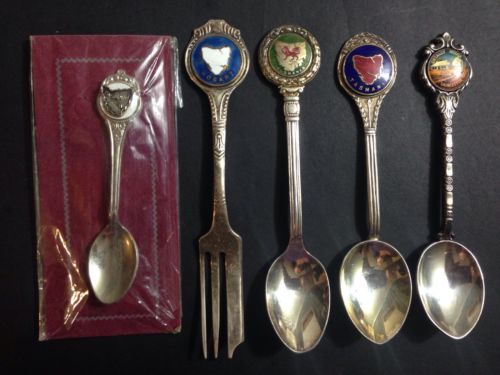
Imagine you have a collection of souvenir teaspoons from all over Australia... except Queensland. Some are old, some are new. You could call it the Museum of Old and New Spoons, or MONS. The thing you wouldn't want to do would be to have a room with "VICTORIAN SPOONS", "NSW SPOONS", "TASMANIAN SPOONS" and so on over the gallery doorways, as people would soon be asking, "Where are the Queensland spoons?"
So instead you have a room full of teaspoons with pictures of animals on them, and another room with teaspoons with machines on them, and so forth. Maybe a whole long line of spoons with fruit on them. The collection feels much broader all of a sudden.
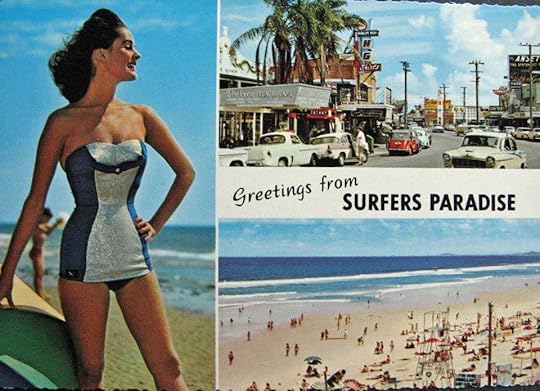
Then you realise that people aren't coming to your MONS, so you change it to the Museum of Old and New Souvenirs, and you introduce saucy postcards. Some of which are from Queensland.
And then you make fun of people who collected spoons from everywhere, including Queensland. And you spruik that people spend more time looking at your saucy postcards than they do at other people's teaspoons of Cloncurry.
KPI delivered. Business model deployed.
Labels
The other way our anthropologist lets us down is through his inability to engage with the paradox of label-shaming.
In short, SADCOC has no labels on any of its artefacts.
None.
You are free to engage with the artefacts entirely on your own.
You can also use the digital guide - the "O" - which will provide you with background information on the artefacts, interviews with the creators, interviews with the collector (that would be David Walsh, of course), and so on.
The anthropologist says this. Quite clearly.
In other words: labels.
But you can choose not to use the O. Some people (around 10%) choose not to. Or else the O doesn't work for them, or they can't work it, or they share the O of someone else such as a friend or partner, so the visit isn't completely solitary and onanistic. No data on that, sorry. Just a vibe.
Our anthropologist has no research into what actual visitors think of the "no labels (here are your labels)" philosophy. Just none. He could have interviewed people. You know, done some anthropological research.
He doesn't even really deal with the paradox.
But, of course, not all artefacts need a label. They are self-evident, and can exist in a contextual vacuum.
Pretty Pictures
But the book has many pretty pictures.
Mainly, though, it is a record of the thinking, discussions, and meetings that went on between people eminently unqualified to run a museum of art, old or new. Enjoy.
Thank you to Eastern Regional Library Service for making this black and pink tome available to sit on my lounge room Lack for three weeks without my having to pay $43 for it.
Adrian Franklin has ensured that the making of Mona (or MONA, Museum of Old and New Art) is explained very prettily with lots of very nicely written words that actually go the distance in explaining a very great deal indeed, without kissing too much arse, or putting the boot in. It is also the nuts and bolt of how Mona used anti-marketing to create the most successful anti-museum in the world in the suburb of Berriedale. A lovely book.
This lavishly presented coffee table book digs deep into the origins and evolution of the Museum of New and Old. It features quality reproductions of many of the works in MONA, details many of the design considerations from both architectural, display and institutional perspectives, and is slavishly on brand.
A great read for those familiar with MONA and/or other collecting institutions more generally but not recommended for those who haven't yet visited. It would definitely ruin the fun.
An insightful book about the philosophies driving Hobart's newest and biggest tourist attraction.
The Making of Mona describes how David Walsh and his team slowly developed the museum from the responses to its predecessor, the Moorilla Museum of Antiquities, while delving behind the scenes into Mona's planning, construction, branding and festivals with anecdotes from the main players. Comparing it to various other international-scale museums provides a context which shows how Mona really stands out.
I particularly liked the chapters about the museum's architecture and lighting, complete with drawings and renders. The book design is spot on - its cover and edge treatment radiate the same mysterious allure as the museum whose secrets it holds.
Great outline of how MONA came to be MONA. Fascinating in that it goes beyond the myths and clears up some things while still keeping the museum somewhat of a mystery. I kind of wanted to know about Walsh's house within MONA, the glass floor so he can see into the gallery? Rumour? Fact? Who cares really. I enjoyed a lot of this, and was reminded that I had visited Palais de Tokyo in Paris years before I visited MONA. A good read for any subversive art lover or museum enthusiast.
Very in-depth. Can’t help but be a strong implicit endorsement of David Walsh’s wealth, though. Would be more interesting to read retrospectively once MONA has been demolished, since the book treats it as a given presence and not as a beautiful little curio that will one day be razed to the ground: either when Walsh dies or simply when he loses his capacity to maintain it
In the process of reading this book, I have inadvertently proven David Walsh (the eccentric and wealthy operator behind MONA) completely and utterly wrong.
He shows a blind faith in the everyman's ability to engage with art, saying that "dumbing-down is unnecessary and that a community will rise to the level required for appropriate engagement with an entity".
I did not rise to level required to read this book. I did not engage appropriately. I struggled to make it through some long winded parts that discussed artistic direction and core curatorial values.
Instead I wanted to read about machines that poop and models of vaginas (that are "art")
However I did learn that, I too, can start an edgy contemporary museum if I remove all the labels (labels are a mind controlling evil used by the illuminati to control us says Walsh), and call everyone else in the industry a boring white cube artwank despite being the biggest artwank of all time myself.
The last chapter or so basically reads: geez we're utter geniuses because we take nothing seriously so as to avoid any and all criticism. We're all clowns haha we're so smart but not really because we laugh at ourselves haha did I say David Walsh is a genius? People in the medieval ages had festivals and we do too! Down with the king! We're smart!
Maybe I don't like it because I thought I was the only one doing it. Disingenuous modesty. What a fantastic concept.
I did enjoy reading about how Mr. Walsh effectively gambled on how long an artist would live for in order to acquire his remaining life's works (and lost - professional gambler my ass) and also the part about the pooping machine. How good is contemporary art? 😍
Either way I still can't determine whether I love or hate David Walsh and MONA. Better go buy another book about him.
A quality coffee table book which contains a behind the scenes overview of MONA’s origin, evolution, branding and curation. It also has nice pictures.
It brought back good memories reading about previous exhibitions and festivals. I liked reading about the building design process and how the creators wanted to highlight the humanity of art without the pretentiousness associated with art culture.
There are many bars at MONA to help loosen your inhibitions, subterranean galleries in which to explore similar recesses in yourself, sometimes shocking and grotesque artworks normalising what our bodies really can be (disgusting). The distorted mirror around the entrance was intended to be like the event horizon around a black hole drawing you in. The mirror also creates a distorted self perception but that might have been a happy accident.
The author Adrian Franklin helped me realise how the museum’s sex and death themes are two of the most perpetual human things we do but never discuss in polite conversation. It is intended to be a transformative and meditative experience spending the day at MONA. The place accepts the disgusting creature you are and encourages you to celebrate it anyway.
Franklin also discussed some other interesting things like how MONA shook up museum and art gallery culture, banished tired wall labels, and created a 3D model of the museum in a game so they could easily manipulate how the galleries and lighting looked. I learned about how it is intended that the art and the artists aren’t untouchable or far removed from ourselves. Visitors are encouraged to form opinions and vote in the museum app The O whether they like artworks or not, you also don’t have to.
Good museum. Good book about the museum. Good keepsake in case we somehow lose MONA in the future.
Yes. So much here that inspires, discomforts and uncovers layers of thinking. Nothing good is an accident and this shows beautifully how much expertise, vulnerability and courage makes the thing.