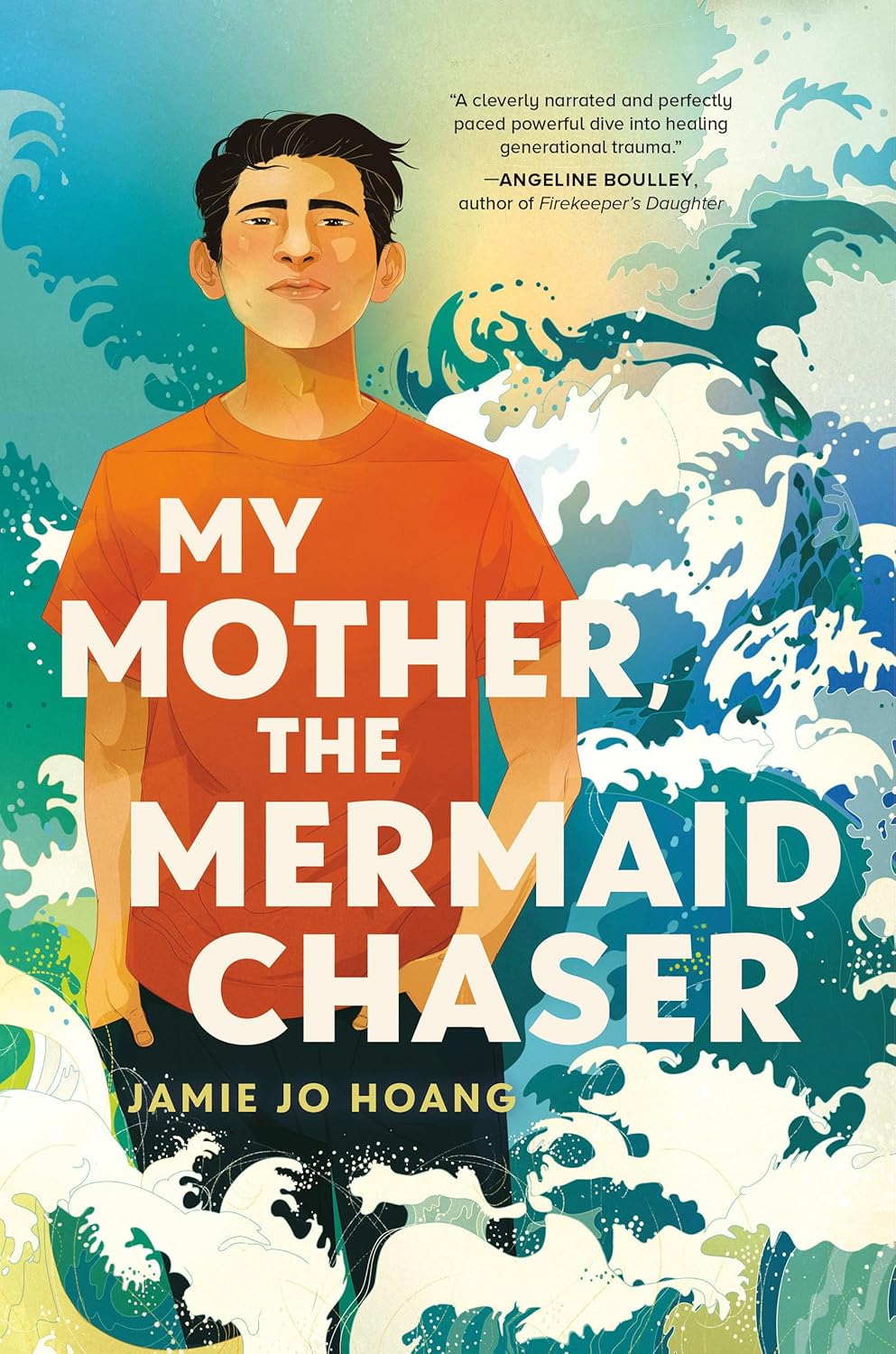
Told in dual POV, this gripping companion piece to My Father, the Panda Killer, follows a teenage son who defies his sister's wishes by searching for more information about their absent mother. Meanwhile, his mother's poignant backstory reveals her struggle with grief and longing, culminating in her heart-wrenching decision to leave her children.
"With sweeping lyricism, this novel unflinchingly explores survival and resilience. A haunting and beautiful reminder of the continual mending of the wounds from wars long past. Laugh, cry, and cheer as Paul steals the pages and Ngọc Lan claims your heart." -Kim Johnson, award-winning author of This Is My America
San Jose, 2008: Paul yearns to know more about the mother who abandoned his family, but she is the only topic no one discusses. Now’s he’s in Vietnam, feeling displaced and considered an outsider. Plus, a ghost is haunting him even though he doesn’t believe in ghosts. His cousin and the grandmother he’s never met before now keep telling him that he’ll get answers only if he’s willing to open his ears.
Vũng Tâu, 1975: Ngọc Lan is eleven when her family breaks her brother is drafted into the army; her father leaves on the last helicopter to the US. She and her sister are sent from Vietnam on a harrowing journey by boat. Only Ngọc Lan will survive. But what is the American dream when you are haunted by the death of your sister, missing your homeland; seeing ghostly mermaid sightings; lost in an abusive marriage; struggling as a parent?
Told in the alternating perspectives of Paul and Ngọc Lan, My Mother, the Mermaid Chaser is a haunting story about the intergenerational effects of war, estranged family bonds, and how a teenager discovers a new connection to a lost part of himself.
Jamie Jo Hoang is the award author of BLUE SUN, YELLOW SKY. Her driver's license says she lives in Los Angeles, but she tries to escape to foreign lands as often as possible. She is a writer, thinker, explorer, lover of tea, certified advanced diver, and never far from an ocean. She blogs about her life and travels at: www.heyjamie.com. Tweets at: @heyjamie. And posts pretty pictures on Instagram as @heyjamiejo. So far she's visited Peru, China, Vietnam, Cambodia, Thailand, Uruguay, Chile, Bonaire, France, England, Jamaica, Ireland, Scotland, and numerous other cities within America.
The long awaited companion to My Father, the Panda Killer, this book does not disappoint. It is so well-written, taking place about 9 years after the first book which was set in 1999, if I remember correctly. Having witnessed Jane's pain and resilience, I was fascinated to see how Paul internalized the emotional pain, and how Ngoc Lan's story provided a sense of redemption.
In the first book I felt that the mother figure was this mysterious, surreal image of an absentee parent. As a mother myself I wondered, what could have caused her to leave her children with such an abusive parent? Just as in the first book I learned so much about the pain and horrors that Vietnamese refugees and villagers suffered under the Communist occupation and the trauma of leaving their homes.
The characters are vivid, complex, and unapologetic for what they had to do to survive. I especially appreciate that there is untranslated Vietnamese throughout the book, with only footnotes to translate after the chapter has ended. It leaves the English-speaking reader feeling the disconnect between languages and word meaning.
I was transfixed by this story and at this point I will read anything Jamie Jo Hoang writes, even the telephone book.
This is the Sequel to My Father, the Panda Killer, and goes into the story of the Mother this time. The previous book was one of the best books i read last year, so I really looked forward to the sequel as well as find out what exactly happened to the mother and what would make a mom abandon her two children.
This time, we get the point of view of the brother, then just a 5 or 6 year old. Its been close to 10 years since the end of the Panda book, and now he's a full grown teenager. The book once again uses the one chapter of the brother in the present, one chapter of the mother's pov from the past. Like the last book, its a bit jarring, and takes about 1/4 of the book for me to get fully comfortable with it.
I wasn't really aware of this last time, but this book makes it very clear. The authoress is a much better author of women than she is of men. I felt like the women chapters of both books were so much better written and more full of elucidation than the ones of men. This could be just that the authoress wanted to perpertuate the "woman is of venus, mars is of men" trope, but I think its just that she's got a very good womens' voice and her men's voice is nowhere as strong. the boys chapters always end up in some odd state that discomforts me for reasons I can't explain, while the womens' voice is always much better. It could just be my imagination.
This time, the setting has changed as well, with the bulk of both chapters taking place in Vietnam. The protagonist is there on a trip with his father, and they make a stop to the paternal Grandmother's house where he experiences the heat, the lifestyle, and the food first hand. Its all cute and everything. Meanwhile the mom's side of the story starts with the war, and increasingly as the war starts tearing the family apart, you get to see the hardship, suffering and the pain that war inflicts on the mother's family. Unlike the first book, where I suffered the dad's part of the story to listen to Jane's story, here I find myself tolerating the boy's story to listen to the mom's.
At the end, everything is made clear, the family kind of sort of reconciles, and some things are nicely tied up in a knot. Perhaps too cleanly, but its fine. The bulk of the book is still amazing and the pain of what happens in a war to a family is still the overall theme. The first book was absolutely amazing in that it also showed the effects on the 2nd generation. This time, the 2nd generation has already been insulated by the sister, so its not as powerful.
The book does broach upon mental health quite a bit, but that bit was little more than just a handful of chapters, so not the overall theme of the book.
All in all, a great sequel to the first book, even if its nowhere as good as the first. Recommended if you loved the first book. Worth a listen too, as the narrator does a great job with the vietnamese pronounciation.
My Mother, the Mermaid Chaser is a companion story to My Father, the Panda Killer. You don’t have to read the first to love this one, but if you do, you’ll see how the stories reflect each other, like two sides of the same torn family photo.
This time, the focus is on Paul, a son dragged back to Vietnam by his dad on a trip. Once there, Paul seeks uncover the truth about his mom, Ngọc Lan, who vanished from their lives years ago. It’s a journey filled with ghosts, both "real" and emotional. There are spirits, memories, and secrets that refuse to stay buried. As soon as the Grandma character appeared (Paul’s mom’s mom), I knew this was a story I was going to love. She’s tough and intimidating, with a surprising profession.
The story flips between timelines: the present-day adventure of Paul’s trip, and the past, where we see Ngọc Lan as a young girl escaping the Vietnam War with her sister. Her chapters are heartbreaking, showing how one moment can shape an entire life, and how pain echoes through generations.
This book mixes adventure, humor, and underneath it all the ache of wanting to understand your parents - to see them not as villains or heroes, but as people.
If Panda Killer was about fury and survival, Mermaid Chaser is about forgiveness and finding light. Together, they make an unforgettable saga about growing up, looking back, and learning that healing doesn’t erase the past, it transforms it.
Highly recommended, especially if you’ve ever felt caught between two worlds.
Love love love this beautiful book! This poignant novel tells the story of Paul and his mother, Ngoc Lan, a companion to My Father, the Panda Killer, about Paul's sister and father. I was swept away from the first page, knowing Ngoc Lan's inevitable choices but wanting to understand the how and the why. Hoang has a real talent for writing characters who are complex and flawed, yet real and you find your heart goes out to them even in their worst moments.
This book is an emotional journey in the best way, taking me from laughing out loud to getting choked up within pages. I was gripped the whole time! I can't wait to see what Hoang writes next.
This was a nice companion to My Father, the Panda Killer, as it answers some questions the reader may have had in the first book, particularily when it comes to Paul and Jane's absent mother.
It reads just like the first, and makes for a valuable read on Vietnamese culture and the state of the country after the war - just because a war is finally over, it doesn't mean the country will bounce back automatically.
One thing that Hoang does that is very crucial for YA is that her prose balances the very heavy trauma with tenderness, humor and empathy. The anticipatory questions I had early on were "When is it better for a mother to abandon her children to an abusive father?" "What might be the implications of this abandonment on the children as they grow up?" Hoang does not shy away from showing the trauma, but she also opens up a door for empathy to seep in.
This is the sequel to My Father, the Panda Killer, and it was good in a different way. Still talking about being a refugee from Vietnam and what her journey looked like and what it was like to come to the States and start over while still being haunted by ghosts. The metaphorical elements felt stronger in this book than the previous one but perhaps because I didn't grow up in a culture that was strongly ghost/spirit-oriented. What happens when you make really tough decisions for yourself that impact others like your children arguably for the worse?
~~Thank you to NetGalley and Random House Children's for the ARC!~~
4.5/5 stars rounded up!
To say I was excited to see one of my favorite books from 2023 get a companion novel / sorta sequel would be an understatement.
Paul is very different from his older sister, as is Ngọc Lan from Phúc, and that is very imperative to the story and its themes. In comparison to his predecessor, Paul's journey is much more emotionally packed. He's the type to demand answers directly and doesn't know how to hide his feelings like Jane. It's refreshing to see where the guy is more emotionally driven than the girl for a change. Ngọc Lan's story is just as, if not more devastating, than Phúc's, for her journey from Vietnam to America was not one she chose for herself, nor her marriage. With her sister's tragic death on top of it all, it's incredibly hard NOT to empathize with her. Again, Hoang is so incredibly talented at portraying complex family dynamics. Explaining their actions, but never letting them slide, either, for one generation's choices go on to severely impact the next.
I just really loved this book and its predecessor; I'm so excited to put this book next to his sister when it officially releases.