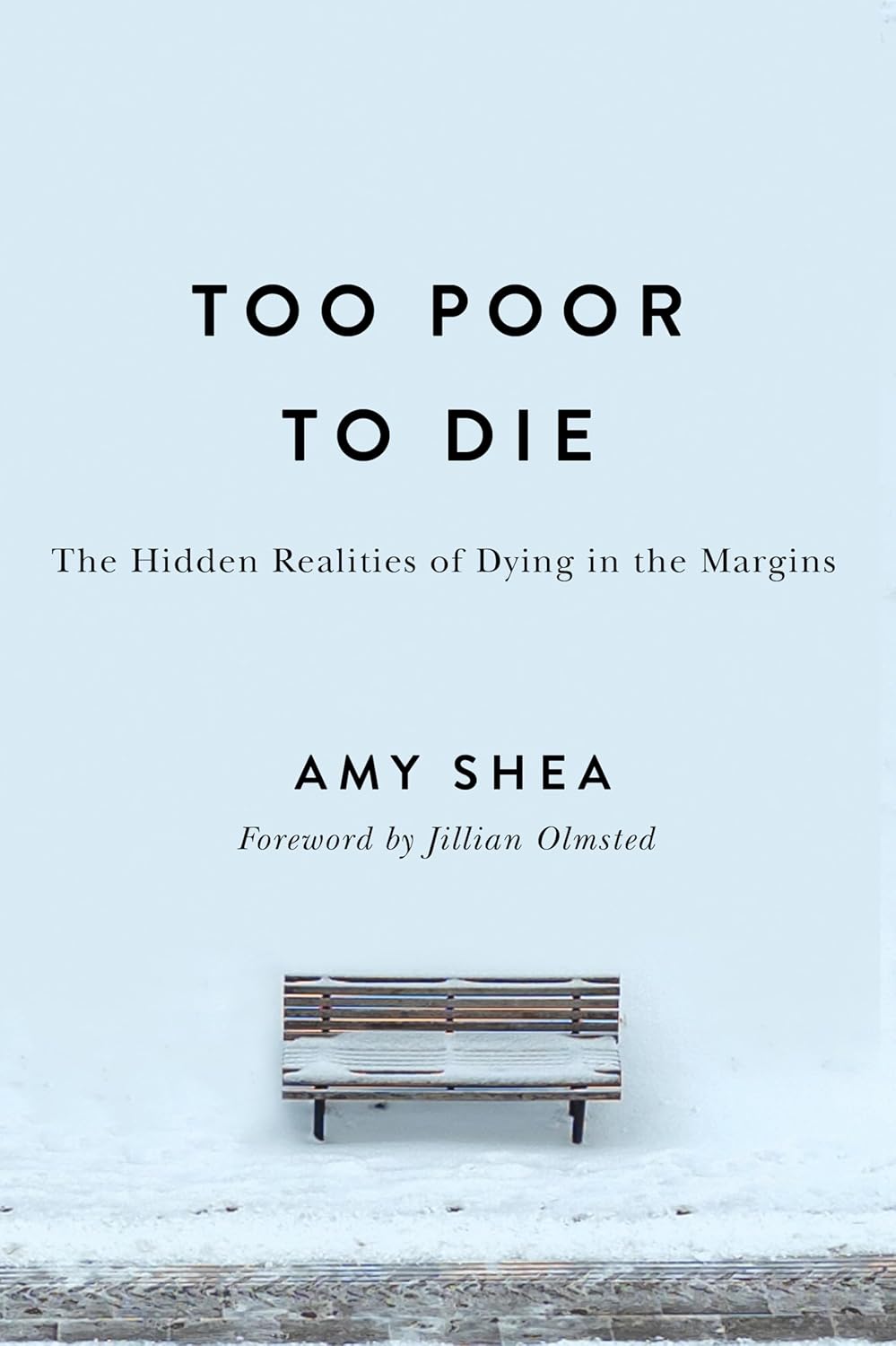
Death is the great equalizer, but not all deaths are created equal. In recent years, there has been an increased interest and advocacy concerning end-of-life and after-death care. An increasing number of individuals and organizations from health care to the funeral and death care industries are working to promote and encourage people to consider their end-of-life wishes. Yet, there are limits to who these efforts reach and who can access such resources. These conversations come from a place of good intentions, but also from a place of privilege.
Too Poor to The Hidden Realities of Dying in the Margins, a collection of closely connected essays, takes the reader on a journey into what happens to those who die while experiencing homelessness or who end up indigent or unclaimed at the end of life. Too Poor to Die bears witness to the disparities in death and dying faced by some of society’s most vulnerable and marginalized and asks the reader to consider their own end-of-life and disposition plans within the larger context of how privilege and access plays a role in what we want versus what we get in death.
I grew up near a Potter's Field. It was a blank green expanse of lawn where the city of Flint buried people who didn't have the money to purchase a grave plot or pay for their own cremation. For many years, the space wasn't marked at all. Eventually someone planted a stark white cross in the middle of the space. I never visited, but I was curious about how someone might end up there.
When I saw "A Certain Kind of Death," a movie about people on the margins who are buried by LA County, I got a better understanding of the herculean efforts that went into identifying someone who died alone or on the streets. Amy Shea's Too Poor to Die delves more deeply into the inequities that lead to early deaths of disparity and the myriad ways cities dispose of their poor, as well as programs that provide hospice for people who might otherwise die on the street.
Along the way, she struggles with her curiosity about the subject and her right (and privilege) to tell the stories of people who are failed by society. That aspect of the book fascinated me. Originally it felt as if she was centering herself in the narrative, but at some point I found it liberating, giving readers (and myself) permission to ask these questions and search for ways to help, even if the subjects were unfamiliar or distant to ourselves. It was the reverse of othering: inviting us to participate in the solutions.
When one unaffordable hospital stay or downsizing or banking crash could unhouse any of us, this powerful book raises issues we all should consider now.
“Death is the great equalizer, but not all deaths are created equal.” 💀 This collection of essays taught me SO MUCH about the death industry and life (and death) as an unhoused person. It also included photographs that made the reading experience even more personal. I did feel that the essays (and book itself) ended a bit abruptly, but I loved the book overall and would highly recommend it to anybody wanting to learn more about life and death in the margins of the world. Overall, I would give this four out of five stars. Keep your eye out for “Too Poor to Die” this September!
Death is our one certainty in life. It’s something we will all experience, yet many of us have never had to think about what happens to the unhoused and poor when they die in the United States. In Too Poor to Die: The Hidden Realities of Dying in the Margins, we learn that the playing field of death is not always level. As the author, Amy Shea, says, “Not all deaths are created equal. Not everyone has a good or dignified death or is treated with respect.” Shea draws on in-depth research, personal anecdotes, and fieldwork experience with marginalized communities to tell the story of what happens to those who can’t afford dignity in death.
Through several connected essays, Shea shares her own journey of discovering the fate of the indigent and unclaimed dead, from visiting potter’s fields with her father to meeting unhoused hospice patients in a medical respite center. She takes great care to write about this topic responsibly by blending facts with moving stories that follow unhoused and disadvantaged individuals leading up to and after their deaths. Through these essays, a story unfolds that sheds light on a system that is ill-equipped to provide a dignified death to those who can not afford one.
Shea points out the privilege behind the growing death positivity movement and how good death education, while useful to many and often driven by good intentions, fails to meet the needs of marginalized communities. She examines the influence of capitalism on death care, stating, “Where there is death, there is profit to be had.” Shea backs up this claim by uncovering what is done with the bodies of the unclaimed and indigent and who is left to foot the bill. The stories she shares are handled with care and compassion and are accompanied by context that highlights how close the average American is to experiencing this fate themselves.
Too Poor to Die highlights differences in the indigent death care industry in several different locations across the United States. Having lived in the Boston area, Shea shares her experiences working with the homeless population in the city. She shares their stories and common struggles of finding shelter, holding on to personal property, and staying healthy on the streets. Being from Massachusetts myself, this book has changed the way I view the local unhoused community when I walk through the Boston Commons on my way to work each day. While I’ve always had sympathy for this community, I now have a deeper understanding of the complex struggles they face and how we need to do more as a society to care for these marginalized communities, both in life and death.
If you are privileged enough to have the finances or a family to facilitate your passing and burial when the time comes, you may never know the fate of those who have neither. Too Poor to Die draws attention to this important issue that often goes undetected by the general public. It introduces a need for more funding, more advocacy, and more compassion when it comes to dealing with the deaths of those who can not afford a good death. Amy Shea is a compelling storyteller who creates urgency around this issue and asks us all to reflect on what it means to die (and live) well and why this should be available to everyone.
I was lucky enough to snag an early copy of this book, and it was excellent. In a series of essays, Shea explores how the United States treats its unclaimed dead—those who either have no relatives to lay them to rest, or whose relatives can’t afford to do so. These may not be the people you’re imagining. She also weaves in her own personal experiences—learning about indigent burial cemeteries from her amateur genealogist father, volunteering to perform foot care at a homeless shelter. Don’t miss the index poem at the end!
Here's book about an important topic that you probably haven't thought about. And whether it impacts you directly, personally or not, it impacts you, all of us. What's great about Amy Shea's book is how she tells her story with personal narrative deftly interwoven with in depth research. She investigates the issues surrounding death, dying and poverty in hands-on way. It's a compelling read that opened my eyes and taught me a lot. She's a masterful storyteller, compassionate, and able to find the humor a heavy topic needs as well.
I was lucky enough to be sent a proof of this book before publication and would really recommend it. A hugely well researched work, with stats, facts and histories running alongside personal stories, all delivered in a human and engaging way. The list of unclaimed names at the end is extremely affecting. The politics of death and the continuation of social injustice all the way to the grave are writ large in this important book that demands a wider conversation and urgent change.
Amy Shea brings light to an under-explored yer critically important issue: how death and dying are experienced by individuals with limited resources. The author highlights systemic gaps that render even death as inequitable.