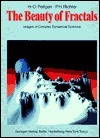
Now approaching its tenth year, this hugely successful book presents an unusual attempt to publicise the field of Complex Dynamics. The text was originally conceived as a supplemented catalogue to the exhibition "Frontiers of Chaos", seen in Europe and the United States, and describes the context and meaning of these fascinating images. A total of 184 illustrations - including 88 full-colour pictures of Julia sets - are suggestive of a coffee-table book. However, the invited contributions which round off the book lend the text the required formality. Benoit Mandelbrot gives a very personal account, in his idiosyncratic self-centred style, of his discovery of the fractals named after him and Adrien Douady explains the solved and unsolved problems relating to this amusingly complex set.
Peitgen studied mathematics, physics and economics from 1965 until 1971 in Bonn, later working for six years at the Institute for Applied Mathematics at the University of Bonn under Christian Fenske, where he received his PhD in 1973. His doctoral dissertation was Asymptotische Fixpunktsätze und Stabilität (en: Asymptotic fixed-point theorems and stability).
After receiving his habilitation in 1977, he first taught as private docent in Bonn before obtaining a professorship for mathematics at the University of Bremen.
In 1986 Peitgen and Peter Richter published their lavishly illustrated and very influential book The Beauty of Fractals, which was amongst the first books popularizing the concept of fractals to the general public. This book was followed up in 1988 by The Science of Fractal Images and in 1992 by a large and authoritative volume entitled Chaos and Fractals: New Frontiers of Science, written in collaboration with Hartmut Jürgens and Dietmar Saupe.
Peitgen is director of the Centre for Complex Systems and Visualization (Centrum für Complexe Systeme und Visualisierung - CeVis) at the University of Bremen. His research work emphasises dynamical systems, numerical analysis, image analysis, and data analysis, as well as the use of computers in image-based medical diagnostics.
Back in 1987 – before the Internet – this book was an eye- (and mouth-) opener. PCs weren't hardly able to reproduce images like the ones presented in this book.
Now the book has become kind of obsolete: The underlying math you can learn from Wikipedia and other sites. The graphics you can make yourself with one of the many free fractal generators (see above and below).
The first major book with pictures of Mandelbrot Set zooming. Articles range from do it yourself (algorithms and coordinates to make Mandelbrot and Julia set images), to meditations on the larger meaning and import of fractals and chaos.
One of my favorite books of all time. And one of the few I can say has dramatically changed my perspective on life. I come back to it time and time again whenever I need to be reminded of the beauty and complexity of the universe.
Long ago, this book and Mandelbrot's work were among the inspirations leading me to decide to go back to school in computer science to pursue further study in computer graphics and animation.
I first became aware of chaos mathematics in 1976, when Robert M. May published his famous Nature review "Simple mathematical models with very complicated dynamics", a preliminary exploration of what we now call the Logistic Map. Chaos research proceeded apace through the late 1970s and early 1980s, to the point where some of the questions May had raised were answered. It also became evident about then that there were connections between chaos mathematics and fractals, which had been explored earlier by Benoît B. Mandelbrot, who published The Fractal Geometry of Nature in 1977. In particular, there are deep connections between the logistic map explored by May and a particular fractal discovered by Mandelbrot that became known as the Mandelbrot Set.
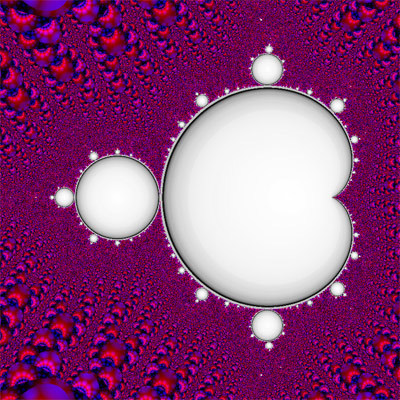
Now, in 2024, many people have heard of the Mandelbrot Set and almost everyone has seen pictures of it. Before 1984 such pictures barely existed. Heinz-Otto Peitgen and Peter H. Richter, respectively professors of Mathematics and Physics at the University of Bremen, set about to produce color graphic representations of the Mandelbrot Set and other fractals. They had access to what at the time passed for powerful computers. Some of their pictures appeared at an exhibition entitled "Frontiers of Chaos". This book is a collection of pictures from the exhibition. In addition, the text of the book explains much of the math behind the pictures.
There are few things more subjective than beauty, so it will be understood that I express only a personal opinion when I say that the pictures are stunningly beautiful. I had seen images of the Mandelbrot Set and other fractals before I received this book as a gift, but none that I had seen were like this. The cover image, in particular, was one of the most beautiful pictures I had ever seen, and I still hold it so almost thirty years later.
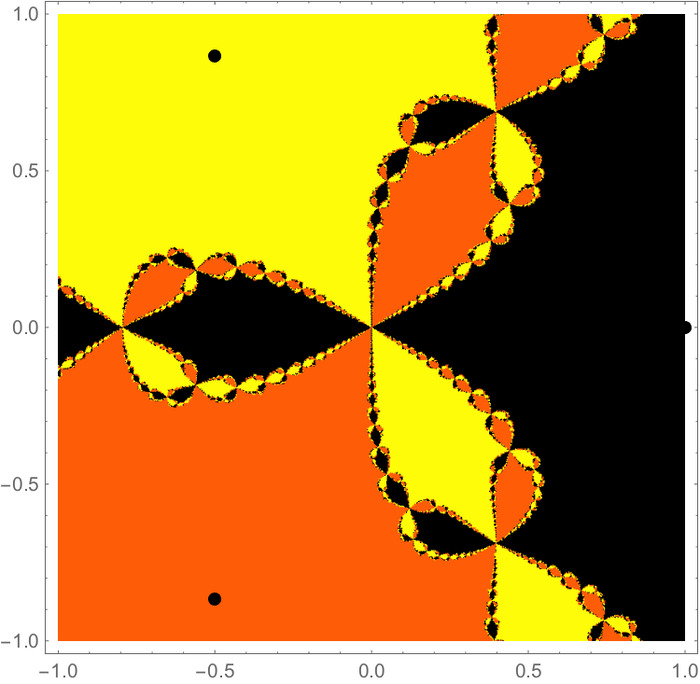
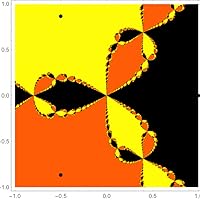
In the thirty years since Peitgen and Richter produced these pictures powerful computers have become far more widely available. I include here a fractal image I produced on my desktop computer in 2015 as my answer to one of the questions in a problem set in Functional Analysis, a course I took as a first-year grad student in Applied Mathematics. This image reproduces Figure 42 of The Beauty of Fractals: Images of Complex Dynamical Systems, except that that image is in drab black and white, whereas mine, since I did the problem set over Halloween, I did in orange, black, and yellow. On my desktop it took mere seconds to produce this image.
I didn't check this book out for reading purposes, but instead for pattern ideas, and I didn't see anything that grabbed me. Book itself is probably decent; I'm just not the right audience for it.