The narrator of Neighbours is a young writer who has taken a room in the attic of a lodging house, where he hopes to find a quiet atmosphere in which to work. One night, the sound of laughter outside his door alerts him to the existence of Victor, a fellow lodger in an adjoining room. The narrator feels an immediate and inexplicable hatred for his unwanted neighbour, which develops into an obsession as he listens to Victor’s fervent conversations and amorous adventures through the thin wall and records it all in minute detail on endless sheets of paper. His morbid fascination with Victor gradually begins to dominate his existence, leading to a shocking climax when he finally resolves to destroy his neighbour, the man he blames for ruining his life . . .
Claude Houghton (1889-1961) won a devoted cult following in the 1930s with I Am Jonathan Scrivener (1930) and This Was Ivor Trent (1935), psychological thrillers with brilliantly sharp dialogue and unusual metaphysical themes. This edition of his astonishingly original first novel, Neighbours (1926), is the first in over 75 years and features a new introduction by Mark Valentine.
“[G]rew upon me with every page, until I came to the dramatic climax … often brilliant … [with] the brilliance of fever, almost of delirium.” – Punch
“It is very shocking … [Houghton] has proved himself to possess considerable talent.” – Spectator
“Neighbours is a novel about ideas concerning life. It is full of dialogue, and good dialogue. It has beautiful moments. It is original.” – Arnold Bennett, Evening Standard
“In Claude Houghton’s work you have come to expect not only an unusual and fast-moving story, but one with its hidden excitements or seeming touch of fantasy, the significance of which may not be apparent until you have reached the last page.” – Sunday Times
“His novels bring us the finest and most firmly thought-out exposition of the spiritual problem of modern times.” – New York Times
Claude Houghton Oldfield was born in 1889 in Sevenoaks, Kent and was educated at Dulwich College. He trained as an accountant and worked in the Admiralty in the First World War, rejected for active service by poor eyesight. In 1920 he married a West End actress, Dulcie Benson, and they lived in a cottage in the Chiltern Hills. To a writers’ directory, Houghton gave his hobbies as reading in bed, riding, visiting Devon and abroad, and talking to people different to himself. He added: “I like dawn, and the dead of night, in great cities.” He disliked fuss, noise, crowds, rows, and being misquoted, or being told how much he owed “to some writer I’ve never read”.
Houghton’s earliest writing was poetry and drama before turning to prose fiction with his first novel, Neighbours, in 1926. In the 1930s, Houghton published several well-received novels that met with solid sales and respectable reviews, including I Am Jonathan Scrivener (1930), easily his most popular and best-known work, Chaos Is Come Again (1932), Julian Grant Loses His Way (1933), This Was Ivor Trent (1935), Strangers (1938), and Hudson Rejoins the Herd (1939). Although he published nearly a dozen more novels throughout the 1940s and 1950s, most critics feel his later works are less significant than his novels of the 1930s.
Houghton was a prolific correspondent, generous in devoting his time to answering letters and signing copies for readers who enjoyed his books. One of these was novelist Henry Miller, who never met Houghton but began an impassioned epistolary exchange with him after being profoundly moved by his works. Houghton’s other admirers included his contemporaries P. G. Wodehouse, Clemence Dane, and Hugh Walpole. Houghton died in 1961.
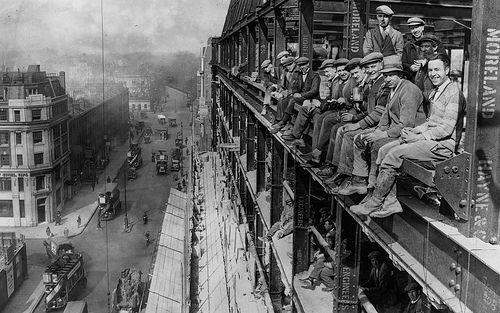
Londra 1929: lavoratori edili in pausa pranzo sui bordi del palazzo su cui stanno costruendo nuove mansarde
Millenni or sono, un antico filosofo diceva che si può conoscere tutto della vita senza lasciare la propria stanza. Guardo fuori dalla mia finestra e osservo la frenesia della folla nelle strade, e sento che io, che non fatto esperienze così cole le intende il mondo, in realtà ne ho fatte ben più della maggior parte degli uomini. Questi si sono occupati solo di ciò che si trova all’esterno di se stessi, mentre io sono sempre stato alla isperata ricerca di ciò che si trova all’interno.
È la storia di un giovane scrittore che prende in affitto una mansarda in un edificio di nove piani, e qui spera di trovare la tranquillità e l’isolamento che brama per potersi dedicare a lettura e scrittura. È lui che racconta, è lui l’Io narrante. Poche sere dopo essersi trasferito, sente venire dalle scale la risata di un uomo di nome Victor, che gli risulta immediatamente antipatico, ostile. Non lo incontrerà mai. Passerà anni a origliare Victor e la sua amante Pam, Victor e i suoi amici, le loro conversazioni gli arrivano attraverso la parete che hanno in comune le loro abitazioni, e il nostro passerà questi anni a riportare su fogli tutto quello che ascolta. Tutto quello che carpisce, che ruba. Dimenticandosi di vivere. Progressivamente ‘occupato’ dal vicino, svuotato della sua linfa vitale, vinto da una personalità che ‘suona’ più forte della sua.
Il finale che viene descritto come inaspettato, per me è arrivato come logica conclusione, non poteva essercene altra. E quindi mi sono rovinato anche la sorpresa.
Il doppio che è in noi (e forse triplo, quadruplo, ma due basta, è già più di uno) può naturalmente essere anche una seconda personalità che non ci piace, che combattiamo e respingiamo. Ma trattandosi sempre di noi stessi, è chiaro e ovvio che ne siamo comunque attratti, per quanto ci opponiamo e cerchiamo di allontanarci, poi torniamo. Classico gioco di specchi, di proiezioni, dove sarebbe lecito perdersi, e invece l’unico che si perde è il protagonista. E chissà, forse anche Houghton.
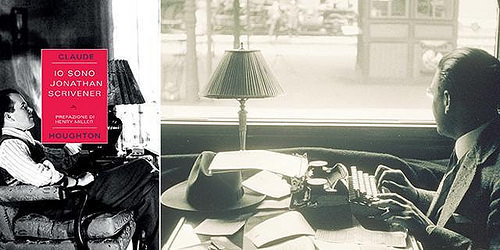
Henry Miller ha scritto la prefazione a Io sono Jonathan Scrivener, il romanzo di maggior successo di Claude Houghton
Libro per me faticoso, spiacevolmente vecchio, pur se nutrito di psicanalisi e di tematiche contemporanee, mi è apparso decisamente datato, ben oltre i novant’anni che si porta dietro. Claustrofobico, volutamente, ma anche sgradevolmente. Ossessivo, enfatico, privo di ironia, si prende maledettamente sul serio. Tra estranei che non si amano e si comunicano solo banalità, all’improvviso il protagonista chiede Cosa ne pensa della Vita?, proprio con la V maiuscola (e, ironia della sorte, risulta la parte più appetibile del libro). Le malattie del corpo inserite a probabile simbolo e sintomo di malattie dell’animo.
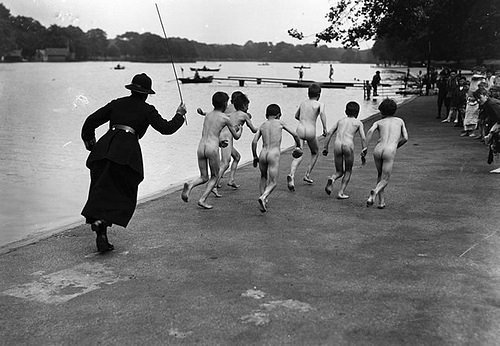
Londra, 1926: Hyde Park, poliziotta insegue bambini che hanno fatto il bagno in un’area interdetta
E quindi, vedete, io che volevo fare tutte le esperienze, io che volevo amare e comprendere l’umanità intera, ho finito per capire soltanto quelli che hanno smesso di vivere facendosi annientare da qualcosa che sentivano più forte di se stessi. Che ironia, vero? C’è una grande differenza tra quello che ci prepariamo a fare con la vita e quello che, alla fine, la vita fa con noi.
Orson Welles era un fan di Claude Houghton. Il regista di The Lady from Shanghai era sempre attratto da qualsiasi gioco di specchi e di prestigio, di rimandi, scatole cinesi…
To be very honest, because of the existential bent of this novel, reading this book at times requires patience extending beyond that of a saint, but it's so worth it. Do not attempt if you want a standard narrative type of story because this is definitely not that.
This book was an ABSOLUTE whirlwind!! I had my doubts at first about this book because my typical genre has been YA, and books that I have been reading right now have been written in recent years. I never thought I would pick up a book written in 1926, but I was curious as to what it was about. In the beginning, I struggled a little to understand what was happening. Once I got over the fact that this WASNT a typical book I would normally read, I finally began to understand it. This book has what I love most about books: AMAZING quotes/ intriguing theories. There were so many theories about people, how they interact with one another, and how one perceives life to be. I was blown away by the words in the story, and loved the way in which the characters spoke to one another and discussed ideas (which seems to be so rare nowadays). This is one case that I was glad I judged a book by its cover, because I was curious to find out the story behind the haunting cover. I would recommend this book to people over 18... Simply because of the in-depth conversations the characters have and the different ways in which people speak to one another, compared to now. Please read!!
sometimes i'm stupid enough to do the maths when ordering novels. 20 bucks for a novel ~180 pages long? hm, i probably could get a reeeaaaally long book for that money, or maybe 3, 4, 5 used books. well, it really is quite stupid, because i totally got my money's worth with this one, as i love, love, love „neighbours“. simply put: it's deep, witty, and has some lines of jaw-dropping, lyrical quality. can you believe this is a debut from 1926 and that it was out of print for 75+ years? not only is it brilliant, it almost feels like it was written yesterday, with it's central theme being metaphysics.
the most astounding thing is how this novel positions itself in the historical context, as it almost feels like a direct response to eliot's „the waste land“, published only a few years earlier, in 1922. it's the zeitgeist, an emanation that was flowing into houghton's text, one might say. but it's clearly more than that. this novel enters a correspondence to the „waste land“, and it does so not only in the way of motives but also in a literal way. the waste land's „wheel“, the „burning“ of the soul, the sensible world of the town as the „sea“, samsara – it‘s all there. yes, even the edenic „paradise“ or „homeland“, the „garden“, which becomes a waste land, a „desert“ in times of spiritual drought. meaning: as is „the waste land“, so is this novel a story of the journey of the soul and of inner transformations.
conclusion: you lovely people out there should read houghton. as of now, „neighbours“ only has received 19 ratings on goodreads, which is a shame, considering how good it is. houghton did well in the 1920s and 1930s, but for some reason got almost buried in history – until valancourtbooks re-issued some of his absolutely valuable work, hooray!