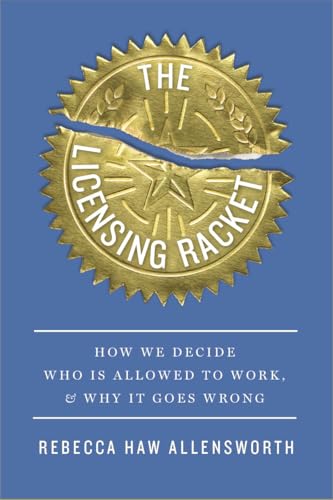
A bottom-up investigation of the broken system of professional licensing, affecting everyone from hairdressers and morticians to doctors, lawyers, real estate agents, and those who rely on their services.
Tens of millions of US workers are required by law to have a license to do their jobs—about twice as many as are in unions. The requirements are set by over 1,500 industry-specific licensing boards, staffed mainly by volunteers from the industries they regulate. These boards have enormous power to shape the economy and the lives of individuals. As consumers, we rely on licensing boards to maintain standards of hygiene, skill, and ethics. But their decisions can be maddeningly arbitrary, creating unnecessary barriers to work. And where boards could be useful, curbing harms and ensuring professionalism, their performance is profoundly disappointing.
When Rebecca Haw Allensworth began attending board meetings, she discovered a thicket of self-dealing and ineptitude. Drawing on hundreds of hours of interviews with board members and applicants, The Licensing Racket goes behind the scenes to show how boards protect insiders from competition and turn a blind eye to unethical behavior. Even where there is the will to discipline bad actors, boards lack the resources needed to investigate serious cases. The consequences range from the infuriatingly banal—a hairdresser prevented from working—to the deeply shocking, with medical licensing boards bearing considerable blame for the opioid crisis and for staffing shortages during the COVID epidemic. Meanwhile, unethical lawyers who are allowed to keep their licenses are overrepresented among advocates working with the most vulnerable groups in society.
If licensing is in many arenas a pointless obstacle to employment, in others it is as important as it is ineffective. Allensworth argues for abolition where appropriate and outlines an agenda for reform where it is most needed.
Goodreads Review of The Licensing Racket: Outrageous Rules, Rogue Regulators, and the Real Cost of Occupational Licensing in America by Rebecca Haw Allensworth
I really enjoyed this book. It’s thoughtful, well-researched, and surprisingly engaging for a subject that could easily feel dry. Rebecca Haw Allensworth, a law professor with a deep background in regulatory theory, takes what at first seems like a niche concern—occupational licensing—and convincingly shows how central it is to understanding some of the frustrations, stagnation, and inequality in the modern American economy.
The core argument is straightforward: licensing requirements, which may have had noble intentions (ensuring safety, promoting quality, protecting consumers), have evolved into tools of protectionism. They restrict access to work, often without meaningful evidence of public benefit. In field after field—from hair braiding and interior design to more sensitive professions like dentistry and law—Allensworth documents how the people enforcing these licenses are often those already in the profession. The result is an economic and legal feedback loop where the gatekeepers benefit and the newcomers, especially those without money or connections, lose.
What makes this book stand out is how Allensworth weaves together legal analysis, economic policy, and real human stories. She draws on legal cases and state-level politics, but also includes compelling anecdotes of people who were fined or shut down for simply trying to earn a living. These vignettes give the book emotional stakes and clarity. You can feel the injustice without the author ever descending into polemics.
At the same time, Allensworth doesn’t argue for outright deregulation. She’s careful to distinguish between professions where licensing may still make sense and those where it has become little more than economic gatekeeping. She’s not opposed to standards but is critical of how those standards are created and enforced, particularly when dominated by industry insiders.
The writing is accessible but doesn’t oversimplify. I wouldn’t call it “popular nonfiction” in tone, but it doesn’t require a background in law or economics either. Allensworth strikes a good balance—clear enough for general readers, serious enough for those in the legal or policy fields to respect.
One of the most thought-provoking parts of the book is its reflection on the intentions behind regulation. The licensing system didn’t start as a racket. It evolved into one. That nuance matters, and Allensworth handles it well. The book pushes readers to consider how slow-moving, self-perpetuating systems, especially ones cloaked in public interest rhetoric, can quietly shift from protecting the public to protecting professional monopolies.
I recommend this to anyone interested in legal reform, labor markets, bureaucracy, or the economics of inequality. It pairs well with works like Matthew Desmond’s Poverty, by America or even Michael Lewis’s The Fifth Risk, both of which are also interested in how American systems can ossify or drift from their intended missions. A smart, incisive book that sheds light on something most of us encounter without ever fully seeing.
A really important topic and I wish I'd read it at a time when I could give it more focus, but in the end I didn't get that much more out of the book than the podcasts I listened to with the author.
The main points: - Licensing boards are comprised of people who already have licenses, so they naturally protect incumbents (even if they've done bad things) and make it harder for new people to get licenses (eg training or degree requirements) - This has economic effects - existing license-holders get paid more, their services cost consumers more - but it's often motivated more by prestige (making the profession feel more important) than pure economics. - Everybody complains about seemingly frivolous licenses ("cutting hair"), and those are probably bad, but licensing does at least as much harm in prestigious occupations like law and healthcare - there's a legitimate need for credentialing but the same problem exists where it restricts supply and helps incumbents (eg ~2/3 of physician conduct cases resulted in keeping license even for behavior like sexual misconduct, opioid sales, or fraud; and even when the license was revoked it was often re-granted in a year or less).
Mainly focuses on how our licensing raises cost, decreases access / supply and acts as protection for workers in the field - but doesn’t necessarily provide consumers with that much more protection. The government outsources disciplinary actions to the licensing board, which is predominantly entirely people from that profession (doctors, lawyers, nurses, pharmacists) and allows them to police themselves. Unfortunately, there are countless examples in this book, particularly of doctors but could be any field, where really bad individuals don’t have their licenses taken away. Even worse they continue to work with the most vulnerable as those are the less desirable positions (prisons, the VA)
But this even applies to vocations previously unlicensed and now have state licenses to do something such as hair braiding with the license acting as a source of pride and differentiation , but also as barriers of entry to the field
This is a smart, unsettling examination of occupational licensing as cartel behavior masquerading as consumer protection. Allensworth shows, with care and evidence, how licensing often serves incumbents far better than the public.
The book excels in case studies—dentistry, medicine, cosmetology, legal services—where barriers to entry inflate prices without demonstrably improving quality. The real damage, however, is moral: licensing quietly restricts opportunity, especially for immigrants and lower-income workers.
Where I admired the book most was its restraint. Allensworth does not argue that all regulation is bad. She argues that unchecked licensing drifts away from safety and toward rent-seeking. That distinction matters.
The book occasionally stops short of the philosophical implications. Licensing is not merely economic friction—it’s a statement about who gets permission to work. I wanted that moral argument pushed harder.
Still, once you read this, it becomes difficult to hear “for your protection” without skepticism.
Pull-quotes: • “Licensing often protects professionals, not consumers.” • “Barriers justified by safety frequently outlive the dangers they were meant to prevent.”