Mad scientists, parrots from Atlantis, witches, madmen, monsters, korrigans, demons, magical paintings and a water sprite trapped in a mirror are but a few of the amazing characters featured in this collection of 45 stories aptly entitled The Crazy Corner which maps out the frontier between madness and nightmare. Of all the late 19th century writers of contes cruels, Jean Richepin (1849-1926) was the cruelest when it came to the treatment of his characters, not so much in the nasty fates to which they were often delivered -- which are typical of the entire genre -- but in the merciless way in which he describes and characterizes them.
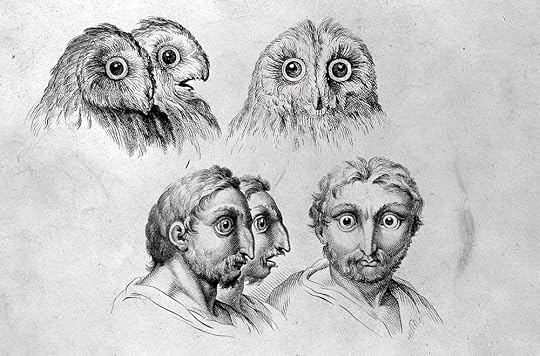
Jean Richepin (1849-1926) "It was, in fact, thee most extraordinary parrot, not only that my eyes had ever encountered but that my imagination would ever have been able to dream up, so old, ugly, thin, bald, scrawny, featherless, bleak, dull, colorless, misshapen, pitiful, wretched, shabby, dilapidated, lamentable, implausible, asthmatic, phantasmal, emaciated, and problematic was it." From Richpin's tale, The Parrot.
Each of the forty-five stories translated, annotated and introduced by author/French literature expert Brian Stableford makes for fun reading, lots and lots of fun reading, crazy, horrible fun reading – not that common in the world of literary fiction. But then again, Jean Richepin was not a common author -tall, broad-shouldered, with a head of curly black hair and full curly black beard framing large, blazing gold-blue eyes, dressed in velvet jacket, scarlet sash and pants and boots of a Hussar soldier, he was a larger-than-life flamboyant literary artist, an outlandish nineteenth century top-hatted cross between, say, Salvador Dali and Allen Ginsberg who refused to belong to any one literary school. I feel a personal connection to the author – in a way, I see him as my spiritual older brother.
Again, these crazy stories of his defy category; they contain elements of naturalism but he was not a naturalist; they contain qualities of fin-de-siecle decadence but he was not a decadent; they contain a touch of horror but he was not a writer of horror fiction. So what else can we say about his stories? Well, for one thing, the stories collected here are short – with the exception of a forty-pager and a thirteen-pager, all the stories are about five pages. They all have a dab of ghoulishness and cruelty and we can encounter, among other monstrosities, such things as madness, nightmares, fiends and witches. Also, they nearly all contain an unexpected twist at the end. More could be said generally but I will focus on the following Richepin tale to convey a more specific taste of what a reader will find in this collection:
The Enemy The first-person narrator of this story is a graphologist, that is, a specialist in inferring character from handwriting. We read the opening lines, “The name engraved on the visiting-card did not strike any chord in my memory. On the other hand, the few lines traced after the name in question immediately and irresistibly rendered me sympathetic to the unknown visitor. Those lines, in fact, revealed on graphological analysis, without the slightest possible hesitation, a noble, dolorous and desperate soul. Without a doubt, the man who had written those lines was not lying in affirming that he had come to ask for mental assistance in a matter of life and death.” In a way, all of these Richepin tales are about life and death. Hey, what do you expect from our larger-than-life author?
The narrator/graphologist receives his visitor and sees from his gaze that his is, indeed, noble, dolorous and despairing. The visitor goes on to tell him how he is being persecuted by a most abominable enemy. Through this interchange, the narrator listens to this gentleman’s pleas of not being mad but concludes he is, in truth, definitely dealing with a case of insanity, more specifically a case of insanity involving delusions of persecution.
And why does he conclude thus? Because he sees this gentleman has the wealth to effectively deal with any real flesh and blood persecutor and the good-looks and noble bearing to deal with any female, ergo, his enemy is purely imaginary. The gentleman instantly reads the narrator’s thoughts and not only replies but insists the enemy haunting him is truly human and made of flesh and blood. And when the narrator asks for more specifics, the gentleman relates how his enemy underlines the faults of his verse in pencil; his enemy renders odious the woman he loves; his enemy spits on the food he eats.
Rather than saying anything further and possibly spoiling the ending of this story, let me pause and note how there was one thinker much admired by the French decadent fin-de-siecle writers, a thinker who held the imagination of cultured, educated people of the time in his grip: German pessimistic philosopher Arthur Schopenhauer, hater of ordinary work-a-day life and spoiler of romantic love. It doesn’t take that much to see how the gentleman in this story, who by nature wants to write romantic verse, love women and enjoy the everyday round of life, is haunted and tortured by Schopenhauer’s pessimistic philosophy.
This is but a modest take on one of these amazing, remarkable, wonderful, marvelous, outlandish, mind-blowing, bizarre tales. Should I go on? I think not, as it should be clear I highly, highly recommend this book by one-of-a-kind author, Jean Richepin.
FIRST TIER - Who would enjoy this book? Those seeking some decadent short fiction might be better served by an anthology like French Decadent Tales, but those interested specifically in the Conte Cruel or the origins of Roald Dahl styled twist ending stories should find much to enjoy, and some to vex!
SECOND TIER - I would suggest those seeking a shorter overview to check out Glenn Russell's enthusiastic review here, as I have a lot to say below (the last 2 paragraphs of which note the best pieces!)
THIRD TIER - So, I was looking forward to this collection of Jean Richepin's feuilleton (newspaper) short fiction from the 1890s. In my continuing exploration of decadent writing, I'd only read a few Richepin pieces (most notably the morbidly humorous "Pft! Pft!", read in French Decadent Tales but also included here) but his reputation proceeded him, as they say, and so here we are with one of Brian Stableford's translated collections, presenting not only the contents of Les Coin des fous, histoires horribles (The Crazy Corner: Horrible Stories) from 1921, but also almost the entirety of Cauchemars (Nightmares) from 1892, and selections from Contes sans morale (Tales Without Morals) (1922) as well as a short playlet from Théatre Chimérique (1896). Some small procedural stuff needs to be knocked out of the way first - while I love that Black Coat is doing work like this, their quality control needs to be slightly better. This book features frequent OCR mistakes and editing gaffes which can generally be read "around" but in at least one case an entire sentence appears to be missing.
Stableford's introduction is quite excellent - placing these works in their chronological, social and literary context. What you are reading here are short (in the specific case of Les Coin des fous, short-short) stories originally published in French newspapers in the 1890s, at a time when the popular, contemporary papers (whose fiction offerings tended to consist of serialization of novels-in-progress by authors like Gaston Leroux) were being challenged in the marketplace by upstart publications, who chose to feature distinctive (sometimes "shocking") short pieces as a contrast (so, in a sense, the Les Coin des fous pieces could be seen as a precursor to today's "flash fiction").
So that's the "where" & "why," but there's also the "what" of these stories to contend with. And here's where I began to have some problems as I read them. I'm presuming (without exact knowledge and obviously "after-the-fact") that one could argue that what you're reading here provides a good example of how the growing "fin de siécle" literary movement of decadent writing was absorbed into the more general popular culture through the feuilleton. Absorbed, yes, and sharpened (certainly not "tamed") but also cheapened (by circumscribed length and repetition) into sensationalistic & shocking gestures, as these are all cruelly black comic pieces not intended to frighten but to evoke something like sardonic disgust.
What all that means in the actuality is that I found this book a very mixed bag. Honestly, I tended to enjoy the slightly longer pieces from Cauchemars more than the contents of Les Coin des fous because something about the latter's brevity seemed to underline their base motives a bit more. Stableford makes the point that "histoires horribles" translates out as "horrible stories" not "HORROR" stories, and that's a good way of noting that these are generally more along the lines of conte cruels than supernatural fiction because, while the conte cruel generally eschewed the supernatural and embraced Naturalism, Richepin - probably always under the gun deadline-wise - turned out so many of these that he occasionally did resort to supernatural topics. So, slick, "sophisticated" and pithy stories that highlight the ironic cruelty of fate, while often featuring madmen, sexual matters or ghoulish topics (Le Théatre du Grand-Guignol, that cathartic playhouse of bloodshed and torture, opened in Paris in 1897)...
And that pithiness is also notable, not just as a demand of the newspaper format but also as a marker of a change in the theoretical style of short fiction occurring at the time: freed up from being "tales" short fiction could now present "slices of life" given the immediacy of character, setting and dialogue available to novels without their length and detail. Thus, a reduction of narrative distance and a new use of brief, impressionistic snatches of description to propel that story.
Historically, what makes these pieces interesting is the position they occupy. In a sense, one can see in them a sensationalizing of the concerns of fin de siécle, expanding on the morbidity, focus on mental illness, or honest discourse on sex that had come into vogue over the previous decades. At their best, this makes for interesting reading. At their worst, they come across as failed jokes or hack-Maupassant pieces, ticking off insanity/fetish/obsession boxes from a long list in service only of the shock ending (more on that in a second), with none of that Maupassant's masterfully subtle understanding of insanity (that civilized 19th century society was beginning to have to grapple with). At times, one even gets a feeling that the desire to present Paris as the ne plus ultra of culture means that its madmen must also be up-to-date and of-the-moment!
On the other hand, many of these stories are also precursors to the "twist ending" movement in short fiction (presenting not so much "twists" - in the sense that you should have been surprised but, on re-reading, have seen them coming - but "solutions" that cast their "mysteries" in a fuller light) and thus Richepin here is something of a father to Saki, O. Henry, John Collier, Fredric Brown, Roald Dahl and popular forms like TALES FROM THE CRYPT, TALES OF THE UNEXPECTED, etc. Here, I would also note Stableford's warning that much of this work is "calculatedly trivial" - which ties back to my feelings of "base sensationalism" earlier - meant to be consumed over a lunchtime, snickered at, and thrown in the trash. And this manifests in two interesting ways. One: Stableford also notes how, quite often, Richepin fails at his own structure, setting up "mysteries" with little or no (or an underwhelming) "solution" - in fact, he even tries to make a virtue of (or at least hangs a lantern on) their lack of satisfying completion. Two: While no doubt casting wide his net for suitable source material on which to build a shocking triviality, Richepin occasionally finds himself straying into surprising areas of sexuality, gender roles, misogyny and race...and not always with positions likely to quell a modern, progressive reader, given the remit of the work and that this was 120-odd years ago.
So, all in all, what am I saying? I guess I'm registering a complicated, qualified reaction to this collection. Don't get me wrong, I did like some stuff here, but a lot of it is disposable as well. I hope I figured out a better reduction of all in this in the preceding, shortened "tiers" (which I compose last).
And now, I find myself in a further quandary because here's the point where, for the edification of the hardcore review reader (as well as a mnemonic device in service of my own short fiction-addled memory), I do brief run-downs of the stories. But there are a lot of them, and most turn on some specific solution or twist, which I would hate to give away, so I guess it's down to walking a line between clarity and recording reactions. Abandon hope...
As might be expected, there's a lot of weak stuff here. "Lilith" has the misfortune of starting the book with one of the weakest offerings (two adventurous young friends fail to follow-up on the mystery of their elderly neighbor who cries the titular demon's name in his back garden every night. A "shoulda woulda coulda/lost opportunity" piece that even fails to confirm its magical conceit - so we could add "mighta" as well), "In A White Dress" is one of those aforementioned "stories that tries to make a virtue of not having an ending" (an older man upbraids the boasting lady-killers in his office about how, in his youth, he was repeatedly propositioned, out of love, by a 13-year-old girl - she later claims to be 16 - who even sneaked into his bed one night), "Mademoiselle" is a rather ugly little tale of gender confusion, featuring a pleasant "town idiot" who dresses in woman's clothes until he's mocked into acting "like a man", and a similarly dark take on gender roles occurs in "Violated" when a lost hunter is given refuge for the night, only to be visited in his bedchamber by the presumed ghost of the refuge's Marquisse...who turns out to be something else entirely, "Jeroboam" features a married reverend who tolerates sex with his hideous wife until their 12th child is born, at which point he cuts off marital relations (and how she tries to seduce him with "erotic dances" that she learns at a city exhibition), "Behemoth" is another grotesquery with a non-ending (a dwarf introduces a visiting artist to his "artistic" wife, an obese elderly woman who puts on an absurd show) and finally "The Two Gwaz" is a trifle about which of two provincials provides the best lobster.
A little better but still pretty weak: "A Legacy" - which is a shortened rewrite (to less success) of the older "Man With Pale Eyes", see below (Richepin re-purposed a few of his older stories) and which strikes a recurrent theme of modern Parisians who underestimate the cruelty and invention of provincials (a young man is surprised with an inheritance from a doctor from his home village who he barely knew, which turns out to be sealed, bitter letter - to be read and burned - in which the doctor confesses to his criminal manner of handling his wife's affairs), "Fezzan" has an explorer recount his rapturous massages at the hands of two native woman, and the jealous, dire results of wooing both of them. "The Goat Kid" has a man attempting to explain why he turned down the advances of the Countess Marcussia, spinning a yarn about the favorite young nanny goat of his youth, "Booglottism" has a young French traveler offered a sexual assignation with a veiled woman in a darkened room, only to discover her unfortunate, disfiguring secret the next day, "La Morrillone" (which starts as the story of a lewd and wanton young girl who sleeps with everyone in a small village, and who eventually sets her eye on a lonely shepherd) is an unfunny black joke with as the punchline, "The Malay" has a slumming young Frenchman followed to a London opium den by a sinister figure (who resembles Thomas de Quincey's nightmarish, Orientalist 'Malay' figure from Confessions of an English Opium-Eater) only to have it all end up as...a story without an ending.
Quite a lot on the "Good but slightly flawed" tip: "The Clock" is a nice bit of morbidity about a town "ruled" by a mystic-eyed old clock-maker who sets all the town clocks, church bells, etc, but who's letting his responsibilities lapse as he tries to get a clock from the middle-ages working again...he just needs to find the right weight (I liked the "storm of gossip" conceit used here for exposition), "The Parrot" is a kooky, fun joke - almost vaudevillian - about a hideously ancient parrot (nice flow of comedic adjectives!) who hides a secret about a connection between modern Basque and Ancient Lemuria (in an odd way, this is a more humorous, antiquarian-focused version of a later classic SF story by Howard Waldrop, "The Ugly Chickens"), "The Two Portraits" features the titular items of a husband and wife with stunning, hateful expressions discovered in an antique store, with the discoverer later learning their backstory but returning too late to save them from accidental defacing, "The Enemy" has an alienist confronted with a patient who claims to be beset by an abominable enemy who persecutes him (critiques his poetry, poisons his opinion of women) but the doctor's suggestion leads to tragedy - a pretty good story, "The Mirror" has a young man discover an antique mirror in a shop, only to become ensnared by the magical creature that lurks within - also pretty good, "The Gaze" features an asylum patient fixated on an old painting of a sea captain that purportedly reveals the location of a treasure (), "The Ugly Sisters" attempts to solve the mystery of a provincial towns' notable eccentrics - two unfeminine, elderly women who hated children but were extremely gracious in their financial charity (), "The Double Soul" involves a seemingly sane man repeatedly plagued by periods of amnesia from which he awakes years later with a different life and name - sadly, as footnoted, the punchline of this story works much better in the French language, "The Other Sense" tracks the tutelage of a French philosopher under a Tibetan yogi, as he attempts to reduce all of his bodily senses so as to awaken a larger sense. A "dangers of Eastern mysticism" story, "The Plague Man" reveals how a painter of Macabre subjects is able to populate his pictures with such realistic depictions of contagion and pestilence (once again, an Eastern Yogi is involved), "The Old Fogey" has a successful but aging police detective made redundant by "new methods", whereupon he becomes a laughingstock...until an unsolvable murder occurs, "Less Time Than It Takes To Write" is a strong, novella length tale let down by a weak/familiar cheat-ending - as a young man, inspired by the bad adventure novels he's read, rejects his modest inheritance and travels to the big city to get involved in some dubious immorality in order to make a fortune. Quite fun...but the ending, ehhh, "Dead Drunk" is an odd little piece about superstitions and appearances, as two friends make a drunken tour of Whitechapel and end up taking a strange prostitute home, "An Honest Man" spins romantic stories to himself about the prostitutes he visits, until he comes upon one whose room smells of phenol....and is still able to help her with her tragic secret, "A Monster" has a fairground freak, missing all his limbs, bemoaning the fact that all his children were born normal, and finally "A Confession" turns on the deathbed confession of the secretly debauched Comte de Myers (nice play here on the Decadent frictions between Atheism and the Catholic faith).
There are a handful of solidly good stories here (ooof- I warned you it was going to be long): "A Duel of Souls" has a magistrate receive an anonymous letter claiming that the author and the magistrate are both members of long-lived families (descendants of Cain & Abel!) involved in an ancient feud between justice and crime, and the letter claims the criminal will conspire to maneuver the judge into condemning an innocent man. An interesting little thing! (CONTINUED IN COMMENTS, BELOW)
5 stars for the stories and their translation; one star debited for this edition, which is in desperate need of a (human) proofreading that it apparently never got before going to press. Just about every page contains a typo, glaring word omission, or word substitution, and these hiccups in the text are more than a little aggravating. It's a testament to Richepin's storytelling and wryly witty, ironic, and misanthropic sensibility that I kept reading on, nonetheless. This is the only edition available in English, and for lovers of 'contes cruels' and feuilletons like the Fantômas series, it's sure to please. I'm hooked and wanting more, but the other available works by Richepin are from the same Black Hat Press...so turning instead to Villiers de L'Isle Adam's contemporary "Cruel Tales" in an Oxford University Press edition for more 'horrible stories', cleanly edited!