

What do you think?

Before the Beginning: Our Universe and Others
In this landmark book, one of the twentieth century's greatest astronomers presents scientific evidence that our vast universe may be only a grain of sand on the infinite cosmic shore.It is now widely accepted that our universe exploded around 15 billion years ago from an unimaginably energetic initial event: the big bang. As the primordial material expanded and cooled, it evolved into the exquisite patterns of stars and galaxies we now observe. The mix of energy and radiation that characterizes our universe was imprinted in that initial instant—as were the binding forces of nuclear physics and gravity that controlled our universe's evolution.The experimental triumphs and theoretical insights of recent years—from the detection of neutrinos from exploding stars to the search for extraterrestrial life—offer the most dramatic enlargement in our concept of the universe since astronomers first realized the sun's true place among the stars. In this illuminating work, Sir Martin Rees, Britain's Astronomer Royal and one of the most creative and original of contemporary scientists, draws these advances together with up-to-the-minute research on black holes, dark matter, and nucleosynthesis of the elements. He also sheds light on some of the personalities behind the science, offering first-hand impressions of Subrahmanyan Chandrasekhar, Stephen Hawking, John Archibald Wheeler, and Fred Hoyle, among others.With stunning clarity, Professor Rees argues that a family—even an infinity—of universes may have been created, each by its own big bang, and each acquiring a distinctive imprint and its own laws of physics. These baby universes will either live out their immense cosmic cycle, or die because those laws do not allow them to achieve longevity.Our ”home universe,” then, is just one element in a cosmic archipelago where impassable barriers prohibit communication between the islands. But, as Rees demonstrates, our universe is an exceptional member of this infinite ensemble, for it is still near the beginning of a fascinating evolutionary process that will end either in the heat-death of external expansion, or in what scientists call a ”big crunch.” Most remarkable of all, our universe contains creatures able to observe it. The multi-universe revolution in cosmological thought limned by Rees casts a piercing light on man's place in the cosmos, and argues that the conditions permitting the evolution of life stand on the razor's edge between a dead universe and one filled with living beings.
304 pages, Paperback
First published January 1, 1997
About the author
Martin J. Rees
64 books301 followersMartin John Rees, Baron Rees of Ludlow, OM, PRS (born June 23, 1942 in York) is an English cosmologist and astrophysicist. He has been Astronomer Royal since 1995, and Master of Trinity College, Cambridge since 2004. He became President of the Royal Society on December 1, 2005.
Ratings & Reviews
Friends & Following
Create a free account to discover what your friends think of this book!
Community Reviews
Displaying 1 - 19 of 19 reviews

April 24, 2011
Either the universe was created expressly to be able to support living beings, or there are many universes.
This extraordinary thesis, the most exciting one of its kind since the Copernican Revolution, is starting to become fairly well-known - but I would hesitate to say it's mainstream yet. If it were, I don't think most supporters of Intelligent Design would still be wasting their time attacking the well-defended fortress of Darwinian Evolution. Instead, they would be concentrating their energies on the far more profitable area of cosmology, where the case looks better than it has for centuries, and they would all be buying copies of this book. As far as I'm aware, that's not happening. And don't get the idea that Before the Beginning is in any way crank science or New Age mysticism. Far from it: the author is an extremely respectable observational astronomer and astrophysicist, who is doing his best to present the facts and let the reader decide for himself. There is an amusing exchange in the first few pages between Rees and Hawking that sets the tone. In the Introduction, Hawking concludes with the following passage:
But enough about what the book isn't; let me tell you what it is. The first two-thirds present an overview of the relevant background from astrophysics and cosmology, as of the late 90s. It's just a little dated - in particular, there is no explicit reference to Dark Energy, which was discovered shortly afterwards - but I didn't experience this as important. Rees knows everyone and is personally familiar with most of the history. He does a great job of showing you how the key ideas evolved, starting with far-fetched hypotheses and odd observations and, in many cases, ending with detailed, coherent theories which have won general acceptance. I particularly liked his account of pulsars; I didn't realise how well-understood they now are, and that we can interpret the signals from them clearly enough that we can infer the existence of "starquakes". The topics he focuses on are galactic evolution, in particular the creation of heavy elements in stars and supernovae; neutron stars and pulsars; black holes and quasars; dark matter, and its role in the formation of the galaxies; and the very early history of the universe, where tiny quantum fluctuations created the imbalances that got the galaxies started. The greater part of this is now quite uncontroversial; he is honest about the areas that are still unclear and contentious.
Having set the scene, Rees presents his case in the last few chapters. The structure of the universe is determined by a few physical constants. There is no obvious reason why these constants should have the values they do, but, if they were only slightly different, life would be impossible. If omega, the density of the universe, were much greater, the universe would have collapsed long ago, and if it were much less then everything would have dispersed. Q, the constant which measures the large-scale "graininess", is set just right for galaxies to form. If the ratio of the strengths of the gravitational and electromagnetic forces were slightly different, long-lived stars would be impossible. The ratio of the mass of the proton to the mass of the electron is pretty much exactly what's required to permit complex molecules. If neutrinos interacted slightly differently with protons, supernovae wouldn't be able to synthesize heavy elements. There are other items. It's a startling list.
It is not out of the question that there are ways of explaining some of these "coincidences". Rees tells one illustrative story about a coincidence that fooled as great a thinker as Paul Dirac, who could not understand why the ratio of the strengths of the gravitational and electromagnetic attractions between two protons should be almost the same as the ratio of the size of a proton to the size of the universe. In fact, there is an ingenious explanation of this fact due to Dicke. But it's a lot to expect all the items on his list to be crossed off this way. His basic argument is convincing. One possibility is that the universe was designed to be hospitable to life. The other is that there are many universes, with many different settings of the physical constants. Since we are living observers, we have to be in one of the few universes that can support life.
The "multiverse" hypothesis isn't as far-fetched as it first sounds. When you trace back the history of the Big Bang, you hit this mysterious "inflationary period", when the universe suddenly got much bigger, for reasons no one really understands. Or at least, many cosmologists think so; it was interesting to read that Penrose, one of the most respected people in the field, is dubious about "inflation" and thinks it's mistaken and ugly. But, if "inflation" is correct, it could easily have created a much bigger universe than the one we see, or many universes. We don't know, and right now it's hard to think of ways to test these theories empirically. The history of science, however, is full of theories that didn't at first seem testable, but later turned out to be open to empirical verification. My gut feeling is that Rees is right: people will think of ways to do experiments.
This is a remarkably interesting book. If you're also fascinated by cosmology and have a decent grounding in high-school physics, go out and buy yourself a copy. I doubt you'll be disappointed.
____________________________________
I evidently wasn't paying attention - a few months before I wrote this review, Gurzadyan and Penrose published a paper in which they claim to have found signals emanating from violent black hole collisions in a universe (possibly even several universes) which existed before the Big Bang. I don't follow their reasoning, which requires rather a rather greater understanding of General Relativity than I possess, but the claim is that these events would show up as concentric circles in the Cosmic Microwave Background radiation. The key graphic is extremely striking, and I'm surprised I haven't already seen it on a T-shirt:
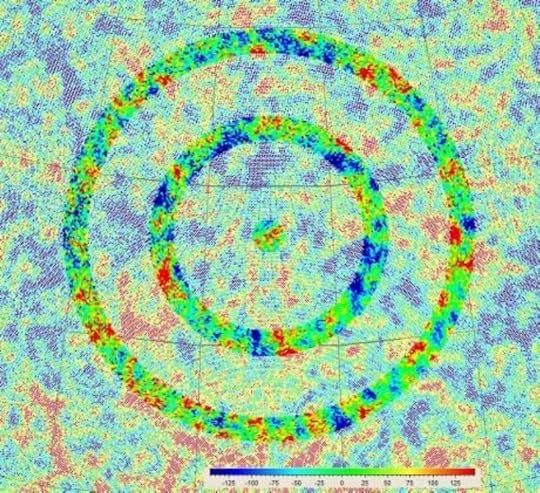
Gurzadyan and Penrose estimate that the probability that this pattern could occur by chance is less than one in 10^14. Moss and Scott write to say that the analysis is faulty, and the patterns could easily be random and don't prove anything. Gurzadyan and Penrose reply, if I may paraphrase, that they do so prove something. The debate continues.
____________________________________
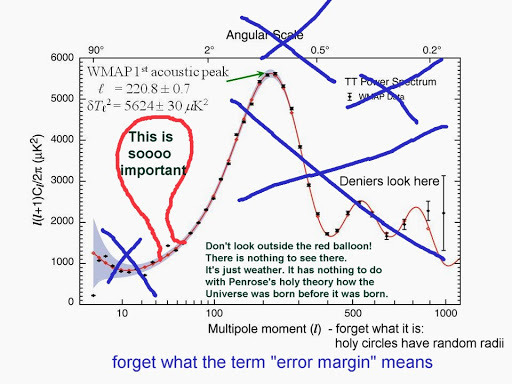
Damn! I am such a sucker. A bit more looking around, and I see that the Gurzadyan/Penrose idea was shot down in flames within weeks of being launched. So that's why there's been so little buzz.
I couldn't help laughing at this diagram, which I found in an article posted on The Reference Frame:
This extraordinary thesis, the most exciting one of its kind since the Copernican Revolution, is starting to become fairly well-known - but I would hesitate to say it's mainstream yet. If it were, I don't think most supporters of Intelligent Design would still be wasting their time attacking the well-defended fortress of Darwinian Evolution. Instead, they would be concentrating their energies on the far more profitable area of cosmology, where the case looks better than it has for centuries, and they would all be buying copies of this book. As far as I'm aware, that's not happening. And don't get the idea that Before the Beginning is in any way crank science or New Age mysticism. Far from it: the author is an extremely respectable observational astronomer and astrophysicist, who is doing his best to present the facts and let the reader decide for himself. There is an amusing exchange in the first few pages between Rees and Hawking that sets the tone. In the Introduction, Hawking concludes with the following passage:
... Martin and I have taken rather different courses. While I have been primarily interested in developing the theory and much of my work has not yet been confirmed by observation, Martin has always worked closely with the observations and what they tell us about the universe. I think this difference in approach is reflected in the books we have written. This one beings the reader in contact with the real stuff of astronomy - without mentioning the word God that Martin seems so uneasy with. After all, it is a theoretical concept.To which Rees retorts:
My Cambridge colleague, Stephen Hawking, claimed in A Brief History of Time that each equation he included would halve the book's sales. He followed that injunction, and so have I. But he (or maybe his editor) judged that each mention of God would double the sales. In flattering imitation, God has figured in the titles of several subsequent books - The God Particle, The Mind of God, and suchlike. In that latter respect I shall not follow Stephen's lead. Scientists' incursions into theology and philosophy can be embarrassingly naïve and dogmatic.True to his word, Rees makes sure that God is not mentioned again in the remaining chapters, though I'm afraid he was right: it does seem to have hurt his sales.
But enough about what the book isn't; let me tell you what it is. The first two-thirds present an overview of the relevant background from astrophysics and cosmology, as of the late 90s. It's just a little dated - in particular, there is no explicit reference to Dark Energy, which was discovered shortly afterwards - but I didn't experience this as important. Rees knows everyone and is personally familiar with most of the history. He does a great job of showing you how the key ideas evolved, starting with far-fetched hypotheses and odd observations and, in many cases, ending with detailed, coherent theories which have won general acceptance. I particularly liked his account of pulsars; I didn't realise how well-understood they now are, and that we can interpret the signals from them clearly enough that we can infer the existence of "starquakes". The topics he focuses on are galactic evolution, in particular the creation of heavy elements in stars and supernovae; neutron stars and pulsars; black holes and quasars; dark matter, and its role in the formation of the galaxies; and the very early history of the universe, where tiny quantum fluctuations created the imbalances that got the galaxies started. The greater part of this is now quite uncontroversial; he is honest about the areas that are still unclear and contentious.
Having set the scene, Rees presents his case in the last few chapters. The structure of the universe is determined by a few physical constants. There is no obvious reason why these constants should have the values they do, but, if they were only slightly different, life would be impossible. If omega, the density of the universe, were much greater, the universe would have collapsed long ago, and if it were much less then everything would have dispersed. Q, the constant which measures the large-scale "graininess", is set just right for galaxies to form. If the ratio of the strengths of the gravitational and electromagnetic forces were slightly different, long-lived stars would be impossible. The ratio of the mass of the proton to the mass of the electron is pretty much exactly what's required to permit complex molecules. If neutrinos interacted slightly differently with protons, supernovae wouldn't be able to synthesize heavy elements. There are other items. It's a startling list.
It is not out of the question that there are ways of explaining some of these "coincidences". Rees tells one illustrative story about a coincidence that fooled as great a thinker as Paul Dirac, who could not understand why the ratio of the strengths of the gravitational and electromagnetic attractions between two protons should be almost the same as the ratio of the size of a proton to the size of the universe. In fact, there is an ingenious explanation of this fact due to Dicke. But it's a lot to expect all the items on his list to be crossed off this way. His basic argument is convincing. One possibility is that the universe was designed to be hospitable to life. The other is that there are many universes, with many different settings of the physical constants. Since we are living observers, we have to be in one of the few universes that can support life.
The "multiverse" hypothesis isn't as far-fetched as it first sounds. When you trace back the history of the Big Bang, you hit this mysterious "inflationary period", when the universe suddenly got much bigger, for reasons no one really understands. Or at least, many cosmologists think so; it was interesting to read that Penrose, one of the most respected people in the field, is dubious about "inflation" and thinks it's mistaken and ugly. But, if "inflation" is correct, it could easily have created a much bigger universe than the one we see, or many universes. We don't know, and right now it's hard to think of ways to test these theories empirically. The history of science, however, is full of theories that didn't at first seem testable, but later turned out to be open to empirical verification. My gut feeling is that Rees is right: people will think of ways to do experiments.
This is a remarkably interesting book. If you're also fascinated by cosmology and have a decent grounding in high-school physics, go out and buy yourself a copy. I doubt you'll be disappointed.
____________________________________
I evidently wasn't paying attention - a few months before I wrote this review, Gurzadyan and Penrose published a paper in which they claim to have found signals emanating from violent black hole collisions in a universe (possibly even several universes) which existed before the Big Bang. I don't follow their reasoning, which requires rather a rather greater understanding of General Relativity than I possess, but the claim is that these events would show up as concentric circles in the Cosmic Microwave Background radiation. The key graphic is extremely striking, and I'm surprised I haven't already seen it on a T-shirt:
Gurzadyan and Penrose estimate that the probability that this pattern could occur by chance is less than one in 10^14. Moss and Scott write to say that the analysis is faulty, and the patterns could easily be random and don't prove anything. Gurzadyan and Penrose reply, if I may paraphrase, that they do so prove something. The debate continues.
____________________________________
Damn! I am such a sucker. A bit more looking around, and I see that the Gurzadyan/Penrose idea was shot down in flames within weeks of being launched. So that's why there's been so little buzz.
I couldn't help laughing at this diagram, which I found in an article posted on The Reference Frame:

May 1, 2011
An interesting post on Many Worlds vs Multiverse:
http://blogs.discovermagazine.com/cos...
-----------------
The last word.
My friend Elisa is a born story teller and they are always prefaced with either 'this is a true story' or 'this is a really true story'.
In the spirit of Elisa, this is a true story.
Late of a night in Geneva, should you happen to be walking the streets, you'll come upon huddled, sobbing shambles of human beings, bottle in hand, tragic tale to tell. They'll stop you and start asking if you have -
Now, if this happens to you, don't just pull back, thinking they are after your hard earned. They are physicists you see, and something has gone terribly, terribly wrong for them.
'What's wrong, mate? Can I help?'
'I just left them together for a few minutes. I - '
I sigh as I break in. If only I had a dollar for every time I've heard this story. 'You didn't, did you? Please don't tell me you left your dog alone with your pet meson.' He nods dumbly. 'What is it with you physicists? Conduct an experiment and even if it works you don't believe it. In a hard bitten cynical way you repeat it a dozen times. But you ask your dog if it's going to be a good dog, it woofs and you believe it. And every one of you says the conditions were different this time. But not so very different, are they? The data is pretty clear isn't it? You understand natural laws? Well this is one of them. DOGS EAT MESONS.'
You walk on, shaking your head. They just never learn. How can they be so trusting?
You turn a corner and there's another one. He's on the bridge, and you think you'd better coax him off that.
'Mate, mate. It can't be that bad, what's wrong?'
'See that number there?'
You squint at it - 'that tiny one up to the right of the other number?'
'Yes, that's the one. It should be 2, not 3. Everything is ruined now.'
'Now be sensible,' I say. 'If that number was important, it wouldn't be in one point font, would it? Look at it. It's tiny. It's squashed in up the top there next to the number in a proper sized font because it doesn't really matter, isn't it?'
He starts crying more and says something about the end of the world. I start saying everything will be okay in the morning, nobody will mind and he says 'No, you don't understand. It really IS the end of the world. The universe. Everything. Because it's a two, it means that we know the exact time everything is going to end and....'
I can't say I followed it all, but after a while I asked if I could take a swig from his bottle and, well. I'm sworn to secrecy, so I can't say exactly when it's all ending, but Paul and Manny, I just wouldn't be putting all that much effort into who's going to be top this week. If I were you I'd come and join us on the bridge. You can have a drink and we think we're going to get a pretty good view from here. -
Earlier.
You can't read, not string two words together. Music makes you weep. You can't write to save yourself, indeed, very literally you can't do that.
So you are in this universe, this one where the things that should give you respite don't. You cannot bear to be in your skin.
You cannot write.
In this particular universe there is a physicist, Mr Rees, who explains to us why there are other universes.
Now, Mr Rees I hope will forgive my addressing his humility when I say so fucking what. And I am saying that, not asking.
Somewhere else there is another universe. It has a booksite called goodreads on it and a girl whose name is gettingenough and she writes a hilarious review of this book. I know because she took it from me. She writes a hilarious review, even the pursed-lips scientists on goodreads can't help voting for it.
Somewhere else there is another universe.
And after initially thinking wow, that's kind of amazing, I've come around to 'so fucking what.' So there is a universe where I died when I was five, as I almost did. Or died when I was fifty as I also almost did. So there is a universe where little miss getting enough is very smugly thinking she's glad she's in that one as well she might. So fucking what?
Even if it is true, what is the point of saying it?
And please don't bother answering this question, because if you think you can answer it, you don't begin to understand what the question is.
Somewhere out there is a universe where no-one ever begged:
Let me become
the shadow
of your shadow,
the shadow of your hand,
the shadow of your dog,
Somewhere out there somebody begs this and is heard.
So what?
-------------------------------
'You haven't reviewed much on goodreads lately, have you?'.
Enquired my number one fan. (Please permit me this poetic license).
Well, no, I wouldn't have, would I? Because I'm reading another %#@~&* physics book.
I have this sinking feeling that I'm not going to be finished it until After The End. I'm going to post my review in the middle of the small crunch or whatever the end is going to be, completely pointless because all my goodreads friends will be star dust most literally.
Shit.
http://blogs.discovermagazine.com/cos...
-----------------
The last word.
My friend Elisa is a born story teller and they are always prefaced with either 'this is a true story' or 'this is a really true story'.
In the spirit of Elisa, this is a true story.
Late of a night in Geneva, should you happen to be walking the streets, you'll come upon huddled, sobbing shambles of human beings, bottle in hand, tragic tale to tell. They'll stop you and start asking if you have -
Now, if this happens to you, don't just pull back, thinking they are after your hard earned. They are physicists you see, and something has gone terribly, terribly wrong for them.
'What's wrong, mate? Can I help?'
'I just left them together for a few minutes. I - '
I sigh as I break in. If only I had a dollar for every time I've heard this story. 'You didn't, did you? Please don't tell me you left your dog alone with your pet meson.' He nods dumbly. 'What is it with you physicists? Conduct an experiment and even if it works you don't believe it. In a hard bitten cynical way you repeat it a dozen times. But you ask your dog if it's going to be a good dog, it woofs and you believe it. And every one of you says the conditions were different this time. But not so very different, are they? The data is pretty clear isn't it? You understand natural laws? Well this is one of them. DOGS EAT MESONS.'
You walk on, shaking your head. They just never learn. How can they be so trusting?
You turn a corner and there's another one. He's on the bridge, and you think you'd better coax him off that.
'Mate, mate. It can't be that bad, what's wrong?'
'See that number there?'
You squint at it - 'that tiny one up to the right of the other number?'
'Yes, that's the one. It should be 2, not 3. Everything is ruined now.'
'Now be sensible,' I say. 'If that number was important, it wouldn't be in one point font, would it? Look at it. It's tiny. It's squashed in up the top there next to the number in a proper sized font because it doesn't really matter, isn't it?'
He starts crying more and says something about the end of the world. I start saying everything will be okay in the morning, nobody will mind and he says 'No, you don't understand. It really IS the end of the world. The universe. Everything. Because it's a two, it means that we know the exact time everything is going to end and....'
I can't say I followed it all, but after a while I asked if I could take a swig from his bottle and, well. I'm sworn to secrecy, so I can't say exactly when it's all ending, but Paul and Manny, I just wouldn't be putting all that much effort into who's going to be top this week. If I were you I'd come and join us on the bridge. You can have a drink and we think we're going to get a pretty good view from here. -
Earlier.
You can't read, not string two words together. Music makes you weep. You can't write to save yourself, indeed, very literally you can't do that.
So you are in this universe, this one where the things that should give you respite don't. You cannot bear to be in your skin.
You cannot write.
In this particular universe there is a physicist, Mr Rees, who explains to us why there are other universes.
Now, Mr Rees I hope will forgive my addressing his humility when I say so fucking what. And I am saying that, not asking.
Somewhere else there is another universe. It has a booksite called goodreads on it and a girl whose name is gettingenough and she writes a hilarious review of this book. I know because she took it from me. She writes a hilarious review, even the pursed-lips scientists on goodreads can't help voting for it.
Somewhere else there is another universe.
And after initially thinking wow, that's kind of amazing, I've come around to 'so fucking what.' So there is a universe where I died when I was five, as I almost did. Or died when I was fifty as I also almost did. So there is a universe where little miss getting enough is very smugly thinking she's glad she's in that one as well she might. So fucking what?
Even if it is true, what is the point of saying it?
And please don't bother answering this question, because if you think you can answer it, you don't begin to understand what the question is.
Somewhere out there is a universe where no-one ever begged:
Let me become
the shadow
of your shadow,
the shadow of your hand,
the shadow of your dog,
Somewhere out there somebody begs this and is heard.
So what?
-------------------------------
'You haven't reviewed much on goodreads lately, have you?'.
Enquired my number one fan. (Please permit me this poetic license).
Well, no, I wouldn't have, would I? Because I'm reading another %#@~&* physics book.
I have this sinking feeling that I'm not going to be finished it until After The End. I'm going to post my review in the middle of the small crunch or whatever the end is going to be, completely pointless because all my goodreads friends will be star dust most literally.
Shit.

April 27, 2011
one problem was that i thought this was published recently (ie, 2008 or later), and was thus stunned by its out-of-date assessments of, say, Sag A* or Λ/Ω_Λ or gamma ray bursters. the superstring/multiverse stuff is thrown in pretty arbitrarily, and developed to no further than a Kaku level of complexity. the mandelbrot set is referenced towards the end in what seems a perverse quest for keyword search satisfaction and reads like a sixteen year old's journal entry fresh off reading some crichton. this just doesn't cut it if you've done any serious reading in astrophysics and cosmology, sorry.
as a pop science book, i give it two stars. it gets another one for amazingly obscure epigraphs heading each chapter, and a deliciously snarky attitude regarding 20th century astrophysics. in particular, his commentary on the COBE effort, refusing to even mention Smoot's name, perfectly captures the vituperative attitude my astrophysicist crew seems to harbor towards 2006's vainglorious Nobel Laureate.
Manny, your recommendation has failed me. It shall not be forgotten.
------
Manny's review was very enticing, though I'm rapidly approaching the point in my life where reading yet another pop cosmology book will cause me to collapse in on my own gravity, and not even light will be capable of escaping my volume hrmmrmph.
as a pop science book, i give it two stars. it gets another one for amazingly obscure epigraphs heading each chapter, and a deliciously snarky attitude regarding 20th century astrophysics. in particular, his commentary on the COBE effort, refusing to even mention Smoot's name, perfectly captures the vituperative attitude my astrophysicist crew seems to harbor towards 2006's vainglorious Nobel Laureate.
Manny, your recommendation has failed me. It shall not be forgotten.
------
Manny's review was very enticing, though I'm rapidly approaching the point in my life where reading yet another pop cosmology book will cause me to collapse in on my own gravity, and not even light will be capable of escaping my volume hrmmrmph.

November 16, 2008
As the author says, this book presents an individual view of cosmology: how we perceive our universe, what the cosmological debates are about, and the scope and limits of our future knowledge. While cosmology and its companion science, quantum mechanics, have advanced considerably since this book first appeared in 1997, thanks to the WMAP project and a host of discoveries made by the good offices of our increasingly advanced ground-based and space-based telescopes, this book is still very much worth reading carefully and completely, because it lays the groundwork for everything that has come about in those fields since. From galactic ecology (Chapter 1: "From Atoms to Life") to "Anthropic Reasoning -- Principled and Unprincipled" (Chapter 15), Before the Beginning covers a wealth of topics in just 269 pages, and does so in depth and very satisfactorily. The author quotes Alfred North Whitehead: "Philosophy begins in wonder. And when philosophic thought has done its best, the wonder remains." That summation is as true of this book as it is of philosophy in general -- and the wonders untold of our cosmos.

August 27, 2019
Frees the mind to think about the unknowable
This is an exciting and accessible book of cosmological speculation tempered by rationality and an awareness of the scientific method. Consequently I was very happy to read here about the possibility of "universes" beyond ours; or differently put, something beyond the big bang. I used to speculate about what happened before and beyond the big bang, but I was told that such speculations were unscientific because by definition the universe and all of time and space came into being with the big bang. Like Fred Hoyle, I never liked this theory of the beginning of the universe, and wished that his steady state model would gain some serious credence. It didn't and the evidence for the big bang grew. Now however, as Rees makes clear, the perspective and even the terminology has changed. Many scientists now speculate that our universe (notice we now have an "our") may just be a budding off of one "universe" from perhaps an infinite potential.
On page 158 Rees writes about the universe at the Planck time (ten to the minus 43 seconds) which is as early as we can get, and incidentally the universe at that time was as small as anything can get: "At this stupendous density...quantum effects and gravity would both be important. What happens when quantum effects shake an entire universe?"
Now that is a question! And the way it is put propels us into something like a glimpse of the universe at that ultra early stage. The Planck time is a constraint on the size of anything including space. One of the things that this means is that spacetime is not infinitely divisible. Space itself has a quantum-like quality. Really?!?
On page 24 he is talking about communicating with other intelligent beings: "It would be easy to devise signals that would be incontrovertibly artificial: for instance, attention could be attracted by a series 1,3,5,7,11,13,17,19,23,29... These are prime numbers: no natural process could generate them, but they would be recognized by any culture that was interested in (and capable of) picking up cosmic radio waves." Notice how simply but beautifully put this observation is.
On the same page he makes the point that even though we might get some startling advice from a more advanced civilization, there is some question about whether we would follow it, or even if we could benefit from it. He writes: "Optimists claim that such signals could convey enlightening messages of such import that they would enable us to bypass centuries of scientific endeavor and discovery... But such a gap would be hard to bridge, even within human culture. Could, for instance, a short ‘message from the future' have guided a leading intellect from an earlier era toward some aspect of modern scientific knowledge? Could Newton have been steered from alchemy toward chemistry...? It would be a daunting challenge to bridge even a few centuries of human cultural change, essentially because scientific advance depends on gradual advances of interconnected techniques and technologies."
I was delighted to find on page 161 my favorite "Zen koan" question, "Why is there anything at all? Why isn't there nothing?" being asked in a slightly different form by Stephen Hawking: "What is it that breathes fire into the equations?...Why does the Universe go to all the bother of existing?" In my opinion, it is a question like this that makes the study of cosmology so compellingly religious. I stopped being concerned with the question of whether God exists or not when I realized how incredibly vast is the known universe that beings superior to us almost certainly must exist and therefore it would be only a matter of degree to get to some being approximating the anthropomorphic conception of "God." That there are demigods out there is clear. That there are demigods who could pass for God among humans is also clear. As for a creator or a first cause, or any sort of nonpersonal "God," the Universe itself is sufficient. So, strangely, I became a deist of sorts.
Still on page 161, Rees makes the very important distinction between the physicist's vacuum (which is actually a "rich construct," including "all the particles and fields described by the equations of physics") and the philosopher's "nothing," which really is nothing. Now that I think about it, however, maybe that sort of "nothing" is not even possible, just a philosopher's construct.
Notice that what is wonderful about Rees's book is how freeing it is instead of confining. The mind soars. If his intent was to communicate to a large audience I believe he has succeeded. This is the most informative and readable book on cosmology that I have read in quite a while.
One last speculation: suppose that instead of the expansion of spacetime, we have the implosion of matter, that is to say, instead of having the universe expand, we have matter shrink. Is it possible to tell the difference? Although this may seem frivolous, and perhaps it is, asking such a question has the virtue of engaging the mind, which is what Rees does in this book.
--Dennis Littrell, author of “The World Is Not as We Think It Is”
This is an exciting and accessible book of cosmological speculation tempered by rationality and an awareness of the scientific method. Consequently I was very happy to read here about the possibility of "universes" beyond ours; or differently put, something beyond the big bang. I used to speculate about what happened before and beyond the big bang, but I was told that such speculations were unscientific because by definition the universe and all of time and space came into being with the big bang. Like Fred Hoyle, I never liked this theory of the beginning of the universe, and wished that his steady state model would gain some serious credence. It didn't and the evidence for the big bang grew. Now however, as Rees makes clear, the perspective and even the terminology has changed. Many scientists now speculate that our universe (notice we now have an "our") may just be a budding off of one "universe" from perhaps an infinite potential.
On page 158 Rees writes about the universe at the Planck time (ten to the minus 43 seconds) which is as early as we can get, and incidentally the universe at that time was as small as anything can get: "At this stupendous density...quantum effects and gravity would both be important. What happens when quantum effects shake an entire universe?"
Now that is a question! And the way it is put propels us into something like a glimpse of the universe at that ultra early stage. The Planck time is a constraint on the size of anything including space. One of the things that this means is that spacetime is not infinitely divisible. Space itself has a quantum-like quality. Really?!?
On page 24 he is talking about communicating with other intelligent beings: "It would be easy to devise signals that would be incontrovertibly artificial: for instance, attention could be attracted by a series 1,3,5,7,11,13,17,19,23,29... These are prime numbers: no natural process could generate them, but they would be recognized by any culture that was interested in (and capable of) picking up cosmic radio waves." Notice how simply but beautifully put this observation is.
On the same page he makes the point that even though we might get some startling advice from a more advanced civilization, there is some question about whether we would follow it, or even if we could benefit from it. He writes: "Optimists claim that such signals could convey enlightening messages of such import that they would enable us to bypass centuries of scientific endeavor and discovery... But such a gap would be hard to bridge, even within human culture. Could, for instance, a short ‘message from the future' have guided a leading intellect from an earlier era toward some aspect of modern scientific knowledge? Could Newton have been steered from alchemy toward chemistry...? It would be a daunting challenge to bridge even a few centuries of human cultural change, essentially because scientific advance depends on gradual advances of interconnected techniques and technologies."
I was delighted to find on page 161 my favorite "Zen koan" question, "Why is there anything at all? Why isn't there nothing?" being asked in a slightly different form by Stephen Hawking: "What is it that breathes fire into the equations?...Why does the Universe go to all the bother of existing?" In my opinion, it is a question like this that makes the study of cosmology so compellingly religious. I stopped being concerned with the question of whether God exists or not when I realized how incredibly vast is the known universe that beings superior to us almost certainly must exist and therefore it would be only a matter of degree to get to some being approximating the anthropomorphic conception of "God." That there are demigods out there is clear. That there are demigods who could pass for God among humans is also clear. As for a creator or a first cause, or any sort of nonpersonal "God," the Universe itself is sufficient. So, strangely, I became a deist of sorts.
Still on page 161, Rees makes the very important distinction between the physicist's vacuum (which is actually a "rich construct," including "all the particles and fields described by the equations of physics") and the philosopher's "nothing," which really is nothing. Now that I think about it, however, maybe that sort of "nothing" is not even possible, just a philosopher's construct.
Notice that what is wonderful about Rees's book is how freeing it is instead of confining. The mind soars. If his intent was to communicate to a large audience I believe he has succeeded. This is the most informative and readable book on cosmology that I have read in quite a while.
One last speculation: suppose that instead of the expansion of spacetime, we have the implosion of matter, that is to say, instead of having the universe expand, we have matter shrink. Is it possible to tell the difference? Although this may seem frivolous, and perhaps it is, asking such a question has the virtue of engaging the mind, which is what Rees does in this book.
--Dennis Littrell, author of “The World Is Not as We Think It Is”
January 25, 2018
Very readable for the novice!

April 13, 2018
Very well written.

June 8, 2013
Martin Rees did a good job of explaining what theories are out there, what supports them and why, with the alternative points of view. Throughout this book, he was careful to present the facts in a clear, unbiased manner, all the while giving the reader a good basis to reach their own conclusions.
He did not claim to have all the answers or anything close to that. He took the attitude that we we think today makes sense to us from our investigations; what we think later will depend on what we have determined at that point. Come back in 1,000 years, and the ideas may be very different.
Putting all this together, I have to wonder if we can really rely on mathematics to identify whatever happens in the vicinity of black holes. My suspicion is that conventional analysis will not extend that far, and mathematical equations simply cannot help us very much there. We cannot even begin to very accurately predict the path of a hurricane -- what makes us so certain we can say anything conclusive about a black hole that is a vast distance away? Or is there any valid reason to expect one black hole to behave just like another?
I do not believe in the concept of wormholes to other universes. Chances are we have plenty of other universes to keep company with ours, but getting there through a wormhole? This idea strikes me as being far past anything other than conjecture.
Anyway, Martin Rees wrote a very informative book. The whole subject wears me out, though. My favorite subject is math: As long as it is based on Euclid. Black holes probably break all of Euclid's axioms, so I do not especially want to think or read about them and their "event horizons" any more.
He did not claim to have all the answers or anything close to that. He took the attitude that we we think today makes sense to us from our investigations; what we think later will depend on what we have determined at that point. Come back in 1,000 years, and the ideas may be very different.
Putting all this together, I have to wonder if we can really rely on mathematics to identify whatever happens in the vicinity of black holes. My suspicion is that conventional analysis will not extend that far, and mathematical equations simply cannot help us very much there. We cannot even begin to very accurately predict the path of a hurricane -- what makes us so certain we can say anything conclusive about a black hole that is a vast distance away? Or is there any valid reason to expect one black hole to behave just like another?
I do not believe in the concept of wormholes to other universes. Chances are we have plenty of other universes to keep company with ours, but getting there through a wormhole? This idea strikes me as being far past anything other than conjecture.
Anyway, Martin Rees wrote a very informative book. The whole subject wears me out, though. My favorite subject is math: As long as it is based on Euclid. Black holes probably break all of Euclid's axioms, so I do not especially want to think or read about them and their "event horizons" any more.

August 20, 2013
I admit, the majority of the content of this book went right over my head. The author is a leading astrophysicist who studied with Stephen Hawking at Cambridge, and the book is an overview of how the universe formed. The theoretical physics involved in the first 10^-30th second of the Big Bang is incredible, but pretty dense and there was quite a bit that I skimmed. However, the author's conclusion presented in the final two chapters is phenomenal. Here is the introduction to that conclusion:
"The physical laws laid down in the Big Bang seem to apply everywhere we can now observe. But though they are unchanging, they seem rather specially adjusted. This could be a coincidence: I used to think so. But an enlarged cosmological perspective suggests an interpretation that seems compellingly convincing. There may be other universes - uncountably many of them - of which ours is just one. In the others, the laws and constants are different. But ours is not randomly selected. It belongs to the unusual subset that allow complexity and consciousness to develop. Once we accept this, the seemingly "designed" or "fine tuned" features of our universe need occasion no surprise."
Basically, the number of coincidences that we have so far quantified in the cosmological foundation of the universe are so plenty as to allow for only two possible interpretations - that there exists a multitude of universes, each with a unique set of cosmological constants set at random or, more likely, that the universe exhibits intelligent fine-tuning.
"The physical laws laid down in the Big Bang seem to apply everywhere we can now observe. But though they are unchanging, they seem rather specially adjusted. This could be a coincidence: I used to think so. But an enlarged cosmological perspective suggests an interpretation that seems compellingly convincing. There may be other universes - uncountably many of them - of which ours is just one. In the others, the laws and constants are different. But ours is not randomly selected. It belongs to the unusual subset that allow complexity and consciousness to develop. Once we accept this, the seemingly "designed" or "fine tuned" features of our universe need occasion no surprise."
Basically, the number of coincidences that we have so far quantified in the cosmological foundation of the universe are so plenty as to allow for only two possible interpretations - that there exists a multitude of universes, each with a unique set of cosmological constants set at random or, more likely, that the universe exhibits intelligent fine-tuning.

January 5, 2009
For a self-proclaimed atheist, Rees makes the best argument (from a cosmological perspective) I've ever seen for the existence of God. Rees' work is way better than anything by Stephen Hawking.
I only give this four stars because, of course, Rees' conclusions are all wrong. To avoid acknowledging a Creator, Rees decides that our exquisitely fine-tuned Universe must be one of an infinite number of universes (the "Multiverse" argument). Takes a lot more faith than just believing what the Bible tells us...
I only give this four stars because, of course, Rees' conclusions are all wrong. To avoid acknowledging a Creator, Rees decides that our exquisitely fine-tuned Universe must be one of an infinite number of universes (the "Multiverse" argument). Takes a lot more faith than just believing what the Bible tells us...
October 12, 2011
A great read. Rees is a recent recipient of the Nobel Prize for Astrophysics (along with three others). He is a mover and shaker in British scientific circles. He had the same doctoral advisor as Stephen Hawking, and Hawking wrote a foreword for the book. His writing style is excellent and, unlke other authors, doesn't bury you with equations, etc. The book's payoff is in the last chapters. Rees won the Nobel Prize for his work in the 90s on the "accelerating universe". Nice discussions of people who have contributed to the present understanding of the cosmos.
November 30, 2011
Older book, that I had tried to read when I was 12, and only returned to in the last year. It was very accessible for a lay person such as myself, explaining concepts without overwhelming amounts of math. It also gave a sort of history of astrophysics and cosmology. It didn't get me hooked or wow me with its manner of explaining things. However, it's well-organized, approachable, and worth reading for an introduction to cosmology and astrophysics.
November 2, 2008
Very good survey of the field of astrophysics. If you ever wanted to know how heavy a star has to be to collapse into a black hole and "that kinda stuff", this book will teach you the current understanding of how universes are created and destroyed. I'm tempted to start my own universe with different constants just to play around with it myself.

August 5, 2011
An excellent cosmology primer, well-written for the lay-person and well compiled to read straight through as well as for use as a reference tome. Personally, I am not in the "string theory" camp so I did reject some of the paths the book took, but aside from that, it is an excellent surface discussion of what we do and don't know, and what both of those can tell us as we continue to search.
September 13, 2008
An incredible book about current ideas in cosmology and multoverse. Completely accessible, and well written. Rees has the remerkable ability of taking some very abstract concepts and make them digestable, much like Carl Sagan had the ability to do.
March 17, 2007
What if every black hole can spawn another universe with its own laws and constants?
March 11, 2011
My favorite book of alllllll time.
March 30, 2014
Ditched. A little too dumbed-down and slow-paced.
Want to Read
October 28, 2018Not available from Audible.
Displaying 1 - 19 of 19 reviews