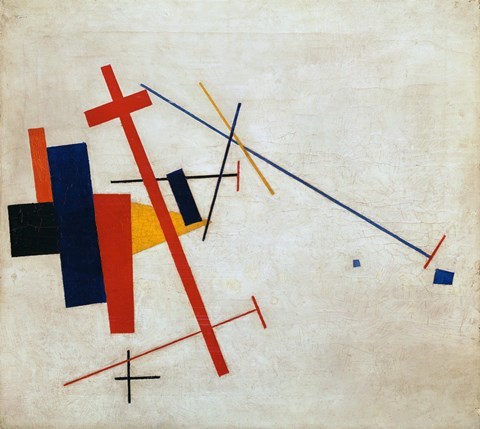
Maleviç, sanat tarihinde ve görsel sanatlarda kırılma noktalarından birisidir. O güne değin geçerliliğini koruyan, alışıla gelen Konstrüktivizmin (Yapısalcılık) faydacı amaçlarının soruşturularak yıpratılmasına neden olmuştur. Hilberseimer'in bu konudaki sözleri oldukça açıklayıcıdır: "Maleviç süprematizmiyle, Platon gibi, gerçekliğin duyularla algılanması engelini aştı. İkisi de dünyanın, duyularımız aracılığıyla bildirilen halinin bir hayal olduğunu düşünüyordu. Maleviç'in yalınlığı ve özlülüğü sadece Rusya'da değil, Batı'da da soyut resmi güçlü bir şekilde etkilemişti. El Lissitzky'nin bu konuda bir hikâyesi anlatılır. Lissitzky esasında Marc Chagall'ın öğrencisidir. Fakat Maleviç'in Süprematizminden öyle bir etkilenir ki Chagall'ı bırakır ve Maleviç'in takipçisi olur. Her şeye bir isim gerektiğinden, tabloları için yeni bir "izm" icat eder - Proun ve tablolarını resimle mimari arasındaki bağ olarak görür.
Kazimir Severinovich Malevich (Russian: Казимир Малевич) was a painter and art theoretician, pioneer of geometric abstract art and the originator of the avant-garde Suprematist movement.
The Non-Objective World: The Manifesto of Supermatism contains not only Kasimir Malevich's manifesto but over 90 black-and-white prints, giving the reader a broad overview of the radical vision and creative output of this Russian avant-garde artist who had a profound influence on the course of modern abstract art.
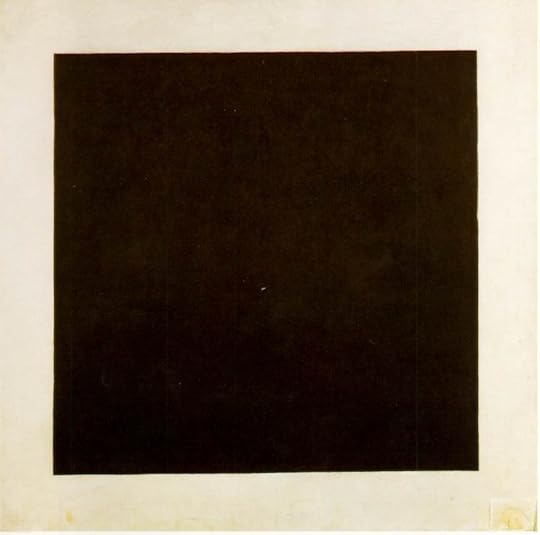
To fully comprehend Malevich's innovation and revolutionary approach to art, imagine your average art-goers, men and women visiting galleries and museums, people who particularly enjoy the way an artist applies his or her skill in painting a broad summer landscape with swans in a lake and cows grazing in a meadow under clouds in the style of, say, John Constable, or perhaps a fruit and flower still life or portrait of a famous leader. Now imagine these same art loving men and women entering a gallery where the featured artwork is a painting of a black square on a white background. This was precisely the experience of art-goers during a 1913 exhibition in Russia.
Predictably, the art-goers felt betrayed since their familiar art was nowhere to be found, such recognizable realistic art providing them with beautiful objects to look at and think about (concepts) as well as firm aesthetic grounding, a grounding serving art lovers since the time of the Renaissance.
Thus, Kasimir Malevich responded with his Supermatism Manifesto, a declaration of purpose and intent wherein Malevich wrote 65 bold statements expressing his philosophy and views on art, the artist and creativity, citing how the realism those art-goers hanker for has absolutely no value in the type of art worth creating since objectivity is meaningless and concepts are worthless. Rather, for Malevich, art expresses the fullest possible feeling and ignores the familiar appearance of objects. As stated in his Manifesto, in such a non-objective art there is a blissful sense of liberation and nothing is considered real except feeling. And the Supermatist does not observe or touch, the Supermatist feels.
So, how should we encounter his black square on a white background? Malevich's manifesto states the equation clearly: "The black square on the white field was the first form in which nonobjective feeling came to be expressed. The square = felling, the white field = the void beyond the feeling." Malevich goes on to state, "The Supermatists have deliberately given up objective representation of their surroundings in order to reach the summit of the true "unmasked art" and from this vantage point to view life through the prism of pure artistic feeling."
And he goes on further in stating, "Now that art, thanks to Suprematism, has come into its own that is, attained the pure, unapplied form and has recognized the infallibility of nonobjective feeling, it is attempting to set up a genuine world order, a new philosophy of life. It recognizes the nonobjectivity of the world and is no longer concerned with providing illustrations of the history of manners." This is strong language. No wonder Malevich moved to abstraction.
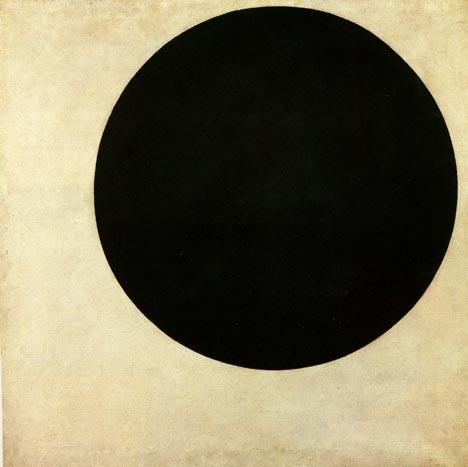
In addition to the Black Square, we have Malevich's memorable Black Circle, where, on a white field, the large black circle is positioned toward the top and on the right side of the square canvas. There is something unspeakably pure and unique about this painting, so simply yet so provocative. Who would have envisioned a painting of a black circle on a white field having such a transforming effect on viewers and the world of art?
Perhaps, applying Malevich's equation of the black square, we unconsciously equate the black circle with our feelings and the white field as a realm beyond our feelings. Whatever the reason, we join Malevich in crossing an artistic threshold - we enter the modern world, a modern world with a place, both permanent and distinctive, for abstract art. And by launching this phase of modernism in his writing and his art, Kasimir Malevich occupies a prominent position in history.
Nuestro amado Malevich teoriza sobre los procesos de creación visual tomando como hilo conductor dos conceptos: la sensibilidad y la representación.
El problema es que podemos acercarnos al texto con tales nociones cargadas de prejuicios, pero zas, cuidado. La representación pictórica no es —siguiendo a nuestro autor— esa mimesis que, bajo amparo tradicional, ha empeñado en hacer de la pintura una suerte de reflejo de lo “real” y con ello, lo distinguible y de “fácil acceso” al ojo humano. La representación en este caso es “una percepción plástica reproducida en el plano, es decir, una composición.”
Esto significa que la percepción de la realidad no puede traducirse al lenguaje plástico única y exclusivamente desde el modelo externo que se intenta imitar: la creación pictórica no consiste en copiar el cómo se nos presenta un objeto en el plano visual, mucho menos en buscar en una obra una “vivacidad de la ilusión.” (Gran interrupción: sobre este problema ya han dado luz Baudelaire y su Sr. G, Bazin, etc. al reflexionar sobre la crisis de la pintura desde la invención de la fotografía).
Entonces, la sensibilidad (esa cosa rara) es importantísima puesto que es la única relación formal que desearía establecer el artista con el mundo para hacer visible algo. De hecho, la sensibilidad (según Malevich) es totalmente independiente del ambiente donde surgió. Pum. (Piensen en estética evolucionista, qué bien aporta al tema).
Lección de Malevich:
“Si fuera posible extraer de las obras de los grandes maestros de la pintura la sensibilidad expresada en ellas y esconderla, los críticos, el público y los estudiosos del arte ni siquiera se darían cuenta de ello.”
la clave está en que Black Square, un emblema de la modernidad y de la vanguardia rusa, representa también los crímenes que la modernidad perpetró bajo los imperios nazi y soviético; eliminando el pasado, borrando la textura de la tradición para dejar solo la mínima diferencia del blanco y negro, Malevich sin darse cuenta crea el espacio en el que puede prosperar la violencia «totalitaria».
When those who shift paradigms pick up a pen, you’ll never find them a waste of time to read - it takes a rare brilliance to change a milieu, regardless of your stance on the transition. Malevich is no exception. Reading this changed how I view art, and what I consider art as. As to be expected from an abstract painter, his words can be near impossible to decipher. He points towards the ever-shifting epoch we now reside in, ultimately aiming to reinvigorate the soul of man in a technologically morose world. Rejecting realism as a reproduction of the world & turning art into a static object, he opts to make the canvas a dynamic vehicle for qualia. Not what it is to see the world, but what it is to feel the world you see - no longer a lifeless snapshot but a means to directly evoke feeling within the viewer, skipping all the unnecessary steps. In a broader philosophical statement: his work aims to bridge (or destroy) the subject-object duality our mythos has ushered in as fact, by marrying himself and his pure emotional observation with the canvas, subject and object are reunified as one.
Worth reading but nearly impossible to find in English.
"The works of such artists [those who copy] are always comprehensible to the public (the majority of people) because they represent nothing new, whereas the works of the creative artists contain new solutions to the eternal conflict between the subject and the object and bear little or no resemblance to accustomed reality." P.34
Incredible. This is one of the first very art-oriented books I’ve ever read, but it certainly won’t be my last. If you’re a person who wants to understand non-objectivity in any media, this is an incredible resource.
Very well written, shows why it is important to simplify the work art to express feelings with geometrical roots as opposed to academic painting that depicts only things related to nature and are always things of the past, without dynamics.