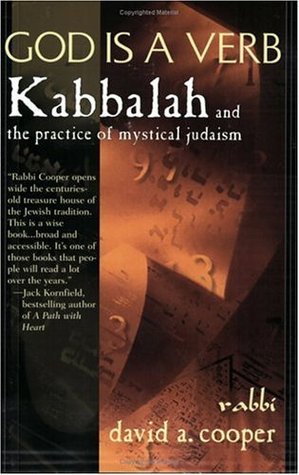
Since medieval times, the mystical tradition of Kabbalah was restricted to qualified men over forty—because it was believed that only the most mature and pious could grasp its complexity and profound, life-changing implications. More recently, Kabbalah nearly disappeared—as most of its practitioners perished in the Holocaust. Now this powerful spiritual tradition, after centuries of secrecy and near-extinction, is explained clearly in this book by one of its most prominent teachers.
Who are we? Where did we come from? Where are we going? How do we get there? These questions have fueled Kabbalists for nearly a millennium. Rabbi David A. Cooper is the first to bring this obscure and difficult tradition to a mainstream audience in a way that gently leads us to the heart of the subject, showing us how to transform profound teachings into a meaningful personal experience—and appreciate fully this great mystical process we know as God.
Rabbi David A Cooper lived with his wife in the Old City of Jerusalem for over six years during the 1980’s, studying Kabbalah and Hasidism with a number of different masters of those traditions—who typically choose not to be identified. He has also been a student of Sufism, initiated by Pir Vilayat Khan, as well as Zen Buddhism with Roshi Bernie Glassman, and Tibetan Buddhism with Tsoknyi Rinpoche. He has studied and sat on retreat with many Vipassana teachers, from both the East and the West, in the Theravadin tradition.
Prior to his time in Israel, Cooper owned a business in Washington D.C., doing political consulting, and before that he worked at the Democratic National Committee in the infamous Watergate, as the Director of Research. He has studied the world’s wisdom traditions from the time he was a teenager, over fifty years ago. He has studied with dozens of teachers in the Jewish world. His primary teachers have been Rabbi Zalman Shachter-Shalomi and Rabbi Shlomo Carlebach. He was ordained by R. Zalman in 1993.
Rabbi Cooper has written about many of his experiences in seven books and two sets of CDs. His most popular book, God Is a Verb, has been a national best seller, with over 125,000 copies in print in English, plus being available for Dutch, Portuguese, Rumanian and East Indian readers. His best selling audio set, The Mystical Kabbalah, was for a while one of the top ten best selling series at the well known firm of Sounds True. He has led workshops and retreats in almost every state of the union as well as Holland, Germany, Poland, Israel, Australia, New Zealand, and Canada. He has appeared on public radio and public television, as well as the main subject in a Dutch produced documentary on Jewish Mysticism.
Obviously, Cooper is comfortable in dialogue with many different traditions; some have called him the Buddhist Rabbi. This identification has a certain degree of truth in that Cooper openly acknowledges his indebtedness to the cross-fertilization of esoteric teachings from various traditions, while at the same time deeply honoring the powerful themes of virtue, respect, study and service that are found in his root tradition of Judaism. All of this comes through clearly in his published works and his private communications, much of which appears on his website.
Rabbi David is a dedicated retreatant and he commits himself to extended silent retreats at a fairly steady frequency, either teaching, or for his own personal reasons. This contemplative life style, for both he and his wife, is itself the hallmark of the teachings—walking the talk, as some would say.
He has done many three-month retreats and currently is planning to set aside three months each year from now on for personal retreating. When not on retreat, he is engaged in writing, teaching and the ongoing fulfillment of a ever-blossoming relationship with his wife, Shoshana.
(recommended by Patrick) Yes, it's finally switched from "Currently reading" to the "read" shelf, but this is one of those books one will always be "currently reading"... A wonderful introduction to Kabbalah that demystifies the mysticism a bit, and true to Kabbalah form ends up raising as many questions as it answers. Which is, you know, the point of life. We're all constantly in motion, each day brings an entirely new set of circumstances. Kabbalah reminds me a lot of a fractal - highly structured chaos, infinite possibility existing simultaneously with repetitive patterns, the potential for change at any level....yes, you really could think about it forever and some people totally do. This is one I'll certainly keep nearby and spontaneously open now and then for thought provoking "random" page du jour...
I spent Friday night and today reading the first half of this book, two of the four sections. It is a MIND OPENER. For years I have struggled with many aspects of Judaism, things I did not understand, difficult question about life, and all those questions that ache in the back of our minds but we somehow never quite come to answers that we understand. This book gives an excellent introductory explanation about Kabbalah, but goes far beyond that. The author also explains many aspects of Judaism and how the mystical world up above and the world down here interact.
I know little about Kabbalah but have a pretty good knowledge of Jewish texts and sources. Raised in a modern orthodox home I was curious to learn where Rabbi Cooper received rabbinic ordination as Wikipedia indicates his involvement in the Jewish Renewal movement, something I had not heard of. I have not been able to find the answer. But I can tell you three interesting things: 1) This book is well-referenced 2) His translations are accurate. Even to the point that when I was curious about the way he translated something I picked up a well-accpepted translation and as I looked at the words it turns our Rabbi Cooper's translation of the Hebrew might actually have been BETTER 3) Nowhere does he go against the grain of Orthodox Judaism
I get the sense that he lectures and interacts in mystical activities outside classic Judaism- but every word I have read in this book has been TOTALLY CONSISTENT with orthodox Judaism. This should not frighten anyone away. Even if you are not Jewish you will find this book FASCINATING. The reason I mention the issue of the Rabbi's views is that I had not heard of him, and when I pick up a book on Kaballah from an author I do not know I am a bit wary. Having completed half the book it seems to me that Rabbi Cooper is well-learned in classical Jewish learning, and I suspect he has studied Kabbalah with truly knowledgeable people. Finally, the book reads like a dream. The prose is clear, concise, just beautifully written.
In summary, I believe in two days this book has changed my interaction with the world, and I suspect it will do the same for everyone who reads it. HIGHLY recommended.
The fact that praise from Jack Kornfield and Ram Dass appears on the cover of Rabbi David Cooper’s “God Is a Verb” means:
a) Cooper’s publisher was trying to market the book to “spiritual seekers” all of stripes, not just Jews.
b) The book is based more on Eastern philosophy than on Judaism.
I would say a) is obviously true, but I’m not so sure about b).
Most of “God is a Verb” is actually grounded in Jewish sources, particularly The Zohar, the main text of Kabbalah. And Cooper doesn’t shy away from pointing out a few of the significant differences between Jewish and Eastern philosophy.
The rabbi offers two interesting definitions in this book.
The first is, you guessed it, “God is a verb.” While this might strike some as a strange idea, I would agree with Cooper that it is a much more helpful way of conceptualizing God, and that we have a relationship with a Dynamic Universe.
I also liked Cooper’s definition of the Messianic Age, which he describes as a time when humanity will have achieved higher consciousness.
As he writes in his epilogue, “Higher awareness is a huge reservoir. All we need to do is remove our fingers from the dam of self-identity.” (He wrote this two years before Eckert Tolle cashed in on the same concept with The Power of Now.”)
We don’t have to wait – indeed, we dare not wait – for the Messianic Era to reach a state of awareness. We have access to higher consciousness right now, Cooper reminds us. And while this idea may be found in thousands of books and articles on spirituality, I would say it bears repeating, as far too few people are availing themselves of this Gift.
Whether these ideas resonate with you, there are other worthwhile elements to the book, such as the many wonderful stories from Jewish lore that Cooper retells. After reading this book, you might find yourself retelling them at the Shabbat table or even at your child’s bedside.
The book also presents a number of guided meditations, which, as far as I can tell, Cooper himself created. And some of them are, uh, quite creative.
In sum, Cooper has given us a peak at Kabbalah and, more importantly, some theological concepts worth embracing -- and in a very Jewish context.
An amazing and moving introduction to Kabbalah. Great not only as an overview of this subject but also as a motivator to practice it in your daily life. I have actively been trying to follow the paths of moderation and generosity, and they have actually helped me move forward in subtle ways. As Cooper notes in the epilogue, we break open the shell one crack at a time. This is one of the only books on spirituality that has succeeded in getting me to practice the truths presented, beyond just agreeing with and ruminating on them. I’m so glad I gave this book a chance when I saw it on the shelf at a thrift store (for one dollar!). “For it is the service of every person to struggle every hour until their death with extraneous thoughts, and time after time to uplift these thoughts and bring them into harmony with the nature of creation.”
Rabbi Cooper's God is a Verb is a bit uneven, but in the end I found myself disposed toward giving it a positive review. Among other things, it is probably this most egregiously mis-titled book I have ever read. The title comes from Rabbi Cooper's concept that God should be seen not as a being but as a process, which he calls "God-ing." Of course, if I may geek with the grammar for a moment, "God-ing," as the name of a process, is not a verb but a noun. Granted, "God is a Participial Noun," doesn't have quite the same ring.
The book's subtitle, "Kabbalah and the Practice of Mystical Judaism," is equally inapt with regards to the actual content of the book. Though Rabbi Cooper does cite the Zohar with some frequency and does include a number of Hasidic folktales and legends, the book largely is not about Kabbalah (at least not in any truly in-depth sense). Similarly, the book is not about the practice of mystical judaism -- what mystical practice actually appears in the book (the series of meditation and visualization techniques in Part Three) feel much more like standard-issue Yuppified New Age Enlightenment on the Cheap with a thin veneer of Judaic mysticism brushed over it.
Aside from Part Three, however -- a section which I would advise most readers to simply skip over -- the book does have its redeeming values. These come primarily from the aforementioned folktales and legends, which are simply wonderful, fun-to-read, and even enlightening. Similarly, a good bulk of Part Four, covering death and olam ha-bah, is well worth reading (again, just skip the few pages with the "visualization" exercises"). It is this section of the book that actually draws most deeply from the well of Judaic mysticism, and the legends and anecdotes in this section are largely rewarding.
My friend, Carlos, gave me this book back in 2013. Since then it has sat on my bookshelf in Georgia, Arizona, Ohio, West Virginia and Maine. Every once in a while I would scan the room, my eyes would land upon it, and I would think to myself "I really miss Carlos, he was such a good friend, I really should aught to read that book one of these days."
I think the reason it took me so long to get moving on it was because I was approaching it with the wrong mindset. I was hoping for a technical explanation for what the Tree of Life is, but that's not the theme of this book. If I had to articulate one theme, it is that God co-creates our reality with us using our thoughts, which are real things (this is similar to the theme of Neale Donald Walsch's "Conversations with God series). What this book amounts to is an old rabbi recounting a lot of old stories passed down among rabbis, and which are arranged so as to describe different methods of purifying oneself spiritually.
I myself did not go through any of the mental exercises. It may be useful if you want to take the time, but I think the book is best approached if you feel a desire to learn some things about Jewish culture. For centuries this information was restricted only to the learned, but we live in an age where all men might benefit from this wisdom. For that reason, I'm going to keep in on the shelf a little longer.
Incredibly rogue choice for an agnostic, I was interested when I saw the following quote from the book: "There is a lovely Sufi story of a man who constantly cried out to God but received no response. After a while the devil whispered to this man, "How long will you wait for God to respond 'Here I am' to all of your entreaties?" This broke the man's spirit, and he stopped calling out to God. In a dream, however, he envisioned an image of the Divine, who asked him why he had stopped. The man said that God had never answered his call. The wise dream-image, representing God, then said, "Did you not realise that every calling of yours IS itself my response?" The urge to call out to God is always answered simultaneously as it is spoken, for ultimately there is no difference between the caller and that to which it calls."
And while I don't agree with everything, I've found so many incredibly beautiful concepts and ideas that I will be keeping with me always.
What you get out of this book - well any book actually - will depend on where you are at and what you are looking for. Rabbi Cooper presents his take on Kabbalistic Judaism, and then offers up reflections and activity suggestions (mainly forms of meditative/reflective spiritual practice). It's a generous and positive book. It came into my hands some years ago, purchased after a Rabbi Cooper workshop in Auckland that a friend invited me to, so this is actually my second reading. As with the first reading, I like the generosity and positivity of the interpretation in the first section of the book. This time around I'm in a better place to see the value of the exercises in the second section, though just as likely to be sporadic and ill-disciplined in my practice :)
I've been studying Kabbalah for about a year now, and for the most part all of my study's have come from the Kabbalah Centre in Los Angeles, CA, and out of that center 90% of books that I have are from Michael & Yehuda Berg; which are both AMAZING teachers, writers, and mentors; so you could never go wrong picking up any one of there books. With that being said this book by Rabbi David Cooper is so far the most AMAZING book on Kabbalah that I've ever had the privilege to read. I started reading this book about a month ago, and usually I skip the introduction with the books that I read, but with this one, as soon as I started reading it I knew there was something special. I had to literally go back, and read the intro. THEN I became so inspired that not only did I start re-reading everything I had previously read, but I stared highlighting the key points that stood out to me. Once I hit the pages in the 70's I realized that I probably highlighted 75% of everything I had read, so I went back to re-read it all again but this time I started taking notes! The information is that compelling! Every time I went back to read the pages I had already read through I kept getting more and more out of it.
This is the type of book that you constantly keep going back to more and more, and never get tired of. I've encouraged a few friends of mine to start studying Kabbalah, and the order of books I tell them to read start with Yehuda Berg's "The Power of Kabbalah" Technology of the Soul, AND THEN THIS ONE! One of my friends said that he was only going to start off with one book at a time, and I said, "Well then you better just go ahead and get God Is a Verb, because that book is going to sum up a years worth of MY studies in a few hundred some odd pages!" I love this book, and would recommend it to anybody that is either studying Kabbalah, or wants to just broaden there opinions on how "US" as mankind, and our souls relate to everything on this planet, the universe, and beyond.
A good bit different than most Kabbalah texts. There is less numerology/path information here and more story telling. The stories, warmth and winks that come from a loving Rabbi make this an exceptional read
Originally I borrowed it from the library but as I got halfway through I realised it was one that I would enjoy re-reading.
The book is obviously based on the Jewish faith and has many stories from that source. They are all relatable as at no point did I find them to preach, it was all guidance.
This is not a 'how to' manual on Kabbalah, so if that is what you are looking for you will not find that here. I found that as the chapters were broken down into easy small sections, it is a book that can be dipped in and out of over a period of time, to uplift, as Rabbi Copper had a lovely energy about his writing.
This book is a delicate treat that I reread slowly to savor each image. As a Gnostic leaning Christian, my experience of Rabbi Cooper's peaceful mysticism is that he brings me closer to the roots of Rabbi Jesus. The highlight of the book for me was the insight Cooper provides into understanding Jewish symbols such as the chariot as metaphor. An excellent read for anyone studying the Bible or wanting to relax into peaceful mysticism. Cooper does a wonderful job contextualizing Mystical Judaism.
I finally put a finished date on this book, however I continue reading and contemplating the ideas put forth in it and so really I never consider that I have finished it. It resonated with so many thought I have had and of course added more to think about. I highly recommend this book.
Thank you to my friend Mo for the recommendation and the loan!
This is a delightful book and I very much enjoyed Rabbi Cooper's writing and wisdom. The highlights are, without a doubt, Rabbi Cooper's narratives of his personal experiences, the retellings and contextualizations of Hasidic folktales, and the guided meditations and explanations. Through all of these, Rabbi Cooper is gentle, kind, and aware, even through the page.
As someone who is not mystically inclined, and without a background in Judiaism, this book was, however, bound to lose me at some point. I was a bit surprised at how it happened though - a persistent flaw of Rabbi Cooper's is the lack of explanation or systematic treatment of the mystical phenomena he treats. For example, in the section on gematria, Rabbi Cooper lays out a fascinating introduction to the idea that the letters used to spell a word have mystical, numeric hidden meanings. He explains the values used, the ways that sages analyze the text, and relays lots of stories about particular connections. But nowhere at all, however, does he ever say how such mystical meaning arose, why such values were assigned to the letters in the first place, or even what exactly it is supposed to mean that such values exist. Without a strong foundation from which to teach, and without imparting the reasoning behind doing such a deep examination of the system, the teachings fall flat. This major problem was most self-evident in the section on "soul travel." The only introduction the reader gets of the concept is the sentence "Jewish mystics often engage in soul-travel to other realms." This leads into a section explaining those other realms and what one can do when there, culminating in a lovely guided meditation. What is soul-travel? What are methods to perform it? Who are the mystics who have done it? How do we know they did? and any other questions are left unanswered and unperceived. Even if you are willing to suspend your disbelief, Rabbi Cooper makes it difficult to do so.
In this way, Rabbi Cooper follows his own statement in the book that "Mystics...discuss the soul with disregard for logic, consistency, or concern about agreement with any accepted system" to the letter.
That key flaw is responsible for every star loss - otherwise I loved the book and found it captivating. It has given me a baseline idea to discuss Kabbalah and understand some of the rich meaning behind the rituals of my Jewish and Hasidic neighbors, as well as given me ideas for ways to improve my awareness in my own life. That's all that the book asked for in the introduction.
Recommend, as long as you are willing to suspend your disbelief and engage with the meditations and hasidic tales
More about the latter phrase of the subtitle, although of course the selling point comes with the former noun. Rabbi Cooper comes from a Jewish renewal and Buddhist background, unsurprisingly mixing Eastern insights into his how-to guide, full of guided meditations, visualizations, and tips.
It makes for a handier guide than I expected. It's not as grounded in traditional Torah practice, of course. Instead, Cooper applies the teachings. While the angels and demons reified within took me for a loop, he integrates their existence into the kabbalistic worldview where even evil plays a persistent, inextricably bound, role in creation, free will, and the restoration of the shattered vessels of the light primordial in Lurianic cosmology. There's also much more on death and dying, resurrection, and even reincarnation, although the last named doesn't come across as very convincing... same with theodicy.
It gets better as it goes along. He offers many down-to-earth suggestions about excision of negative input, cutting back on indulgences, and increasing tzedakah and righteous generosity from our share of wealth. It doesn't delve as deep into more esoteric or theological concerns, focusing on daily life.
Co-Owner Tony’s pick: This thought-provoking book invites you to explore the vastness of the divine through the lens of Kabbalistic teachings. I found God Is a Verb redefines spirituality, suggesting that God is an evolving, active process rather than a fixed entity. Cooper presents a compelling idea that life as we know it can feel like “hell,” and it’s through our good deeds and spiritual practices that we elevate ourselves toward “heaven.”
This book beautifully weaves mystical concepts like the Tree of Life and the Sefirot with practical exercises, making profound or seemingly confusing spiritual wisdom accessible and engaging. I think this is a great read for anyone curious about the deeper connections between our actions and the universe. Let me know what you think! Enjoy!
Library Book Club - Didn't get far into this at all. Not at all what I was expecting. Information dense, on a topic I'm a little sketchy on. Maybe if I was in the right frame of mind, it would be worthwhile, but at this point in life, it just wasn't working for me. And I'm gonna miss this meeting anyhow.... Marked as "read" only to get it off my current list - did not read.
I was hoping for a little more philosophy, but what was here was delicious. I find The imagery in Jewish mysticism to be irresistible. I was surprised to find how much storytelling and exercises there were in here. Definitely going back to do the exercises.
This is a fantastic read. I could relate most of it to my journey with Zen. I can and will continue with the exercises rabbi Cooper suggested and keep my ongoing journal. Thank you for taking me on this journey. mikiel
Beautiful book that allowed me to connect with my Judaism in a way I haven’t before by introducing me to the “spiritual” side of the religion. At times it reads like a textbook, but all in all really good
A mind opener. Just starting a re-read on Yom Kippur 2018. The book explained the “unexplainable” to me in the past and I think more insights are coming. It’s a keeper!
Rabbi David Cooper is a Vipassana meditator who draws some interesting parallels between Tibetan Buddhist concepts and Kabbalah. A good read for those interested in mystical Judaism.