This book was converted from its physical edition to the digital format by a community of volunteers. You may find it for free on the web. Purchase of the Kindle edition includes wireless delivery.
George Farquhar (1677 – 29 April 1707) was an Irish dramatist. He is noted for his contributions to late Restoration comedy, particularly for his plays The Recruiting Officer (1706) and The Beaux' Stratagem (1707).
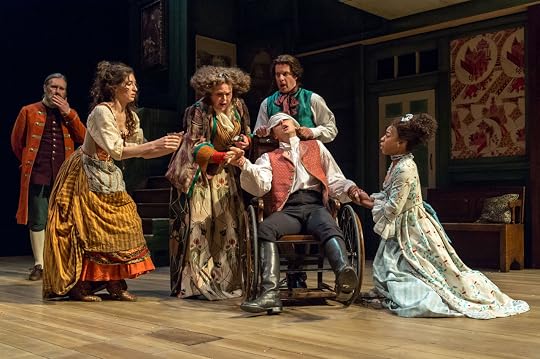
[The Inn at Lichfield. ARCHER, AIMWELL, MRS SULLEN, DORINDA]
ARCHER: Good friends, we have been tasked with this grave duty, to determine if our entertainment can withstand the test of time. Three centuries hence, will the groundlings yet laugh and stamp their feet in answer to our merry jests? And be the response nay, I would know more: whether our play, if helped and amended in right wise, may still enjoy the favor of the fickle public. On these matters, I have asked my good friend and companion Aimwell to bend the powers of his keen intellect. And to our dear Mrs Sullen, I have posed a second question. In these future times, when philosophers assure us that the weaker sex will have thrown off the yoke laid on her shoulders and acknowledge no more the tyranny of men, how will womankind conceive the heroines of our drama? Do we here have women, like Helen and Electra, fit for the ages, or transient simulacra, sketches that our granddaughters will view as no more than shadows? Speak now, and discover to me your thoughts.
AIMWELL: Fear not, good Archer, and cast aside your cares! I have by certain means learned, that our play will even in 2015 be met with favor, and without the least amendment.
MRS SULLEN: And I may make as good an answer as Aimwell. Dorinda and, if I may be so immodest, myself will prosper in the future age, and be held in regard as entire and perfect specimens of the playwright's art.
ARCHER: This is good to know! I--
[Commotion without. ARCHER, AIMWELL and MRS SULLEN hastily exit left, leaving only DORINDA. Enter LADY BOUNTIFUL right.]
BOUNTIFUL: Well? And how did our friends answer? Did Aimwell make complaint that his given task was too great?
DORINDA: He told us he had been given a large one.
BOUNTIFUL: And said he that that the play required explanation or amendment?
DORINDA: He said it would stand on its own.
[Audience demonstrates appreciation of this subtle piece of eighteenth century wit]
BOUNTIFUL: Minx! And what of Mrs Sullen? Has her earnest study discovered worthy and truthfully portrayed characters?
DORINDA: She said she had two. And that they were well-rounded.
Originally published on my blog here in July 1999.
Just as the term 'Elizabethan drama' is frequently extended well into the seventeenth century, so too the term 'Restoration comedy' is not restricted to the historical period implied by the title. George Farquhar is a case in point; of Irish origin (son of an Anglican clergyman of Londonderry, who lived through the siege of that city), his success as a playwright falls firmly in the reigns of William and Mary. Though well after the 1660 restoration, his plays still fall within the stylistic genre of Restoration comedy. By the time he was writing, this genre was on its last legs, and the new fashion, a more mannered style, was soon to replace it. Farquhar is clearly not happy with some of the literary conventions of the time, but his ideas lead more towards low comedy and in a few years would have been considered somewhat immoral. (In particular, he was very cynical about the charms of matrimony - an attitude which plays an important part in The Beaux Stratagem.)
The plot of The Beaux Stratagem is reasonably simple for this sort of comedy. The main male parts are two fashionable beaux, on the lookout for a heiress to marry so they can repair their fortunes. Aimwell and Archer are taking it in turns to be the fashionable gentleman, the other being the gentleman's servant. When they arrive in Lichfield, Aimwell is the gentleman, and his insinuates himself into friendship with the beautiful Dorinda, daughter of Lady Bountiful (the origin of the expression). Meanwhile, Archer strikes up an extremely worldly friendship with Dorinda's sister-in-law. She's married to Sullen, the country squire parody in this play, mad for hunting and eating and (especially) drinking.
While Aimwell and Dorinda continue their inexorable approach to an engagement at the end of the play, in accordance with the rules of the genre - young lovers always marry in the end, to live happily ever after - Farquhar uses Mrs Sullen to criticise this facile outcome. She, originally rich in her own right, is trapped in a loveless marriage to a man she despises, who keeps her from the town-based society she adores, by a legal system which does not allow divorce for incompatibility, and in which divorce would leave her disgraced and in absolute poverty (as her property passed absolutely to her husband when they married). The dark side to the play produced by this theme threatens to overwhelm the rest of it, and Farquhar has to resort to a deus ex machina character and an arbitrary adjustment to English law to get out of the hole he has dug for himself. Noticeably, even when her separation from Sullen seems an accomplished fact, the possibility of marriage never seems to cross either her or Archer's mind.
A pleasant, if unlikely diversion involving con men pretending to be noble, a husband and wife fiercely unhappy in their marriage, a captive French count, a passel of highwaymen, and a deux ex machina brother. Not too much to be said except that the writing is spritely.
As Restoration comedies go, this is far from one of my favourites - it's fairly static and far less witty/satirical than a lot in the genre.
What makes it interesting however is its strong feminist themes and the notion of divorce - remember this was written in 1707. We parallel the usual romantic fluff (Dorinda/Aimwell) with the unhappy marriage of Lord and Lady Sullen.
I also rather like the character of Archer, but find him fickle - he first romances Cherry the inkeeper's daughter before falling for Mrs. Sullen. It's quite difficult to believe his sincerity in the 2nd half of the play.
There's great scope for music in this one - The trifle song livens it up no end when performed, but is rather dull on the page.
Definitely a play that works much better in performance than as a text.
Учуди ме фактът, че Фаркуар е написал пиесата едва ли не на смъртен одър. Не знам дали не е вследствие на адаптацията, но хуморът (*предупреждавам, типично британски) бе толкова свеж, а сюжетът- толкова грабващ и изобилстващ от весели и нелепи моменти, преплитащи се един през друг, че останах очарована.
Британският национален театър за пореден път ме остави без думи, този път- с комедия. Рядко съм се смяла толкова. Излишно е да коментирам музика, сценография, актьорска игра... удоволствие беше!
3.5/5 - It was fun to read a play for the first time in awhile! I can see why this is a classic; it has a fun cast of characters, plenty of subversive moments, and a lot of great lines. I enjoyed it but found the number of people hard to follow (which would surely be helped by seeing them onstage, but) and did not find much overarching plot. Reading the blurb, I expected more of a strong statement as the theme of the play, but it was a fun read. I'd definitely go see it live.
Farquhar's final play is a witty comedy about two dissolute young men in search of wives with fortunes. It contains quite a few echoes of Milton's Doctrine and Discipline of Divorce, particularly from the unhappily married Mrs. Sullen (who is anything but sullen). Archer and Aimwell begin as scoundrels, but this is a comedy, so...
I enjoyed this a lot - very witty, one of the better Restoration comedies I've read. I was also delighted to discover that this is where the character "Lady Bountiful" comes from. Quite moving to realise that Farquahar wrote this practically on his deathbed, and could still be so funny.
This is a tricky play to review, having only read the script. It's not a great read - it's convoluted, and tricky to figure out the plot. However, I feel it would probably be brilliant to watch. I'm giving it a 3 because I'm really not sure... Will go see it at first convenient opportunity.
Farquhar's best-known work and a high spot of Restoration drama, the play is a brilliant, witty, and still glinting sabre thrust into the heart of Restoration manners. But it remains timeless with its adroit mockery of hypocrisy and folly, which, as long as the human race endures, are sure to be perennial.