Jump to ratings and reviews
Rate this book

La trabajadora

Rate this book
Elvira Méndez trabaja como correctora para un gran grupo editorial. Sus escasos ingresos la obligaron a mudarse a un piso al sur de Madrid, y para poder pagar el alquiler aceptó como inquilina, por recomendación de su amigo Germán, a su antigua colega Susana, una estrambótica e inmensa rubia con algunos problemas mentales que acaba de regresar de una temporada en Utrecht. Susana es una artista que hace collages con trozos de mapas, pero que trabaja como teleoperadora. Elvira siempre está intentando sonsacar información sobre sus labores a Susana, aunque sea sólo para conseguir un trabajo similar con el que lograr llegar a fin de mes, pero nunca lo consigue. Años después, Elvira intenta poner punto y final a una novela que cuenta todo lo que vivió en el pasado. Sentada frente a su psiquiatra, le expone que necesita que la terapia le sirva de coda a su obra; y que su superación del miedo y su paranoia serán narradas como un capítulo final a partir de sus conversaciones. Pero la cuestión es: ¿y si no consigue superarlos? Entonces el libro, y la vida, tendrán que quedarse como están.

160 pages, Paperback

First published January 1, 2014

38 people are currently reading
1039 people want to read

About the author

Elvira Navarro

29 books93 followers
(Huelva, 1978) es licenciada en Filosofía. En 2004 ganó el Certamen de Jóvenes Creadores del Ayuntamiento de Madrid, y entre 2005 y 2008 disfrutó de una beca de creación en la Residencia de Estudiantes. En 2007 apareció su primer libro, La ciudad en invierno (Caballo de Troya), que fue acogido calurosamente por la crítica y distinguido como Nuevo Talento Fnac. En 2009 publicó La ciudad feliz (Mondadori), que obtuvo el XXV Premio Jaén de Novela y el IV Premio Tormenta al mejor nuevo autor, y que resultó elegido por Culturas del diario Público como uno de los libros revelación del año. Elvira Navarro fue incluida en la lista de los 22 mejores narradores en lengua española menores de 35 años de la revista Granta.

Ha colaborado con revistas como El Cultural de El Mundo, Ínsula, Letra Libres, Quimera, Turia o Calle 20, y con los diarios Público y El País. Ejerce la crítica literaria en Qué Leer y en el blog La tormenta en un vaso, e imparte talleres de escritura.

Ratings & Reviews

What do you think?
Rate this book

Friends & Following

Create a free account to discover what your friends think of this book!

Community Reviews

5 stars
68 (11%)
4 stars
157 (26%)
3 stars
217 (37%)
2 stars
95 (16%)
1 star
46 (7%)
Displaying 1 - 30 of 101 reviews
Profile Image for Paul Fulcher.
Author 2 books1,964 followers
August 7, 2022
Elvira Navarro’s La Trabajadora, published in 2014, was translated into English by Christine McSweeney, and published, in 2017, by the excellent Two Lines Press (best known for their championing of Wolfgang Hilbig and Marie NDiaye).

In its 189 pages, it presents a layered meta-fictional narrative that touches on female sexuality, mental illness, the city of Madrid, and the increasing division into two cities, and the impact of the financial crisis on employment security.

The story is narrated by Elisa, who works as a proofreader for a publisher in Madrid, but, with a degree and masters, aspires to be a writer, having published one novel. She lives on the outskirts of the city, and, to make ends meet, sub-lets her flat to the older Susana, 44 at the time the novel begins.

But the novel presents their tale in a rather unsettling format, beginning with a 40 page story, almost a novella in its own right, based on a story told by Susana to Elisa and relayed by Elisa to us (including Elisa’s own inserted doubts as to the veracity of the story). It begins:

This story is based on what Susana told me about her madness. I’ve added some of my own reactions, but to be honest, they are very few. It goes without saying her narrative was more chaotic.

And goes on to relate how, two decades earlier, Susana sought, for a long-time unsuccessfully, a partner through the lonely hearts ads. Prospective partners were put off both by her red-faced blondeness, my coming-apart-at-the-seams way of speaking, and a pair of eyes whose futile, terrifying ship-wreck said it all, but also her very specific request for an unusual sexual practice. But she eventually meets Fabio (an immigrant, homosexual, dwarf) who is happy to oblige, and the two form a couple of sorts.

The shorter 2nd section is an article – a short-story or perhaps an essay – Elisa had published in a ‘now defunct’ Spanish newspaper: actually based on one that the author herself wrote in 2010. It focuses on the impacts of the financial crisis – Elisa’s role has moved from a permanent employee to contract work, and increasingly the publisher doesn’t pay the bill. And as a result she has been forced to move to Aluche in the outskirts of Madrid.

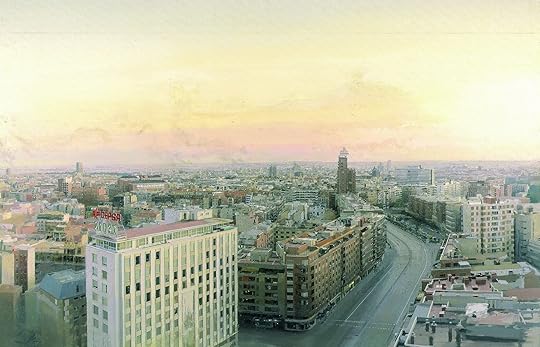
The piece also references the Madrid cityscapes of Antonio López Garcia, whose works (as well as the more impressionist works of Ortega Muñoz) are referenced throughout the text:

description

The third section, which constitutes the bulk of the book begins with Elisa taking on Susana as a lodger, recommended to Elisa by her friend (perhaps more than that) Germán.

When Susana moved into the apartment, I hadn’t been paid for a few months, and my attempts to find a place in some other publishing house had come to nothing. My roommate was paid punctually for her work at the call centre, and didn’t have to give it a second thought after five, while I would be battling with galleys until eight, and constantly waiting to be paid. Some nights I’d slave away on proofs until ten or eleven, not that I spent all that time hunting for errors. What I was doing, with increasing frequency and without the least benefit, was surfing the internet. I’d visit the home page of El Pais twenty times, look at the blogs I follow, check out Facebook. It was a vicious circle, because the next page of the galleys always held some unavoidable search, infinitely duller than rereading the same newspaper headlines.

Susana, who has returned from time living in the Netherlands, isn’t quite what Elisa had expected:

She wasn’t as I’d hoped, short and plump like a Hispanic mother, but the Nordic type: tall, blond, horsey, with a complexion the colour of something like raw silk.

The Amazonian Susana, with her ‘Wagnerian breasts’, rather takes over the cramped flat, her possessions not confined to her own room, and the mirror-like relationship between the two women dominates this section.

Elisa herself suffers from panic attacks, and takes medication to control her mental health. And she is disposed to exploring the City at night, particularly the more abandoned environs, half-built or abandoned buildings often populated by the homeless, dispossessed or illegal immigrants, semi-tolerated by the owners and authorities.

I usually left the apartment at night, which meant my encounters with the guys from the truck became almost routine. I continued to haunt the old prison, which had become a forest of rubble, a steep forest through which cockroaches scurried, and emitted a false glow at night—what in fact glimmered on the rubble were the lights from the Avenida de los Poblados. But it was as if those Dantesque fragments had light bulbs within them.

The ‘guys on the truck’ are a recurring motif throughout her life, having first met them years earlier when she was 20. A band of 5 Romanies who roam the outskirts at night, scavenging for rubbish. She seems to encounter them unrealistically often - Their ubiquity reminded me of the man with white hair, a crazy we’ve all seen sometime or other in free movie screenings, or standing in the shade of a tree on Pintor Rosales, rocking his Chinese girlfriend’s wheelchair - indeed the readers wonders if the re-encounters are more nightmares and manifestations of her mental state). And they typically throw abuse at her, or, quite often and as they did on their first encounter, sharpened pieces of cardboard (the edge of some stapled box) – or she wonders, do they, or did the cardboard simply blow off their truck? One such encounter:

They didn’t see me. I was a long way away, quietly hunched down out of sight: there was a candy wrapper on the ground at my feet, and I could hear the chirping of insects. The third night I saw them playing daredevils on rotten planks; I realized they were looking for something that wasn’t cardboard. My discovery shouldn’t have been surprising, but then I know nothing of the criminal underworld. What I did know was certain materials were being stolen for resale on the black market. Copper ¬mostly. Yet it didn’t ring true for me that, after years of standing empty, there would be anything of any value left in the prison. I don’t know exactly what they were pilfering, but expected to see them carrying long, sharpened sticks, weapons. I felt the need to stand up, and as I did brushed against some piece of corrugated iron that fell with a loud clang. The five Romanies turned, and shone their flashlights in my direction; my knees were shaking slightly, and although I very much wanted to hunch down again, I couldn’t even manage to breathe. They stood very still, making sweeps with their lights. The only things behind me were wire fencing, trees, and darkness. “Who’s there?” they shouted, followed by, “If you don’t get out of here, I’ll slash you.” Another one of them answered, “It’s a cat or something, dumbass. Let’s go.”

Other than an on-off relationship with her Dutch boyfriend, Susana seems to have little hinterland. She refuses to talk about her job, her family (other than admitting, at one point, that her father spent time in the aforementioned prison) and even her friends seem more recent acquaintances. Elisa struggles to reconstruct Susana and has some doubts as to her story, which she is incorporating in a story she is writing:

I wondered if I’d ever been capable of interpreting her tendency to construct herself from movies, books and TV series, or her silence about her work

although the reader can’t help but feel Elisa’s own self-portrayal is little different, other than the very detailed discussion of her employment situation, with the only other characters she encounters her stressed boss and her ‘friend’ Germán, and with no real family history disclosed of her own.

Susana is also an aspiring artist, her medium of choice maps of the city which she painstakingly assembles from manually cut out and pasted images. This perhaps speaks to the shadow city that so preoccupies Elisa, but when Susana starts to achieve the success in her field that has so eluded Elisa in hers, it brings about both a fracture in the flatmates relationship but also brings the question of Elisa’s own relationship with Germán to a head.

The final, brief, section of the novel is a conversation between Elisa and her psychoanalyst, one which felt was meant to cause us to question the nature of what we have read – although Elisa has been clear throughout her account that she is telling us a cathartic story.

Overall, a far from straightforward work and at times I found it difficult to get a foothold but thought-provoking and worthwhile. 3.5 stars rounded up to 4 as this feels a novel that would give up more of its secrets on a re-read.

An interview with the author:

http://lithub.com/of-working-women-in...

An interview with the translator:

https://www.catranslation.org/blog-po...

Some excellent reviews:

https://roughghosts.com/2017/10/20/wh...

http://blog.pshares.org/index.php/you...

http://www.complete-review.com/review...

A sample excerpt from the novel:

https://live-cat-translation.pantheon...
Profile Image for Jenny (Reading Envy).
3,876 reviews3,715 followers
August 29, 2018
This was a bit of a challenging read for me. I read it for Women in Translation month. It's a short novel told in three long pieces, the first is Elisa's roommate Susana telling about her attempts to find a partner willing to do a specific sexual act. And as in most instances where a writer fixates on a body part or a sexual act, I grow weary before they are through and feel like, okay, great, you proved you can. Is there a purpose? Is this a metaphor? (And should we still be using the word dwarf?) The middle section focuses on Elisa and her financial and mental struggles. Life is not easy for an editor in Madrid. Then the last section focuses again on mental illness and versions of reality.
Profile Image for H.
136 reviews107 followers
August 27, 2017
This book snuck up on me. It kept getting better and better and I couldn't really put my finger on why I was enjoying it so much. After finishing, I think it's because it's such a multifaceted, mutating work. It changes from one thing to another, which is a testament to both its subtlety and, from a story standpoint, the baseline unreliability of the characters.

I think what's most impressive about the book is how many layers there are to it. There's a whole aspect of the book that weaves in the Spanish fiscal crisis from 2008-2016 that manifests itself in the poverty Elvira sees on her walks around Madrid and in Elvira's underpaid job at a book publisher--how she'd like to make enough money "to pay for a downtown apartment, without having to share." But you can read the novel purely as a psychological/character study and it doesn't lose any of its appeal--at the most basic story level, this is a subtle, excellent, memorable depiction of mental unraveling. And then there's a brilliant metafictional/unreliability twist at the end that makes you want to go back and study the text more closely for clues to what you may have missed.

I was reminded of so many of my favorite books. The casual askewness of Tom McCarthy's Remainder; the interior strangeness and isolation of Claire-Louise Bennett's Pond; the icy sharpness and straightforwardness of Fleur Jaeggy's books; the potentially volatile closeness of two women, especially toward the end as Susana's art gains focus, reminded me of The Woman Upstairs; the patchwork structure of Valeria Luiselli; and, sometimes, despite being first person, the book will sort of disembody itself and just describe the city of Madrid and other details of the landscape, which reminded me of Gerald Murnane's characterlessness and plotlessness. It also reminded me of Mulholland Drive and Persona in the psychological twisting of Susana and Elena. Of course, the inclination with something that feels new and exciting is to try to think of what else it reminds you of that you're familiar with, but really none of them exactly apply. The novel stands on its own.

The writing is excellent. It's not showy, it just sort of unfolds using its own momentum. Here's one of my favorite passages:

The silence, on the other hand, suggested unoccupied buildings about to be torn down. When I turned onto one of those streets on another occasion, I saw cables strung from some of the balconies to streetlights, stealing electricity. It was only a few, of course, but that didn't stop me from returning to the unlikely conviction that there were underground movements capable of modifying my mental vision of the city, and also the conception of it I read in newspapers, or saw on television and the Internet. This pretty vague conviction--or perhaps, better, off-track intuition--made me uneasy. If accurate, it was equivalent to discovering we were Martians, someone's dream, or a computer program in which the rules changed from day to day. But then the Romanies and homeless families had been occupying the city's empty buildings for decades, and since the increase in immigration, many dwellings on the outskirts had been broken into. I'd heard stories of family members being unable to come to an agreement about what to do with their inheritance, of empty properties perched on the slopes on either side of the railroad tracks, or boxed in between new buildings when, for complex legal reasons, they could not be expropriated. The heirs allowed homeless families to live in the disputed buildings for the cost of maintenance. At one time I'd taken an interest in uncovering such phenomena, and used to prowl the streets where the aged houses seemed to be fresh and flourishing, but that was all Id' been able to confirm.


And another:

Susana brought me a cup of rooibos tea in one of the cups with a cow design I cart from apartment to apartment. I'd bought them one of the summers I spent in small Irish towns, learning English with a view to my promising future. I stayed with families where the women had the same pale complexion as Susana, and her blue eyes, although none of them were either tall or corpulent. All I remember about Ireland is the coastal scenery between Greystones and Bray, and the afternoon some friends and I broke a window of a tumbledown empty house and scrambled in. There were no bats, no rat skeletons, just columns made of packs of A4 paper. The packs were old, the paper yellowing; we took as many as we could carry and scattered the sheets of paper along the beach. I haven't been back to Ireland since that summer.


And another:

What's more, I love it when breaches open up, and when things take an unexpected turn. I like it when the car breaks down halfway to my destination, and I have to spend the night in some small town I'd never have even considered stopping in otherwise, or when there's a power outage--though that hasn't happened for a long time--and the air is filled with the scent of candles and camping-stove fuel. I like lazing around in a blackout, spending two, four, six hours, a whole day, not doing any of the things I'd planned; it's when I'm closest to the keenness of the senses I had when I was younger.
Profile Image for lau.
46 reviews
February 23, 2023
La primera de las tres partes de la novelita está dedicada a nuestra querida Susana, que busca desesperadamente un individuo (su único requisito es que sea eso, individuo) que le “lamiera el coño con la regla en un día de luna llena”. Comienza con un buen titular en Helvética, de esos que deshumanizan a los personajes y hacen que el lector, al que le asoma la caspa, morboso por naturaleza, siga leyendo a la espera de material provechoso. Nada de eso, solo un banquete para la editorial. Ahora bien, aunque luego ironiza sobre esta insólita y nunca conocida estrategia, siempre queda la sospecha de que la ironía sea más bien una justificación pobre para abusar, con cierta gracia, de un burdo truco comercial.

Pero, bueno, digamos que Elvira redacta bien, ligera, como una periodista entrenada, incluso hay un punto de crónica social, urbanita y desorbitada, que puede ser interesante. En realidad, ni siquiera sé si es periodista y, si bien construye cierta crítica del sector editorial (fácilmente extrapolable a otros), no muerde lo suficiente, ya saben, como para no ser publicada. En fin, que Elvira Navarro maneja los tiempos, las pausas, los nexos… pero no he sabido encontrar una experiencia estética más allá de una cuidada sintaxis y brillantes obsesiones sexuales que acaban, curiosamente, protagonizadas por un enano. Una novela epiléptica y contemporánea. El “epílogo” me ha gustado pero, por mí, dos estrellicas i prou.
Profile Image for Bruno.
255 reviews146 followers
January 9, 2018
There's a woman who wants to find someone who will lick her pussy while she's on her period (during a full moon). This woman has a gay dwarf boyfriend with psychic powers (?!). There's another woman who works for a publishing house but never gets paid. Everybody seems to be unstable, on meds and constantly showing severe signs of psychosis. There's a gang of Romanies who go around in a truck throwing pieces of cardboard at one of the women(?!). Lots of sketchy neighbourhoods and run-down buildings. Nothing makes sense in the end.
Profile Image for jeremy.
1,204 reviews311 followers
September 6, 2017
elvira navarro was one of the 22 young spanish-language novelists featured in granta's best-of issue in late 2010 (most of whom have had full-length works translated into english since). navarro's a working woman (la trabajadora) is the second of her novels to be rendered into english (after the happy city).

the spanish author's 2014 novel (named a "best book" by several spanish publications) is the often unsettling story of elena and susana (narrated mostly from the perspective of the former), roommates each with their own creative ambitions (and elusive pasts), struggling to overcome their respective psychological challenges. a tale of friendship, artistic ambition and frustration, mental disorder, interpersonal observation, and, um, unique sexual proclivities, a working woman offers a glimpse into two disparate lives (although far more similar than either character would likely admit) plagued by desires and motivations seemingly alien even unto themselves. navarro's prose, coupled with her unreliable narrator, make a working woman an intriguing, ever-curious work of personal fragility and estrangement.
in fiction everything is false, but i'm not referring to that type of falsity—i mean not respecting the coherence of the text. so to maintain the coherence of what i've written, i need this conversation to take place.

*translated from the spanish by christina macsweeney (luiselli, saldaña paris, rabasa)
Profile Image for Luna Miguel.
Author 22 books4,800 followers
January 12, 2014
Me ha encantado. Quizá al final me sabe un poco a poco porque quisiera conocer más detalles de Elisa y Germán... pero a pesar de ello, me ha gustado mucho.

Me siento identificada con la protagonista: ¿precariedad laboral en el mundo editorial? ¿Amigas obsesionadas con el sexo que intentan acaparar toda la atención? ¿Soledad? ¿Enfermedad? ¿Sensación de que lo que uno escribe termina por conquistar nuestra vida? Etc.

Se lee rápido, pero se disfruta.

Muy buen comienzo de 2014.
Profile Image for adrixx.
23 reviews
March 16, 2024
No me ha gustado mucho… El inicio bastante chocante, en el mal sentido. Las primeras palabras al inicio de este libro ya generan rechazo (para mi y para muchos otros lectores supongo) aunque bueno…, según los gustos del público, puedo llegar a entender que este tipo de lenguaje produzca “curiosidad”. Para mi desagradable.

En cuanto a los personajes, con Susana y Elisa… no me echaría ni un café, ni siquiera 30 min. Tema central de la obra: la locura, but yo no he empatizado, sintonizado en ningún momento con los personajes. Luego, esos paseos y la observación de Madrid no me dicen nada, descripciones “adolescentes” y pido perdón por si etiqueto y caracterizo así (cito según El Pais) a “una de las voces narrativas más poderosas de su generación”.

Mucho desorden mental y tratamiento del mismo con poca sensibilidad, quizá su crudeza sea intencionada para querer demostrar algo, pero la sensación que a mí me ha dado es que ha hecho de un tema tan complicado como es la enfermedad mental (actual) algo muy áspero y poco empático (aunque, repito, su intención no haya sido esa).


Profile Image for ceka.
58 reviews2 followers
March 25, 2025
es absolutamente horrible. malisimo. un coñazo. no me ha gustado nada de nada y no estoy preparade mentalmente para que la profe lo halague constantemente. he estado leyéndolo con una expresión constante entre confusión e incredulidad
goodreads me obliga a ponerle una estrella
Profile Image for Beatriz.
57 reviews6 followers
December 3, 2025
3,5. Desasosiego en estado puro. Críptico. Me gusta como escribe la autora, pero tengo la sensación de haberme quedado a medias… No sé explicarlo mejor.
Profile Image for Claudia.
63 reviews7 followers
March 26, 2024
la primera parte terrible e infumable, si hubiese sido todo el libro así… lo habría dejado sin duda💀

por suerte, a partir de la segunda parte no se me ha hecho tan tedioso

no quita que sea un libro aburridísimo, con 0 valor literario for me y que me la haya pelado 💋

el final, bueno… ha ido dejando pistas por todo el libro y me ha parecido corny as fuck acabarlo así

no me apetece llegar a clase y escuchar maravillas de este libro :/
Profile Image for Rosario Villajos.
Author 6 books598 followers
Read
November 21, 2020
Me ha gustado mucho. No sé por qué había esperado tanto a leerme esta novela. Ya conocía la voz de esta escritora por sus relatos, que me fascinaron. Tal vez sabía de qué iba este libro y el bajonazo que me podría dar (y me ha dado) al final. Pero vale mucho la pena leerlo.
Profile Image for Dan.
Author 21 books548 followers
December 2, 2017
There's a small part of me that thinks maybe I only picked up this book because the author's first name is Elvira and that's an unusual name that my mother also happens to share. There's a larger part of me that is certain I only picked up A Working Woman because it's a work-in-translation and struck me as similar to How Should a Person Be? by Shelia Heti — a novel that I adore. Both parts of me are glad I decided to read this slim volume. Navarro's prose is evocative, incisive, and richly detailed. It seduces you with its descriptions of bohemian life on the margins in contemporary Spain. I'm not ordinarily a fan of the avant-garde and there are gimmicks in here that would ordinarily have me rolling my eyes, but for some reason the whole thing really worked for me.

In an interview with LitHub, Navarro says that she wanted to address the "precariousness of working life and also the psyche and, at a deeper level, identity as a profoundly unstable construction that gives us a false sense of calm."And that's it exactly. The story at times seems to meander, but upon completing the read these themes emerge. As a whole, the book has a feel of hopping from one sinking stone to another. It's a living-life-paycheck-to-paycheck kind of read, a look at the sacrifices artists make for their work, and a vision of how our self-conceptions shift with our circumstances. I found it absorbing once I got into it, but I will say that it's not the type of book that I can dip into and out of. I needed to read big chunks of it in one sitting to let its slow magic work on me.

If you liked this, make sure to follow me on Goodreads for more reviews!
Profile Image for José Carlos.
247 reviews9 followers
September 30, 2018
Los delirios mentales de la protagonista, una escritora, con la crisis de 2007 como telón de fondo.

Aquí no hay denuncia social, sino mera descripción onírica de la realidad de aquellos años: nos quedamos con que Madrid tiene barrios donde la gente engancha la luz y es perturbador a la par que estimulante pasear por ellos, siempre que tengas cuidado con los camiones de los que recogen chatarra de madrugada (parece ser que te tiran cosas si te ven paseando). ¿Por qué están así esos barrios? Circulen, lo que importa de verdad son los problemas psiquiátricos de los personajes principales.
En un momento dado, la protagonista pretende solicitarle a su jefa una mejora de condiciones laborales. Uno piensa que ah�� ya no es posible eludir más el conflicto socioeconómico de aquellos días, que se va a entrar en materia; pero no, la jefa se descuelga con un discurso metido con calzador sobre sus deseos sexuales que te deja en blanco. Seguir leyendo a partir de ese pegote de varias páginas es todo un acto de fe.
Profile Image for Javier.
463 reviews11 followers
October 20, 2023
La precariedad laboral, vital, habitacional, psíquica. Todo ello en esta joya. En la linea de generar en el lector incomodidad y negarnos la felicidad, porque quizá esta no exista ni en los libros.
Profile Image for María.
16 reviews
September 17, 2024
Es increíble lo mucho que refleja de nosotros lo que vemos en los demás (lo bueno y lo malo).

Menudo descubrimiento Eva Navarro y qué análisis más bueno hace de la salud mental.

Por otro lado, me encanta la idea de perderse por Madrid y descubrir calles nuevas todos los días 📝
Profile Image for Karli Sherwinter.
799 reviews6 followers
December 31, 2022
Sort of strange. I did not understand who the narrator was in the second section until I was almost halfway through it. Is Elisa the only one with psychological problems or is Susanna also struggling with her sense of reality. Why does she ask Susanna to leave the apartment at the end? I don’t understand the sexual fetishes or the idea of a gay man who happens to have regular sex with a woman. I read this book because it was on a list of up and coming Spanish writers and I am getting ready for our trip to Spain in February. Not sure if this novel helped me better understand the culture or the geography of Madrid.
Profile Image for Jim.
Author 23 books347 followers
June 14, 2017
A fascinating work of metafiction reminiscent of aspects of Valeria Luiselli's Faces in the Crowd and Ben Lerner's At the Atocha Station. It's not an enjoyable read per se, but a haunting portrait of psychosis in a life pushed to the margins. I'll be thinking about this one for a long time. That Christina MacSweeney translated it should be enough of an endorsement.
Profile Image for Andrea.
271 reviews
September 26, 2015
Creo que es uno de los libros más incoherentes que he leído en mi vida. No tuvo ni principio ni fin.
Profile Image for Kay.
232 reviews
April 11, 2021
The really clever ending did not quite make up for the boring majority of this story unfortunately.
Profile Image for Esencia a libro nuevo.
251 reviews2 followers
March 23, 2021
Gentrificación. Precariedad laboral. Enfermedades mentales como bipolaridad o ataques de ansiedad. Relaciones humanas. Búsqueda vital. “La trabajadora” trata muchos temas, pero ninguno en profundidad. No sé cómo afrontar esta lectura porque ha sido una novela rara en cuanto a contenido y forma. ¿Me ha gustado? Sí. Aun así, sigue siendo rara. El libro consta de tres partes y al principio, el lector se siente perdido. Según van pasando los capítulos y se van conociendo a los personajes, vas uniendo piezas y teniendo más idea. Elvira Navarro nos presenta a dos mujeres: Susana, una chica joven bipolar, misteriosa y amante del silencio que alquila una habitación a Elvira Méndez, quien sufre ataques de ansiedad por su situación laboral y que emprende un viaje hacia su identidad. Son la singular pareja: viven juntas, pero no conviven, no son amigas ni conocidas, pero tampoco extrañas, a veces se consuelan y se desnudan emocionalmente la una a la otra, y otras, hay un ambiente hermético y tenso por toda la casa. Hay un par de cosas que me han gustado: el protagonismo de Madrid y la crítica al sistema imperante y la precariedad laboral. El argumento es un poco pobre para mi gusto, me ha faltado algo de cohesión entre una parte y otra. Al final no deja de ser un batiburrillo de sentimientos y actos que no terminan de casar. A veces he tenido la sensación de leer tres bloques en vez de una novela. Esperaba más.
Profile Image for Mariana D..
102 reviews6 followers
January 14, 2019
Este libro me mantuvo enganchada hasta el final. No sé si encontré lo que esperaba hallar pero me pareció que estaba bien planteado. Me brindó un par de personajes complejos y muy humanos con los que logré empatizar. El encuentro entre Susana y Elisa está nutrido por conversaciones que versan en torno a ellas, sus pasiones, sus vidas, sus historias. Elvira Navarro aporta una visión de la enfermedad psiquiátrica de la que no había leído: sin la carga y el estigma, la romantización y el señalamiento. La autora nos permite andar y deconstruir al Madrid de ensueño para volverlo "de carne y hueso".
Profile Image for tute cespedes .
30 reviews
August 29, 2023
“No sé si todo sigue como lo recuerdo; ignoro si los parques cambian”
pf estoy nerviosa eh… una lectura densa y que llega a generar ansiedad. Susana y Elisa no se conocen pero comparten los mismos problemas, se fijan en las mismas cosas de formas tan diferentes y se odian de lo mucho que se parecen. Leyéndolo me ha asaltado la pregunta si algún día mi vida se verá así, un Madrid solitario que te acaba comiendo… que miedo… Menos mal que no me llegue a leer este libro cuando me lo mandaron en mi primer año de carrera porque me hubiese vuelto loca.
Profile Image for Dareen.
794 reviews8 followers
Read
March 29, 2023
tbh I am confused!!
this was interesting to read, but basically everything you think is true just isn't
(also I read this for a class! and sorry my review isn't in Spanish)
Profile Image for fdifrantumaglia.
208 reviews49 followers
June 27, 2019
La lavoratrice, con quel suo stile duro e spietato, non ci culla e non ci giustifica, come se volesse dare uno scossone a chiunque viva una situazione del genere e, a fine lettura, ci riesce decisamente bene.

Leggi la recensione completa qui: http://www.lindiependente.it/precarie...
Profile Image for Natalia Ruiz-Poveda.
Author 2 books6 followers
June 14, 2017
https://nataliaruizpovedavera.wordpre...


Si tuviese que describir en una palabra lo que me ha provocado la lectura de “La Trabajadora”, de Elvira Navarro (Mondadori), diría: empatía. Y por qué, pues en resumidas cuentas, porque se trata de un retrato de la inestabilidad, el vacío y la precariedad de la juventud actual, así como su consecuencia o propuesta ante esta situación: la locura, ya sea voluntaria o involuntaria, desde la que construir, si no una identidad, ni tampoco un camino, sí un refugio.

Desde la poética, -y sí, digo poética por todo lo que rodea a la obra: un cuidadísimo lenguaje, una detallada y perfecta ambientación de las afueras de Madrid, y muchos pequeños y refinados detalles,- Navarro describe ese desamparo de la vida actual, donde en ocasiones solamente algunos atisbos de la amistad, de humanidad y de ternura son salvables, pero donde, generalmente, el individuo se construye la inestabilidad, en el continuo tránsito, en la soledad.

La protagonista –y todos los personajes, de hecho- son jóvenes, y tienen en común unas condiciones precarias de vida, una situación laboral vergonzosa y ningún atisbo de futuro. Y esa precariedad es la que conduce a la patología, a la enfermedad, al desencanto, a la locura. La protagonista construye su propia identidad en el tránsito de los barrios de la periferia sur de Madrid –otro motivo por el que recomendar el libro a cualquier madrileño que esté lejos de casa, por cierto- donde el paisaje se convierte en el testimonio de la historia reciente de un país, y donde la crisis –crisis económica, de valores, espiritual, emocional…- es un tamiz tupido y constante en el panorama de la novela.  Navarro habla de la identidad en el intersicio, de construirse en el no-lugar. 

Me he hecho muchas preguntas a lo largo de esta lectura: ¿debemos, por tanto, los jóvenes –y no tan jóvenes- que vivimos una situación laboral, económica y emocional precaria reconstruir nuestra propia identidad desde la enfermedad, desde la herida, desde la locura? Si no desde la apatía, pienso que si no es desde la herida, no hay otra manera posible de inventarnos.


Por eso, por su poética, por su temática devastadoramente actual y cotidiana, por su actitud, por su testimonio y su periferia es por lo que considero que “La Trabajadora” es una novela necesaria, actual, testimonial de nuestros días, y de lectura obligada para cualquier lector.  
Profile Image for María Ibáñez.
1 review
January 27, 2015
Una novela breve pero intensa, brutalmente contemporánea. Me gusta la aparente sencillez, la importancia del paisaje, la ciudad. Me ha llamado la atención la forma de fundir personaje-ciudad de una manera tan sencilla, profunda y natural. El misterio sobre la vida y el pasado de la compañera de piso, no es un zumbido molesto a lo largo de la obra, fluye hasta que el lector se da cuenta de lo que ocurre realmente, de lo que la novela en realidad nos está contando.
Una obra sobre la angustia y la locura que no cae en los estereotipos ni lugares comunes. Una obra de referencia para los escritores en ciernes.
Profile Image for World Literature Today.
1,190 reviews360 followers
Read
October 30, 2017
"Elvira Navarro’s latest novel hinges largely on two questions: How do we know we’re being told the truth, and how does that lack of certainty influence the way we interpret information presented to us? In this thin and seemingly slow-paced work, she picks apart our understanding of reality and reliability, challenging assumptions of the truth while examining the nature of friendship and life in urban spaces." - Bridey Heing

This book was reviewed in the Nov/Dec 2017 issue of World Literature Today magazine. Read the full review by visiting our website:

https://www.worldliteraturetoday.org/...
Displaying 1 - 30 of 101 reviews

Can't find what you're looking for?

Get help and learn more about the design.