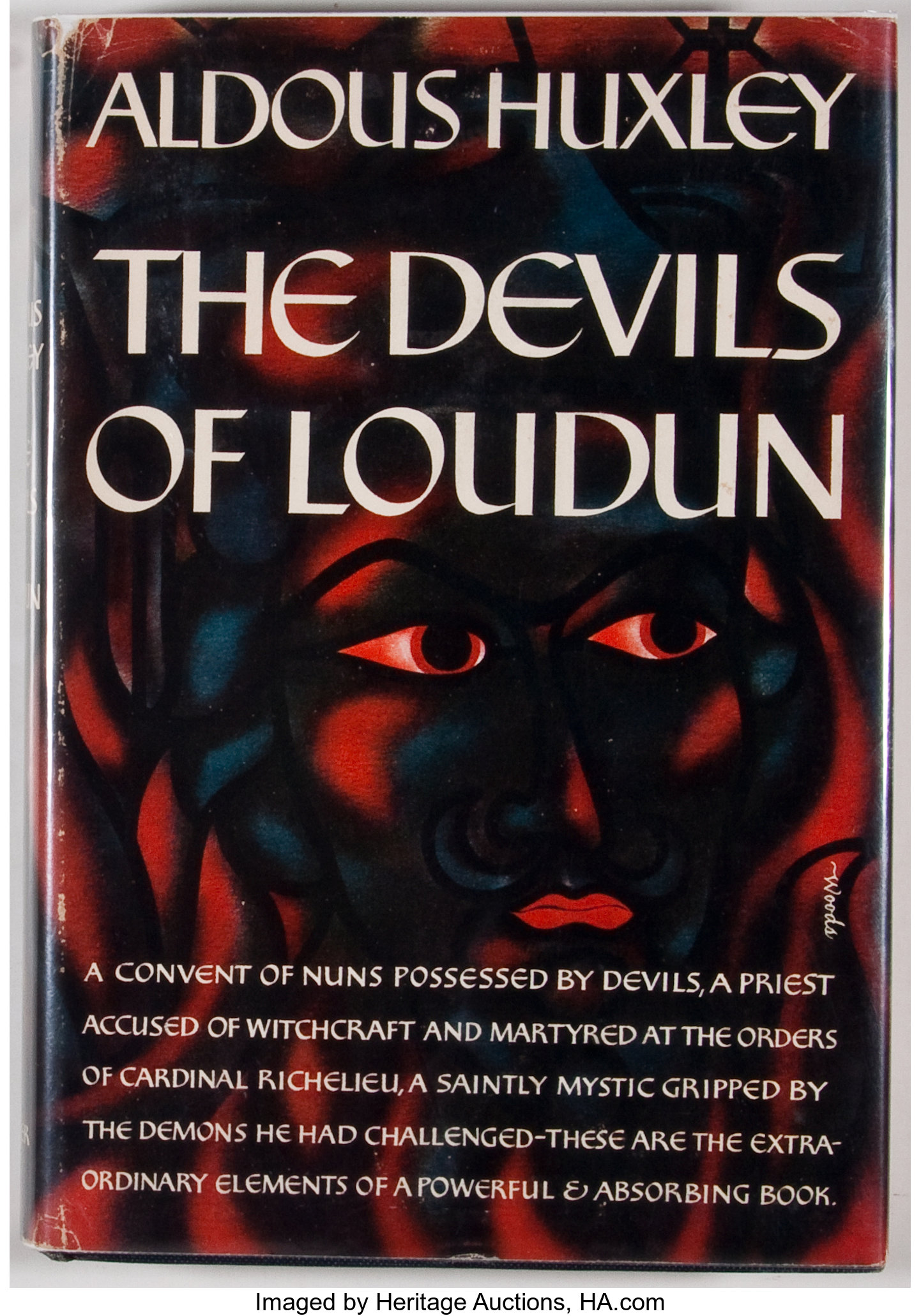
The Devils of Loudun is a 1952 non-fiction novel by Aldous Huxley. It is a historical narrative of supposed demonic possession, religious fanaticism, sexual repression, and mass hysteria which occurred in 17th century France surrounding unexplained events that took place in the small town of Loudun; particularly on Roman Catholic priest Urbain Grandier and an entire convent of Ursuline nuns, who allegedly became possessed by demons after Grandier made a pact with Satan. The events led to several public exorcisms as well as executions by burning.
Aldous Leonard Huxley was an English writer and philosopher. His bibliography spans nearly 50 books, including non-fiction works, as well as essays, narratives, and poems. Born into the prominent Huxley family, he graduated from Balliol College, Oxford, with a degree in English literature. Early in his career, he published short stories and poetry and edited the literary magazine Oxford Poetry, before going on to publish travel writing, satire, and screenplays. He spent the latter part of his life in the United States, living in Los Angeles from 1937 until his death. By the end of his life, Huxley was widely acknowledged as one of the foremost intellectuals of his time. He was nominated for the Nobel Prize in Literature nine times, and was elected Companion of Literature by the Royal Society of Literature in 1962. Huxley was a pacifist. He grew interested in philosophical mysticism, as well as universalism, addressing these subjects in his works such as The Perennial Philosophy (1945), which illustrates commonalities between Western and Eastern mysticism, and The Doors of Perception (1954), which interprets his own psychedelic experience with mescaline. In his most famous novel Brave New World (1932) and his final novel Island (1962), he presented his visions of dystopia and utopia, respectively.
What a fascinating immersion n in the mentalities not only of early 17c French Catholics, but, as Huxley insightfully explores for hundreds of pages, attitudes and actions not unfamiliar to those of us supposedly living in more informed times. He looks at the mob-mentality, the frenzy to which ordinary people can be stirred by demagogues, and how illusory are the self-rationalizations by which humans have always given in the crowd while imagining they're asserting commonsense.
The first half, which culminates in the fate meted out for Fr Urban Grandier (an appropriate name) the urbane but seducing Jesuit climbing the social ladder, carries the story of how an Ursuline convent of sisters was collectively possessed by demons. It happens suddenly, after a chaplain's prank about ghosts, and literally overnight, the frenzy consumes eighteen nuns and Sister Jeanne, their vain, headstrong, and eagerly credulous superior. Although I remain not exactly clear on how the acrobatic contortions could have distinguished the inmates, their inventive oaths, incriminations, condemnations, and twisted logic (devils can tell the truth if compelled in presence of clergy; the innocent charged with heresy etc and pleading innocence can be dismissed as under diabolic influence; good is bad, black white, faith blasphemy, fortitude hypocrisy, devotion dissimilitude...) It's packaged as a "non-fiction novel" and reads like one, hefty, erudite, and witty.
The second half looks at Sister Jeanne and especially her confessor Fr Surin, another Jesuit, in the aftermath of his confreres auto-de-fe. It relies more on Surin's tormented journals, rather than the earlier segment on public records, so it leans into the mysteries of mysticism, delusion, and madness in deeper detail. It concludes with a thoughtful reflection by Huxley on the relevance of media manipulation, willed gullibility, and safety in numbers in what in this era seemed limited to television, radio, the press, and cinema. Reading this as the protests against Israel escalated across campuses, the cautions Huxley shares about how easily a gathering can become a force convinced of its own self-evident reason in the face of an opposing force's self-incriminating irrational outburst rings too true. While the amount of detail, and the reliance on untranslated French, may overwhelm now and then, Huxley's dedication to unraveling our age-old frailties remains too apt, post-1952.
Equal parts brilliantly insightful, throughly engaging, and painfully long-winded, Huxley brings the story of Urbain Grandier to life in vivid detail…while intermittently getting bored of the history and deciding to change to any number of other topics, veering into tangentially related bits of existentialism and some knowing references to the politics of the day. It shouldn’t be a dealbreaker if you’re interested, but my engagement flagged a bit in those parts, since I was only really interested in the historicity of the story.
I sought this book out after watching the 1971 film (release the Criterion blu-ray, you cowards), and I was genuinely surprised to see that any artistic liberties are faithful adaptations of Huxley’s own flourishes and interferences.
A historical event from the early 17th century is described, and the author uses the story to also expound upon and explore human spiritual approaches.
In the village of Loudon in western France in the 1630’s, an entire abbey of Ursuline nuns was apparently possessed by demons. The prioress Jeanne de Agnes, “Sister Jeanne,” was obsessed, in part sexually, with a local parson by the name of Urbaine Grandier. Grandier was a Jesuit parson who was very charming and attractive to the local females, and he had numerous affairs with them, including seducing a young lady whose spiritual education had been entrusted to him by her father, and marrying another young lady, a ceremony he carried out himself.
Sister Jeanne’s demonic possession, or obsession, ultimately was transferred to the other nuns, even though none of them apparently had any direct contact with Grandier whatsoever. The nuns displayed outward signs of possession such as rolling on the ground and shouting profanities and scandalous sexual references. This became a curiosity and an entertainment attraction, and many people traveled to the abbey and witnessed repeated attempts to exorcise the demons by various ecclesiastics, including, ultimately, Jesuit priests. This went on for perhaps 3-5 years. Upon questioning by the exorcists, Sister Jeanne and other nuns made reference to Grandier as the source of their possession.
Grandier had made powerful enemies in the area, and those enemies eventually succeeding in having Grandier convicted of sorcery and burned at the stake, a horrific injustice.
After the killing of Grandier, the book pivots to focus mostly on another Jesuit priest named Jean-Joseph Surin. Surin was the main priest leading the exorcisms for the last several years at the abbey. He also worked painstakingly with Sister Jeanne one to one, attempting to rid her of her obsessions through meditative reflection and contact with God, a task which is ultimately successful around 1636, at which point the outward demonstrations of possession and the exorcisms came to a halt. Surin’s own spiritual journey is chronicled. Surin wrote extensively about mankind’s spiritual philosophies and behaviors. He had terrible struggles of his own to the point of physical incapacitation, despite having no actual physical issues other than perhaps fatigue. Surin eventually overcomes his psychosomatic state and lives out his final years with relative health.
Huxley uses the stories of the nuns, Grandier, and Surin to explore at length each of their own spiritual outlooks and convolutions. Through their examples he expounds upon how humankind seeks self-transcendence, making comparison and reference to modern-day approaches.
This entire review has been hidden because of spoilers.
“Insofar as they are incarnated minds, subject to physical decay and death, capable of pain and pleasure, driven by craving and abhorrence and oscillating between the desire for self-assertion and the desire for self-transcendence, human beings are faced, at every time and place, with the same problems, are confronted by the same temptations and permitted by the Order of Things to make the same choice between unregeneracy and enlightenment.”
“‘There is an exceedingly great distress when the soul is unable, if the expression may be permitted, to disgorge herself through her faculties; the overplus within her causes an oppression more painful than can be imagined. What is happening in the souls depths is like the banking up of great waters, whose mass, for lack of an issue by which to escape, overwhelms her with an unbearable weight and causes a deathly exhaustion.’ In some impossibly paradoxical way, a finite being contains the infinite and is almost annihilated by the experience. But Surin does not complain. It is a blessed anguish, a death devoutly to be desired.”
“‘You will recognize your mistake, you will be able to think and act like other men, you will die in peace.’”
The Devils of Loudon offers an account of religious mass hysteria without equal. I'm counting this as a 'non-fiction horror' and I'm amazed the true story of Urbain Grandier isn't as well known as other nightmarish French figures like Gilles de Rais. Huxley is prolific in detail and I found myself taking down notes on the fascinating historical and sociological tangents of every second page, but it slows the story to a crawl - and while I adore Huxley's voice, I mostly want him to just shut up and get out of the way.
Regardless, this was a wild ride: lust, obsession, secrecy, betrayal, plotting, political maneuvering, religious fanaticism, medieval torture, insanity, demonic possession, exorcisms, sex-obsessed convents of nuns... I'm keeping this review extremely G-rated, but this historically accurate depiction of the events of Loudon in 1634 are bananas. Spoiler, although, not really - Grandier has one of the, if not most, metal executions of all time. Wikipedia just says he was 'burned at the stake', but wow - the devil's in the details with this one.
Approaches every angle of the story with humanity, humor, and an unexpected philosophical wisdom. Genuinely stunning writing. However, Huxley’s expectations of his audience (other oxford dorks who are fluent in french?) can make reading it a bit slow for the first half as you put the book down to travel through the Wikipedia page on anabaptists, because Huxley trusts you remember them from the half paragraph in your history book from 25 years ago.
Other than that, my only real objection to the text is his fascination with one particular exorcist for the last chunk, notably his spiritual/psychosomatic (?) suffering. It’s not the most interesting character in the drama, and yet he occupies the entire last act of the story.
Heady and dense, but fascinating look at mass delirium, through the lens of a 17th century convent of "possessed" nuns. Huxley presents the historical facts of the event and a thoughtful analysis through the eyes of both a contemporary and modern person. I'd love to know what he would have thought about the mass psychosis the internet has wrought.