Jump to ratings and reviews
Rate this book

33⅓ Europe #19

To the Cold Land

Rate this book
This book explores the album 'Külmale maale' (To The Cold Land, 1989) by J.M.K.E. - the most legendary punk rock band in Estonia - concentrating on the meaning of the album in different sociocultural contexts from its release until today. In 35 years, the album has not lost its relevance: It was selected by 102 music critics as the best Estonian album of all time in 2014 and is listened to by all generations of punks. The story of J.M.K.E. illustrates the subcultural organization not only in Estonia but in the Soviet Union in general, where pop music and the existence of subculture was more or less censored for 50 years. Broadly, it presents the influential role of pop culture in the transition from a totalitarian society to early capitalism and from subcultural to post-subcultural society.

160 pages, Paperback

First published December 12, 2024

Loading...
Loading...

About the author

Brigitta Davidjants

16 books9 followers

Ratings & Reviews

What do you think?
Rate this book

Friends & Following

Create a free account to discover what your friends think of this book!

Community Reviews

5 stars
8 (50%)
4 stars
8 (50%)
3 stars
0 (0%)
2 stars
0 (0%)
1 star
0 (0%)
Displaying 1 - 5 of 5 reviews
Profile Image for Alan (The Lone Librarian) Teder.
2,952 reviews319 followers
January 17, 2025
Hello Perestroika
Review of the Bloomsbury Academic 33 and 1/3 Global Europe paperback edition (January 9, 2025), not credited but probably* translated from the original Estonian.
These years are remembered as the Singing Revolution, a poetic euphemism for the national mass demonstrations between 1988 and 1991. People came together to sing patriotic songs, whereas only a few years earlier, doing it in public could be punished. It is said that such singing was initiated by punks – a social group which dared to deviate from the Soviet order.

Tere perestroika demokraatia,
Diktaktuuri küüsist on pääsemas üks maa.
[Translation: Hello Perestroika, Democracy
From the grip of dictatorship, a country is being liberated.]
Along with such dramatic events as The Baltic Way aka The Baltic Chain (1989) and the Singing Revolution (1988-1991), Estonian punks also lent a hand to the eventual re-independence of Estonia from Russian Communist dictatorship in 1991. The punk band J.M.K.E. was in the forefront of that movement, especially with its breakout song Tere Perestroika [Estonian: Hello Perestroika]. Perestroika [Russian: Restructuring] was the name for Mikhail Gorbachev's attempt to save the stagnating Russian Soviet Empire but which, along with Glasnost [Russian: Openness} led to its dissolution.

Brigitta Davidjants provides the historical context for the emergence of J.M.K.E. and related Estonian punk and project bands such as Propeller in this overview of the groundbreaking first album. Full translations of the song lyrics are provided along with explanations of the context and meanings.


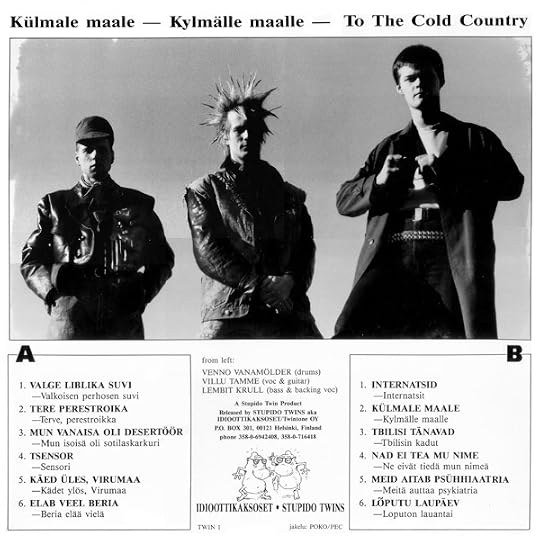
The back cover of the original 1989 LP release on the Finnish label Stupido Twins. Image sourced from Discogs.

I was quite thrilled to see this first time ever 33 1/3 book about an Estonian band and album. Only a few copyediting issues kept it out of a 5-star rating.

Soundtrack
Listen to the 30th Anniversary edition of the full album at a YouTube playlist which begins here or on Spotify here. NOTE: On Spotify you can get the Estonian lyrics to each song and then web translate them to the language of your choice.

Footnote
* There are a few artifacts remaining in the English which hint that an AI translation from Estonian may have been used and copy editing did not catch them. Estonian has no grammatical gender and no future tense (this gives rise to the joke that "Estonians have no sex and no future."🤣). On page 26 the male Villu Tamme is referred to as "she" and on page 29 the band Propeller is described as "his." This sort of gender mix-up occurs when non-gendered Estonian is translated into English.

Trivia and Links
It is explained in the Introduction that the band name J.M.K.E. stands for "Jeesus Maria Karjatas Eit" (Jesus Mary shrieked the hag) which is supposedly from Czech author [author:Jaroslav Hašek|1774448]'s The Good Soldier Švejk (1921). The closest quote that I can find is in Book 1:8 Svejk Goes To War with "„Panenko Maria,“ vykřikla paní Müllerová" (Virgin Mary, cried Mrs. Müller), but the Estonian translation may differ.

The album title originates from Estonian author Eduard Vilde's same-titled novel Külmale maale (1896). The title alludes to the Russian proclivity of forcibly sending dissidents to Siberia (i.e. To the Cold Land), whether in Tsarist or Communist or present day Putinist times.

If you know anything about Estonians you might know that we love our Song Festivals. For a few years there was even a Punk Song Festival that was organized with the mass choir singing the classic songs of Estonian punk. You can watch a choral version of the J.M.K.E. classic Tere Perestroika (Hello Perestroika) on YouTube here. NOTE: A bemused Villu Tamme (with spiked orange hair) looks on from the audience.

There was a preview article posted for this book about the seminal Estonian punk rock album Külmale maale (To the Cold Land) at the Bloomsbury Books 333Sound website which you can read
here. The article includes the video for the J.M.K.E. band's breakout song "Tere Perestroika" (Hello Perestroika) with English subtitles.


J.M.K.E.'s To the Cold Land was published as part of Bloomsbury Academic's 33 1/3 World Music series of books. The 33 1/3 books in the Global series focus on music from the regions of Europe, Oceania, Japan, Brazil, South Asia and Africa. You can search through those at their World Music listing here.
Profile Image for Kalli Talonpoika.
61 reviews2 followers
May 20, 2025
sisu on super, aga inglise keel on sageli konarlik. täidab mitmeid lünkasid
Profile Image for Dimitrii Ivanov.
685 reviews23 followers
January 31, 2025
A careful examination of the album's artistic, cultural and historical meanings, with extensive translation of the lyrics (which are worth the effort indeed), explanations of political contexts, and personal anecdotes. Introduces interesting sources, including interviews with band members and fans, and is rather level-headed yet enthusiastic. The copy-editing is sometimes a little faulty but still reads quickly (it's a short book).
15 reviews
March 24, 2026
tulevik on tunni aja pärast.

palun uut väljalaset, kus on sisseehitatud muusikamängija, et iga laulu kirjelduse juures hakkaks automaatselt laul vaikselt taustal käima. oleks kirss tordil. kuigi samas see idee töötaks vaid ideaalmaailmas, kuna praegusel juhul hakkas peas meloodia kõlama, aga ülla-ülla, mu pea ei suuda mitut asja korraga teha (keskendunult lugeda ja muusikas hõljuda), seega vahepeal oli kohati skisofreeniline tunne
Profile Image for Gerli Köösel.
80 reviews
May 14, 2025
I grew up with punk music – J.M.K.E., especially Külmale maale, has been the soundtrack of my life since childhood. Being a 90s kid, I didn’t experience those times firsthand, but the messages of that album have always resonated deeply with me.

This book gave me a whole new perspective. It was especially fascinating to read the in-depth analysis of the lyrics – to learn what Villu actually meant by certain lines and to uncover the layers beneath the surface.

The book is thoroughly researched and engaging. The author does an excellent job of placing the music in its historical and cultural context, showing just how powerful a form of protest a punk album could be.

After reading this, I now listen to those songs in a completely different way. Truly – this album deserved a book of its own. Huge thanks to Brigitta for such a strong and insightful reading experience. I highly recommend it to anyone interested in punk, recent history, or just good cultural analysis.
Displaying 1 - 5 of 5 reviews