The inspiring story of David Wingate, a living legend among birders, who brought the Bermuda petrel back from presumed extinction Rare Birds is a tale of obsession, of hope, of fighting for redemption against incredible odds. It is the story of how Bermuda’s David Wingate changed the world—or at least a little slice of it—despite the many voices telling him he was crazy to try. This tiny island in the middle of the North Atlantic was once the breeding ground for millions of Bermuda petrels. Also known as cahows, the graceful and acrobatic birds fly almost nonstop most of their lives, drinking seawater and sleeping on the wing. But shortly after humans arrived here, more than three centuries ago, the cahows had vanished, eaten into extinction by the country’s first settlers. Then, in the early 1900s, tantalizing hints of the cahows’ continued existence began to emerge. In 1951, an American ornithologist and a Bermudian naturalist mounted a last-ditch effort to find the birds that had come to seem little more than a legend, bringing a teenage Wingate—already a noted birder—along for the ride. When the stunned scientists pulled a blinking, docile cahow from deep within a rocky cliffside, it made headlines around the world—and told Wingate what he was put on this earth to do. Starting with just seven nesting pairs of the birds, Wingate would devote his life to giving the cahows the chance they needed in their centuries-long struggle for survival — battling hurricanes, invasive species, DDT, the American military, and personal tragedy along the way. It took six decades of obsessive dedication, but the cahow, still among the rarest of seabirds, has reached the hundred-pair mark and continues its nail-biting climb to repopulation. And Wingate has seen his dream fulfilled as the birds returned to Nonsuch, an island habitat he hand-restored for them plant-by-plant in anticipation of this day. His passion for resuscitating this “Lazarus species” has made him an icon among birders, and his story is an inspiring celebration of the resilience of nature, the power of persistence, and the value of going your own way.
What does it take to bring a species back from extinction? Luck and an obsession.
For over 300 years the Bermuda Petrel or Cahow was thought to be extinct. Then ornithologist, Robert Cushman Murphy and Bermuda naturalist, Louis L. Mowbray were sent specimens that they identified as Cahows and launched an expedition in 1951 to find 17 nesting pairs on Bermuda's rocky islets.
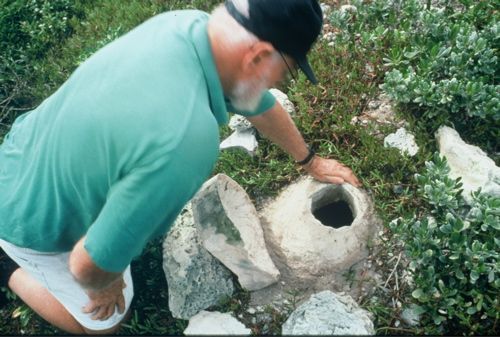
Along on the journey was 15 year old Bermuda-born David Wingate. Until his retirement in 2000, Wingate would devote his life to saving Bermuda's Cahow. It took decades of often back-breaking and dangerous work eliminating pest like rats from selected islets, recreating local flora and even building custom burrows for the nesting sea-birds.
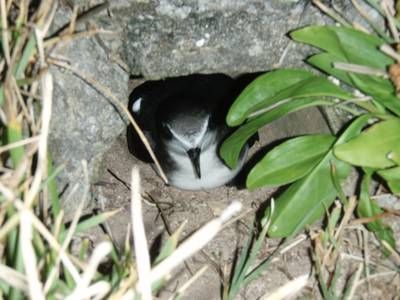
Here's a Cahow at the entrance to his custom nest.
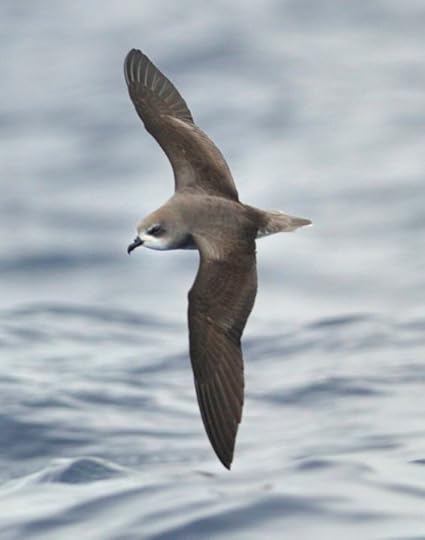
The birds spend most of their lives at sea, only returning to land to mate and raise a single chick each year.
Cahow generally mate for life and like to return to the same burrow each year. Mating activity starts in November and usually by January a single egg is laid. Both mates share the task of raising the chick, ranging as far as Newfoundland and the Azores in search of squid and other delicacies to feed their baby.
These days the cahow colonies and chicks are monitored and maintained by Jeremy Madeiros, Senior Conservation Officer with Bermuda's Dept. of Environment and Natural Resources. In 2018 a record 71 chicks successfully fledged.
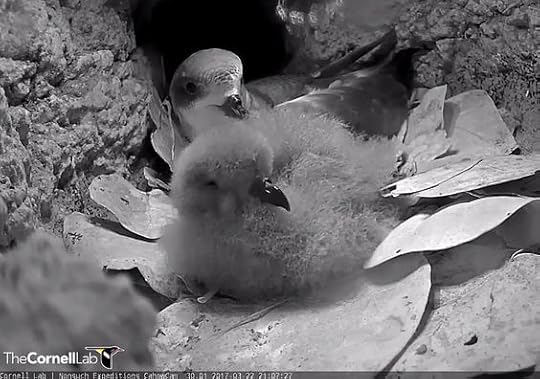
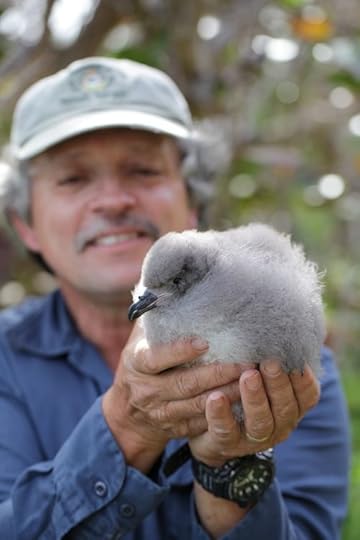
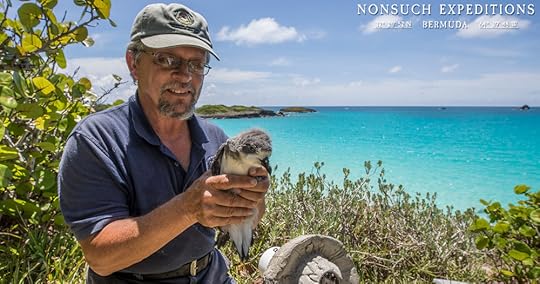
Here is Madeiros with a Cahow chick
And checking a chick that's almost ready to fledge.
There was less about the birds and more about Wingate's sometime tempestuous relationship with the Bermuda government than I would have liked and I was sad that Madeiros and Wingate had something of a falling out about how best to monitor and save the birds. Still, this really is an extraordinary tale and a cautionary one--saving wildlife is never as simple as clicking the "like" button on a WWF Facebook page.
(4 star for lack of pics, 5 for story) I thing I didn’t realize about Bermuda is how isolated (it was) the island is (totally as exotic as Galapagos, Madagascar, dodo island etc, but of course all fucked up now in those aspects) and some of the really neat wonders of evolution on islands in general. Bermuda now though, after 400 years of people, is suffering from sprawl, deforestation, mass extinctions, water pollution, invasive species run amuck, and the home of a visionary, and really, an extraordinary fellow named david wingate. Wingate more or less single handedly brought back the Bermuda petral/ cahor from the very very edge of extinction, AND took over a small island to try and re-populate with indigenous plants and animals, while simultaneously fighting tooth and nail with invasive species. A wonderful book, full of great anecdotes, history, natural history, and birds, author gehrman did a great job! Has one rudimentary map, no pics (criminal really, wtf? Didn’t she even have a smart phone?) and fairly comprehensive bibliography. Also need to mention how utterly fucked up the british are, how brutal their brand of colonialism is, and how hard they work to make it right now.
One of the more difficult tasks in this sort of nonfiction is achieving balance between all the distinct angles available on the subject. Gehrman does an exceptional job, blending the human interest of David Wingate's story with the drama of the cahow's plight and the larger scientific issues involved in endangered species protection and habitat restoration in a skillfully woven whole that remains gripping from the first page to the last. Her writing style is light but precise, ideal for her subject matter. As a result, she's written a book that seems likely to appeal to a wide variety of readers, not just die-hard birders and environmentalists.
I had seen this book on the library shelf for a while but never picked it up until today, but it turned out to be a great story of the restoration of an entire ecosystem in Bermuda that I hadn't heard of. The book is a combination of a natural history of the cahow, or Bermuda petrel, and a biography of David Wingate, the person mostly responsible for creating the nature preserve of Nonesuch Island and rescuing the cahow from near extinction. Both sections were very interesting.
Sometimes when I travel I use the eBird app to find local birders to go birding with. I keep a pair of binoculars in my suitcase and add new birds I see to my Life List. (There are about 10,000 bird species in the world which means I only have about 9700 to go!) Shoutout to Dave who drove me around Nevada looking for Burrowing Owls last year, Jodi who I stood on the edge of a muddy lake with in northern Alberta watching thousands of migrating American Avocets, and Graham who just two weeks ago told me the story of the Bermuda Petrel. Graham told me he’s really into pelagic birding. I had no idea what that meant but turns out it just means “getting on a boat and looking for birds that live permanently on the water”. Lot of birds like that! Puffins, for instance. Just use land for nesting and then back to their rolling human-free paradise. The Bermuda Petrel is an interesting nocturnal squawking seabird that ‘haunted’ explorers for hundreds of years. When Europeans finally settled on Bermuda they released a bunch of pigs, stole all the birds eggs, and rendered the entire species extinct…. in like a decade. OR DID THEY!? Three hundred years later, in 1951, on a tiny set of craggy rocks jutting out from the water, 15-year-old David Wingate was in a boat that spotted a few pairs of Bermuda Petrels. Like that was all of them in the entire world. He then spent his life, the next seventy years, nurturing these birds back from the brink. “He was bawling when I went out with him,” said Graham. “We counted 183 of the birds and he’d never seen that many before.” This book gives a deep journalistic portrait of David, the birds, and, higher level, the ability our notoriously steamrolling-everything species to (perhaps) undo some of the damage we’ve done. Great for environmentalists, birders, and, you know, people who love earth.
I was lucky enough to receive this book as a giveaway through Goodreads from the publisher, Beacon Books, and I am very grateful to them for providing me a copy.
Gehrman, a freelance journalist, does a reporter's job with the story of David Wingate and his mission to save a bird that was once thought to be extinct--the Bermuda petrel--and the effects his mission had on the country of Bermuda. Wingate's monomania to protect the petrel and other indigenous plants makes for a fascinating story.
But as a causal reader, the book kind of failed me. The book primarily focuses on Wingate and not the petrel--Wingate was the first conservation officer on the island of Bermuda and did some amazing things to help preserve native species of plants and animals, and the list of things he was able to accomplish is rather mind boggling. But for me, I was hoping to learn all about the story of an animal species that was thought to be exinct, and when the Bermuda petrel all but disappeard from the story Gerhman was telling, I lost much of the interest I had in reading the book.
If you go into this book knowing that it it the story of an environmentalist who was able to make great strides into preserving local flora and fauna with nothing much more than his own willpower, you will love this book. If you go into it thinking it's going to be the story of a bird brought back from extinction, you're going to be sorely disappointed.
How many people would devote their entire life to saving animals? Not many, so it's a good thing we have David Wingate and his love of nature and birds. The lengths him and his family went to just to make sure that we didn't lose the petrels is amazing. When we lose a species, we all lose but our children and grandchildren are the biggest losers. I may not live in Bermuda, but I know that those who do are very thankful for his intervention. I actually found myself cheering on one little chick that couldn't make it back up the cliff to the burrow. To know that it was saved made me smile.
I found this book in a used book store in New York and thought it must be an old book--but it was written in 2012. You have to love birds, nature or conservation to enjoy this book, but I think it is a fascinating story of a man dedicating his life to the recovery of one species of birds, the Bermuda Petrel, that everyone thought was extinct for many years. It was an all consuming matter for him---and even his wife, with a proper British background, went and lived on a very small island with no electricy or running water much of the time to support him.
I found learning about the conservation history of Bermuda and the Bermuda petrel in particular very interesting. The focal character, the scientist who recovered the bird, I found difficult to like, although reading about him was interesting and his dedication admirable.