The first section consists of the entire text of the diaries which Bion wrote as a young man to record his experiences on the Western Front, including his photographs and diagrams. The second section comprises two essays in which he reflects on his war time experiences.
These clichés do nothing to convey an impression to anyone who had not had the experience but to me - sixty years later - their very banality recalls that immensely emotional experience. The behaviour, facial expression, and poverty of conversation could give an impression of depression and even fear at the prospect of battle. Fear there certainly was, fear of fear was, I think, common to all - officers and men. The inability to admit it to anyone, as there was no one to admit it to without being guilty of spreading alarm and despondency, produced a curious sense of being entirely alone in company with a crowd of mindless robots - machines devoid of humanity. The loneliness was intense; I can still feel my skin drawn over the bones of my face as if it were the mask of a cadaver. The occasional words exchanged echoed like a conversation heard from afar. ‘Wipers’, ‘Yes, the Salient’, Guns sound a bit frisky.’ ‘Awful - but cheer up - you’ll soon be dead.’ ‘You’ve said it.’
— Wilfred Bion, 1972
I have a curious obsession for books with recollections from the Great War and over the years I have read many. This book took me by surprise as a very intense and moving personal memoir.
Wilfred Bion (1897-1979) is primarily known as a very influential thinker-practitioner in the areas of psychoanalysis and group dynamics. Early on he served as a junior officer in a British tank unit in the First World War. His memoirs were written soon after the war, when he was just 21 years old. During his sojourn in France he found himself unable to write letters home and upon his return he proceeded to inform his parents of what he experienced during the military campaigns in Flanders and France. This diary was never published and it was only in the early 1970s that Bion’s spouse, Francesca, decided to make a typescript. This was published as a book only after his death, in 1997.
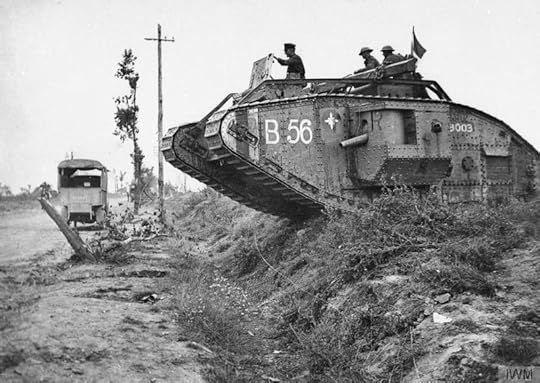
Bion was first exposed to battle during the Third Battle at Ypres and later moved to France where he was involved in the battles of Cambrai (1917) and in the great battle of Amiens that opened the Hundred Days Offensive and ultimately led to the end of the war. Tanks were new on the battlefield and very unsophisticated fighting machines. They were useful to force passage through barbed wire defences and to provide psychological support to infantry troops, but as offensive firepower their impact was minimal. Bion’s report leads me to believe they were genuine death traps due to their slowness, lack of manoeuvrability, mechanical unreliability and perfunctory armour.
The diary is written in a rather plain idiom and displays an occasional juvenile streak. But in its understatement and directness it makes a big impression. The savagery of war grabs the reader by the throat. Bion complemented his story with hand-drawn maps and his own pictures which are of surprisingly high quality. The book also includes an unfinished, third person and slightly fictionalised narrative that centers on the Amiens battle, written by Bion in the 1950s after a moving visit to the north of France. I didn’t read it as I didn’t want to dilute the impact of the 1920 diary.
The introductory quote is drawn from a short interlude, written in the form of a conversation between two characters: the inexperienced young man who wrote the diary and the wise old man who looks back at seventy-five. It’s a very candid and poignant exchange that dances over the scars that Bion's front experience had left.