Simon^^^^^^^^^^^^ Lee (12 spaces) is Associate Professor in the History of Art, University of Reading. He specializes in French and Spanish art of the eighteenth and nineteenth centuries, particularly the work of Jacques-Louis David, Eugène Delacroix and Francisco de Goya. His particular interests are in the relationship between the visual arts and the social and political upheavals of the Revolutionary and Napoleonic periods. Lee is the author of Phaidon’s A&I series volume on the French Neo-classical painter David (1999).
“To achieve their goal, masterpieces must charm but also penetrate the soul and make a deep impression on the mind that is similar to reality. . . Therefore, the artist must have studied all the motives of mankind and he must know nature thoroughly. In short, he must be a philosopher.” - Jacques Louis David
David is one of my favorite artists and his approach to art is simply what made me fall in love with painting. I have always loved his Oath of the Horatii, as I believe his rendering of Camilla to be one of the most beautiful figures in art.
Quick notes: Not much needs to be said about the book itself - it’s a great book for learning about David. The author, Simon Lee, provides enough historical context to understand the artist and his analysis of the art is simply outstanding, as he provides strong detail but doesn’t drag on. I simply loved his commentary. David’s life is so so fascinating, he was one of the few artists that was actually at the center of historical events.
So, with regards to David’s works themselves some are home runs and other are misses for me. Some political undertones are fine and expected but I’m not that interested in the overtly political pieces, as I think they destroy the the role of what art is. “Politics,” Stendhal states in the Red and the Black, “is a stone attached to the neck of literature, which, in less than six months, drowns it. Politics in the middle of imaginative interests is like a pistol-shot in the middle of a concert. The noise is deafening without being emphatic. It is not in harmony with any of the sounds of instruments.” Therefore, I do not find his painting during the revolution very agreeable. But this isn’t the place for this review.
Favorite Works: 1. The Farewell of Telemachus and Eucharis 2. The intervention of the Sabine women 3. Oath of the Horatii 4. Leonidas at Thermopylae 5. The Funeral Games of Patroclus 6. Belisarius Begging for Alms 7. The Death of Socrates 8. The Lictors Bring to Brutus the Bodies of His Sons
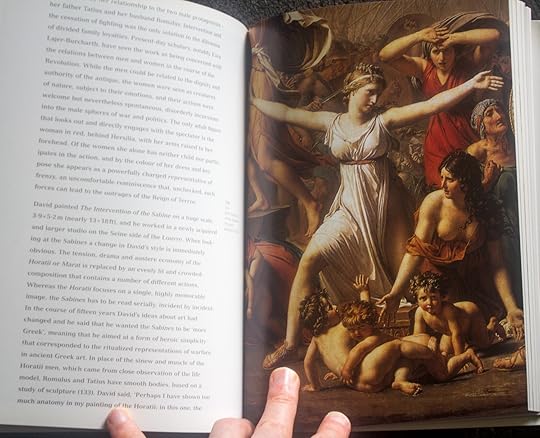
Quotes and Notes: - Pleasure, fantasy, delight and escapism were the principles behind this style that later became known as the Rococo. - Rococo paintings might be a feast for the eyes, but they were a famine for the soul and spirit. Enlightenment critics and writers claimed that art should not simply decorative and sensual. They urged artists to create an art of substance, that would touch the emotions of the spectator while at the same time educating, improving and providing models of behavior. Diderot proclaimed: ‘First move me, astonish me, tear me to pieces; make me shudder, weep and tremble, make me angry; then soothe my eyes, if you can.’ - Boucher said Vien was a good painter but ‘a bit cold’, and told David to, ‘come and see me from time to time and when you bring me your work I will correct Vien’s coldness and teach you my warmth’. - (French Academy in Rom schedule) Students we’re to rise at five in the summer and draw the life model from six until eight, when the light was at its best, and in winter to work in the evening under artificial light. A rigorous programme of drawing and making copies in the Vatican museums, in churches and in palaces also existed, and paintings of the students’ own composition had to be sent back to Paris for assessment. A student’s social life was also regulated: they had to be back inside the Academy by 10pm in the winter and 11pm in the summer. - (On his early works) a command of drawing was fundamental to the development of David’s style; a mastery of the purity of line allowed for a purging of the decorative and the inessential. - Belisarius is a painting about charity, sympathy, dutiful patriotism and the reversal of fortune. - His work was continually cited by critics such as Diderot as the prime example of the noble, severe and intellectual qualities of painting, and was seen as a model for the regeneration of French art. - Diderot speaking of Belisarius painting, ‘I see it every day, and each time I think I am seeing it for the first time (in a paraphrase of Racine’s Bérénice, Act 2, Scene 2). This young man works in the grand manner, he has a soul, his faces are expressive without being contrived, the attitudes are noble and natural, he can draw, he can dispose drapery and make handsome folds; his coloring is fine without being garish.’ - He repainted the left foot of Old Horatius at least twenty times before he was satisfied. - Because of its austerity and depiction of dutiful patriotism, The Oath of the Horatii is often considered by some writers to be the clearest expression of Neoclassicism in painting. - (On the Horatii) it’s uncompromising directness, economy and tension made it instantly memorable and full of visual impact. Each of the three elements of the picture – the sons, the father and the women – is framed by a section of a Doric article, and the figures are located in a narrow stage-like space. David split the picture between the masculine resolve of the father and brothers and the slumped resignation of the women. Camilla in the white dress, Sabina in the blue and yellow, and nurse with the children all avert their eyes from the oath-taking, and only the young boy, whose future duty will also be to bear arms and defend the homeland, is allowed to watch. The focal point of the work is occupied by the swords that old Horatius is about to distribute to his sons, thus capturing a moment just prior in the passing of power and authority from one generation to the next. While the rear two brothers take the oath with their left hands, the foremost one swears with his right. Perhaps David did this simply as a way of grouping the figures together, but people at the time noticed this detail, and some supposed that this meant that the brother in the front would be the one to survive the combat. - It might even be argued that the Horatii story, if taken as a whole, is less of an example of Enlightenment secular virtue than it first appears, since it advances a form of patriotism where violence is seen as the ultimate solution, and the price of personal attachment and sensitivity, as paid by Camilla, is death. - He (David) eloquently summed up his attitude to the Academy in a most forthright way: ‘The Academy is like a wigmaker’s shop; you cannot get out of the door without getting its powder on your clothes. How much time will you waste in forgetting those poses, those conventional positions into which the professors force the model’s torso, as if it were a plucked chicken?’ - So the Brutus, like the Horatii, became a painting about conflict between duty to the nation and love of the family, and also about how men and women respond differently to such a dilemma. - (The Oath of the Tennis Court) the violence of the weather is suggestive of an act of cleansing from which the land emerges renewed and invigorated. - (Horatii, Socrates, and Brutus) their direct and heroic messages seemed even more compelling and topical than before and it was even said that ‘they inflamed more souls for Liberty than the best books’. - (Symbolism of the king) As the king had always proclaimed that he was the state and ruled by divine right, it was as if France had turned on and executed herself. - “I am prevented from returning to my studio, which alas, I should never have left. I believe in accepting the honorable, but extremely difficult, task of legislator, that a righteous heart would suffice, but I lacked the second quality, understanding.” - Portraits, of course, were ideal vehicles for David at this time because they were politically neutral subject matter and free from the possible controversies of interpretation that history paintings could bring. - (Sabine) David decided to contrast the violence of the rape [Poussin’s previous depiction] with the pacification of the intervention. The image of family conflict in the Sabines was a metaphor of the revolutionary process which had now culminated in peace and reconciliation, and the subject had both a general and a personal relevance to him. France itself was returning to normality and recovering from the shock of the reign of terror, factional strife had diminished and political refugees were returning from exile. The painting was also a tribute to Madame David, and a recognition of the power of women as peacemakers. - Present-day scholars, notably Ewa Lajer-Burcharth, have seen the work as being concerned with the relations between men and women in the course of the Revolution. While the men could be related to dignity and authority of the antique, the women were seen as creatures of nature, subject to their emotions, and their actions were welcome but nevertheless spontaneous, disorderly incursions into male spheres of War and politics. - In the course of fifteen years David’s ideas about art had changed and he said that he wanted the Sabines to be ‘more Greek’, meaning that he aimed at a form of heroic simplicity that corresponded to the ritualized representations of warfare in Ancient Greek art. In place of the sinew and muscle of the Horatii men, Romulus and Tatius have smooth bodies, based on a study of sculpture. David said, ‘Perhaps I have shown too much anatomy in my painting of the Horatii; in this one, the Sabines, I will hide it with more care and more taste.’ - Thus the heroic intervention of the Sabines women is played out against a backdrop associated with an infamous dimension of the female character – based greed (pg. 206) - The fact that the sisters offered to pose for David at all is somewhat surprising, and signifies the healing of old wounds and forgiveness of past actions – during the Revolution he had signed warrants for their arrests. - The Greek purity of the Sabines, when contrasted with the Roman drama and theatricality of the Horatii, shows us that David’s art continued to evolve and was by no means static. His style reflected changes both in himself and in the society around him and as such was neither cold nor detached. Although it may seem odd that David chose to paint a Roman subject in a Greek style, this was a time when a return to simplicity pervaded both art and fashion. Ancient Greek art was seen to be genuine and unaffected, giving it a moral and aesthetic superiority over more sophisticated Roman art. - He also wanted his students to be well educated and neat of habit and appearance - ‘a painter should be a man of order.’ - Napoleon was so keen to talk to David that he is supposed to have switched the place cards around so that they could sit next to each other. - (David’s opinion on Napoleon bringing back captured art) He observed that, ‘the arts are not naturally loved in France; the taste for them is artificial. You can be sure that, in spite of all the enthusiasm which we see these day, the masterworks from Italy will soon be regarded only as curiosities … The sight of these masterpieces will perhaps produce scholars, men like Winckelmann, but artists - no!’ - (David on Leonidas at Thermopylae) “I want to endow this scene with something more serious, more reflective, more religious. I want to paint a general and his soldiers preparing for a battle like veritable Spartans, knowing full want that they will not be spared; some absolutely calm, others weaving wreaths of flowers in preparation for the banquet they will attend in Pluto’s domain. I want neither movement nor passionate expression, except on the faces surrounding the man who inscribes on the rock: passerby, tell Sparta that her sons died for her.” - To emphasize the fervent patriotism of the Spartans, David once again includes an oath, and behind Leonidas the young soldiers lift up wreaths above two altars dedicated to Hercules and Aphrodite. Hercules was invoked for strength and courage but also because Leonidas and all kings of Sparta were supposed to be descended from him. - The values derived from the past that had governed enlightenment thought – reason, logic, order and human perfectibility – were unable to explain the horror and misery of recent events. Such changes were best explained in terms of organic and dynamic processes rather than by mechanistic and rational conceptions. Many artists came to consider that expression replaced imitation as the goal of art, and the term ‘romanticism’ began to be used in an attempt to define the new currents and directions that were developing in reaction to the inability of Neoclassicism to capture the enormous changes in society and the individual suffering that had occurred. - (On David’s exile) Barère recounted that, when they were talking about France, ‘I saw a wave of sadness pass over David’s face; for some time he did not speak, but sought a secluded seat whereon to rest with me… David only broke the silence with these words: ‘Amor patriae’ (Love of one’s own country). Inevitably, there were also traces of bitterness and anger – David wrote that: ‘I have never ceases to be persecuted, tormented in my work by all of the most odious means, and if heaven had not favored me with a certain resolution I would have succumbed.’ - Wellington informed David that he wished to have his portrait painted. This request was unceremoniously dismissed, with the artist saying: ‘I have not almost reached the age of seventy just to dirty my palette. I works rather cut off my own hand than paint an Englishman… I do not paint the enemies of my country.’ - (David on Gros’ proposal so apologize to receive a pardon from France) ‘Never speak to me again of things I ought to do to get back. I do not have to do anything; what I ought to have done for my country I have already done. I founded a brilliant school; I painted classic pictures that the whole of Europe came to study. I have fulfilled my part of the bargain; let the government now do the same.’ - Cupid and Psyche is meant to disconcert the viewer. Mythological painting depends for its effects on the creation of an ideal fantasy world distanced from everyday reality, but when we get the combination of the real and the ideal, as with the figures of Cupid and Psyche, the result is unexpected, unsettling and discordant. - Telemachus stares out at us with an expression of regret and sadness at his departure, while Eucharis throws her arms around her lover’s neck, making the most of their last moments together. I’m contrast to the list and desire of Cupid and Psyche, Telemachus and Eucharis has as its theme love, fidelity and painful separation. - Many artists when they reach out age become anxious about how posterity and future generations will judge them. Some are eager to make sure that their best works are in major collections, others try to buy back their old work with which to surround themselves (David’s pupil Ingres was later to do this). Another common characteristic of elderly artists – painters, writers and composers – is a profound sense of independence or isolation and a loss of the desire to communicate. The artist wants to be taken on his or her own terms with few concessions to anyone else, and so the results are often highly personal. In painting, we can think of Titian’s highly expressive and technically breathtaking works, and also of Francisco Goya (1746-1828), two years older than David, who, in 1819, removed himself to La Quinta del Sordo (The House of the Deaf Man) outside Madrid and produced powerful and aggressive virtuoso works on the absurd nature of humanity for his own private consumption and with little regard for the public’s gaze. Though we can see that David’s work at this time became more personal, he never cut himself off from the artistic life around him. - David wrote touchingly: ‘I feel my imagination to be as vivid and as fresh as it was in the first part of my youth, I compose with the same facility all of the subjects that come into my mind; but when I pick up my pencils to sketch them onto the canvas, my hand refuses.’ - To view the close proximity the Horatti, Sabines, Coronation and Leonidas in the louvre leaves one marveling at the breadth of invention and clarity of thought and purpose.
This reminds us of virtue The prose and style of this monograph of David by Mr. Lee is as limpid and unalloyed as the Grand Style of the master whose life and works he lays bare. I speak from a personal attitude to art when I say that I had never been truly moved by a painting, other than perhaps the usual Impressionist or Romantic flurry of color and nature, without first being exposed to the story behind it. However, such depictions as The Oath of Horatii and the Death of Socrates struck a chord with me because their intellectual history coupled with the muscular expressions and poses have always given me a sense of a call to action, of edifying Roman virtue. To get more of this story behind the paintings and of the man behind the brush, I chose Mr. Lee's smaller Phaidon monograph over the large-scale, visual ones also available. Now I am grateful I did, doubly moved by the nobility of David's works but also by the acutely and humanly flawed arch of his character. A youth less than a prodigy, a petty, vindictive, ambitious upstart who challenged the engrained artistic system of the Academy only to see it replaced by the more élite Institute; a friend of Robespierre and a loyal admirer of Bonaparte, a devoted husband and father and a teacher who inspired a generation of artists but was often jealous of their successes––David was all of these and more. But, rather ironically, he was always true to his own self as an artist and fiercely independent, even though the Romantics that came after him accused him of academic strictness and stagnation. Nothing could be further from the truth, as this book pointedly shows. David, in his art and life, was first and foremost an artist, and nothing could force him to compromise his style. Napoleon, during his 100 days from his return from Elba to the fateful Battle of Waterloo, visited David's studio one last time to congratulate the First Painter on the finished Leonidas at Thermopylae, unaware that fate would soon deliver him his own Thermopylae at the hands of the British and the Prussians. He said: "Continue David, to illustrate France. I hope that copies of the picture will soon be hung in military academies: they will remind cadets of the virtues of their calling."
This book was recommended by my brother, whom David is his personal favorite artist. I read this in the week approaching our trip to the Louvre, so that I would have context for his paintings.
David was a really fascinating and conflicting person, and the author does a good job contextualizing the works within French revolutionary history.
I'm slightly embarrassed to say that we learned basically no French or Napoleonic history in high school (good job British public school system). This book has provided the bulk of my education on this part of history, which I'm thankful for. I have always felt left out of discussions on this part of history, but now I feel I have the fundamentals down. Such is the legacy of one who wished to be the best historical painter of his time.
You couldn't find a better introduction to Jacques-Louis David. David is one of the most interesting artists to read about, as his life is heavily intertwined with major historical events. Simon Lee's book follows David's conquest of the French art world at a time of socio-political upheaval, including all the context you could want in an accessible, narrative way. Even complex art theory is broken down so that someone fresh to the subject can understand. The book is full of beautiful reproductions, as well as close-ups of the artworks, sketches, studies, and even works by other artists to compare styles and illustrate how they competed with/influenced each other.
Lee comes at David's life and works from many angles, supplementing the straight-forward biography with information about revolutionary France, the paths of professional artists of the time, and the catalysts that pushed David towards a new style (such as the archaeological discoveries at Pompeii and the philosophical writings of Voltaire and Denis Diderot). As an artist, I was giddy to see David's sketches, studies and practice runs of his famous artworks, and reading about David's trial-and-error process of planning and composing each painting. I found this book informative and inspiring for my own work.
Though this isn't the most technical or theory-heavy work on JL David, Lee's narrative biography on this master French artist is perfect for someone wanting to jump into the subject. This book is now out of print and remaining copies are pretty expensive, but if you're interested in art theory/history and can find this at a reasonable price, I highly recommend it.