

What do you think?
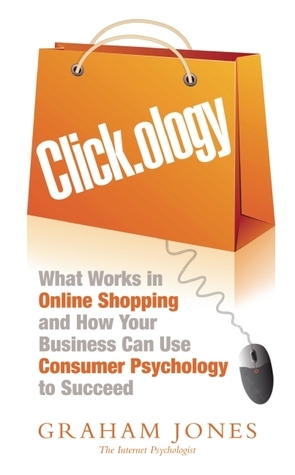
Click.ology: What Works in Onlline Shopping and How Your Business Can Use Consumer Psychology to Succeed
Online shopping continues to grow at an astounding rate: in 2012, more than $1 trillion was spent in online retailers alone. The nature of shopping is drastically changing, but with so little information on how best to interact with online customers, how are businesses to succeed?
With Click.ology, internet psychologist Graham Jones has filled that gap. Through years of research into Internet psychology and online consumer habits, Jones has written the first how-to of its kind for online businesses. With his C.L.I.C.K. system, businesses will learn the crucial ways in which online shopping differs from traditional brick-and-mortar salesmanship and how to tweak their websites to avoid the dreaded "abandoned shopping cart." Jones tackles tricky psychological subjects such as priming customers for a certain price point and the social aspect of online shopping in a way that makes his strategies easy to implement. In addition to these essential tips, Jones investigates the fast-paced future of ecommerce and what businesses can do to stay ahead of the game. In an online world where customers make their choices in a matter of seconds, Click.ology distills the essentials every company in the online economy needs to know in order to turn clicks into dollars.
Graham Jones is an internet psychologist who helps businesses understand the online behavior of their customers and website visitors. He was one of the first psychologists in the world to start investigating the way human behavior has adapted to the online world. He lives in the United Kingdom.
With Click.ology, internet psychologist Graham Jones has filled that gap. Through years of research into Internet psychology and online consumer habits, Jones has written the first how-to of its kind for online businesses. With his C.L.I.C.K. system, businesses will learn the crucial ways in which online shopping differs from traditional brick-and-mortar salesmanship and how to tweak their websites to avoid the dreaded "abandoned shopping cart." Jones tackles tricky psychological subjects such as priming customers for a certain price point and the social aspect of online shopping in a way that makes his strategies easy to implement. In addition to these essential tips, Jones investigates the fast-paced future of ecommerce and what businesses can do to stay ahead of the game. In an online world where customers make their choices in a matter of seconds, Click.ology distills the essentials every company in the online economy needs to know in order to turn clicks into dollars.
Graham Jones is an internet psychologist who helps businesses understand the online behavior of their customers and website visitors. He was one of the first psychologists in the world to start investigating the way human behavior has adapted to the online world. He lives in the United Kingdom.
- GenresPsychologyBusiness
200 pages, Paperback
First published December 9, 2013
About the author
Graham Jones
17 booksGraham Jones is a leading internet psychologist and has spent the past 15 years analysing how consumer behaviour has adapted to the web. He is an Associate Lecturer at the Open University and a Visiting Lecturer at the University of Buckingham.
Ratings & Reviews
Friends & Following
Create a free account to discover what your friends think of this book!
Community Reviews
Displaying 1 - 7 of 7 reviews
February 11, 2021
Very informative.
I took a lot of notes and it also inspired ideas of my own.
There is a portion of information that I didn't really feel applied to what I would need. But it was nice to see that information.
Recommend for those who have an online store or are looking to have one.
I took a lot of notes and it also inspired ideas of my own.
There is a portion of information that I didn't really feel applied to what I would need. But it was nice to see that information.
Recommend for those who have an online store or are looking to have one.

October 14, 2025
Decided to re-read this book and it is very outdated. Some few good basics.

April 4, 2018
Good
Easy read and fun
Recommend to everyone wants to know about digital marketing
I will buy the other books of the author.
Easy read and fun
Recommend to everyone wants to know about digital marketing
I will buy the other books of the author.

January 2, 2014
Disclaimer: While I aim to be unbiased, I received a copy of this for free to review.
Click.ology promises to teach you what works in online shopping, and it's written by a guy who ought to know his stuff - Graham Jones, 'the internet psychologist'. I was skeptical at first, but I quickly came round to Jones' lucid writing and his simple explanations of the psychological concepts which guide users around the internet in search of products.
Packed with advice and information, it's backed up by thorough citations and excellent case studies, like that of Meat Pack. Meat Pack is a Guatemalan shoe store chain, which used location-based mobile marketing to 'steal' customers from rival stores. When one of their app users entered a rival shop, the app knew where they were and delivered an offer for 99% off at Meat Pack. The catch? The discount reduced by 1% every second, giving people about a minute and a half to run to the store. And run, they did - over 600 people claimed their discount in the first week alone.
Click.ology promises to teach you what works in online shopping, and it's written by a guy who ought to know his stuff - Graham Jones, 'the internet psychologist'. I was skeptical at first, but I quickly came round to Jones' lucid writing and his simple explanations of the psychological concepts which guide users around the internet in search of products.
Packed with advice and information, it's backed up by thorough citations and excellent case studies, like that of Meat Pack. Meat Pack is a Guatemalan shoe store chain, which used location-based mobile marketing to 'steal' customers from rival stores. When one of their app users entered a rival shop, the app knew where they were and delivered an offer for 99% off at Meat Pack. The catch? The discount reduced by 1% every second, giving people about a minute and a half to run to the store. And run, they did - over 600 people claimed their discount in the first week alone.

March 15, 2014
Lots of good info backed up with references.

Read
June 21, 2014i want to read
This entire review has been hidden because of spoilers.
June 12, 2016
Decent book with some practical suggestions
Displaying 1 - 7 of 7 reviews