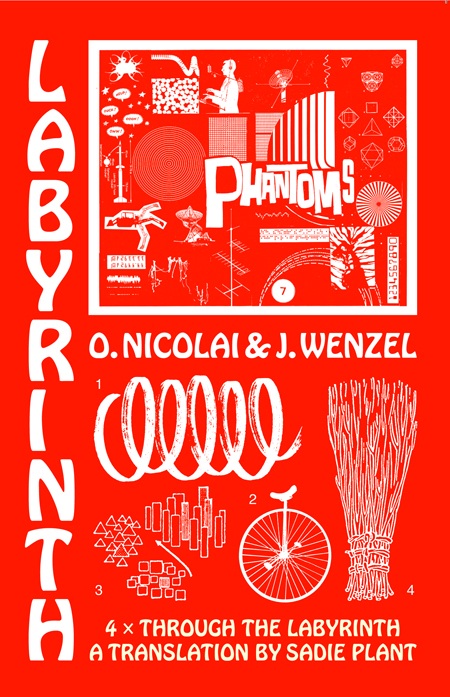
After reading Neuroplasticity by Moheb Costandi and Finite and Infinite Games by James P. Carse, I decided to read this book. The back cover of Four Times Through the Labyrinths includes the following questions:
1.) "Does one's sense of direction improve, the more one knows? Or is it even harder to find the way when one knows how easy it is to get lost?" This reminded me of Costandi's explanation of a cab driver's training and the resultant increased grey matter density of their hippocampus. As one learns to navigate their city, however, it becomes more difficult to acquire different spatial knowledge… "This comes at a price, however-qualified London taxi drivers appear to be worse at acquiring new visuospatial information than others…" (Neuroplasticity p.95)
2.) "How does the labyrinth make us so ready and willing to play its games?" This reminded me of the inevitability of finite play as described by Carse in Finite and Infinite Games. Finite play can occur within infinite play, however, it is possible to lose sight of one's infinite play when overcome by finite aspirations. Here are a couple of quotes from this book, Four Times Through the Labyrinth, that I think readers of Finite and Infinite Games may enjoy:
"To go for goal or linger on the way - one must constantly decide between these options or pursue a mixture of them in line with the form of the labyrinth." (p.210)
"In 'Man, Play, and Games', Roger Caillois writes that although we enter into games voluntarily, the particular choices we then make are determined by the nature of our thoughts about the ways in which our decisions are affected by internal impulses and external forces - ways of thinking that govern how we play. So the games we enjoy suit the ways in which we think. We put this principle to work; we externalize and control it to the extent that we control the game. But a game also grips us: we play, and are played by the game as well." (p.148-149)
Additional Notes:
The first section, Urban Life/Migration, describes Jan Pieper's interpretation of the myth of the labyrinth and minotaur as the Greeks' reaction to the stone cities, especially Knossos, found on the island of Crete. These Minoan cities… p.46 p.50
Dancing p. 18 - The crane dance depicted on Achille's shield (and other sources) suggests that exiting the labyrinth may have been achieved through dance. Similarly, I believe dancing is the ultimate form of people experiencing and co-producing space. Dance as mind/body coordination. Dance as space-making. Dancers feel the spaces they inhabit through their grace, power, and confidence.
As a city is constructed, materials are extracted from the earth and utilities are tunneled thus creating an excavated, undermined network. During the eighteenth century, entire streets in Paris collapsed due to such material extraction (p.57) The catacombs were the result of overflowing cemeteries (p. 58)
The second section, Game/Control,
Dancing in the church (gothic churches had labyrinthine patterns in their Nave floors) and dance denied (these flooring patterns were later demo'd) and dance as play (demo'd largely because kids played on them and this was a distraction) p.109-112
It was not until the Renaissance, and Giovanni Fontana, that mazes veered from their unicursal bent and started incorporating alternative routes and dead ends. p.119-121
With this advancement, Labyrinths could also be considered the act of decision-making when there is an abundance of choice options p.124
The third section, Orientation/Disorientation, asks "Why did Theseus need Ariadne's thread to extricate himself from the labyrinth? Did it grow more complex the longer he was there?"
"Gottfried Wilhelm Leibniz coined the term 'relational order-space to define such spaces in terms of the relationships between the things it contains…" p.179 I believe there should be a hybrid planning strategy that includes ordered boulevards and option scenic routes for play and discovery within the zones bounded by the boulevards.
The dérive of the situationists.
p.192-97 failure of Halle-Neustadt to assign numbers to buildings.
p.211 "the material precondition for a playful atmosphere [a layout that offers a sense of disorientation], in which people's movements are determined neither by the ways in which the space is planned nor by the rhythms of the day." Pynchon "feet will find steps that are their own against the day and its demands." (Mason and Dixon)
p.224 Michel de Certeau's comments regarding high vantage points "This elevation turns one into a voyeur, puts on at a distance. The world which had held one bewitched and 'possessed' is spread out like a text before one's eyes, to be read as though by a solar eye or the gaze of God. The elation of a scopic, gnostic, impulse: to be nothing but this pure viewpoint - this is the fiction of knowledge."
The fourth section, Garden/Camp, describes Daedalus' labyrinth as one of Michel Foucault's "heterotopia, a place beyond all others, the flip-side of society." It thus "gave evil a location." Because of this, the minotaur which "was destined to neither life nor death" became a target. It further masked the unknown compounding the fear caused by the unknown. p.249 The essay goes on to discuss the entanglement of biological and mechanical systems. I figured there would be a discussion of bio-engineering/biofabrication but it didn't which is probably for the best because this connection to the myth seems like a stretch. Instead it focuses on AI and brings up Claude Shannon (he is mentioned elsewhere in the book), instrumental to information theory, and his inventions such as the Mind Reading Machine and Theseus Mouse.
p.283 Camps take two forms: training camps and camps of exclusion. "To banish the living or maximize its potential - the parallels between labyrinth and camp come down to this simple formula. Both exclusion and education are technologies designed to secure the state…" (p.286)
p.291 Israels army training site "Chicago"