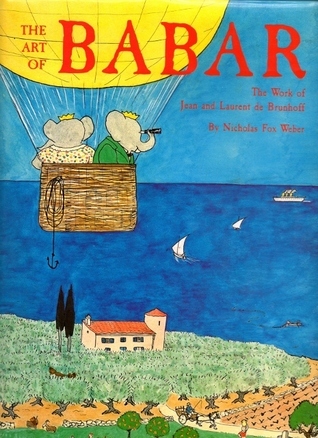
His tales translated into 17 languages, Babar the elephant fled the jungle and entered Western civilization in 1931 in a book by the de Brunhoffs. Here, for the first itme, is a fascinating look at the story behind Babar and his creators. 280 illustrations, 256 in full color.
Nicholas Fox Weber is a cultural historian and Executive Director of the Josef and Anni Albers Foundation. He has written extensively about both Josef and Anni Albers and curated many major exhibitions and retrospectives dedicated to their work. He is a graduate of Columbia College and Yale University and author of fourteen books including Patron Saints, The Art of Babar, The Drawings of Josef Albers, The Clarks of Cooperstown, Balthus, Le Corbusier: A Life, and The Bauhaus Group.
On the plus side, there's lots of great art here, some from the books but most of preparatory work, and most in colour, so visually, this enhances one's understanding of the Babar universe and its creation. I also found Weber's comments on the art specifically, especially when he was discussing influences and technique, frequently interesting, though I am no expert so cannot speak to haw accurate what Weber says (admittedly, at times I did wonder whether he was stretching things). Seeing some of the other work by the de Brunhoffs was also a plus. On the minus side, the tone is often breathlessly adulatory, and it glosses over, understandably but arguably unfortunately, some of the problematic aspects of the series. For instance, Weber does mention the racist imagery in the second book in the series, and informs us that Laurent also withdrew one of his books due to such imagery, but there's not really anything meaningful in the way of commentary about such imagery, beyond the usual "they were different times" stuff. There's a lot of speculation about, as well as elision over, what I would assume to be important facts about the lives of the de Brunhoffs, even for a book that is on their art, rather than being a biography. Nevertheless, I do feel like I learned something about the art of and associated with Babar from this book.
Admits in one place that the stories are colonialist, but wrongly identifies the why/how, lacks any further analysis. Plus there's a few additional moments in the intro where you wince.
*Very* fluffy descriptions of the art itself, though it was a bit confusing that the whole Laurent section was solely color sketches, and none of the finished line art as had appeared in Jean's. Probably legal reasons, but the lack made the writing about it feel potentially mis-applied.
I used while teaching the Babar books. It shows the original drawings and changes made. I had seen an exhibit of de Brunhoff's illustrations at Walter's Art Gallery in Baltimore years ago and this brought back fond memories.