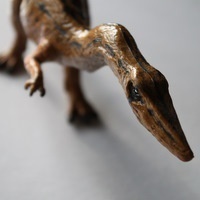
Colbert (Museum of Northern Arizona) explores the excavations at Ghost Ranch, which have yielded thousands of fossilized remains over the past 50 years of Coelophysis bauri , the 200-million-year-old ancestors of the giant dinosaurs. Color and b&w photos and illustrations chronicle the search for the reason so many of the small dinosaurs died in one place in this narrative introduction to the study of fossil life. Annotation copyright Book News, Inc. Portland, Or.
_The Little Dinosaurs of Ghost Ranch_ by Edwin H. Colbert is a delightful, well-illustrated, and informative book written by the man most responsible for what we know about _Coelophysis bauri_, an important early dinosaur. Writing that one can view this book as a "paleontological case history," Colbert recounted not only the discovery and excavation of the famed mass burial of these little dinosaurs in New Mexico but also what is know of their anatomy, physiology, environment, and what the study of these animals has revealed about dinosaurs in general.
Originally on his way to prospect for fossils in Petrified Forest National Park in June of 1947, George Whitaker and the author (both working for the American Museum of Natural History in New York) and Tom Ierardi decided to investigate a promising fossil deposit on some privately owned land in New Mexico known as Ghost Ranch. The area was known to have produced phytosaur fossils and they only expected to spend a few days there. What instead happened was the beginning of decades of work as Colbert and others over the years came to work on a mass concentration of not "the huge bones of the giant dinosaurs of song and story" but instead the tiny bones of "ancestral dinosaurs."
Colbert described in detail the excavation of these 200 million year old fossils in the "colorful rounded badlands" that so entranced famous painter Georgia O'Keefe (who by the way lived nearby and befriended the scientists). The fossils were "exceedingly fragile," not only because the bones were very small and slender and the leg bones and vertebrae hollow, but because of the nature of their fossilization. They could disintegrate easily into tiny fragments if mishandled. The fossils had to be removed in huge sections instead of relatively thin slabs as the sandstone and siltstone that comprised the Chinle Formation at Ghost Ranch was very friable and liable to collapse. They had to be carefully, painstakingly, and sometimes dangerously removed in huge blocks, coated in thick plaster, burlap bandages, and a supporting framework of wood and then laboriously hauled out of the quarry. Eventually close to thirty blocks were removed from Ghost Ranch.
Of course removing the blocks from the quarry was just the start, as years were spent preparing the blocks. Though generally the lab preparation time and labor on a fossil takes more than ten times the work expended in the field, Colbert estimated that it took something "on the order of twenty to one" for _Coelophysis_. The fossils had to be removed from the rock by hand using jeweler's hammers and small chisels and treated with hardener; even the small, electric vibrating tools, commonly used in paleontology, would quickly reduce the fossils to powder.
Very early in the preparation stage the scientists made discoveries. Some fossils preserved the stomach contents of some of the dinosaurs, only the second time this was known from a carnivorous dinosaur and fascinatingly it revealed that _Coelophysis_ was a cannibal! Other interesting tidbits include the discovery of a "giant" _Coelophysis_ eleven feet long (most were usually six to eight feet; what was the ultimate size limit for this species?) and the fact that in almost all the specimens the lower jaw was tightly locked in place against the skull (evidence that the animals were buried so soon after death that muscles still held the lower jaws tightly in place rather than the skull and jaws becoming separated as is common with dinosaurs).
Colbert provided information about the history of the study of this dinosaur before the Ghost Ranch excavations, centering on David Baldwin of Abiquiu, New Mexico, who found the original _Coelophysis_ fragments in 1881 and Edward Drinker Cope of Philadelphia who first described them in 1887 (first it was placed in genus _Coelurus_ and later in genus _Tanystrophaeus_ before Cope named it _Coelophysis_ from Greek koilos meaning "hollow" and physis meaning "form, nature").
A chapter is spent on a quarry survey, describing the nature of the deposit, the climate at the time, and how the animals might have died and then been quickly buried. Though they apparently died in such numbers due to some catastrophe, there is much disagreement on its nature. Colbert discussed theories relating to volcanic activity (there are no volcanic sediments anywhere near the fossil deposit), poisoning perhaps from drinking water from a highly alkaline pond (unlikely as their bones indicated being deposited and buried by stream currents, not in the still waters of a lake), predator trap (unlikely also, as few individuals are maimed and there is very little disarticulation), and asteroid impact (Ghost Ranch "hardly qualifies for a "Wagnerian twilight"" as it was a local event). Most likely it was due to hunger or thirst from a drought or from drowning while crossing a flooding river.
Another chapter is spent on the anatomy of _Coelophysis_, notably on the key features of its skull and jaws, its vertebra, its tail and the role it played in balance and movement, and its bird-like feet with five toes, only three of which were functional.
A chapter on its lifestyle showed us what tracks attributed to the animal revealed about its physiology and speed (it seems to have been able to reach maximum speeds of fifteen to twenty miles an hour), what analysis of Haversian canals in the bones revealed about its growth rate and physiology, the complicated issue of just what it means to be "warm-blooded," and discussed issues relating to diet, cannibalism, possible congregation in age groups, the size and shape of their eggs, and what their senses might have been like.
Colbert also discussed the ancestors and descendents of _Coelophysis_, how it was one of a very few late Triassic dinosaurs, residents of a largely non-dinosaurian world, and how it established the pattern followed by later small coelurosaurs, ostrich-like struthiomimosaurs, dromaeosaurs, and the tyrannosaurs.
Colbert does not neglect the animals that shared the world with _Coelophysis_ and discussed contemporary amphibians, reptiles, other dinosaurs, pterosaurs, and early mammals.
What an enjoyable read! A first-hand account of the discovery of a very important bone bed in New Mexico, written by one of the scientists who found it. There is a lot of biographical detail here, including memories of Georgia O'Keeffe, but the narrative doesn't skimp on hard science for those who are interested in just how these fossils fit into the history of life on Earth.
This is a good book, probably more like 3.5 stars for me, but one I feel a prospective reader should be a little careful of.
Colbert does a great job discussing his activities at the Ghost Ranch fossil quarry, the Coelophysis and its biology, how it fits in dinosaur evolution, etc. It is very informative, and the figures/tables were A++.
But it is not the easiest read. This is a book by a professional scientist. He was writing almost 30 years ago, and by that point had been working in the field for over 50 years. These things show in his writing style and the information included. There are multiple digressions into geologic time scales, how geologic formations are delineated and named, anatomical specifics for Coelophysis and multiple other species, etc. All of these things have a place in the book, but that also means it has a lot of technical detail. I am not an expert on dinosaurs or geology, but I am likely more knowledgeable on the topics than the average person, and I was lost a couple times in the technical jargon. Colbert did a pretty good job of then bringing it back in to explain the conclusions and why they matter, but it is a tougher read than many other dino books I have read.
So for that reason, even though I would really rate this 3.5 out of 5, I would urge the prospective reader to be careful. This should not be one of the first dino books you pick up. But if you do have a good background in the subject, you will likely enjoy, as I did, the deeper dive into one species and its environment, even if the book is a little dated (Colbert's rejection of dino feathers and discussion of the quite recent development of plate tectonic theory were gems).
My rating might be a little unfair since I didn’t read the whole book, but only the chapters that most interested me about the first discovery of Coelophysis ( New Mexico’s state dinosaur) at Ghost Ranch in the late 40s, Georgia O’Keeffe’s visit to the quarry, and the discussion of these little Triassic dinosaurs in the larger picture of dinosaur evolution. What I found especially interesting was Colbert’s comments about the « serendipity of discovery « . If you are interested in paleontology, scientific discovery, Ghost Ranch history, this is a very readable account of an amazing discovery.
Coelophysis, an early theropod dinosaur, is scrutinized from all angles following its inital discovery at Ghost Ranch in the 1940's. Although this book was a very long time in coming, Dr. Colbert fortunately was able to get his involvement down on paper just a few years before his death in 2001. This book is a great read for the scientifically-minded; however, the casual reader may find the anatomical and geological terminology intimidating. You may want to have a few reference books handy while reading as I did. The beginning of the book deals with the story of how Coelophysis was found with a bit of history concerning Ghost Ranch. The author then covers subsequent excavation in the 80's and moves rapidly into what was learned from the fossil-containing blocks that were removed and sent to various museums throughout the country for cleaning and study. Colbert focuses mainly on the blocks he and his museum personally studied, although the most interesting features of other museum's specimens are mentioned. He writes about the implications of Coelophysis' skeletal features in life and how the dinosaurs at Ghost Ranch might have died. The book concludes with a fairly thorough overview of possible ancestors, descendents and contemporaries of Coelophysis as well as the type of environment Coelophysis probably inhabited. Colbert leaves no stone unturned up until the time of this writing, and leaves room for future Triassic paleontologists to fill in the blanks as we continue to approach a more complete understanding of the prehistoric world.
I am fortunate to live within a days' drive of awe-inspiring Ghost Ranch and I plan on spending many future weekends exploring the area and pondering the Triassic landscape where Coelophysis once roamed and Dr. Colbert once got his first glimpse of these amazing dinosaurs.