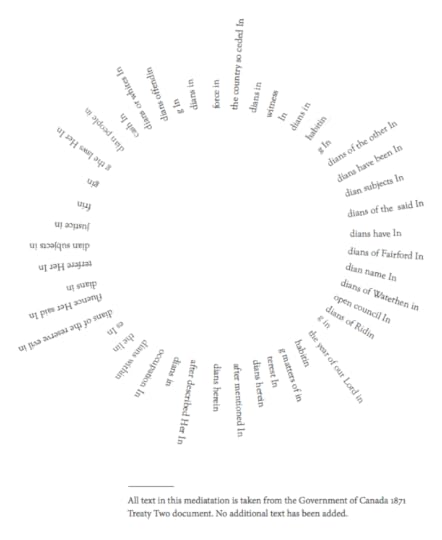
One of the first lines of X , Shane Rhodes' sixth book of poetry, is a "this book of verse demands more of verse, this book demands perversity." He goes on to
This book is about where I live, a place still settling, still making the land--law by law, arrest by arrest, jail by jail--its own snow blown
Heed this warning. In X , Rhodes takes poetry from the comfortable land of the expected to places it has seldom been. Writing through the detritus of Canada's colonization and settlement, Rhodes' writes poems to and with Canada's original documents of finding and keeping. He writes a poem to each of the eleven numbered treaties (the Post Confederation Treaties between many of Canada's First Nations and the Queen of England)--he writes to the fonts he finds in Treaty 5, the river he finds in Treaty 6, and the chemicals he finds in Treaty 8. Rhodes' writes poems to and with the Indian Act.
Beyond the treaties, Rhodes writes formal poetry using Indian status registration forms. He writes to the memory of Oka. He writes to the Government of Canada's Apology for the Indian Residential School System. He writes to the procreating beavers he finds in the Royal Charter of the Hudson Bay Company. X culminates in "White Noise," a long poem grown from Canada's collective rants, threats, cries and shouts in response to the Idle No More protests and the hunger strike of Chief Theresa Spence.
Through out the book, Rhodes surprises with what poetry and art can actually do with the seemingly unsalvageable and un-poetic that surrounds us. The design of X is also exhilarating. Not only is the book reversible--it must be read in two directions--but every page bursts with design, interference and thought.
X sings a new national anthem for Canada, an anthem stripped of patriotic fervor that truly sings of the past many would rather forget and the current state of Indigenous/settler race relations in Canada, an anthem fit for "a land held by therefores, herebys and hereinafters."
from the mouth thence northward to the centre of White Mouth Lake issuing therefrom to the mouth thereof in Winnipeg to its mouth in the mouth of Drunken River and the mouth of Swan Creek set the hand (Broken Finger)
- body of text, pg. 33
* * *
- circle the wagons: in ink, pg. 52-53
* * *
cedE ReleASE
surENDer and yieLD
fOr his majeSTy
all THeir rights titlEs
pRIVileges whatsoevER
that iS to say: OF apprOxImateLy three hundred AND square mILeS seventy-twO thousand
more that just a simple book of poems - this book explores and pushes past the black and white stories that are told about Canadas history and calls for settlers to take account. Both in the words and themes and also in the structure of the book. Did not really love the poetry but I did really enjoy the use of structure and images.
This collection of poetry is rather unusual and modern. It features several types of poetry like erasure, found, flarf, visual and concrete poetry. The most interesting poem in the collection is the ‘anti-poem’ “White Noise” at the end (or the beginning, depending on which cover you start from) of the book. “White Noise” is a long, flarf poem. Composed of internet comments found in several places, “White Noise” is a veritable masterpiece of flarf poetry. Rhodes explains the poem as having been filtered out of over 15000 comments on newspaper articles, videos, and journal entries alike, all concerning the Idle No More movement begun in Canada in 2012. Many of the articles concerned Chief Spence’s hunger strike that stretched from December in 2012 to the end of January in 2013. The comments range in tone from anger to sadness, pity to racism, bullying to support, and intellectualism to spelling mistakes. “White Noise” reminded me of “The Waste Land” by T.S. Eliot. In the same way that Eliot juxtaposed various characters, voices, languages and ideas, Rhodes does the same thing with the vastly different way internet commenters utilise their media. Each new comment seems to represent a very different view than any other, often juxtaposing informed opinion with naivety, blind rage to self-discrimination, and harassment to sympathy. As changeable from comment to comment as the Canadian government is in the poems earlier in X, “White Noise” is tedious and simultaneously riveting. It drowns out the issues put forward in the rest of X, as I suspect is the intended point. While the rest of X discusses the hardships that Native Americans went and continue to go through, “White Noise” so successfully drowns them out in a perfect representation of reality in Canada. The issues are present and pressing but are fogged by the immensity and irrelevance of the comments made on the subject of Native American rights. The erasure poems are a rather interesting example of this as well. Several forms related to Native Americans in Canada, such as an application for Indian Status, have had erasure performed on them resulting in general silence pierced by the words Rhodes kept. The erasure poems wipe away the fog to reveal the tender core of the issues, undoing what “White Noise” demonstrates so successfully. The poem “Preoccupied Space” is also very interesting in relation to this, mostly because of its title. The space in the media that Native Americans feel is designated for issues pertinent to them is preoccupied with nonsensical arguments that beat around the issues without addressing them. Rhodes’ poems do what they say while simultaneously saying what they do. They address and ignore the topics they discuss, using the very papers the topics originate from. This collection is extraordinarily self-reflexive and filled to the brim with issues all about Native Americans. On that basis, I would recommend it to anyone who is interested in Post-Post-Modern poetry, or Native American issues in Canada.
Hey, Everyone! Please check out my interview with Canadian poet Shane Rhodes as we discuss Native Indian rights and his latest collection X (Nightwood Editins, 2013). Read the interview and 2 poems from X on my TTQ Blog now. http://thetorontoquarterly.blogspot.c...