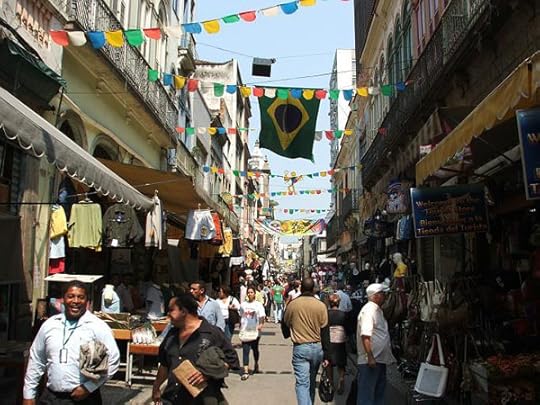
The setting for this witty and insightful debut crime novel is a Rio de Janeiro, Brazil, family hotel. Rio is the perfect backdrop with its history of military dictatorship, drug wars, child gangs, and violent policing tactics. The decapitated body of a hotel resident is found. The eyes have been removed from the head, casually left on the floor of the room. The victim's eerie, frozen Mona Lisa smile seems to indicate that the murderer had been received as a friend. According to the police, the victim was stabbed in the heart and died before the decapitation. As the investigation continues, with few leads or clues worth pursuing, other hotel clients are found dead; all decapitated, usually with the head found delicately balanced on their knees. This classical crime novel provides an opportunity for Frei Betto (a Dominican friar, once a political prisoner, a union activist, and then an adviser to President Lula da Silva) to describe Brazilian society, especially those left at its edge, like Rio's favela children, abused, hunted-down, but also addicted to drugs and violent crime. The book tells the fascinating back stories of the hotel residents, suspects, and eventual victims, such as the maid who dreams of making it in television soaps, and the female pimp who has survived incestuous rape, while being faithful to a suspenseful intrigue that could have been thought up by Ruth Rendell. Brazil will receive much attention as host of the 2014 Football World Cup and the 2016 Olympics.
Frei Betto, born 1944, is a Brazilian writer, political activist, liberation theologian and Dominican friar. He was imprisoned for four years in the 1970s by the military dictatorship for smuggling people out of Brazil. In addition to work on eliminating hunger in Brazil, Frei Betto is involved in Brazilian politics. He worked for the government of President Lula da Silva as an advisor on prison policy and child hunger.
The mystery in this novel is a shell for the real story focused on the life of a group of urban folks in Brazil living at the lower end of the class spectrum. Don’t read this if you are a real mystery fan looking to figure out the culprit from the clues or seeking a tightly-knit police procedural. There are no clues or evidence, just headless bodies with their eyes gouged out showing up in a hotel. Yes, all the characters are interviewed by the hapless police detective each time there is a murder but the detective never figures it out, although the reader knows on the last few pages. The detective’s conversations with the hotel guests simply shed light on their lives and the interactions among the hotel residents.
The hotel is really a pension where these folks live. The real action occurs in their conversations in TV lounge and around the boarding room style dinner table.
And what a fascinating bunch of single, lonely, financially struggling people we have. The main character is a former teacher who writes and spends time helping poor kids in trouble with the police. There is an elderly semi-retired gemstone merchant, his socks showing through the holes in his shoes, who will try to sell you a ruby or an emerald. There’s a young female housecleaner waiting for her chance to be discovered and to become a star in Brazil’s famous telenovelas (soaps) industry. There’s the old madame, her face caked with a pound of cosmetics, whose line to her girls is “you aren’t a puta peddling yourself on the street; I have the men come to you.”
We also have a black nightclub singer who is a transformista. And then there is the part-time journalist whose goal is to solve the crimes before the police. There’s one way to make yourself a prime suspect. There’s the custodian; the first to be accused because – well he’s the custodian, and the police have to arrest somebody, don’t they? There’s a Marxist political aide and hanger-on. (If he’s so well-connected and important, why is he living in this place?) And maybe another half-dozen other fascinating characters including the cat-loving old lady who runs the pension: “Don’t ever touch my broom.”
We have some romance as our main character starts falling in love with a woman he is working on a story with. And there is the glue-sniffing 12-year old prostitute the two are helping hide from the police.
In the course of the novel the real story becomes an indictment of Brazil’s corrupt law enforcement system. Fear of crime rules a lot of public life. The police use that fear as authorization to do what they want. The cops and judges are in on it, getting a take of what is stolen and sometimes ordering the crimes in advance and selling stolen goods back to those victimized.
The author knows what he is writing about. He is a Dominican friar and a political activist. He was imprisoned for four years under Brazil’s military dictatorship in the 1970’s and he was an adviser to former President Lula da Silva on two topics in this novel; child hunger and prison policy. This is a good read with a lot of local color of modern Brazil. It reminds me of two other good novels set in modern Brazil: Blackout and Turbulence.
Top photo from daytours4u.com Bottom photo from reports.travel.ru
It's a good book, but contains some gory descriptions. If you're bothered by gore, you can pass this book.
The atmosphere and descriptions are very good. The story line is nice, but not exceptional, however it makes you want to read and finish the book as soon as possible.
For me, Hotel Brasil was as much an allegorical tale about the state of Brasil as a country as it was a murder mystery. As with Alone in Berlin, where each floor of the house represented a different social group in wartime Germany, each resident in the Hotel Brasil represents a different constituency and varying social ills, and the murder case and travails of Candido, the central character, reveal the ways in which Brazilian society is structured and run. When taken in that context, it’s a fascinating literary tale of social inequalities and divides, corruption, and morality, with a glimmer of hope running throughout. In this sense, it is not a conventional murder mystery and those readers expecting such might find the tale not quite to their taste. I thought the structuring of the text was cleverly done and the prose was engaging and often witty in subtle ways. And despite its literary sensibilities, Betto does keep the reader guessing as to the identity of the murderer until the very end. A book I’ve been thinking about a fair bit since finishing.
SET IN RIO, readers does get a look inside the barrancas of the favelas, but a bit disjointed as a police procedural, more an existential noir of a corrupt society. Confucians say (in a round about theory, circular that is) a leader is virtuous is she is incorrupt. if corrupt, they are not a leader. all hell breaks out in corrupt rio.
not remotely as you might expect from the subtitle, can see how this would frustrate the usual crime fiction reader who is looking for some exotic taste to mystery, some gruesome, some logistically or procedurally challenging mystery. this is mostly a portrait of Brazilian society. the murders can best be interpreted symbolically- though this only makes sense after you read a chapter vividly recounting arrest, torture, rape, pregnancy of one woman. headless, eyeless, yes perhaps it is most effective, this is postmodern genre fiction that takes you other than simple crime fiction...
This is not in any sense a whodunnit or police procedural. Rather it's an occasionally humorous, slightly satirical gloss on the unsatisfactory state of life in Rio.
O que se inicia como um promissor romance policial, logo se torna um melodrama desempolgante. O autor tem o interesse de falar de vários assuntos ao mesmo tempo, o que leva o foco do livro pra um caminho completamente oposto ao que é proposto: o que deveria ser sobre uma investigação policial, logo se torna sobre os sentimentos conflituosos de um personagem água de salsicha.
Investigação policial essa que, ao se tornar inexistente, desperdiça um personagem interessantíssimo na narrativa: o delegado Del Bosco, um personagem que poderia ser brilhantemente desenvolvido como metáfora pra incompetência e abuso de poder policial, mas que é renegado à escanteio no momento em que Frei Betto esquece que estava escrevendo um romance policial. Não apenas o Del Bosco é esquecido, mas toda a gama diversa de personagens que alugam os quartos do Hotel Brasil é completamente esquecida no momento em que Candido toma controle da narrativa.
Um livro sem foco, sem força, e que não engata além da segunda marcha.
finished this afternoon of the 12th of january 2020 (note to self, check other reviews from this year, make sure i've got the year right...for the exam at the end of the week) good read four stars really liked it, liked the setting, the various characters, was somewhat confused by the sporadic use of portugese wondered why...the translator? left those words as is though reading this library loaner on the kindle works since you can call up the translation, definition, so forth so on. and the telling is interesting, too, for the different spices thrown in, variations on themes, different narrative points of view you know the drill, a section italicized and one character candido has a kind of...something...alter ego? ummm...something, and he has short conversations with such and another...monica...same thing only her tellings are in letter form. hotel brasil. first, too, from betto.
Very disappointed in "Hotel Brasil". The book starts out with an acceptable plot premise and some decent writing. From there it's a slow trek downhill. After some slow plot development, the author appears to get bored and takes some tangential (at best) diversions. The original plot goes nowhere as we are seemingly expected to invest in newly introduced characters. The book loses focus and one starts to wonder if the author had several short stories he decided to force into one novel. The writing deteriorates and seems rushed. The book ends with a "happy ending" for some of the characters and a patched on seemingly contrived ending to resolve the initial plot. Not worth your time.
Frei Betto apresenta neste livro um interessante mistério em um hotel, com 8 suspeitos bem diferentes. Então para de focar nisso e passa a maior parte do livro em algo bastante sem graça.
A escrita é rica e densa com adjetivos e caminhos pouco usuais, que deixam a leitura um pouco mais poética, mas raramente acrescentam dimensão aos personagens ou a história.
Eu entendo como uma pessoa pode gostar do livro - se apreciar a história secundária, o estilo da escrita - mas pra mim, foi um potencial desperdiçado. O melhor que se pode dizer é que, fugindo da trama inicial que se propõe, também foge do lugar-comum.
3.6 stars. The murder mystery is only a small fraction of this book and I wasn’t too intrigued with the Bia and Monica side stories. I was glad to finally find out who the killer was but I wish we had more of that, less random mini stories
Li este livro em português. É um bom livro. Bem amarrado em sua trama. Frei Betto leva o leitor até o final imaginando quem é o culpado por uma série de mortes. É um livro do gênero policial da melhor qualidade.
Frei Betto (aka Carlos Alberto Christo) is a Brazilian writer, political activist, and a Dominican friar. He has an interesting biography, which includes being imprisoned for four years as a political prisoner by a dictatorship in Brazil starting in 1969 for smuggling ten people out of Brazil. He was involved in "liberation theology" and social justice and visited with Fidel Castro and Mikhail Gorbachev. Betto's book on his interviews with Castro became a bestseller in the 1980's. Betto again met with Castro in February 2014.
Hotel Brasil is Betto's first English-translated book although he has previously published dozens books. The translation is by Jethro Soutar and the translated book is well-done, conveying Betto's prose in a rich way. It is a murder mystery, subtitled the mystery of the severed heads and involves a rundown guesthouse or residential hotel in Rio de Janiero where one of the residents is found murdered, his head severed off his body, and his eyeballs stolen. The police inspector (Del Bosco) then, as in a classic who-done-it mystery, interviews each of the residents of the hotel, positing possible motives for the murder.
The story is more about the characters in the hotel and they are all characters. In particular, it is about a reporter and editor named Candid0, who is a resident of the hotel and who also counsels the street youth of Rio, attempting to protect them from police abuses, and who ends up sheltering a twelve-year old streetgirl who escaped from juvenile detention house. Candido roams the city on his motorbike, especially at night. By day, Candido read his numerous books and dreamed. The story does document numerous police abuses and the fact that the streets of Rio are swarming with abandoned or runaway youths in the various favalas. The book legitimately has a South American feel and is more poetic than hardboiled with a feel that is more Gabriel Garcia Marquez than Raymond Chandler or even Agatha Christie.
The story begins with the discovery of the severed head: "He'd seen it out of the corner of his eye, without meaning to see it. Now he couldn't believe what he saw: a head lying dumped on the floor." The victim was Seu Marcal, and older man who dealt in gemstones and lived in the hotel. Marcal had the "honey-tongued tone of a man whose business it was to make money while letting customers think they were getting a bargain."
It is a rich, lush book filled with prose that gives the reader a flavor of Rio de Janiero, the crime, the corruption, the poverty, the abuses heaped upon the street children who were ever-present. It tells the story of numerous characters and their motivations. The focus is on Candido, although he does not narrate the story. The crime story, though, is the background for this glimpse of Brazilian life.
This is only nominally a mystery. Frei Betto wanted to illuminate the problems of Brazil in 1999 and while the book starts of with a grisly murder the focus of the book are the inhabitants of the hotel. The book is a character study of people from different classes. Yes, the murder is solved but that is not what is important.
Located in the heart of Rio de Janeiro, Hotel Brasil is a respectable if somewhat shabby establishment for long term guests. When the decapitated, eyeless corpse of one of the residents is found in a bedroom, the lives of the other lodgers are thrown into chaos. A cloud of suspicion hovers over the building as the police are certain the murderer must reside within. The list of suspects includes: the reputable editor Professor Cândido, Marcelo the tabloid journalist, the well-connected ministerial aide Pacheco, a colourful cross-dresser known as Diamante Negro and the elderly ex-prostitute Madame Larência. To say nothing of the humble janitor, soap opera-mad maid and cat crazy hotel owner. But who from among them could have committed such a heinous crime?
This is a thoroughly enjoyable murder mystery with a social conscience. The narration alternates between the diverse range of protagonists and through their eyes you are introduced to the underbelly of Rio society, from the abused, drug addicted street children to the corrupt and violent police force, as well as being given an insight into Brazil's tempestuous past.
The writing style takes a bit of getting used to, as the book is divided into small sub-headed paragraphs and it is not always immediately obvious who is narrating, but it is well worth the effort. Flawlessly translated with an exquisitely executed plot, Frei Betto's first foray into the crime genre is a resounding success.
Probably closer to 3.5 stars. I did initially pick this up as a detective/thriller read and figured the Brasilian setting could make things interesting. Reviews suggested that it wasn't so much a detective story but more an existential take on the state of Brasil, which actually interested me even more. I took it for what it was and liked it. I must admit I was a bit of a sucker for the little 'love story' in there too :P
Mais clichet impossível, os personagens são verdadeiras caricaturas e as situações absolutamente previsíveis. Talvez o autor tenha desejado mesclar o mundo do Cortiço de Aluísio Azevedo à uma trama policial tipo Agatha Christie e o resultado foi desastroso. Apesar de curto e rápido de ler por suas letras grandes, a sensação que se tem é de se estar lendo um livro que não acaba.
Will start this tonight or tomorrow... Like to read it before the pub date on March 18. Sounds really good and might make a great book group tie-in with the World Cup coming up in Brazil this year.
Kitaba 4 yıldız verdim ama çevirisi için aynı şeyi söyleyemeyeceğim. Kötü bir çeviri. Ayrıntı yayınlarının Portekizce'den doğrudan çeviri yapan çevirmenler varken neden İngilizce'den bir çeviriyi tercih ettiğini merak ediyorum.