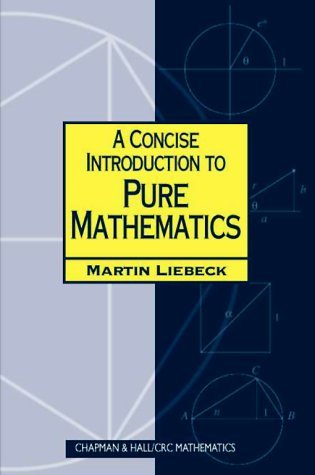
For many students interested in pursuing - or required to pursue - the study of mathematics, a critical gap exists between the level of their secondary school education and the background needed to understand, appreciate, and succeed in mathematics at the university level. A Concise Introduction to Pure Mathematics provides a robust bridge over this gap. In nineteen succinct chapters, it covers the range of topics needed to build a strong foundation for the study of the higher mathematics.
Sets and proofsInequalities Real numbersDecimals Rational numbersIntroduction to analysis Complex numbersPolynomial equations InductionIntegers and prime numbers Counting methodsCountability FunctionsInfinite sets Platonic SolidsEuler's Formula
Written in a relaxed, readable style, A Concise Introduction to Pure Mathematics leads students gently but firmly into the world of higher mathematics. It demystifies some of the perceived abstractions, intrigues its readers, and entices them to continue their exploration on to analysis, number theory, and beyond.
Good book to give to a student yet to apply to university and who is considering a degree in mathematics. Can also make for a fun read over Summer for a student who will be pursuing a maths degree once the term starts. Easier to sink one's teeth into and requires less mathematical maturity than something like Spivak's Calculus yet stills maintains the flavour of undergraduate mathematics - thereby making it a better fit for students who are either yet to settle on studying maths or whose backgrounds at such a point in time may not yet be strong enough to cope with a more challenging text (i.e. Spivak). Particularly able prospective maths students with stronger backgrounds will likely get more out of self-studying either Spivak's Calculus or Apostol's Calculus Volume I.
Questo libro è fondamentalmente un'introduzione all'analisi matematica e all'algebra che si studiano (negli USA) nel primo anno di università, il che significa che è tranquillamente alla portata di un liceale nostrano dell'ultimo anno, tenuto conto che le dimostrazioni più complicate sono omesse.
Rispetto a quello che ricordo io del mio primo anno di matematica, il livello è molto più basso; sarà che la facoltà di Pisa voleva mantenere la sua fama e teneva corsi molti teorici, però garantisco che non lo si può certo usare come libro di testo, o forse sì ma per informatica. Ciò detto, non è che sia da buttare: è scritto in maniera molto scorrevole e quindi permette una lettura agevole. Non garantisco sulla difficoltà degli esercizi, che ovviamente non ho nemmeno provato a risolvere, non avendone al momento necessità alcuna; dateci comunque un occhio, perché alcuni sono carini almeno come formulazione... sempre che apprezziate i giochi di parole matematici.
Interesting and challenging but pure maths is so slow to read 😭
I had to use this for Fundamentals of Pure Mathematics. Painful proof course. The median mark was 45% on a course that requires an A* in A-Level Mathematics. Ouch.
Though – in fairness – it was Year 1 (Edinburgh is 4 years), and didn't count to your degree classification, so I presume a lot of us were just using the year as an opportunity to have fun and acquaint with university life; which, ostensibly, means less work done? (I certainly crammed)