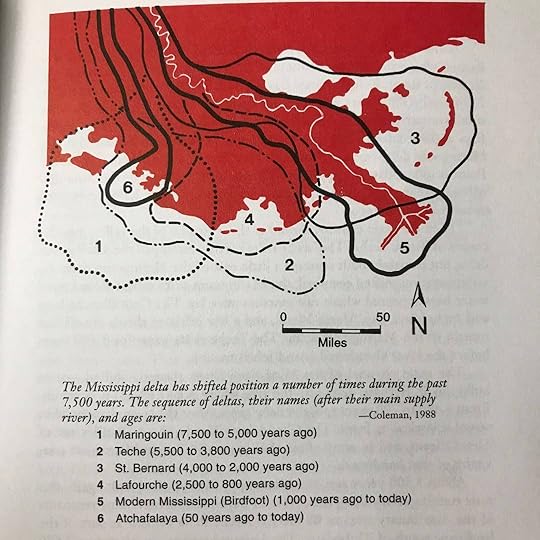
After Hurricane Katrina, the fanlike pile of sand, mud, and silt that formed near a breached levee was unique in the urban environment of New Orleans. Over the 7,500-year history of the modern Mississippi River delta, however, it was just another splay deposit. Author Darwin Spearing explains the geologic forces behind the formation of the delta, shedding light on the human struggle to control the powerful river that breaches its own levees and switches its own deltas. With sections on wetland loss and land subsidence, Roadside Geology of Louisiana is a must-read for understanding the vulnerability of the Mississippi River delta to floods and hurricanes.
First published in 1995, Roadside Geology of Louisiana is back in print by popular demand, with several updated sections. The introduction presents an overview of Loiusiana's geological history, and 57 road guides discuss the landforms visible from a car window, including sand ridges, natural levees, oxbow lakes, and the Five Islands salt domes.
Louisiana is a pretty young place, without a whole of rocks on the surface, and those mostly being pretty soft and friable, making for terrible outcrops. Everything on the surface, except the salt domes*, is tertiary or younger in age, or less than last 60 million years old. But that doesn't fully capture it. The whole southern part of the state, everything within the lines at the link above, formed in the last 7500 years, all since the last ice age.
What Louisiana lacks in rocks it makes up for in living natural processes, in the interplay and movement and control of massive rivers and the Gulf of Mexico. The Mississippi and Red rivers have never been stable. They have moved dramatically, switching valleys, building large deltas, and then abandoning them to slowly sink. The Mississippi's birds-foot delta is only 600 years old (with documented settlement during half its life, since the 1700's). The Mississippi would have switched itself to the much shorter Atchafalaya river in 1973, a major flood year, if there weren't structures in place to prevent it. (Barely. Those structures physically shook throughout the flood.)
The book itself is an entertaining overview. It is supposed to be designed for a reader to check out the sections they are driving trough. But, as I learned with Spearing's book on Texas, it reads best if read straight through, if you have the time. Recommended basically to those who likely have already decided to read it.
*An extra note on those salt domes: The salt is ~160 million years old, but is light and mobile and gets forced upward though younger rocks. It has formed local diapirs that occasionally reach the surface, dragging older rocks up with them. In places they create local rises, such as what are called the fives islands where the land rises over a hundred feet above the surrounding flat marsh. You can pick them out on Google Maps (Satellite view).
-----------------------------------------------
59. Roadside Geology of Louisiana by Darwin Spearing published: 1995 format: 220-page paperback acquired: August 2020 read: Nov 20-25 time reading: 8:43, 2.4 mpp rating: 4 locations: 😊 about the author: publisher website says he was exploration geologist in Louisiana and now lives in Colorado.