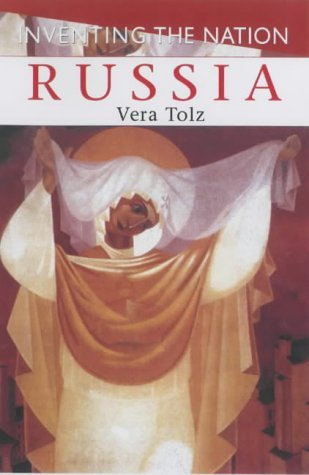
The question of national identity is central to the future of Russia. In this analysis, which spans three centuries of Russian cultural history, Vera Tolz places post-communist Russia in a broad historical background. She focuses on three ways of defining Russia and Russia as a counterpart to the West; Russians as creators of a unique multi-ethnic community; and Russians as members of the community of Eastern Slavs. She demonstrates how these three perspectives have dominated the views of Russia in the modern era and traces their origins back to writers and historians in the eighteenth century. Combining a rich historical study with a rigorous analytical framework, the book is an essential tool for understanding contemporary Russia and its immediate future.
Vera Tolz’s Russia is a contribution to the Inventing the Nation series by Oxford University Press, a project which explores questions of nationalism and nationality as constructed identities, and has produced volumes on such contested spaces as Ireland, China, and India and Pakistan. As such, its purpose is not only to introduce students to the standard chronology of modern Russian history – which it does admirably – but also to provoke readers to consider the historicity of nations as “imagined communities,” as they have been termed by Benedict Anderson. Anderson further defined the nation as “imagined as both limited and sovereign,” and it is the question of its limitation through defining itself against an “other” (the West), that Tolz’s text focuses upon. Her argument is that Russia’s ambiguous relationship with its “other” (sometimes imitative, sometimes rejecting) led to a situation in which “Russian nationalist discourse…had a negative effect on the Russian nation-building process” (Tolz, 15). This argument is presented over the course of 8 chapters, most of which are organized thematically, with two introductory chapters which give a chronological view of the early process of modern state-building in Russia under Peter the Great and Catherine the Great. The third chapter, far and away the longest and best-developed, focuses on Russia’s construction of its “other” in the West, followed by a more desultory discussion of Russia’s construction of an “other” in the East. The next three chapters look at the problems of Russian identity that have resulted from this process, and the final chapter as well as a brief conclusion, consider Russia’s problems as a nation in the post-Communist world. Tolz utilizes a wide variety of primary and secondary sources, displaying a particularly strong knowledge of intellectual Russian writings in the 18th and 19th centuries. She uses these sources, along with Soviet-period propaganda, to develop a picture of the Russian national identity that was produced, first, through elite discourse, and then propagated to the masses via state organs until it has become a consensus. Tolz’s analysis of the Ukrainian question is especially useful – she delves into the importance that Kiev and the region have historically had for Russian identity, and the crisis posed to that identity when Ukrainians first insisted on their separate national identity. Tolz’s book is clearly and compellingly written, and her argument generally convincing, but the book is not without its problems. She boldly pushes back the date for the founding of the Russian intelligentsia by at least 60-100 years, arguing that Russia had an elite intellectual tradition during the time of Catherine, and that many of the same arguments made by the “enlightened bureaucrats” of the 1830s and beyond had been presented during this period (see In the Vanguard of Reform: Russia's Enlightened Bureaucrats 1825-61). The reperiodization is interesting, but is based on a broad assertion that “most scholars” would agree with the working definition of intelligent offered by Richard Pipes: “someone not wholly occupied with his personal well-being,” but dedicated to the improvement of society at large (Tolz, 58). It is not at all clear that all scholars have accepted this definition. Perhaps most the most significant problem the book raises is that of nation-building in a comparative context. Tolz repeatedly refers to Russia’s special historical problems as a result of the “incompleteness” of the nation-building process there, even though she acknowledges that the “process is never complete” anywhere (Tolz, 6, 12). What, then, is unique about Russia? The fact that its state collapsed twice in the twentieth century, while other European nations have mostly (seemingly) stabilized does suggest a need for an analytical process that identifies its Sonderweg, but Tolz does not carry this through as completely as one might wish. Making the same mistake she accuses the Russian intelligentsia of, Tolz limits her comparison to simplified views of the West, characterized by France and England, as if these were the standards by which all processes of nation-building are held. More directly comparable, and therefore more useful, would have been comparisons to other multi-ethnic empires, such as the Ottoman or the Holy Roman/Austro-Hungarian, and their redistribution into ethnically-based nation-states. These problems aside, Tolz has succeeded in presenting a sophisticated argument in a succinct and readable manner. The book synthesizes several current debates among scholars and presents them in brief but not oversimplified terms to the novice reader. Scholars with greater familiarity with the historiography will also find useful material, particularly in the later sections of the book. Tolz has, in part, set out to present a vision of a Russian nation that still has the potential to transition into a progressive, modern state, and to suggest pitfalls that can be avoided in the future. In that sense, her book must be seen as a welcome addition to the discussion on Russia.
While Tolz does a great job describing Russian history in detail, this book is extremely dense with historical facts that overwhelms the reader. The overarching history is often lost in the many specifics Tolz includes in her book. This makes a good textbook for a Russian history class, especially if read slowly over, say, a semester long course, but does not make for a book that I would read for fun or if I wanted something interesting to read before bed.