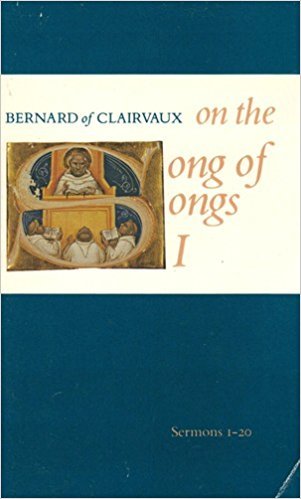
These eighty-six sermons are among the most famous and most beautiful examples of medieval scriptural exegesis. In them the modern reader can catch a glimpse of the genius an entire generation found irresistible.
Piety and mysticism of Saint Bernard of Clairvaux as widely known instrumental French monastic reformer and political figure condemned Peter Abélard and rallied support for the second Crusade.
This doctor of the Church, an abbot, primarily built the Cistercian order. After the death of mother, Bernard sought admission into the Cistercian order in 1112. Three years later, people sent Bernard found a new house, named Claire Vallée, "of Clairvaux," on 25 June 1115. Bernard preached that the Virgin Mary interceded in an immediate faith.
In 1128, Bernard assisted at the council of Troyes and traced the outlines of the rule of the Knights Templar, who quickly the ideal of Christian nobility.
Read this for a class and found a new friend in St. Bernard. A few sermons I found lack luster but overall his allegorical style moved me deeply and came into my prayer quite a bit. A few of St. Bernard’s more famous ideas are found in these sermons, namely his insistence on being reservoirs not canals in the spiritual life. Powerful to read it first hand and in the broader context of his sermons on the Song of Songs.
Though this is only the first of a four-volume work, Bernard is intriguing enough as a preacher to merit a few words. His sermons on the Song of Songs take some getting used to, being filled with allegorical theology intermixed with some intermittently strange imagery. What ultimately drew me in was the "ad hoc" quality of what Bernard preached to his monks, giving the reader a sense that he's eavesdropping on a conversation many centuries old. Of course, we only get Bernard's side of the dialogue, but the praise and reproach he offered his brother monks is none the poorer for that.
Outstanding. The depth, scope, and eloquence of Saint Bernard are on full display in these sermons. There is a reason he is known as the “Mellifluous Doctor”!
Bernard of Clairvaux was a Cistercian monk and this work is the first collection of his sermons on the Song of Songs. I always hope that these works would be a great inspiration to me and I could mine their theological depths, but I always come away slightly disappointed. Not that there isn't great insight in what Bernard says, but I often struggle with the way such ideas are packaged and presented.
The biggest struggle is that Bernard approaches the Song of Songs and perhaps Scripture in general very allegorically. I struggle with this quite a bit. It is that allegorical approach that allows him to spend the first eight sermons or so on the first half verse of Song of Songs, "Let him kiss me with the kisses of his mouth." He uses this little verse to go into talking about kissing Jesus' feet, hand, and mouth and how they all indicate different intimacy with God. While interesting ideas, they're hard ideas to get from the first verse of Song of Songs. This is largely what you get in all of his sermons. It makes for some interesting and at times very awkward allegories (like when he starts talking about breasts).
I also feel that due to this very allegorical approach that Bernard kind of goes down any rabbit trail he happens to think of. If a certain verse brings to mind some other topic, he'll chase that rabbit. This is perhaps something tolerated by monks in a setting with a daily sermon, but harder to use as a model for modern church.
Now I believe that Bernard loved God very much, and that really comes through in his preaching. As I said he has good things to say, but sometimes they seem a bit forced on the verse or part of a verse he's trying to preach on.
Overall, I'd say that Bernard's sermons on the Song of Songs are interesting. They're an interesting window into the sermons that would have taken place in monasteries. They also display the attitude of someone who very much loves God and is seeking after following him. However, I found that his reliance on allegory and extremely slow progression through Song of Songs made it a littler harder for me to get into.
Warm, rich, insightful! My Protestant sensibilities were occasionally challenged, not to mention my modern eyes (e.g. multiple sermons on the breasts of the bride!) but I take it as a good thing to hear from my brothers and sisters in the faith from earlier centuries, not least when they surprise or disconcert me. Bernard is exceptionally delightful reading - his voice comes off the page in a remarkable sweet, clear, heartfelt way. Amazing that across all the centuries it's still preserved on the page.
Each sermon is 5-7 pages and the language is very pastoral and accessible. I did have to refer to the Vulgate rather than English Bible translations because there are some variations in language (notably Song of Songs 1:1), but this was easy to look up. The Cistercian Publications edition is readable and rather pretty, and I appreciate the Scripture references in footnotes. For those who wish to know, the first twenty sermons here in volume 1 cover about the first three verses of Song of Songs.
Some of his sermons were easier for me 'to digest' than others. After studying the Wisdom literature recently, the book was a little less daunting. Three volumes still await the rest of his sermons.
"The name God liquefies and dissolves into the title God-with-us ."
With these short yet beautifully rich sermons (both in theology and in imagery), one can see how St Bernard has deserved the title of Mellifluous Doctor—he whose doctrine is as sweet as honey.
Great book! Short and rich in spiritual reflection. St. Bernard has a beautiful way of preaching, without it being to "pretentious" or confusing. Excited to read the next sermons... - Talks a lot about Jesus as the Bridegroom and us as his Bride