Jump to ratings and reviews
Rate this book

The Boarding-House

Rate this book
William Bird has always taken in boarders who are on the fringes of society: the petty conman, the immigrant who's never been able to fit in, the blustering officer who really doesn't know what's what , and the just plain lonely. He's built a unique place with a unique atmosphere. But then he realizes he's dying, and he decides to leave the place to the two tenants likely to cause the greatest amount of trouble, and the whole enterprise goes up in smoke.

William Trevor's dark comedy, reminiscent of Evelyn Waugh and Muriel Spark, was his second novel.

254 pages, Paperback

First published January 1, 1965

149 people are currently reading
565 people want to read

About the author

William Trevor

177 books760 followers
William Trevor, KBE grew up in various provincial towns and attended a number of schools, graduating from Trinity College, in Dublin, with a degree in history. He first exercised his artistry as a sculptor, working as a teacher in Northern Ireland and then emigrated to England in search of work when the school went bankrupt. He could have returned to Ireland once he became a successful writer, he said, "but by then I had become a wanderer, and one way and another, I just stayed in England ... I hated leaving Ireland. I was very bitter at the time. But, had it not happened, I think I might never have written at all."

In 1958 Trevor published his first novel, A Standard of Behaviour, to little critical success. Two years later, he abandoned sculpting completely, feeling his work had become too abstract, and found a job writing copy for a London advertising agency. 'This was absurd,' he said. 'They would give me four lines or so to write and four or five days to write it in. It was so boring. But they had given me this typewriter to work on, so I just started writing stories. I sometimes think all the people who were missing in my sculpture gushed out into the stories.' He published several short stories, then his second and third novels, which both won the Hawthornden Prize (established in 1919 by Alice Warrender and named after William Drummond of Hawthornden, the Hawthornden Prize is one of the UK's oldest literary awards). A number of other prizes followed, and Trevor began working full-time as a writer in 1965.

Since then, Trevor has published nearly 40 novels, short story collections, plays, and collections of nonfiction. He has won three Whitbread Awards, a PEN/Macmillan Silver Pen Award, and was shortlisted for the Booker Prize. In 1977 Trevor was appointed an honorary (he holds Irish, not British, citizenship) Commander of the Most Excellent Order of the British Empire (CBE) for his services to literature and in 2002 he was elevated to honorary Knight Commander of the Most Excellent Order of the British Empire (KBE). Since he began writing, William Trevor regularly spends half the year in Italy or Switzerland, often visiting Ireland in the other half. He lived in Devon, in South West England, on an old mill surrounded by 40 acres of land.

Ratings & Reviews

What do you think?
Rate this book

Friends & Following

Create a free account to discover what your friends think of this book!

Community Reviews

5 stars
75 (21%)
4 stars
141 (40%)
3 stars
93 (26%)
2 stars
32 (9%)
1 star
8 (2%)
Displaying 1 - 30 of 60 reviews
Profile Image for Jim Fonseca.
1,163 reviews8,514 followers
November 20, 2025
This is one of Trevor’s earliest novels – his third (1965). It’s almost as if Trevor was still finding his stride. I’ll call it a black comedy.

Eight people live in a run-down London rooming house. They have been hand-picked by the owner because of their loneliness. The founder of the boarding house seems genuinely sympathetic to lonely people (he has no family himself) and he keeps a notebook on them from which we learn about their backgrounds. For example, one entry reads: “I weep when I think of Joseph Scribbin’s life, and the emptiness thereof.”

description

Despite his attempts to provide these folks with the companionship of each other, they are still lonely because in different ways they are seriously damaged people in a psychological sense. Every night they sit in the lounge and their conversation never moves beyond talk of the communal meal or what’s on the TV. They never pry into each other’s business; they never visit each other’s’ rooms; they avoid personal questions and, after 10 or 15 years of acquaintance, still address each other by some title – Nurse, Major, Mr, Miss.

The black comedy comes in through who these folks are. One man who interrupts the TV viewing with his violent coughing fits is “…dying on his feet because he feared the thought of hospitals.” A middle-aged Nigerian immigrant has been in love with a woman for years simply because she was kind to him at the immigration office. He brings her flowers weekly and leaves them at her door while her roommates make excuses about where she is. There’s a man whose only pastime is listening to recordings of train engines – annoying all the other tenants with the noise. A woman clerk approaching middle age has never even had a man make a pass at her. A small-time con artist flimflams clerks and waitresses to get extra change back but he’s also a black-mailer and a stalker. There’s a nurse who seems to delight in giving old people shots and a former military officer who attends live porn shows.

In the first chapter, the founder of what he calls his “institution” dies. In his will leaves the boarding house jointly to two of the most unlikely characters. Was this a cruel joke on his part or did he have something else in mind?

description

Trevor gives us good writing:

“The drizzle freshened the short grass of the graveyard and toned down the lime of new headstones.”

“…the clergyman blinked, finding it difficult to respond with words.”

“…there was a seediness about his clothes and about his face; he had not led a dissolute life, one would have guessed, but somewhere in his life something had gone wrong.”

“Her face had lines, not many, but clearly the precursors of many.”

Not a great Trevor but it kept my interest and I thought it was a good read. William Trevor is one of my favorite authors and I have read about 15 of his novels and collections of short stories. Below are links to reviews of some others of my favorite novels of his:

Mrs Eckdorf in O'Neill's Hotel

After Rain

The Hill Bachelors

Fools of Fortune

Nights at the Alexandra

The Children of Dynmouth

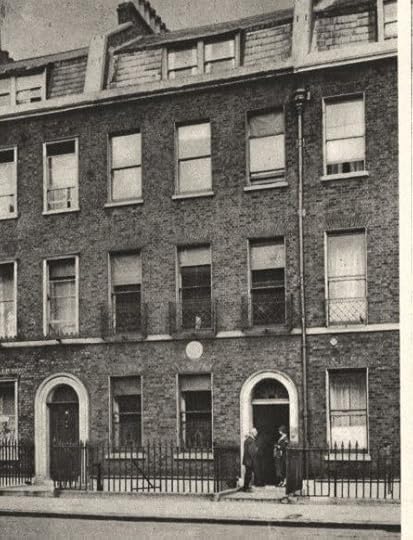
Top photo from lostwomynsspace.com
Bottom photo from whatpub.com
Profile Image for Vit Babenco.
1,787 reviews5,804 followers
May 21, 2024
Collision of traits… Impact of interests… A comedy of situations…
The owner of The Boarding House is aware that his end is near…
‘I am dying,’ said William Wagner Bird on the night of August 13th, turning his face towards the wall for privacy, sighing at the little bunches of forget-me-not on the wallpaper. He felt his body a burden in the bed, a thing he did not know. His feet seemed far away, and it came to him abruptly that he was aware of his feet in an intellectual way only.

He was alone in the world… No relatives… The boarding house was his accidental inheritance… And he himself carefully chose his boarders… All of them are odd solitary souls…
He in his time had sought these people out, selecting them and rejecting others. He sought them, he said, that they in each other might catch some telling reflection of themselves, and that he might see that happen and make what he wished of it. ‘I rose from my desk, most down-trodden of men. I smote adversity to make myself a God to others.’

He dies and bequeaths his boarding house to studious Nurse Clock on parity with a foolish chiseler Studdy… And they loathe each other badly… However there is no obvious confrontation… They collaborate pursuing secretly their own private interests…
‘There will be a lot of work in this, straightening the place out. Will you be available, Mr Studdy? What work is it you do at present?’
‘I’m concerned with a religious organization.’ As he spoke he determined to write no more letters, nor to fritter away his time following people about. He resolved to become a new man, to turn his talents to the success of his newest and most promising venture.
People live and do strange things so the world becomes even the more peculiar place.
Profile Image for Fionnuala.
887 reviews
Read
September 4, 2020
Whenever I read William Trevor's novels and stories, I'm never quite able to forget the presence of the author. Sometimes I can visualise him deciding what to include in a scenario, other times I imagine him deciding what to leave out, but he's always somewhere on the edge of my vision, tweaking the props of what I'm reading. I enjoy his mild and nostalgia-inducing presence very much.

In this book, he faded out of my vision almost completely, his name on the cover the only reminder that I was reading a William Trevor novel. That, and the era the story was set in, the 1970s, and the fact that the characters are steeped in the strong tea of an earlier time as his characters often are.

So, even as I was missing William Trevor's kindly presence, I was aware that there was someone tweaking the props of this story all the same. Little by little, I began to imagine that it was Mr Bird, even though he's not the narrator but only one of the characters. The narrator is one of those nameless third person omniscient narrators (usually a stand-in for the author), but the narrative voice sounded so much like Mr Bird that the two became indistinguishable for me. The fact that Mr Bird dies on the first page only made me more convinced that he was the narrator and that he was telling the story from his newly acquired omniscient position in the afterlife. I've often found the notion of an omniscient narrator a little mysterious in any case. Such a narrator sometimes has personal opinions but at the same time can see right into characters's minds. Mr Bird embodied all that puzzling quality. I imagined him hovering over the boarding-house residents, watching their public and private moments, and even allowing himself to be seen on odd occasions as a fluttering presence on the edge of a character's vision.

But he was more than just a fluttering presence. It gradually emerges that Mr Bird carefully selected each of the characters who were to play out this boarding-house story after he'd left it, odd as that might seem. Yes, Mr Bird, as the owner of the boarding-house of the title, hand-picked the residents who make up the cast of characters, and according to a particular design of his own. The few other incidental characters in the story are literally plucked out of the telephone directory by one of Mr Bird's boarding-house residents who likes writing anonymous letters. He of course was selected for just such nefarious skills.

So the characters, chosen by Mr Bird and subliminally worked on via his words and actions while he was alive, gain an extra measure of freedom now that he's no longer around to tweak their emotions with his mild but manipulative comments. What will they do with this free will they have been granted?

Well, not as much as they might hope or you might expect..
The script, you see, was written in advance by Mr Bird.
Profile Image for Laysee.
631 reviews344 followers
September 11, 2020
The Boarding-House is the third novel William Trevor published in 1965. The craft of a master storyteller is evident in this unsettling novel. Trevor cleverly juxtaposed sinister and comic elements in this story about eight residents in a rooming house after the death of its owner, Mr. Bird.

The Boarding House is a rundown red brick building located in the south-western suburbs of London built during Victorian times. Mr. Bird selects ‘solitary spirits’, lonely folks like himself who have neither family nor personal ties. A quirky crew of five men and three women spend evenings watching TV and drinking cocoa together. This seems pretty cozy on the surface but lodged within the personal history of each character are eccentricities, aspirations, and insecurities that threaten their co-existence. Mr. Bird dies when the novel begins and life at The Boarding House will never be the same again. The Boarding House is willed to two dubious residents who hate each other’s guts but are compelled to work together while straining to achieve their personal agenda.

As the story unfolds, an omniscient narrator takes us into the interior life of each resident and we become acquainted with their anxiety over the future of The Boarding House and its impact on them. The strength of Trevor’s writing lies in the insight he offers into the motivation of each resident – his or her unique preoccupation, hopes, and fears. Their quests include a desire to be freed of the past, to be loved or married, to be successful in courtship, to be sexually titillated, to extort money, to avoid harassment at work, and to appear to be useful to others. Some of the scrapes and faux pas the characters get themselves into are laughable in cringe-worthy ways. The petty fights and arguments among the residents contribute lighter comic moments.

However, an unmistakable streak of malevolence can be detected in a few of the residents, including Mr. Bird himself, which lent this story a disturbing edge. The residents perceive Mr. Bird as a kindly father figure, yet the omniscient narrator let on that Mr. Bird was laughing when he was making out his will. A subtle cruelty underlies Mr. Bird’s decisions as he knows full well the consequences that will befall the residents. In fact, they continue to feel the stronghold of his presence and pay the price of his audacious plan with respect to The Boarding House.

I marveled at Trevor’s revelation of the impulses that drive human behavior. It was discomforting to discern the dark side of human nature. Noble intentions can innocuously turn ignoble. The Boarding-House has a fascinating tapestry woven from threads of contrasting hues: ominous dark, comic light, brooding grays. For an early work, it is compelling piece of dark comedy.
Profile Image for Karen·.
682 reviews903 followers
Read
February 23, 2017
A collection of oddballs and misfits in a mid-20th century boarding house might bring Mrs. Palfrey at the Claremont or At the Jerusalem to mind, but whereas Ms Taylor can let rip a bit of flatulence and expose quietly cruel social mores, Mr Trevor's world is disturbing in a more existential way. For William Wagner Bird appears as a limping daemonic demiurge, a Prometheus who has called forth this set of preposterous creatures, created them for his own rather suspect pleasure, and then, having decided that the whole idea was a terrible mistake, gifts his creation to two lesser gods in order to guarantee its destruction. Studdy is a scandalous wannabe conman, and Nurse Clock is no less of a ruthless schemer even if she believes herself to be caring and tender. Neither of them are serviceable as Lord and Lady of this domain, and in combination they are toxic. Fire comes as a blessed release.
And the whole thing is absolutely hilarious.
Profile Image for Tony.
1,032 reviews1,910 followers
February 24, 2017
I spent the entirety of the reading of this book wondering who...or what...is Mr. Bird. Mr. Bird is the owner of the Boarding-House of the title, who greets us immediately on page one with this: "I am dying." He does not mean sometime down the road. No, Mr. Bird dies then and there, from the feet up he tells the nurse.

But that is not quite the end of Mr. Bird, who leaves a will: two of the residents of the Boarding-House will inherit it (comically disparate enough to move the plot forward, entertainingly); the rest of the residents may be tenants for life, their exodus only voluntary.

When Mr. Bird had written his will and had read it over he became aware that he was laughing. He heard the sound for some time, a minute or a minute and a quarter, and then he recognized its source and wondered why he was laughing like that, such a quiet, slurping sound, like the lapping of water.

Interlude: Note the precision of the time of laughing just above: a minute or a minute and a quarter. Trevor does this - a specificity of time - all through the novel: one resident must face the officer of punctuality every morning entering his work; another character times barmen to the second after ordering drinks; Hell, one character is named Nurse Clock. No, I don't know what that all means. I add it here as a public service, hoping someone smarter than me (a large enough pool) can figure it out. End Interlude

Mr. Bird very carefully, very intentionally, selected the residents. Without itemizing here, let's just say they are all just a bit off. Individual peccadilloes aside, though, what links them is their solitary nature. Yet they are not solitary in the Boarding-House.

Mr. Bird continues to be a presence: in the execution of his will; in somewhat spectral appearances; in truly delightful quick biographies he penned of the residents; and in flashbacks, such as his greeting to new kitchen help, a woman who entered the Boarding-House in a rush to pee:

You must stay here, you will like it. In this old boarding-house no one had told the unvarnished truth for the last fifteen years.

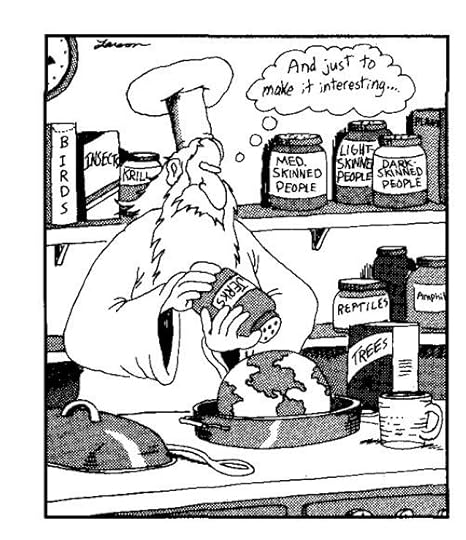
One resident, confused, identifies Mr. Bird as "the founder of heaven and hell on earth." Another says that he is "a man of infinite, subtle cruelty." So if Mr. Bird is a god - you could see where I was going - he is not a benevolent one. "I built that I might destroy," he is alleged to have said. But he is not a terrible, frightful god, I don't think. It doesn't matter if I'm wrong, because I'm the reader; and I see Mr. Bird as a fractious god, a stinker, a god Gary Larsen might have drawn, back in the day:


----- ----- ----- -----

Postlude: I first found William Trevor's writings fourteen years ago and I've been reading him ever since but mostly his later works. Just because they've been more readily at hand. But I found this just recently in a used bookstore in Seattle, a mere twenty minute walk from my granddaughter. It was hiding darkly on a bottom shelf; indeed, it took two trips for me to see it. It was remaindered, a few nicks to the cover, but it has turned out to be everything I love about a book: it made me laugh; it made me think; it entertained the hell out of me; it has a rarity about it; it is brilliantly imagined; it made me hide for pockets of time; it lies in my hands like a gift from an old man who just died; it will edge itself out of the space I put it in on the shelf, or I will think so; it makes me think I could do something similar; it will linger, teaching me otherwise; and, serendipitously, I read it with a friend. End Postlude.
Profile Image for Diane Barnes.
1,619 reviews446 followers
November 25, 2025
I was quite surprised at this book, and at my reaction to it. I love Trevor and I love boarding house novels, but this was not my cup of tea at all. I didn't want to give up on it, but on the other hand, sitting down with this novel was like pulling teeth. Thank goodness it was only 250 pages.

Mr. Bird owns a boarding house, but dies on the first page, leaving the home to two of his residents. Scuddy is a con man, and Nurse Clock, whose specialty is caring for the aged, are avowed enemies. His only stipulation is that none of the residents must be asked to leave unless it is their own decision. Mr. Bird had a habit of collecting lonely, frustrated, middle aged people, and all of them have lived there for years. All of them were hopeless and expected nothing more of life than their humdrum little lives had handed them so far.

That was my problem with this novel. There was no redemption for anyone, things just went from bad to worse, and Mr. Bird himself flitted around as a ghostly presence. This was Trevor's second novel, and had it been the first of his that I'd read it would have been my last. Fortunately, I know how great an author he is, so I can just chalk this one up to experience and move on.
Profile Image for JacquiWine.
676 reviews175 followers
June 2, 2018
Set in a South London suburb in 1964, the novel is an ensemble piece, focusing on the lives and concerns of the residents of Mr Bird’s boarding house, the sort of traditional establishment that is fast going out of fashion due to the rise in bedsits and flat-shares. At first, Mr Bird’s tenants appear to be a disparate bunch, each person possessing their own individual characteristics and personality traits. However, it soon becomes clear that they are all solitary figures, mostly flawed or inadequate in some way, at risk of being seen as misfits or outcasts from the realms of ‘normal’ society.

To read the rest of my review, please click here:

https://jacquiwine.wordpress.com/2018...
Profile Image for JimZ.
1,298 reviews763 followers
November 16, 2019
I started to read William Trevor’s books in the late 1990s and consider him as one of my favorite authors. His fiction and short stories are equally good. I joined GoodReads about 2 months ago and wanted to start to build up my library/books read here, since I do enjoy reading.

I got the hardcover edition of this book. Has a blurb by Evelyn Waugh on the back cover of the dustjacket for Mr. Trevor's first book, The Old Boys. Jacket design by James and Ruth McCrea.

I gave it an A which is a 5-star rating per GoodReads!
Profile Image for John.
2,154 reviews196 followers
July 27, 2018
Having enjoyed Miss Gomez and the Brethren, I decided to try another of the author's quirkier works, and wasn't disappointed!

Abrupt point of view switches took some getting used to, but after that I just accepted them and was able to get into the book; I could see where that might drive other readers bonkers! In addition to going into the heads of all of the residents regularly, there are also excerpts from the deceased owner's notes on each.

Our UK friends, as well as Global Britcom addicts, might appreciate that I had the image of Nurse Gladys from Open All Hours in my head for the nurse character.


Profile Image for Fiona.
982 reviews529 followers
July 29, 2016
Mr Bird, the landlord of the boarding house, dies and the scene is set to tell the personal stories of the collection of oddball characters who lodge there, all of them selected by Mr Bird over the years. I didn't find this a very satisfying read. I'm a huge fan of William Trevor but this is a very early work. I find it hard to believe that the person who wrote this book also wrote The Story of Lucy Gault. It's well enough written but it's too wordy for me. Too full of unnecessary conversations that might have worked well as a play but not as a novel. I only read it through to the end because it's WT. I'm glad I know (and love) his later (beautifully written) books because if this was the first I'd read, I'd go no further.
Profile Image for Judy.
1,965 reviews461 followers
May 16, 2021
Trevor's third novel takes place in a boarding house, with a cast of lonely, somewhat offbeat people. Imagine living in a boarding house! Do such places still exist? I kept thinking of the Beatles' song, Eleanor Rigby, as I read. When the owner of the house dies, he leaves it to two of the residents who make a right mess of things. So, from a slow beginning the book revs up to its final disaster.
Profile Image for Peter.
Author 4 books32 followers
March 23, 2017
Delightful little novel from very early in Trevor's career (1965). Unexpectedly funny, yet still with Trevor's usual lonely sadness. Also surprising is Trevor's effective use of a third person omniscient narrator, with the perspective changing from character to character, sometimes even within the same paragraph. In most of the Trevor fiction I've read, he focuses on a single character. But THE BOARDING-HOUSE is about community (specifically, the tiny community of the boarding house), and this form of narration creates almost a chorus of voices that really brings out the characters' idiosyncratic personalities, and tells the story extremely well.
Profile Image for Jonathan.
208 reviews71 followers
January 24, 2018
After reading my first book by William Trevor last year (Children of Dynmouth) I have decided to read a few more of his books this year, especially as a few of them are available at my local library. The one that really appealed to me was this one, The Boarding-House, which was first published in 1965. The blurb on the back of the new Penguin edition states: William Wagner Bird filled his boarding-house with people whom society would never miss—if it had ever noticed them at all. Now, doesn't that just grab your attention?

The novel begins with the landlord of the London boarding-house, Mr Bird, on his death-bed. He is being attended to by one of his tenants, Nurse Clock. Mr Bird had spent the last few decades populating his house with tenants that were lonely lost-souls with neither friends nor family. The house itself had been spared the troubles of decorating or refurbishing for the whole time that Mr Bird had owned the building. It was out-of-date and a little worse for wear just like its owner and tenants.

It turns out that Mr Bird made a study of his tenants; not only did he specifically choose them but he also wrote notes on each one in a notebook titled Notes on Residents. In this book Mr Bird writes:
Well, at least I have done a good thing—I have brought them all together; and though they are solitary spirits, they have seen in my boarding-house that there are others who have been plucked from the same bush. This, I maintain, lends them some trifling solace.
It would seem that Mr Bird's intentions are purely altruistic and recognising that he is in a position to help others, who are similar in many ways to himself, he does so by allowing them to live their lives as free from outside interference as is possible. But, as the novel progresses, it is not so clear that this was Mr Bird's intentions at all.

There are many characters in this hugely entertaining novel. We get to know them as Trevor skillfully flits between characters, moving from the present, to the past, and back again, sometimes entering their thoughts, sometimes their dreams or from direct quotes from Mr Bird's Notes. The novel includes other characters besides the tenants, such as the cook and the maid as well as those that the tenants come into contact with. It would take too long to introduce them all but I will give a quick outline of some of the major participants. Mr Studdy is a petty thief who loves causing mayhem; Mr Bird writes 'Anyone can see that poor old Studdy never had a friend in his life.' And of Nurse Clock he says 'Nurse Clock has morbid interests. She is a woman I would fear were it not for my superior position.' Venables was the first of Mr Bird's 'solitary spirits', he is a weak, lonely man who suffers from stomach cramps. He arrived after fleeing from a girl he made pregnant and fears that her parents are still seeking him. Miss Clerricot blushes at everything and is extremely self-conscious about her face; Mr Bird finds her 'adorable'. Major Eele is full of bluster and visits strip clubs but is rather naive; he married a few years before but it only lasted days. Mr Obd came from Africa to study law but didn't graduate; too embarrassed to return home he works as a clerk; he is deeply in love with a girl called Annabel Tonks but his love is unreciprocated. Mr Scribbin likes listening to records of trains at a thunderous volume. Rose Cave was brought up by her mother after a fling with the wallpaper man; Mr Bird notes that she cries out at night.

It is soon announced that Mr Bird, having no kin of his own, has left the house to two of the residents, Nurse Clock and Mr Studdy, but with the proviso that no changes should be made to the house and that none of the tenants should be made to leave. Just prior to the reading of the will we have witnessesed Studdy trying to wheedle a drink for nothing out of a barman at his local pub, con an old bedridden woman out of some money and write an anonymous blackmail letter to the meals-on-wheels lady. It turns out that Nurse Clock likes caring for old people, especially when they're over ninety, but it becomes clear that it's the power that she can exert over them that appeals to her. In short, Studdy is a petty thief and swindler whilst Nurse Clock is a bully. As the novel continues Nurse Clock decides that she wants to turn the house into a nursing home for the elderly and Studdy goes along with her plans, especially as it involves more disruption and chaos but they are a totally incompatible couple; Clock just wants to boss everyone about and is frustrated when others have ideas of their own whilst Studdy has no intention to help her with her plans, instead he has to fight the overwhelming urge to stick a pin into her arm.

So, given that Mr Bird knew about these characteristics, as is apparent from his Notes on Residents, why did he leave the house to these two people? Was it his intention to cause chaos amongst his residents after his death? Or was he just naive? Trevor hints of possible malice in Mr Bird's decisions:
When Mr Bird had written his will and had read it over he became aware that he was laughing. He heard the sound for some time, a minute or a minute and a quarter, and then he recognized its source and wondered why he was laughing like that, such a quiet, slurping sound, like the lapping of water.
But Trevor points out that Mr Bird had similarly smiled whilst writing about his residents but had murmured an apology when he had realised he was being mean, which isn't really the action of a malicious person.

This is a brilliant book, full of grotesque but strangely likeable characters, by which I mean likeable as characters in a novel, they'd be a right pain in real life. The novel reminded me of Elizabeth Taylor's Mrs Palfrey at the Claremont but surpassed even that superb book in my opinion. I am certainly attracted to books set within a closed environment such as hotel, boarding-house, ship etc. especially if there are many characters. Trevor's Mrs Eckdorf in O'Neill's Hotel looks quite similar and may well be my next book by the author.
Profile Image for solitaryfossil.
420 reviews21 followers
June 1, 2020
I loved this mid-20th century story of the very peculiar residents at Mr Bird’s London boarding-house. I am definitely putting more William Trevor on my To Read shelf. Excellent story-telling, funny but tragic, and peopled with memorable characters. A fun, superb little novel.
Profile Image for Jim Leckband.
787 reviews1 follower
February 13, 2019
I was familiar with Trevor from reading his short stories, but I hadn't read them for quite a while - probably since they were last published in the New Yorker. My impression of him, faulty as it turns out, was as a story-teller of the small lives and small epiphanies sort, but told very well. Boring.

Wrong.

I read this after reading Francine Prose's Reading Like a Writer: A Guide for People Who Love Books and for Those Who Want to Write Them so I was better prepared for reading Trevor. He is a writer who writes in-between the lines, i.e., you must pay attention to what is not being said and how it is not being said.

"The Boarding-House" is a novel of what happens after the collector of lonely souls in a SW London boarding-house dies. Mr. Bird thereafter flits in and out of the novel, sometimes as just thoughts, sometimes as apparitions and sometimes in dreams. In the first sentence, on his death bed, he is sighing at the bunches of forget-me-not on the wallpaper. As Prose taught me - a detail like this, with a writer like Trevor, is IMPORTANT. Indeed, the rest of the novel reinforces that Bird must not be forgotten as he leaves the boarding-house to two of the nastiest boarders with the proviso that all be left as is.

What ensues is the most Sparkian novel I have read outside of Muriel Spark. The omniscient narrator is not sympathetic and frequently displays the snark of Spark. The sadness of the lives of the lonely souls is not dwelt on, and the reader finds it hard to sympathize with them. As such the book can be thought of as a bit cruel - but then God can be, right? Mr. Bird flies over them as if they are his collected creatures.

Much is also made of the fact that the boarding-house is not of the present time - Mod London had not penetrated every where beyond Carnaby St. It is in Havishamian decay, but not of memories, just old stuff that could be discarded without a care to anybody. I think Trevor is quietly making the point that new London is destroying old London, but that it might not be a bad thing. Indeed, at the end of the novel (which is dramatic and perfect - think of a Nigerian Milton Waddams from "Office Space") one can imagine the boarders might be shaken a little bit out of the stasis that they were in.
Profile Image for Chris Rigby.
33 reviews2 followers
January 13, 2015
Mervyn Peake would probably have enjoyed "The Boarding House". Maybe he did - Peake was still alive when it was published. William Trevor has constructed his own miniature Gormenghast: a petty little surreal kingdom where a bunch of misfit inadequates squabble and bicker, and carve out their own niches.

Set in London SW17 in 1964, the boarding house of the title is the type of institution that already - as Trevor notes - is going out of fashion in favour of the bed sitting room, an arrangement that promotes even deeper isolation and where residents are not required to 'get along' with each other. The boarding house is a mixture of the bedsitter - where residents have their own rooms, their little fiefdoms where they can stamp their individuality - and the B&B, where there is a communal living room with TV, and meals are provided by live-in staff.

However, surely no boarding house was ever like this one. Its creator dies at the very beginning of the novel, a William Wagner Bird, who over time has sought out the lonely and the inadequate and found them places in his house. At first this might seem to be a benevolent act, the motive of human kindness, but as time passes, and we become privy to his Notes on Residents, we see that Bird is playing some kind of sinister game, pitting distinct types of personalities against each other. This becomes most evident when his will is read, and it's discovered to the amazement, consternation and fury of the other residents that he has left the house to the two most opposed residents, whose mutual hatred is never far below the surface.

The residents play out their frustrations and antipathies, trapped in this new world of its original creator's making, while the tension slowly but inexorably builds to ... well, I won't give a spoiler.

What is Trevor creating in this book? The clue - I believe - is in his use of names. The residents and staff : Nurse Clock (control freak), Studdy (petty blackmailer), Major Eele (strip club habitué), Mr Scribbin (railway recording enthusiast), Venables (anxious, with a bad stomach), Mr Obd (African full of unrequited love), Miss Clericott (will she ever be safe from men?), Rose Cave, Mrs Slape and Gallelty, are never referred to other than by these names. We never know Nurse Clock's first name, nor Major Eele's, and though we know the Nigerian Mr Obd's first name is 'Tome', this is only from relayed correspondence, or the memories of Mr Bird's cryptic "Alas, Tome Obd" whenever the two passed on the stair.

Yet the 'creator' is by turns Bird, Mr Bird, William Bird, and William Wagner Bird. This, even though he is dead by page 1! So we have a closed world, where the characters - the players - are restricted to the name they are introduced by, but the 'creator' is privileged to be known by several names. One could read into this that the Boarding House is a kind of allegory, a depiction of the modern human condition, where our whole identity is tied into our name and character, and where God ("God of a thousand names") has died. This is perhaps reinforced by Bird's supposed appearance in the kitchen one time after his death, and the "vision" of Bird appearing to Mr Obd as first a mere mark on the ceiling, then gradually in his mind transforming into a complete heavenly vision of golden throne and celestial trumpets.

It's a very good novel. But one needs to read 'below the surface' or it might simply be written off as a piece of great eccentricity, enjoyable to read but leaving too many question marks as to "what it all means".
Profile Image for Chrystal.
999 reviews63 followers
October 2, 2019
3.5 stars

Looking at this book from a purely technical perspective, I would give it the highest rating possible. Trevor's incredible deftness in constructing this novel boggled my mind on every page. The level of skill it must take to write something like this is staggering. First of all, there is a lot of dialogue going on simultaneously between a large cast of characters, both inside the boarding-house, and in many locations outside of the house. The action and dialogue is not only taking place simultaneously in different places, but also in different times. So for instance, we might have people talking in a room in the boarding-house, also in a restaurant across the street, also in an office, on a train, and in the past - all on the same page. This concept is so difficult to think about, let alone construct a novel around. What is amazing is that Trevor does this with absolutely no confusion to the reader at all. I can't think of another novel like this. And I must point out that the dialogue is top-notch; it is on a level with Patrick Hamilton, whom I was reminded of so often while reading this, as he wrote so much about boarding-houses and their odd inhabitants.

The story itself is so-so. He uses a device that I don't think worked that great, with the late owner of the house having died but having written notes on the tenants. We get to learn about them through his notes. The way the dead owner appears throughout the book, with past exchanges popping up randomly in the book, I did like. It served to show us just how good Trevor was at this interplay between times and places.

Another thing that stands out is the humor. The exchanges between the tenants and all of the conversations are flat-out hilarious. I was surprised at this because I never thought of Trevor as a humorous writer.

I have read quite a few of his novels but have not found one to rival READING TURGENEV (ELIZABETH ALONE comes close but is a totally different kind of book). I keep reading him hoping to find another one like it. What I have found is that all of his novels are different and seem to even be written in different styles. Not one of my favorite writers, but without doubt a writer of astonishing diversity and amazing skill.
Profile Image for Cindy O.
128 reviews1 follower
July 30, 2020
William Trevor is an interesting story teller. I do enjoy reading books that were written in the 1960’s. It’s an interesting crossover period of time that is always noticeable in certain writing styles and genres. A book named “The Boarding House” automatically conjures upon your mind an assortment of quirky tenants and the interactions that might occur. So, what we have here is not today’s standard of adorable quirky people that one might expect but are genuine misfits. It surprised me how much story along with depth of character was packed into the pages. The author also conveyed the phobias, weaknesses and strengths of the characters. I liked the style and how it moved forward at a quick pace.
I recommend this book.
Profile Image for freckledbibliophile.
571 reviews8 followers
September 28, 2017
I've finished reading The Boarding House. Trevor's characters were refreshingly offbeat. Down right wacko! Old "Birdman" William Wagner, should've been ashamed of himself. The story was hilarious at times, and dark and frustrating at others. They're were a couple of them that made me want to scream (the unrequited Nigerian being one of them). At certain angles of the book, it took on an eerie vibe. Though, I was wide eyed while mentally eyeing the characters, I quickly remembered they're no different from some of our modern day people. Enjoyable read. 3.5/5
Profile Image for Sarah.
830 reviews3 followers
August 13, 2023
1960s Wandsworth. Mr Bird, the owner of a boarding house, has passed away feet first and left the house to Nurse Clock and Studdy.

My second read of this book and over 20 years apart. I loved it the first time and I loved it the second. Rich characters with lots of inner thoughts and plenty of humour. I particularly liked the Bishop who, in his nineties, spent most of his days in the airing cupboard.

Wonderful.
323 reviews
August 7, 2023
Re read August 2023 having been read before a couple of times.

This book has been one of my favourite all time reads. I first came across it perhaps over 30 years ago. Nothing has changed. Quite simply: it is brilliant. Superbly written in a style of writing that has all but disappeared these days; great characters, well developed and defined; full of humour - laugh out loud at times, and a good storyline.

It is a story about a disparate group of individuals occupying a boarding house in South London in the early 1960s whose proprieter dies resulting in worry and angst among the residents, none of which have really got anywhere else to go. You might wonder how such a novel could command such a glowing review but all I can say is that it is a book that draws you in and is as moving as it is funny.

Just get a copy and read it is my recommendation.
Profile Image for Andréa Lechner.
374 reviews13 followers
December 7, 2020
William Trevor is a master of the underside, with seedy characters which inhabit places such as this boarding house. He creates fascinating individuals, some dark, some innocent victims or misfits. This novel is masterful in its development, and the undoing of the boarding house after the death of its owner, Mr Bird. It combines suspense with dark humour and keeps the reader guessing until the very end. An early work, and a true accomplishment.
Profile Image for Frank.
239 reviews15 followers
May 18, 2012
One of Trevor's earliest works, in the mode of The Old Boys and The Love Department, About those quirky, quare folk from John Bull's original island as can only be appreciated by an emirgré from that other island.

I found a lovely hardcover first US edition on line (not the one pictured), which appears never to have been opened. I really enjoyed it.
Profile Image for Isabella Good.
4 reviews2 followers
December 29, 2018
I usually love William Trevor books but I found this one so bleak. A lot of the characters were mean and self-centred. Not a favourite
Profile Image for Cherise Wolas.
Author 2 books301 followers
March 30, 2020
I've read The Collected Stories of William Trevor, and a couple of his late-career novels, but I've never read any of his early works, and The Boarding House is one. I think it was his third novel. Set near London, it is about the inhabitants of a boarding house established by one William Wagner Bird, who dies at the start, leaving behind a will giving the boarding house to two of its inhabitants, Nurse Clock and Mr. Studdy, who have been for years mortal enemies. Nurse Clock was nursing Mr. Bird, the last person with him at his death, sees herself as a great healer, although she fails to abide by Mr. Bird's last requests, and being left the house taps into her hidden viciousness and avarice. Mr. Studdy is a con man, a thief, a nasty man who preys on people by writing anonymous letters threatening them with some secret he thinks he's discovered about them and demanding money for his silence. The will requires the boarding house be run as it has been run, and everyone's places are safe, but soon, these mortal enemies will work to put away their enmity in order to try and subvert the will's intention and effect Clock's desire to remake the boarding house into a home for the aged. Which means these two want all the tenants gone. The tenants in the house were each handpicked by Mr. Bird, and he kept a journal about his tenants, revealing his views of them. Each is a social casualty, unhappy or lonely, fighting their pasts or their presents, their quirks rather than their characters dominating. Mr. Bird's secret motto had been: "I build that I may destroy," and perhaps that is what he intended to effect by leaving the house to Clock and Studdy. The tenants are varied and interesting - in addition to Nurse Clock and Mr. Studdy, there is Major Eele, who loves strip-tease revues featuring black women; Miss Clerricot, who hates her face and is embarrassed all of her life and wants just one amorous adventure; Tome Obd, a Nigerian exile who came to Britain to become a doctor but does not accomplish that, and for twelve years has left letters and flowers for a woman with whom he used to play ping-pong who does all she can to avoid him; Venables, who cries easily and suffers stomach pain; Mr, Scribbin, who loves to listen to recordings of trains; and Miss Cave who constantly imagines her dead mother. There is a very dark fairy-tale feel to the novel, irony and awfulness combined seamlessly, and the idea of a boarding house that might confer some idea of fraternity among its tenants, feels more like a zoo where the small defenseless animals might be gobbled up. These lonely middle-aged and elder waifs are always fighting their fates, and with the ascendance of Clock and Studdy, their fates are even more precarious. In Trevor's stories, there is such realism and sympathy, and there is great sympathy for these characters too, but a great deal of marvelous blackness as well.
Profile Image for Kim.
2,728 reviews14 followers
August 31, 2018
Setting: London; 1964. The book is set in a London boarding house and starts with the death of the boarding house's owner, Mr Bird. We are introduced to the residents of the boarding house both from their own points of view and the comments of Mr Bird, recorded in a notebook. Mr Bird's death disturbs the residents' settled lives - particularly so when Mr Bird's will is read and it is discovered that he has left the boarding house to the two residents who are probably most diametrically opposed to one another - Nurse Clock and petty thief Studdy. The conditions of the will mean that they must maintain the boarding house as it is and none of the residents can be evicted (although they can move on of their own free will) but eventually Nurse Clock and Studdy manage to join forces to work towards their own ambitions in relation to the house...
Great characters and brilliant observations of the hypocrisies of life in London in the 1960s when you are at the 'lower end' of the pecking order, as most of the residents are, each with their own idiosyncrasies and petty foibles. Wonderful writing as ever from Mr Trevor - 9/10.
Profile Image for Stephen.
501 reviews3 followers
August 28, 2021
Trevor's third novel was published when he was in his late thirties, and in its setting and black farcical comedy is an experimental precursor to 'Mrs Eckdorf in O'Neil's Hotel' (published four years later: 1969). 'The Boarding House', however, stands on its own merits as a quirky story on lost souls gathered in a tired enclave of Tooting.

Trevor plays for laughs but with pathos never far away. The notes kept by boarding house-keeper Mr Bird on how he chose his residents itemise age and misfortune, as well as whether their misfortunes originated at the hands of extortionists (Nurse Clock), thwarted educational ambitons (Tome Obd), ungainliness (Scribben) or perceived ugliness (Miss Clerricot). Bird himself is a shadowy figure whose death in the opening pages means we must rely on both his notes and the opinions of those he claims to have 'saved' - not all of them grateful.

There is a thread of the underworld (in this case Studdy), and a vindictiveness that underscores both the comedy and pathos. Trevor unsettles the reader by showing us different sides of the same people, who physically and verbally attack one another (or get attacked), and provoke shifting sympathies and antipathies. The story is light enough and pacy, but the refracted play of light and shade on the individual biographies gives it depth.

As with 'Mrs Eckdorf...' I liked Trevor's ability to switch between scenes without so much as a paragraph break. Trevor's prose is fluid, lively and compelling. He is proving one of my favourite authors I've started reading this year
Profile Image for David.
667 reviews12 followers
October 21, 2020
The Boarding House is William Trevor's second novel if we discount his first (A Standard of Behaviour) that he always disowned and refused to have republished. It is not in quite the same class as the other eight I have read so far, as if this was a practice run for the prolific writing to come. It was written ten years after he moved from his native Ireland to live in England.

It is almost wholly character driven, there is little plot until nearer the end. It is definitely a black comedy, the various odd characters who inhabit the boarding house are themselves all pretty desperate people. There are some great set pieces in among some less interesting stuff. I'm still not sure what is a flannel dance, is this a dance holding flannels?
Displaying 1 - 30 of 60 reviews

Can't find what you're looking for?

Get help and learn more about the design.