English-born American Christopher William Bradshaw Isherwood was a novelist, playwright, screenwriter, autobiographer, and diarist who portrayed Berlin in the early 1930s in his best known works, such as Goodbye to Berlin (1939), the basis for the musical Cabaret (1966).
After Isherwood wrote joke answers on his second-year exams, Cambridge University in 1925 asked him to leave. He briefly attended medical school and progressed with his first two novels, All the Conspirators (1928) and The Memorial (1932). In 1930, he moved to Berlin, where he taught English, dabbled in Communism, and enthusiastically explored his homosexuality. His experiences provided the material for Mister Norris Changes Trains (1935) and Goodbye to Berlin (1938), still his most famous book.
In Berlin in 1932, he also began an important relationship with Heinz Neddermeyer, a young German with whom he fled the Nazis in 1933. England refused entry to Neddermeyer on his second visit in 1934, and the pair moved restlessly about Europe until the Gestapo arrested Neddermeyer in May 1937 and then finally separated them.
In 1938, Isherwood sailed with Auden to China to write Journey to a War (1939), about the Sino-Japanese conflict. They returned to England and Isherwood went on to Hollywood to look for movie-writing work. He also became a disciple of the Ramakrishna monk, Swami Prabhavananda, head of the Vedanta Society of Southern California. He decided not to take monastic vows, but he remained a Hindu for the rest of his life, serving, praying, and lecturing in the temple every week and writing a biography, Ramakrishna and His Disciples (1965).
In 1945, Isherwood published Prater Violet, fictionalizing his first movie writing job in London in 1933-1934. In Hollywood, he spent the start of the 1950s fighting his way free of a destructive five-year affair with an attractive and undisciplined American photographer, William Caskey. Caskey took the photographs for Isherwood’s travel book about South America, The Condor and The Cows (1947). Isherwood’s sixth novel, The World in the Evening (1954), written mostly during this period, was less successful than earlier ones.
In 1953, he fell in love with Don Bachardy, an eighteen-year-old college student born and raised in Los Angeles. They were to remain together until Isherwood’s death. In 1961, Isherwood and completed the final revisions to his new novel Down There on a Visit (1962). Their relationship nearly ended in 1963, and Isherwood moved out of their Santa Monica house. This dark period underpins Isherwood’s masterpiece A Single Man (1964).
Isherwood wrote another novel, A Meeting by the River (1967), about two brothers, but he gave up writing fiction and turned entirely to autobiography. In Kathleen and Frank (1971), he drew on the letters and diaries of his parents. In Christopher and His Kind (1976), he returned to the 1930s to tell, as a publicly avowed homosexual, the real story of his life in Berlin and his wanderings with Heinz Neddermeyer. The book made him a hero of gay liberation and a national celebrity all over again but now in his true, political and personal identity.
It is a German cultural meme that, in order for a person or family to evaluate whether they would like to be friends with another German person or family, they invite them over for coffee and cake. It's kind of like English 'tea', except without the dainty sandwiches, and with lovely robust Schwarzwälderkirschtorte, or Apfelkuchen (my teenaged speciality!), or Baumkuchen, or or or. If either party doesn't take to the other, or neither of them do, they can part ways after consumption of said baked goods, and both, regretlessly, say, "not for me". If both parties are in agreement, it is possible that the hosting party will encourage the visitors to stay for dinner (this is big!), or invite the guests back some other time, or that the invitation is returned in reverse, and thus a fruitful relationship will begin. It is generally a lovely meme, and leads to my getting to consume copious quantities of my two favourite food groups: chocolate and caffeine.
Unless, of course, one is an introverted and shy child, and one's mother not only enjoys hosting these events, but also forces one to learn, by heart, little poems to recite before such gatherings, inevitably composed of large, boisterous, affectionate, mustachioed men and women. You know where I'm going with this: I was that child.
I've been a voracious reader ever since I was first able to decipher, on my own, stories about possibly fairy-like creatures, one of whom may have been named Ole, in my first-grade reader. Whatever, it was a long time ago.
What I do remember is that I had this absolutely massive, heavy collection of animal-themed short stories and poems and drawings, about anthropomorphic cats and horses and frogs, in dresses and aprons and cravats, that I dragged around and read to its dismemberment. One in particular I loved, a poem about an otter couple, the husband of which was a greedy bastard whose wife kept cooking and cooking and feeding and feeding him and who kept eating and eating until, in true gruesome German fashion, he burst (the German expression for this is the BEST IN THE WORLD: Er ist geplatzt). There was no accompanying illustration.
I had a sick sense of humour, even at seven, and I loved this poem. I read and read and read it until I knew it almost off by heart, and then my mother encouraged/forced me to practice reciting it with her. My introversion and love of reading being in direct corollary with each other, my mother seems to have been of the belief that, in order to get me a bit more socialized (and to show off her first-born simultaneously, I'm arrogant enough to assume) it would be a GREAT IDEA to get me to perform this little poem, and others, at her Kaffeeklatschen. You may be able to imagine how that went down, her having to haul my shaking, terrified, crisply-starched ass in front of a gathering of noisy friends, who bellowed with laughter at the climax of the otter-debacle. I had trauma-induced stage-fright for years.
And, in retrospect, I wonder if my mother realizes the irony of making me tell a cautionary tale of over-eating to a group of adults who have all but lost the ability to move due to the over-feeding they have just been subjected to. I must ask her.
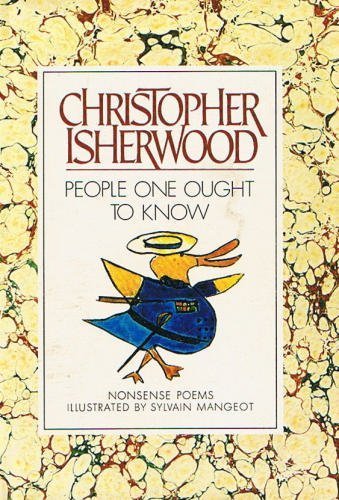
Anyway. On to the reason we are all I am here: Christopher Isherwood's delightful book of nonsense poems. This little guy (the book, not Isherwood) was not published until 1982, according to my good friend Wikipedia, though said good friend gives little other info regarding the book's genesis. The introduction of the book itself details how Isherwood wrote in conjunction with the eleven-year-old son of the friend he was living with at the time; if I remember correctly, the little guy would draw these adorable illustrations of animals, like this militant duck on the cover:
and then Isherwood would write a nonsense poem to go with it. Cute!
And they remind me so completely of those poems that I was made to perform as a kid, which all means that if I ever have children the little bastards better watch out, they're going to be reciting these by heart, the memory-assisting computer chips implanted in their brains be damned. That's right. Because I'm having kids in the future, and, as we all know, misery deepens like a coastal shelf.
My favourite in the collection:
HIPPO The Hoover Hippo's vaccuum jaw Absorbed into his hungry maw All kinds of food, from iron to suet. Most wonderful how he could do it - He swallowed clocks and cannon-balls Twice nightly at the music halls. The people clapped and shouted loud, He was the idol of the crowd; Until, on an unlucky day, A spy of the R.S.P.C.A. Found him out and had him sued And sentenced to penal servitude.
An utterly delightful and whimsical little volume of rhymes written by a young Christopher Isherwood and illustrated by an even younger companion. This whole book sparkles with fun.
"People One Ought To Know” was the first book Christopher Isherwood ever wrote, a collection of nonsense verses about animals, in the tradition of Edward Lear. It was done in collaboration with a child he was tutoring. (The child did the illustrations, while Isherwood wrote the verses.) It was a quick, charming read.