Jump to ratings and reviews
Rate this book

An Account of the Principalities of Wallachia and Moldavia

Rate this book
William Wilkinson was British Consul to the principalities of Wallachia and Moldavia, appointed to Bucharest by the Levant Company in 1813; he was recalled in 1816. He wrote this book "An Account of the Principalities of Wallachia and With Various Political Observations Relating to Them" in 1820. It was one of the books on which Bram Stoker took notes before writing Dracula, and the Romanian name Dracula was taken from it. "Wallachia and Moldavia are at present supplied by Germany with all kinds of cotton and woollen manufactures and hardware, either by land or by the Danube. The plain and printed calicoes, the chintz, glass and earthenware, brought to their markets, are, without exception, German; but they are called English, and as such sold at higher prices than they would fetch were their origin made known. The consumption of the woollen cloths is very extensive; that of the superfine qualities alone is valued at 200,000£ sterling every year. Some French cloths are brought into the country, but as their prices are considerably higher than those of Germany, they do not meet with much demand, French cambrics and English muslins are always profitable articles to speculators, and never remain long on hand. As furs of all kinds form a part of the national costume, and are, besides necessary, owing to the natural rigour of the climate, they are an article of vast importation. Russia supplies the principalities with it, and takes in return brandy and wine, and imperial ducats. Most of the merchants carrying on trade in these countries, are natives, or Greeks. Some have been naturalised in Russia or in Austria, and receive protection from those powers; an advantage which is of no small consequence to their affairs. Of late years, some natives of the Ionian islands have begun to trade in the principalities, and the English flag, borne by their vessels, is now frequently displayed on the Danube. Some overland expeditions of goods coming from Smyrna, are now and then made by way of Enos and Adrianople; but they are attended with risk and difficulty; besides which, the amount of charges surpasses by eight per cent. those incurred by. way of Galatz. The natural richness, and the various resources of Wallachia and Moldavia, are such, that if those countries could enjoy the important advantages of a regular govern¬ment and a wise administration, under which industry and agriculture should receive their due encouragement, the trade of exports laid open, the commercial intercourse with foreign nations set upon a proper footing, and finally, the mines explored, they would in a short time. become the most populous and most flourishing pro¬vinces of Europe. The harbour of Galatz would soon stand in rivalship with all the ports of the Black Sea, not excepting Odessa. The fertility of the soil is such as to procure nourishment for ten times the number of the present population, and leave wherewith to supply other countries besides; the common return of cultivation being sixteen-fold, and in more favourable seasons, twenty-five. Nature has furnished them with every possible means of becoming prosperous; men have ever proved themselves the determined enemies of their prosperity."

Hardcover

First published January 1, 1820

Loading...
Loading...

About the author

William Wilkinson (d. 1836) was an Englishman appointed as the Levant Company's representative in Bucharest in October 1813; his agency was terminated in 1818. He wrote a book An Account of the Principalities of Wallachia and Moldavia, with Various Political Observations Relating to Them (1820), the first substantial account in English. It was one of the books on which Bram Stoker took notes before writing Dracula, and the Romanian name Dracula was taken from it.

Wilkinson was later posted to Syros, in 1829, by the Levant Company. He died in Paris on 23 August 1836.

Ratings & Reviews

What do you think?
Rate this book

Friends & Following

Create a free account to discover what your friends think of this book!

Community Reviews

5 stars
4 (28%)
4 stars
7 (50%)
3 stars
3 (21%)
2 stars
0 (0%)
1 star
0 (0%)
Displaying 1 - 2 of 2 reviews
Profile Image for Cheri.
135 reviews5 followers
January 12, 2024
Published in 1820 by a diplomat who was despatched as the British Levant Company’s representative in Bucharest, William Wilkinson, the book—An Account of the Principalities of Wallachia and Moldavia is a kind of observational book (a travelogue diary) with a lot of inaccuracies (or cultural misunderstanding) stems from Wilkinson’s own ignorance and lack of knowledge regarding the place he resided in. Interestingly enough, this book is also one of the sources that inspired Bram Stoker in his early research days when he was about to write a gothic-horror story. The exotic names and the odd habits of the Wallachians and Moldavians, as written by Wilkinson, compelled Stoker to choose the place (Transylvania) and even borrow the name Dracula (a real Wallachian historical figure) for his novel.

This book is not without its merit, there is many interesting information that Wilkinson mentioned but it’s just passing information without further explanation. Understandable though because Wilkinson was not a historian but I found his lack of curiosity jarring for someone who wrote about the place that he once was resided. An example of this is when he wrote that the Phanariot Hospodars (Wallachian and Moldavian prince of Greek origins, appointed by the Ottomans) was selected because they were obedient like a servant and were chosen to be the tools of the Ottoman empire.

“The porte selected the new princes from the Greeks of Constantinople, whose long habit of obedience and servile degradation, appeared to render them suitable tools for the new policy adopted, relative to the government of the principalities. From that moment the princes have been appointed by Beratt, an imperial diploma, in which the Sultan, in proclaiming the nominations, commands the Wallachian and Moldavian nations to acknowledge and obey the bearers of it, as sole depositories of the sovereign authority.” ~Page 42-43.


Certainly, that was not the reason. An academic research paper written by historian Nir Shafir (an assistant professor of history at UCSD) titled Phanariot Tongues: The Mavrocordatos Family and the Power of the Turkish Language in the Eighteenth-Century Ottoman Empire highlighted that the Phanariots, at best, were enlightened subjects of the Ottoman Empire who wield their pens and tongues to attain high political power within the Porte as official translators, negotiators, and intermediaries between Western Europe and the Ottoman Empire. All Phanariot Hospodars were polyglots, able to master many languages even in their highest bureaucratic forms, and as such, they were the perfect agents (the diplomat middle-men) who relayed information regarding the intrigues in Austria, France, and Russia to the Ottoman Sultan.

“In their own literature and chanceries, they wrote in Greek, often in the highest registers of Attic Greek, and their rule brought about the usage of Greek as a common learned tongue in the Danubian principalities. At the same time, as recent scholarship demonstrates, the Phanariots were also fully part of Turcophone Ottoman state and society. They derived their positions, wealth, and political structure from the Ottoman state. More than mere intermediaries, the Phanariots occupied the positions of voivodas (i.e., governors) of the Danubian principalities of Wallachia and Moldavia and chief dragomans in the imperial bureaucracy.”
“The Phanariots, however, managed to acquire literary Turkish, the Turkish of the bureaucratic corps, the ḳalemiye, and were able to read, write, and speak in eloquent, literary Turkish.”
~From Phanariot Tongues by Nir Shafir, Page 182.


“…the key to the Phanariots’ power was their monopoly over four key political offices: the office of the grand dragoman, the office of dragoman of the imperial fleet, the voivoda of Wallachia, the voivoda of Moldavia. These offices put the Phanariots in the business both of providing information to the Ottomans about the increasingly intricate world of eighteenth-century European diplomacy and acting as intermediaries, whether as translators or negotiators, with these same powers.” ~From Phanariot Tongues by Nir Shafir, Page 187.
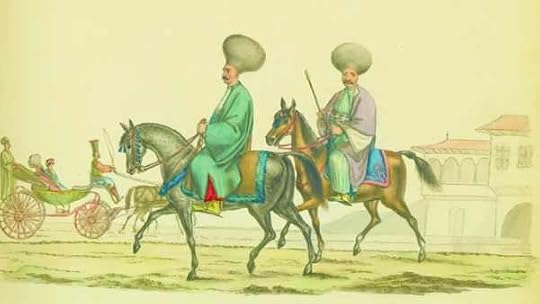
Plenty of Wilkinson’s observations of Wallachian and Moldavian subjects were depicted as displeasing and I’m amazed whether Wilkinson actually enjoyed his time in Bucharest or not. If he didn’t enjoy it, yet he tried to secure another appointment to be posted in Bucharest the second time which ultimately rejected. Anyhow, interesting old book but not a wholly accurate description of a fascinating historical period in Romania and Moldova.

-


-


-


-


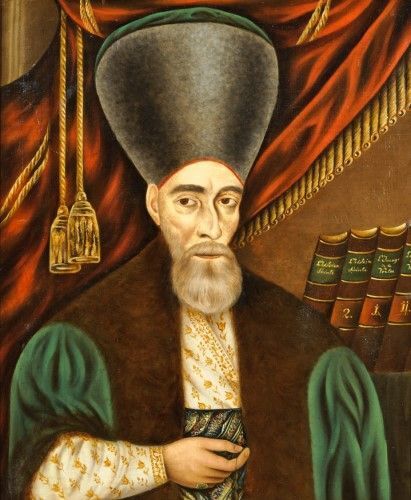
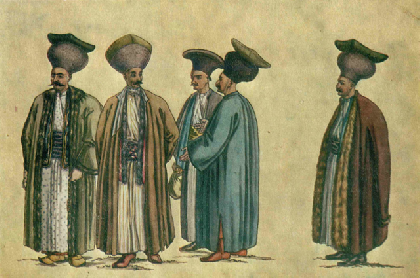
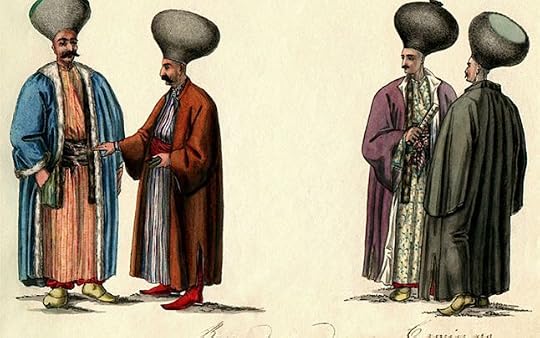
Above is an interesting pear-shaped headgear, worn by Wallachian and Moldavian boyars. Wilkinson wrote “…to which they substitute a kind of cap of an extraordinary size called calpack, made of grey Astracan fur, in the shape of a pear. It is hollow, and the largest part of it is about three feet in circumference, with a proportionable height.” I’m not sure what the headgear was actually called in Wallachian/Moldavian tongues as calpack could also referred to the headgear that the Central Asian tribes (Turkic) usually wore. The last portrait depicts Boyar Manolache Manu.
40 reviews
Read
November 1, 2020
Fascinating. Apparently one of Bram Stoker's sources for "Dracula", but more generally an interesting historical/anthropological work about the two provinces. Come for the tenuous vampire links, stay for the extended translated account of 18th century Turkish military reforms.
Displaying 1 - 2 of 2 reviews