During the 18th and 19th centuries, artists and travellers were lured to Rome, the home of civilized values and artistic beauty. But the history of visiting Rome had a pathological side—not only crisis and disorientation but repulsion at its filth and stink. Rome’s air was considered to contain a chronic source of disease. This book argues that “bad air” (mal’aria) is a neglected aspect of thinking about the city’s history and as a destination for artists, visitors, and Romans both ancient and modern. These problems interfered with exploring Rome, its art and architecture, and representing its landscape. Atmospheric contamination made plein air painting and investigating antique ruins challenging activities.
Roman Fever invites an original and alternative perspective on the city and its countryside, revisiting the history of Rome in terms of ideas about climate and the role of the environment. Beautifully illustrated with unfamiliar images, it focuses on the interplay between enthusiasm and inspiration, and debilitation and mortality, all an integral part of discovering and engaging with the Eternal City’s landscape.
This is an intriguing book about Rome in the eighteenth and nineteenth centuries, and how it functioned as a powerful site of ‘influence’, both artistic and pathological.
On the one hand, Rome was the cradle of European civilisation, to which artists came from far and wide to study the masters of their craft, and copy their techniques. But on the other hand, the city was also the tomb of that great civilisation: a place of ruins and filthy streets, surrounded by a desolate malarial wasteland. Wrigley's study – which he calls an ‘anti-Grand Tour’ book – attempts to show the various ways that these two strands of thought combined in productive ways, drawing on art criticism, travel writing, and contemporary medical literature.
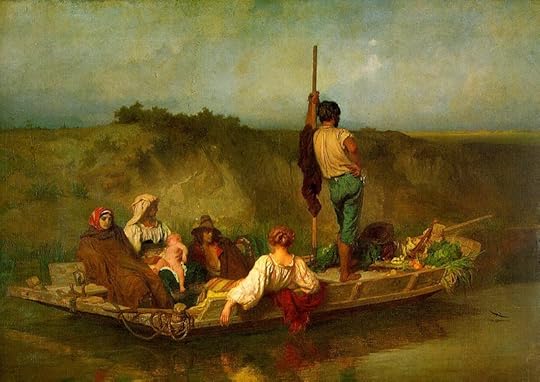
Ernest Hébert, Malaria, 1848–9
In those days, it was not really understood why so many people died of fevers every autumn: the deaths were attributed to the ‘bad air’ – mal'aria – for which Rome and its environs were so notorious. It was something that travellers had to reckon with as a serious issue: almost no one spent long in the city without suffering some kind of serious health problems. A fever that Henry Fuseli contracted in Italy turned his hair prematurely white, and no fewer than three heads of the French Academy in Rome died in place during the eighteenth century. New arrivals were advised to avoid fresh air in the morning and evening by keeping their windows firmly shut, especially when the sirocco blew ‘mephitic exhalations’ up from the Pontine marshes over the city.
The result was that artistic tourists absorbed the palazzos and Old Masters in a conscious state of imminent danger, if not of literally feverish excitement. It put them, Wrigley says, in ‘a disturbingly polarised state of mind and body, oscillating between fascination and repulsion’.
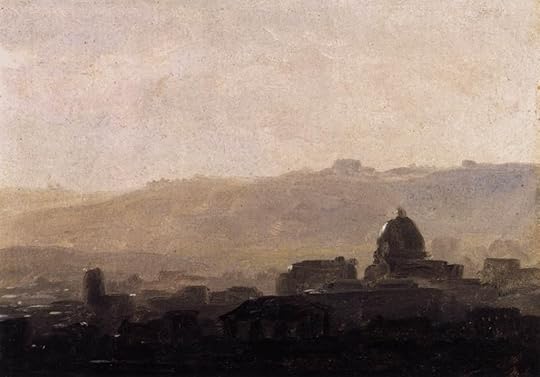
Pierre-Henri de Valenciennes, View of Rome, 1780s
In many ways, of course, this was not a bad state in which to think about art (Wrigley notes that it was around this time that the Romantic ideal of the sickly artist began to gain prominence), and certainly when Rome later became the new capital and started to get cleaned up, not everyone was happy about it. Artists who remembered seeing the Colosseum as ‘a beautiful wilderness of ruins, vines and shrubbery’ didn't find it quite so endearing once it had been tidied up and un-buried from rubbish, although this also stopped it from being a malaria hotspot.
So the city became gradually cleaner and healthier, but for some commentators it lost something, too. ‘Everything we loved, the spontaneity, the dirt, will now disappear,’ Ibsen complained: ‘for every politician that springs up in that city there will be one artist the fewer.’ But at least the artists that did spring up had a better survival rate.