Peter Soyer Beagle (born April 20, 1939) is an American fantasist and author of novels, nonfiction, and screenplays. He is also a talented guitarist and folk singer. He wrote his first novel, A Fine and Private Place , when he was only 19 years old. Today he is best known as the author of The Last Unicorn, which routinely polls as one of the top ten fantasy novels of all time, and at least two of his other books (A Fine and Private Place and I See By My Outfit) are considered modern classics.
As humans we are built for pleasure and enjoyment. Who reading this doesn’t enjoy the taste of a juicy, ripe piece of fruit, enjoy the fragrant smell or fresh flowers, enjoy the feeling of being wide awake and in radiant good health; who doesn’t take pleasure in the sight of a finely constructed, provocative outdoor sculpture or the beauty of nature: a flock of birds, a lush green summer lawn or the beauty of a gorgeous human body ? And for that matter, who doesn’t enjoy being in love, or, at least, dream of being in love and having intimate sensual encounters with his or her beloved? All perfectly natural, perfectly harmonious, perfectly human.
We can ask ourselves: how would this natural urge for sensual and sexual enjoyment play itself out when filtered through the alembic of 14th century medieval Europe’s collective unconscious, a century torn by famine, unending war, marauding brigands, papal schism, peasant revolts and, most dramatically, the black death? How would such enjoyment and pleasure be represented by an artist living in this traumatic historical epoch, one of the most creative and imaginative and skilled artists ever to appear in Europe?
Well, take a look at the middle panel of Hieronymus Bosch’s huge 12’ x 7’ triptych known as The Garden of Earthly Delights, a colossal one-of-a-kind masterpiece where Bosch plays with this very human capacity for pleasure, enjoyment and desire for multifarious earthly delights. What creative imagination, what artistic mastery, what a painting.
For anybody interested in this work by Hieronymus Bosch, Peter S. Beagle’s book is a great find. The clean layout is most appealing -- distinct portions and sections of the painting are presented as their own plates complete with Beagle’s reflections. The book addresses the right and left panels of ‘The Garden’ as well as 10 other Bosch paintings, but, for the purposes of this review, I will focus my comments and observations below on three plates taken from the middle panel since this is the work that has fired my own imagination. For ease of reference I have retained Beagle’s personalized caption for each of these plates.
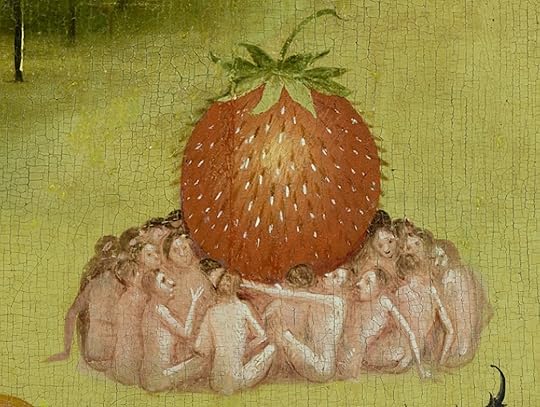
The Strawberry Cult Beagle writes, “A throng of men gather worshipfully around an enormous strawberry. These men merge to become merely a swarm of bodies and heads; having lost all individuality, they resemble insects in their ceaseless quest for satiation, both physical and sensual.” My reading of this scene is quite different. The throng of men remind me of how, for thousands of prehistoric years, men sat in a circle shoulder to shoulder around a campfire. True, with Bosch these men are sitting around a ten foot strawberry, but there is something magical about the sheer size of that strawberry; imagine the tales those prehistoric tribesmen would tell about such a strawberry. Or, envision a fairy-tale where boys and girls are lost in the woods and nearly-starving and come upon this strawberry – what a feast! Or, picture a 21st century farmer putting Bosch’s strawberry on display at the local county fair.
The Pool of Female Enticement What full-blooded male artist hasn’t enjoyed painting beautiful nude women? Bosch certainly was no exception. Beagle says the scene of woman in the oval pool “seems to define lust as the passion which lies at the heart of all the other evils cultivated there.” Well, maybe, since this is the medieval Christian world, but a few dozen shapely young women, most with long golden hair flowing down their back, standing knee-deep in a gorgeous pool of blue water along with several varieties of exotic birds on a clear, sunny summer afternoon. . . that’s a sight most of us wouldn’t mind encountering, medieval times or modern times.
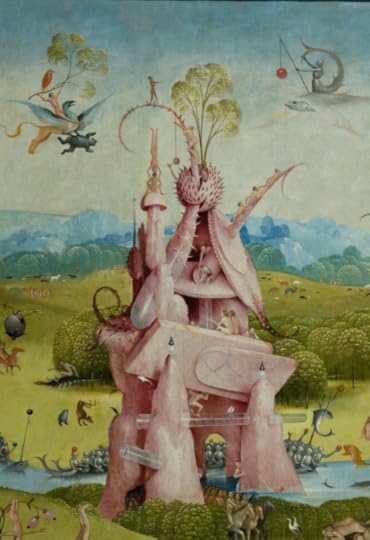
False Flight This plate features one of the five towers in the central panel, the 70’ pinkish tower on the far left. Beagle writes of the humans climbing the tower in euphoria, a climbing that will ultimately send them to hell. Again, my viewing is quite different. I see this scene with its bizarre, fantasy-world tower as an artistic expression of what it is that gives us humans our particular strength – our limitless imagination. Our human knowledge is limited (What do we know with absolute certainty about the meaning of life, really?), our capacity is limited (We are tender, finite beings subject to suffering, disease, sickness, old age and death) but our imagination – completely breathtaking . . . and Bosch provides a clear example of just how far our boundless, astonishing, dazzling imagination can soar.
The book’s back cover includes a quote from the Travel Journal of Antonio de Beatis, describing in 1517 this work by Hieronymus Bosch. We read, “There are also some panels of various strange scenes, simulating . . . things which are so pleasing and fantastic that is would be impossible to describe them properly to those who have no knowledge of them.”
Fortunately for us modern people, we need not travel to the Museo del Prado in Madrid to see The Garden of Earthly Delights (although viewing the original would be ideal – if you can, please do so). We have many reproductions available, including this fine book published by The Viking Press.
”Bosch’s art is a monument to his genius at manipulating the tension between humor and horror, grotesqueness and delicacy, the impossible and the everyday. That Bosch himself encompassed these contradictions ensures that he will remain an enigma.”
The Garden of Earthly Delights is, above all else, a book of art — the grotesque and wonderful art of Hieronymus Bosch. It contains full page, full color plates, several illustrations that span two pages along with text, and many details, both in color and black and white, throughout. Despite its title, the book includes many of Bosch’s famous works, not just the amazing triplicate of the title. Like any good art book, the reason to add this to your collection is the art itself. And while I usually regard the text in an art book to be wholly secondary to the images, the fact that Peter Beagle, one of the premier fantasist of our modern age, provides the text surrounding Bosch’s fantastical images is frosting on this most tasty of cakes.
Beagle opens the book talking about the little we know about Bosch. He emphasizes that Bosch was unique — he belonged to no recognizable school of art, seemingly had no real predecessors, and with the sole exception of Bruegel, had no students. Beagle writes:
”Bosch comes burning out of nowhere, masterless, companionless, slashing like a demon’s talon across the rich, placid fleshiness of Flemish art. How could a whirlwind have roots?”
He addresses several of the popular theories of the origins of Bosch’s unique work, the first of which that he was a member of a secret, heretical cult, and his art conveyed it hidden gnosis in symbol. Beagle points out the unlikeness of this, noting that Bosch was both prominent and respected in his community, and that it’s not really necessary to explain much of his work — that much could be explained from the popular obsessions of his time:
”He could have drawn the orgies depicted in The Temptation of St. Anthony as easily from popular fantasy as any personal observation — the images were part of his world’s fabric, as much as the mysterious rituals and powers of the Mafia are of ours.”
As to whether Bosch’s art was drug induced, Beagle writes:
”The same sort of Occam’s Razor approach may be applied to the inevitable question of whether Bosch’s “pleasing and fantastic” visions might have been drug-induced…The idea is not at all impossible in itself or even unlikely. Natural hallucinogens — mushrooms, fungi, herbs, flower-seeds — were as recognized and available in medieval Europe as their veiled presence in hundreds of folktails would suggest. But whatever Hieronymus Bosch may have been smoking, drinking, or snorting, no other artist of his time can have been on it. It must have been private stock, like his dreams.”
Beagle goes on to discuss the work itself as it is laid out in the book, but that I will leave for you to discover. For as insightful and interesting as it may be, as perfectly matched as Beagle may be to this subject, Bosch’s art is still primary — it is the reason you want this book, with Beagle’s input being an added bonus.
Every time I come across the painting, The Garden of Earthly Delights I come to a full halt. It is a shocking picture, triptych to be exact. Not just for the nudity and the creatures, so many looking like a drugged-out dreams, but also the so many historical problems. It seems entirely wrong for the end of the gothic period and so clearly in appropriate for a church centered Europe. Yet, there it is. Bird beaked humans, musical instruments of torture, a vast anatomical rendering of sensual pleasures, mostly gluttony and detailed sexual concupiscence then finally a grotesque and vastly un desirable eternal condemnation. In attempting to share his understanding of this complex and unnerving accumulation of images, fiction writer and fabulist Peter S. Beagle achieves much, leaves as much un said and adds to the confusion.
About artist Hieronymus Bosch, Beagle tells us that there is very little to know. He also fails to tell us that the painter left behind almost 150 paintings, not all as surreal as his most famous work. Searching the net, I quickly found out that Boch painted at least 4 images centered on St. Anthony. Possibly because of the saint’s association with St. Anthony's Fire an illness brought on by the ingestion of fungus-contaminated rye grain known as ergot poisoning. A symptom of this poisoning is LSD like hallucinations. In fact, the tainted rye grains, when baked can create lysergic acid a precursor of LSD.
Elsewhere I learned that some portions of the images, the bestiary of The Garden can be found in similar forms in older manuscripts, often as the marginalia in illustrated manuscripts. How many of these Bosch would have had access to is not explained. Lastly, Hieronymus Bosch, was painting at a time that was fixated on the details of afterlife, in the more likely assignment to eternal damnation. In other words, Bosh was painting what others were already believing.
None of these ideas can be definitively proven as we lack any direct knowledge of the painter, but they carry reasonable conjectures that help to understand why a world heavily subject to church based censorship tolerated so many graphically engaged naked people.
Author Beagle eventually moves through the triptych in a systematic left to right detail for detail, but not before he skips into a few other paintings. This done with virtually no warning. As he focuses on details, he has a tendency to speculate about facial expressions. In major characters, he may be justified, but with smaller, background figures, his may be baseless opinion. If a detail is worth specifying, it should have its own close in shot. This brings up the best part of this book. It is oversized and lavishly illustrated. Most major images are given extra space and may more incidental beasties, pleasure seekers and condemned can be seen in the generously reproduced marginalia.
This was an interesting read. I knew something about Hieronymus Bosch (HB) already, and have seen a few of his paintings. I encourage anyone to google him and look at a painting or two if nothing else. His art work is like no other.
The book is split into four chapters, the first section being broadly about the artist himself, although very little is actually known about HB so this is not as in depth as you might expect, if you were unaware of that.
As we get further into the book we ‘discuss’ his paintings, not just The Garden of Earthly Delights, for which the book is named, although at times I got lost as to which painting we were actually discussing. There is quite a detailed analysis of both the painter and his art, but of course in particular the painting The Garden of Earthly Delights and that was my favourite part of this book; where in Chapter 3 we ‘zoomed in’ on different areas and analysed these parts of the whole individually. Chapter 4 was good too, a discussion regarding the depicted demons in his work.
Of course maybe HB just wanted to paint some strange pictures and there is no symbolism but I think whilst we don’t know for sure these are educated reasonings and I’m inclined to agree for the most part.
Sometimes this was a little heavy going, more so at the beginning, but hang on in there as it gets better/easier or perhaps I just got into the subject/writing more.
I feel like there might be better books about this artist out there, this came across as someone's personal musings about my current favourite painter, but as I said earlier the author writes with some knowledge on the subject and appears to have not only done his homework but have a genuine love of the artist himself.
Overall an engaging read for anyone interested in Bosch. Fascinating stuff. I will be reading more relating to Bosch and going to see the painting itself when safe to do so.
I'm not a reader of art criticism, but I love Mr. Beagle and Bosch has always been weirdly fascinating, so this was a really interesting, very well laid out book.
from PB: "Everything was religious. So must dreams have been, of course, in a way that I will never be able to imagine. Far more than anything else that I want to know about Hieronymus Bosch, I wonder what the dreamed. I believe, finally, that he painted, not alchemical roadmaps or Kabbalistic minutes of the last meeting, but his own nightmares and daydreams, which were the deepest dreams of his civilization. There have probably been artists like that since the caves, one or two in each generation: somehow commanded to dream for a people in its time, to give a shape and a name to the monsters that exist in the particular darkness of that time. Hieronymus Bosch was such an artist."
and a quote from a Dutch historian in the epilogue, which sums things up well: "So violent and noisy was life, that it bore the mixed smell of blood and roses. The men of that time always oscillate between the fear of hell and the most naive joy, between cruelty and tenderness, between harsh asceticism and insane attachment to the delights of this world, between hatred and goodness, always running to extremes." - Johan Huizinga
I've owned this book since I was in college, and finally got around to reading it. And I am mighty glad I held onto it, as I found it a very engaging read. Beagle is not, by his own admission, an art historian, but his analysis of Bosch's works is informed by a knowledge of both the visual language of late medieval art, and Bosch's time (the late 15th and early 16th centuries), including much that is specific to the painter's Dutch hometown. The book is not systematic in its approach, but hops about among Bosch's works -- Beagle looks at several pieces besides the painter's best known work -- pulling in relevant bits from late medieval religiosity, occultism, folklore, and politics to support its analyses. It also intersperses autobiographical passages about Beagle's developing interest in his subject. The book's copious illustrations, most of them in color, are often placed in and around the text instead of being isolated on separate pages, and coupled with the autobiographical material, this design feature gives the book an immersive feel that is one of its most striking and appealing features. A work that is well worth your time if you're interested in or curious about Bosch and/or late medieval European art and culture.
This is pretty much the perfect book about art. Not written by an artist historian but by novelist, it’s a novelist’s personal perspective on the painting. I don’t know much about Peter beagle and I’ve never read any of his books until this one. But I’ve read as much as I can get my hands on about the wonder that was Bosch. And I think this is my favorite book of all. Beagle, like Bosch, comes from a family of painters. The only person in the entire family apparently who doesn’t paint he becomes a novelist and so he’s very good at looking at pictures and describing what he sees. One of the books I recently read by an art historian quoted him and his commonsensical view of the picture. It’s a wonderful book about a spectacular work of art.
This is my favorite kind of art book: detailed pictures of amazing art paired with the enthusiastic prose of someone who is not an official art critic or historian, but is so moved by the art that they write brilliant words in exegesis. Not only did I learn a bit about Bosch's time and the Medieval symbolism of what he depicted in his singular art, but I got to enjoy lovely prose by one of my favorites.
The Garden of Earthly delights for me is a complex work. Beagle is from a family of artists. The Last unicorn is a fantasy novel. Beagle on Bosch is a treat. Each time I see the work a get new thoughts. Depending on my state of mind the book and the work are always alive!!
This is one of my most treasured books. It's beautifully designed with stunningly laid out pages, and the insights into Bosch's world and art are wonderful. If you're interested in Bosch I'd highly recommend it. In fact, my copy is sadly falling apart and I'll have to buy another.