Thomas Hart Benton An American Original by Henry Adams. Thomas Hart Benton (1889-1975) was an artist whose images express his deepest feelings about American Life and History, about love family and religion. This lavishly illustrated volume brilliantly reproduces hundreds of his works, ranging from the most informal, initimate sketches to monumental mural cycles and noble nudes - works that reveal him as a major recorder and inerpreter of American scene.
This oldest and most distinguished family in Boston produced John Adams and John Qunicy Adams, two American presidents, and thus gave Henry the opportunity to pursue a wide-ranging variety of intellectual interests during the course of his life. Functioning in the worlds of both practical men and affairs as a journalist and an assistant to his father, an American diplomat in Washington and London, and of ideas as a prolific writer, as the editor of the prestigious North American Review, and as a professor of medieval, European, and American history at Harvard, Adams of the few men of his era attempted to understand art, thought and culture as one complex force field of interacting energies.
He published Mont Saint Michel and Chartres, his masterwork in this dazzling effort, in 1904. Taken together with his other books, Adams in this spiritual, monumental volume attempts to bring together into a vast synthesis all of his knowledge of politics, economics, psychology, science, philosophy, art, and literature to attempt to understand the place of the individual in society. They constitute one of the greatest philosophical meditations on the human condition in all of literature.
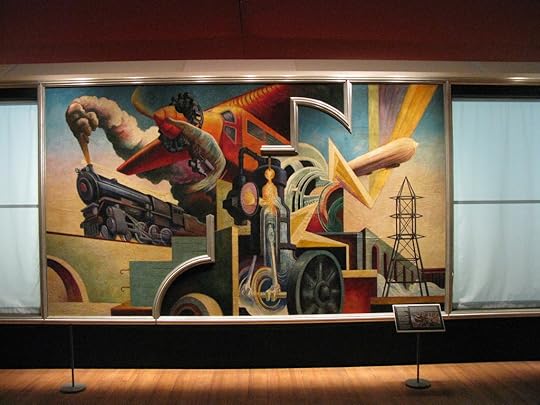
Part of the mural America Today Instruments of Power, 233.7 x 406.4 cm Metropolitan Museum of Art, 1930
Thomas Hart Benton was an ebullient and extroverted artist. He liked to talk. He was born in 1889, but it was only in the mid-1920s that he found his artistic niche. Prior, his style was very variable and imitative. He studied art in Chicago and then went to live and study art in Paris for three years. After, in 1912, he settled in the New York art community.
Thomas Hart Benton could make both friends and enemies. Often, he found others pompous and pretentious – and had no qualms about denigrating them. He also starting teaching art in New York and got married. The vehemence between the different artistic and competing artistic communities was astounding.
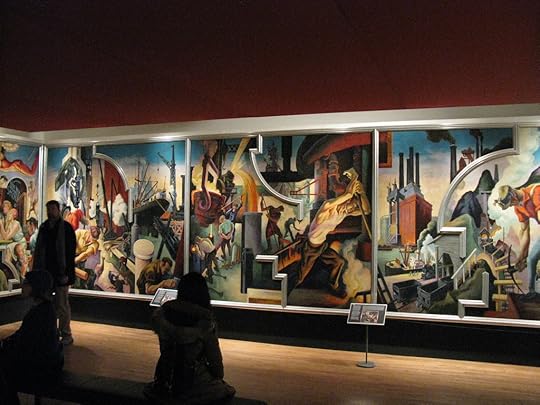
By 1935 Benton became fed-up with all the academic squabbling and moved back to his native state of Missouri. He taught at the Kansas City Art Institute. He had by this time developed what was called the regionalist artistic approach. Benton travelled widely across the United States observing and making sketches of rural communities and farmers, which he then painted. He was commissioned to paint large murals for the Whitney Museum and then for the states of Indiana and Missouri. These are vibrant and full of energy. Perhaps they may be considered as caricatures or even cartoonish – but they are composed of diverse characters and many details.
Part of the murals for "America Today" 1930-31 Metropolitan Museum of Art
A few asides: Although the Benton’s mother is a significant presence in the first half of the book, she largely disappears in the latter half.
Thomas Hart Benton was an absent husband and father; the author glosses over this. His extensive and lengthy travelling was done without the presence of his family. Benton struck me as a chauvinist. He was also homophobic.
Jackson Pollock was a student of Benton. I felt the author belaboured this relationship.
Benton made two nude paintings of women while in Missouri. The outcry over this is shocking and reveals the prudishness of mid-western society during that era. One painting (Susanna and the Elders) was decried as “lewd, immoral, obscene, lascivious…
Benton was eventually released from his teaching position at Kansas City Art Institute. He was constantly stirring up a hornet’s nest!
Page 173 my book
In his desire to express the whole pulse and energy of America, rather than any single part it, Benton devised a form of composition that differs from that of traditional Western paintings, which concentrate the glance on a few central forms and organize these in simple pyramidal groupings. Benton’s design, by contrast, has no single center of focus or impact. Each shape flows uninterruptedly into the next, spreading out toward the edges in a unified field of energy.
Page 174-75 Lloyd Goodrich
“These paintings give one a sensation like that of looking out of the window of a train speeding through cities, past factories and mines, through farmland and woods, over prairies, across rivers. They convey a sense of the restless, teeming tumultuous life of this country, its wide range of contrasts, and its epic proportions… His design is as insistent as jazz or the beat of machinery, seeming in tune with the speed and emphasis of modern American life.”
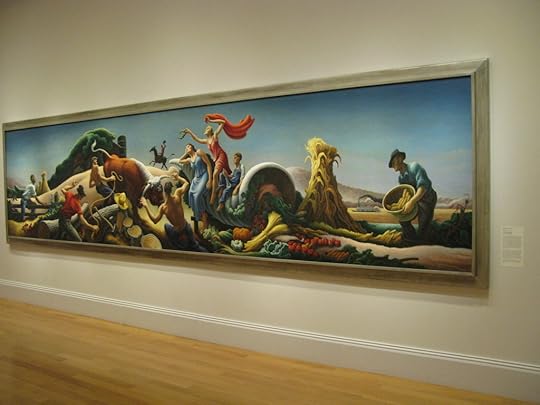
Achelous and Hercules Washington DC - April 2015 - National Portrtait Gallery
This auhtor explains Jackson Pollock's schema of compositional theory and then relates it to Benton's corpus making an audacious connection between the two.
Of course Benton catalogs a bygone Americana in a uniquely inspired manner. Part abstract illusionist, part traditional portraiturist. A Twainian storyteller too. I see the influence of O'Keeffe's aesthetic in his work. Do you?