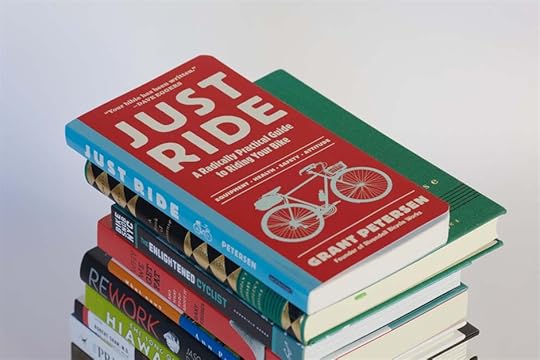
Just Ride is a revelation. Forget the ultralight, uncomfortable bikes, flashy jerseys, clunky shoes that clip onto tiny pedals, the grinding out of endless miles. Instead, ride like you did when you were a kid—just get on your bike and discover the pure joy of riding it.
A reformed racer who’s commuted by bike every day since 1980, whose writings and opinions appear in major bicycling and outdoor magazines, and whose company, Rivendell Bicycle Works, makes bikes for riders ready to opt out of a culture overrun by racing, Grant Petersen shares a lifetime of unexpected facts, controversial opinions, expert techniques, and his own maverick philosophy.
In 87 short, two-to-three page chapters, it covers:
Riding: Count Days, Not Miles; Corner Like Jackie Robinson; Steer with Your Hips, Shift with Your Legs
Suiting Up: The Shoes Ruse; Ponchos—the Ultimate Unracer’s Garment
Safety: #1 Rule—Be Seen; Helmets Aren’t All They’re Cracked Up to Be
Health and Fitness: Why Riding Is Lousy All-Around Exercise; Saddles Don’t Cause Impotence; Drink When You’re Thirsty—Not Before
Also includes chapters on Accessories, Upkeep, and Technicalities, and a final chapter titled “Velosophy” that includes the essential, memorable thought: Your Bike Is a Toy—Have Fun with It.
Grant Peterson is the founder and owner of Rivendell Bicycle Works and writes the Rivendell Reader. His writings and opinions have been featured in major bike and outdoor magazines, including Bicycling, Outside, and Men's Journal. He's commuted exclusively by bike since 1980, and lives with his family in Walnut Creek, California.
Just Ride largely repeats what author Grant Petersen has written on his bicycle company’s Web site. His central idea is that bicycle (road) racing has made bikes sold to non-racers over the last thirty years worse, not better. The reasons he gives include:
- Narrow tires pumped to high pressures are uncomfortable and offer no benefits. - Current “road bike” frames have too little clearance to fit wider, more practical tires. Mounting proper fenders is usually impossible. - Bicycles are built with overly sporty (uncomfortable) geometries. - Carbon fiber is a dangerous material for bicycle frames, because it’s hard to tell when it’s been damaged, and a damaged carbon fiber part can break suddenly. - Clip-in pedals are impractical and provide dubious benefits. - Drivetrains with ten or more rear cogs offer more gear ratios than are useful, and they require fastidious adjustment to work properly. - Lycra jerseys and padded shorts are unnecessary on all but the longest rides.
Not only has racing worsened bikes, it’s also worsened riders. Many bicycle enthusiasts view their bikes as training tools used to exact suffering rather than toys for having fun. The bicycle fitting advice given by shops is all based on received wisdom stemming from racing, the result being that your average rider rolls out of his local bike shop with an uncomfortable setup.
Some cyclists reading this are probably foaming at the mouth over Petersen’s “radically practical” attitude towards cycling. (In case you’re not, consider this: there’s a section about fashioning mud flaps out of used milk jugs.) But is he right?
Bicycle Quarterly has done some research indicating that wide, low-pressure tires are better than hard, skinny ones. Petersen’s health and fitness ideas are based on Gary Taubes’s Why We Get Fat. Overall, however, Just Ride doesn’t provide facts or research to back up its claims. Petersen’s discussions of pedal technology, pedaling technique, and bike geometry refer to “studies” supporting his conclusions, but he doesn’t provide citations. Much of the book seems like common sense, but a reader who wants to evaluate Petersen’s ideas against prevailing bicycle industry sentiment isn’t given enough to go on, short of trying them for herself.
Speaking as someone who has already sipped the Rivendell Kool-Aid, the book contained almost no new material. If Petersen were going to put out a book, I would have preferred a Rivendell Reader anthology. Just Ride’s arguments are too briefly and bluntly stated to win over potentially hostile triathletes and racers, and there is too little supporting fact to convince even a sympathetic reader. Just Ride, then, should be viewed as a list of unfashionable but seemingly sensible ideas that serve as starting points for trying new things. I don’t think Petersen will win over many converts with this book, but his ideas will resonate with some and perhaps lead them to happier cycling.
I was prepared to give the author the benefit of the doubt many, many times during this tedious, depressing read but when I came to the last question in the quiz that ends the book I realized that no, he IS just a man with an axe to grind. Grant Petersen hates bike racing and anything remotely connected to it, and he wants you to hate it as well.
In fact he hates most things connected with bikes, but not everything. He loves heavy frames and pannier bags. He also loves recommending “safety tips” like deliberately swerving in traffic to make car drivers take notice of you and the idea that mudflaps made out of tape and old milk cartons are a good idea. This is a man who owns a bike shop by the way.
Here is one of my favorite nuggets, certainly not the most contentious but it’ll give you an idea of the sort of read you can expect:
When talking about cycling gloves Petersen says that they’re not essential. He then goes on to say “Obviously, they protect your hands but (they) also get stinky…Yes, I can wash and dry them, but that’s too much work”. Wait, so you’re aware that gloves protect your hands but you’re recommending that people not wear them because washing clothes is too much like hard work? I’d hate to hear his theories on the importance, or otherwise, of wearing underwear!
This brilliant chapter on gloves (No 53 for those keeping count) goes on to say, “I have crashed and hurt my hand skin and wished I’d worn gloves but … gloves are just another thing to lose and look for”. Well, thanks for the positive outlook and for the considered advice. It’s not that Petersen is wrong per se, gloves aren’t for everyone, but the reasons he gives are ridiculous. Of course, his advice stems from his personal hatred of anything remotely connected to cycle racing and is not objective in the least.
There are many more erudite reviews of this book floating around on Goodreads than I can manage but I didn’t want to give this title a 1/5 and say nothing. My advice, if you are a new to cycling, is please, please read a lot more books before you take many of the ideas in this title seriously. Make up your own mind about the kind of cycling you want to do and and then read this - it will either confirm the opinions that you have independently formed or help you to understand why you disagree so vehemently with Petersen.
And ultimately, if you find out that you quite like cycle racing and you can in fact name more than five pro bike riders then take heart – you’re not alone!
I really liked and appreciated the concept of Just Ride. What Petersen is saying is don't get caught up in the commoditization and commercialization of the sport. You can have a lot of fun riding a bike with the basics. You don't need the expensive road bike with the expensive apparel and Garmin metrics. The end goal is to enjoy the recreational sport.
I've been riding for almost 15 years. I came to the fun in my early 40s. I was working on an IT project with a team that was very active in the sports community. In Sacramento, we have local flavored 24 mile triathlon where people run, bike and kayak down the American River. You could do it in teams or by yourself. My coworker and I decided to do it by ourselves. To get myself ready, I purchased a T-bar bike which was designed to ride the road mostly but also could be taken on an easy trail. It was marketed as a cross training bike. It weighed about 22 lbs which at the time was considered pretty light. I started commuting to work on it (15 miles each way) to get in shape for the race. A coworker who lived near me had a road bike. I would sometimes leave about 20 minutes before him and he would constantly catch up with me on the way home. It became a goal to leave at least 20 minutes before and not let him catch me before I passed his house which was about 2 miles closer to work than mine. IOW, I didn't want to see him on my ride home. I had become a good cyclist and fast but I couldn't compete. I discussed it with him and he told me first he's been riding for several years and second he had a road bike. I was getting the better workout, but he was always going to be faster. Needless to say, the next year, I purchased a road bike. The race passed, but the bike commute continued for a decade afterward. I have always loved cycling. There is nothing like a bike ride on backroads of rolling hills and beautiful scenery.
That's why this book had such tremendous appeal to me. Philosophically I agree with much of what he is saying. So many riders (who will never be professionals) are more concerned with the metrics of how good they are and how good they look rather than just taking in the joy of being out there. They strive to get those pro stats. They ride expensive bikes and wear expensive apparel designed to reduce the weight and drag on the rider so they can be 0.05 mph faster. It's an obsession. But really that's the same mentality in any sport. There are always people who derive enjoyment by comparing and striving for those professional metrics. With the marketing of cycling, there is this aura that one must start out pursuing those metrics to participate…or at least look the part. It can be intimidating to those who are not in the cycling universe. Petersen says you don't need all that stuff, just get a bike and ride. The book is actually a pretty decent reference about cycling. Petersen explains what all the measurements are that people hear so much about. He explains about the different riding styles and bike geometries and road biking vs recreational biking vs mountain biking etc. He explains some of the cycling vernacular and actually goes into some detail and strategies about gears and climbing etc. He even talks about tires and what all those metrics mean about the casing and strength. Very informative.
I think where the book falls short is with the audience. Most of the people who will pick up this book are people involved in cycling; and most cyclists already know why they ride. Petersen is dismissive the motivations for a sizable portion of his audience. The psychology behind why people are invested in a given activity especially something like cycling or running is that there are many people who enjoy pushing themselves to being the best they can be at a given activity. In short, a lot of people like the challenge and to be victorious in overcoming adversity. That is part of the enjoyment. Climbing that hill, not that much fun. Getting to the top and over the hill…glorious!! Petersen is telling folks, you don't have to suffer to ride a bike or do anything extra. That's true, but here audience analysis is in play. The other issue is that the book drastically needs an update. These last few years, the innovations in cycling have been tremendous. Petersen is talking about "triples" (a triple crankset) which honestly weren't a thing when I started riding for all the reasons he listed. I started riding long before he wrote this book and compacts (cranksets) were the rule. You couldn't find a triple if you wanted one, even on mountain bikes. Why include it in this book except to strengthen an argument about the commoditization of cycling. It's a con and not relevant except maybe with the box stores like Walmart or Sports Authority which are likely years behind in their bicycle offerings. Sigh. Also, I don't agree with him about the need for apparel. He says there is no need to don bike apparel to ride. My experience tells me that anything over 20 miles, you should be in bike shorts unless you want unnecessary pain in your nether regions. To be fair, Petersen is advocating for short rides, but most road bike aficionados don't get out for less than 30 miles. Again, the audience. He also advises against road pedals and shoes. And again in my experience, the pedals increase the average speed by 1-2 miles per hour. That's significant, even for people who are not bike racers. No mention of disc brakes vs rim (calipers). Rim brakes these days are going the way of the "triple". New bikes with rim brakes are going to be hard to find in 5 years or less. Yet no mention of brakes in any form.
In short, I don't completely agree w/ Petersen even though I understand his premise. Additionally, there is some advice for folks in terms of exercise and diet that seems based in pop culture. He has no attributions nor sources listed for his statements. Overall, it's a pretty good book in need of some target audience analysis as well as modernity updates and documentation of sources.
Oh man. I have really mixed feelings about this book. I think it has some solid advice, and its message of casual riding encouraged me to get out on my bike more. But the authorial voice made it downright unpleasant to read at times. It's opinionated, which he acknowledges up front. In some ways this is good; this is the guy from Rivendell bikes, a really experienced and credible rider. I liked getting his take on riding. On the other hand, he's a bit of a blowhard and the tone tips over in to smug at some points. And in places where he has controversial opinions on things like safety and engineering issues, where empirical evidence and science are useful, there are few citations or references besides some handwaving and a vague reference to "the research out there indicates...". In a couple of those places, he reaches conclusions I think are wrong, which makes me suspicious of the advice in other areas I'm not familiar with. This would be a lot more valuable with even a few pages of footnotes and bibliography. (The helmet studies he mentions are really interesting; where were they published? Where are those Ian Walker traffic studies? Where are those injury rate comparisons coming from?)
I'm also not sure who the audience of this book is. Ostensibly it's for novice riders or those who haven't gotten in to regular recreational riding. But the strident tone seems like it would be a bit off-putting, and I don't know how seriously they'd take the advice that bucks conventional wisdom but doesn't cite supporting evidence. Part of me sees this book mostly read by experienced riders who've already formed opinions in all these areas, nodding their head and thinking, "yes, this is what those less-informed people need to hear", but not making that much headway with those unenlightened people it's trying to reach.
I think this book has a place in an ongoing current discussion in the cycling community. But it doesn't make any effort to situate itself with respect to the other literature; in fact, Petersen seems to actively avoid it. For example, when he says "lots of bike advocates and safety experts" in the section on bike trails, I think he's referring to John Forester's "Effective Cycling" and people who follow it. It would be nice to see that directly acknowledged.
So, three stars. I dunno. A lot of this sounds like good advice for myself or other people, but I'd hesitate to recommend it until I can do more research and determine whether that advice is accurate, and the book isn't helping me any with that.
Cycling has become a rolling fashion statement of product endorsements. Pick up almost any cycling magazine today and you'll see all of the ads, usually more than there is editorial content, and you'll find all of the reasons you should own this particular saddle (with its name prominently displayed) or that cycling jersey (heavily endorsed) to the point where meaningful content seems displaced. And of course, Spandex is the rule.
Author Grant Petersen take a sharp aim at these stereotypes and more in his book Just Ride: A Radically Practical Guide to Riding Your Bike, a tight, 225-pages work that is broken down into over eighty small topics or short essays. You'll find some familiar themes and some topics may be unfamiliar, and you'll become familiar with the term Unracer, which is a rider who bikes for the joy of it and one who's not trying to be a pseudo racer.
Within his Introduction, the author states the direction of the book quite openly:
"My main goal with this book is to point out what I see as bike racing's bad influence on bicycles, equipment and attitudes, and then undo it."
Inside you'll find chapters heading covering the following topics: Riding, Suiting Up, Safety, Health & Fitness, Accessories, Upkeep, Technicalities, and Velosophy, and there is a well-crafted index in the back. The author has opinions that he's not afraid to express, and they range from clothing to cycle gear to accessories and more. As a t-shirt and shorts rider, this reader has more than once received the cold stare from riders wearing a $120 cycling jersey with a brand name across the back or on the sleeves in two-inch high letters.
I feel vindicated after reading this book to admit that I have a kickstand on my MTB, and am often glad that I shrugged off the snickers from friends as I was admonished that no true cyclist would ever have such a thing on a bike. It's also interesting to read Petersen take on wide, comfortable bike saddles and their place, and whether or not helmets should be worn all of the time. This rider may disagree with his thoughts on blinking taillights, as riding in a city, I find them to have been a lifesaver on a number of occasions, but most of his advice is excellent.
Just Ride: Read it, then follow the author's title advice
This is not a book that has been cobbled together from a bunch of magazine clipping advising the reader and rider as to which of the latest carbon-fiber bikes is the best to pick up (and he offers opinions on those as well. Grant Petersen earned his stripes with a career that spans a stint in bike racing, a decade of being a designer for Bridgestone Cycle back when they were Japan's largest bike maker, then going on to open his own Rivendell Bicycle Works, where he has been since the mid-1990s. In other words, he's quite experienced, and he appears to be striving to bring back a sense rationality and fun to cycling.
This is not a bicycle repair field manual, though author Petersen does offer some good tips on maintenance and upkeep. It' about getting on your bike and having fun. An earlier, though somewhat more snarky book along similar lines is The Enlightened Cyclist, by BikeSnobNYC (a.k.a. Eben Weiss), whose general theme for cyclists and bike commuters is "To be happy, and to not get killed."
Grant Petersen's Just Ride lives up to its subtitle as A Radically Practical Guide to Riding Your Bike. For beginning cyclists, this could easily be suggested as a good place to start. Experienced cyclists who have been put off by what one reviewer referred to as "the sport's cult of gear and equipment" will find much with which to relate in these pages. This one is recommended to cyclist of all levels. Just read it, and then follow the author's title advice.
I'm trying to figure out who the intended audience is for this book.
The text generally assumes a solid familiarity with riding. This book is not practically instructive enough for beginning riders. Racers, whether real or wannabe, are unlikely to be converted by this book--many of them will not even understand it.
I can only assume, then, that this book is intended for other general and utility riders like Mr. Petersen. I am one of those and from that perspective I will say that there was some good information here, but I think the fundamental flaw of this book is that he's preaching to the choir.
Did I enjoy the book? Yes, I did. It validated much of what I already believed and provided some new information and food for thought. And it did so in a quick, easy way. But, if I am indeed the intended audience, there wasn't enough new information here to make me wish that I'd bought a copy rather than checked out of the library.
Before I start with the book, I want to say that when I moved to Germany I bought a laptop on the second day of my stay and a bike at the end of my first week. I learnt to ride a bike in one day, and I commuted to work right the next day. My average speed on bike is 15km/hour, I don't wear a helmet, I'm a careful rider, I don't race on the streets, I always slow down and put my foot on the ground instead of taking chances. I'm not a party pooper, I just prefer not to murder anyone or be dead myself. I enjoy my slow, relaxed rides and hate when I have to speed up more than I want to.
My opinion on how to ride a bike in such a busy city as Yerevan is very unpopular. I love speed but not when I'm on a two-wheel, unprotected. Sometimes I see riders rushing down Baghramyan avenue at 50km/hour and just like that my mind starts playing different scenarios where a car suddenly stops in front of them, or a child wanders off the sidewalk, and thoughts themselves are painful enough. I don't understand the risks. Let me rephrase that: I understand the feeling, adrenaline. I don't think it's worth it. Just to get to the place a few minutes earlier? Well, my friend, you have to manage your time better.
Almost all my friends race on the streets. And I usually don't enjoy my rides with them. I have 700c tires and high gears on my bike and I can't compete with their lower geared mountain bikes. I always end up breathless and tired after a steep hill. Where's the fun in that? And although I know that I have to take it easy, not try to keep up, just keep my pace, the thought of pedaling faster, harder almost never left my mind. And it's wrong.
This book set my mind at ease. It's written by a racer who discourages the racer mentality in the cities. I think many of my friends need to read this book but they will probably hate it.
I don't agree with everything that is written here. For example, I think that every rider should wear a helmet. The reason why I don't is because I haven't yet found one I like and that fits me right.
There are many technical details I didn't need in the second half, but most of it was very useful tips on how to behave, both riding/maintaining techniques and relationships with pedestrians, car drivers and other riders. I'm a self learner, and I found some of the tricks mentioned here new and very practical.
The writing is very funny by the way. I immensely enjoyed it. And I'd recommend this book to anyone who thinks of starting commuting or riding a bike in general!
On one hand it's hard to argue with the larger points that (I think) Peterson is making.
Of course QUOTESerious CyclistsUNQUOTE should incorporate bike riding into their daily lives, and not treat cycling as a freakish parenthetical in their week. A more expensive version of fly fishing.
Of course beginner cyclists shouldn't be intimidated by all the Lycra, talk of gear ratios and get themselves a nice simple hybrid to start on.
Of course carbon frames are the evidence of Lucifer's hand here in the world.
I am a serious dedicated cyclists who does 90 percent of my rides in jeans. I should be the target audience for Petersen's gospel.
And yet I am emphatically not. To be honest I'm not sure who possibly could be. The person that Petersen seems to be writing to is a cyclist who finds pants clips intimidating yet believes that a fifty mile ride is insufficiently alpha. AKA someone who does not exist.
And Petersen's fitness tips seem equally as specious and strange. He's big into the whole "exercise won't help you lose weight thing," but in doing so assumes behavior that is just strange (most cyclists don't eat a thousand calories a ride thanks). He uses the word glucose the way a tent preacher uses the word, "Satan" but then fails to mention that aerobic exercise, like yaknow, cycling, will burn that glucose up pretty damn efficiently. He's correct that cycling should be part of a more holistic approach to fitness. But seems confused as to what the benefits of cycling are, it's strange to read an entire book about cycling and fitness that doesn't mention the term "cardiovascular" once, which is where most health professionals would agree the health benefits of cycling are, rather than getting swole or losing weight. And essentially you could make the exact opposite point that Peterson makes by inserting the term Low Impact Steady State Cardio where he inserts outdated ideas about Crossfit and Atkins.
Anyway, its a frustrating book. As someone who literally thinks that there's no excuse for every adult not to use the bicycle as their primary mode of transportation I wish I could point to a book that makes that case effectively. Unfortunately this isn't that.
Grant Petersen's view is that "[Bike] racing ruins the breed" by making fragile, technical, uncomfortable equipment the norm rather than the exception and thus making riding work, not fun. Today's typical road bike belongs only under the seat of a few hyperfit, genetically blessed stick insects in their 20's . . . and even then only if they are racing. The manufacturers and dealers, however, have a vested interest in selling the most expensive and often most unsuitable products. Riders shouldn't buy into this trend, he suggests; rather, they should buy equipment that will suit them and help them have fun. I didn't agree with everything he said, but many of his points are very well-taken. It reminds me of windsurfing: in the 90's, it became all about shortboards that only a few skilled riders could use under conditions rare in most of the country, with everything else being uncool. Now, the sport is pretty much dead. I still love my race-inspired road bike (though it has some features that make it suited for long rides and so is not as radical as it might be) and I don't think cycling is dying--just the opposite--but all you have to do is take your hand off the bar and make a friendly wave at people riding the other way on bike paths. Most don't wave back. They seem too busy mashing pedals and checking heart monitors and GPS readings to pay attention to their surroundings, to potential friends riding, and to enjoying a great ride. I've put my heavy "campus" pedals back on, so I can clip in for long rides and just wear street shoes and shorts for a quick jaunt. Thanks, Grant, for talking some sense. I hope to ride until I'm 100. With your advice in mind, maybe I'll get there.
Typically a non-fiction book review looks at the intended audience for a book, assesses the author's credentials, and describes what the book set out to do and how well it accomplished that, among other things. However I am feeling lazy and would prefer to just nitpick. My overall reaction to this book? I was disappointed.
* Grant has an introduction where he explains a little about who he is, but the impression I have is that he assumes that if you are reading his book that you know who he is. In certain circles, sure, he's well known, but this is a small circle of people I tend to think among those who are interested in steel frame road or touring bikes - and who probably already know his views (some of them, anyway) and agree with them. His goal, however, is to dispel some widely held views about road cycling that he feels come from the professional cycle racing world and I don't think most of the people of that ilk have heard of Rivendell Bicycle Works or Grant Petersen. (I believe since I have been riding bikes around the DC area for the last dozen years or so I have seen all of three Rivendells.) Anyway, the book would probably work better for many readers if there was more context by providing more of Grant's story and that of his company.
* The "radical" part of this "radically practical guide to riding your bike" is that he disagrees with many commonly held views, but he is then fairly insistent that his> views are correct, which in some cases seems a little silly. Really, there is a right view on what to wear when riding a bike? A truly radical view, in my thinking, would be that whatever seems to work for you and your common sense would likely be OK. Occasionally that is Grant's advice, but not often enough.
* Certain statements are repeated several times, but repetition does not equal truth. The suggestion is that carbon fiber forks are dangerous, that they fail precipitously, and anyone other than a professional road bike racer who would own a bike with a carbon fiber fork instead of a steel one is sacrificing safety for trendiness. A single scratch could result in failure, after all! I don't doubt that Grant has seen some amazing failures and in fact I have seen photos of such things on the Internet but this country is covered with tort lawyers and I'm thinking if this was that serious a problem, we'd hear more about it.
* Uh, who was this book intended for? This was not published by Velo Press but by Workman, hardly a cycling specialist publisher, so presumably they were hoping to have reasonably broad sales, not just hard core cyclists. My own public library system, for example, bought six copies, so apparently the review version got good write ups in review tools that public library types use to assess what to acquire. Really though, this book would not be very useful for most public library patrons or other entry-level cyclists; it is more for those who think (actually, are sure) they know something and Grant is going to fix their misapprehensions. In other words, this is not a comprehensive introduction "practical guide to riding your bike" but rather the corrections to that sort of book - which means it can clock in at 200 pages and not 400-plus.
* Gee, it's kind of choppy - I mean, 90 "chapters"? (The 89 chapters are grouped into eight subject-orients parts, such as "upkeep" and "velosophy.") Well, this turns out to be because he cribbed them from himself, from Rivendell's web site (http://www.rivbike.com/kb_results.asp... has some examples) and from their in-house publication known as the Rivendell Reader, some of which is available online, such as this (https://docs.google.com/open?id=0Bzeh...). One oddity is that the Rivendell Reader versions (of the same thing) usually have better illustrations than the book - overall the illustrations in "Just Ride" are not numerous or particularly helpful - the illustration that goes with "frame arithmetic" for example is too small and has an error - bottom bracket height is not distinguished from bottom bracket drop; also, what is shown as "chain stay" should be labeled "chain stay length." (Of course, if you already know all this stuff, the illustration is fine, but again - who is the book for?)
Perhaps most interesting to me is that Grant seems to suggest that he really thinks inexpensive cycling solutions are a great thing - for example, using some duct tape to make an impromptu mud-flap for a bike fender. If you look at RivBike.com, however, you soon discover that most of his customers are living in a different universe, since most of what he sells is pretty pricey - good stuff? Yes, but not inexpensive. In the section on bike weight, he reveals further where he is coming from when he characterizes a "more useful, and more all-around durable steel bike costing between $2,500 and $4,500" as having a "typical, early-twenty-first-century price" for an "'enthusiast level' bicycle." Really, the entry point for an enthusiast steel bike is two-and-half thousand dollars? Yes, at Rivendell Bicycle Works. On the other hand, in the book he says a $50 dollar bottom bracket is perfectly fine and his own store has one for $40.
* My suggestion is to just skip part 4, on "health and fitness."
I've recently randomly walked into a local bicycle store. I looked around and realized that I don't see any of what I call just a bicycle. All two-wheel vehicles have become specialized. They no longer have what I need. I can appreciate the low weight of a racing bike, but not for the cost of discomfort and fragility. Mountain bikes look cool, but I don't want fat tires or suspension.
In bicycles, there is so much that you don't need!
The first ~60% of the book was the most useful, talking about the basic accessories, clothing and habits. Dietary and exercise information was interesting, but I'm personally not buying the low carb diet hype, and I remained unconvinced. But as the author says, it's not that you have to agree with every point; he asks you just to consider it.
Achievement centered specialization causes weirdness, and what trickles down to regular bicycle users is not helpful. I love the Unracer. I am one.
It had some useful information, but most of it seemed at best, stupid, and at worst, dangerous, to give to new or returning riders. Any book that advocates 1) riding without a helmet (against the law in many places); and 2) swerving into shared lanes of traffic to appear unstable and thus attract attention of drivers is both offensive and irresponsible. I get the point of taking the road race mentality out of biking, but there are ways to do that while still enjoying protective headgear and clipless pedals.
Good lord, what a crock of shit. Grant takes issue with bike racing! His real issue(s) are marketing and capitalism, which both serve to put food on his table.
I think nobody who knows me and has read this book should be surprised that I liked it. That doesn't mean I necessarily agree with everything Petersen says, but it's no secret that I greatly enjoy a good contrarian take.
Grant Petersen (Rivendell fanatic) shares his strong opinions about bicycling..
1) He hates bike racing and what it has done to cycling..her prefers to call himself an unracer. 2) He thinks bike helmets are ineffective in a crash and often just cause cyclist to have more confidence than they should and ride to aggressively. Grant Petersen goes without a helmet. He claims almost no cylist in the Netherlands wear helmets..and their rate of traumatic head injury is extremely low. 3) Petersen likes upright postured bike frames made of steel 4) Carbo loading is hogwash..it just makes us fat. Eat a lean steak, salad and some almonds. 5) Don't overhydrate. Just drink when you are thirsty. 6) Bicycling is terrible exercise..its sedentary and it is not a weight bearing exercise. Cyclist are known to have porous bones (my Orthopedic brother concurs). 7) Wear cowboy shirts with snaps, and cotton sear suckers and normal short and shoes on a bike. You don't need that tight lycra clothing. 8) Don't clip in..that was a carry over from fixed gear bikes with pedals that could get dangerously out of control and cycling on velodromes. 9) Mash pedals..don't spin. Petersen apparently has evidence that no-one really pulls the pedal up. 10) Shift less..use fewer gears. Rock the bike side to side when going up a hill. 11) No ride is too short for a bicycle. 12) Long training rides don't help your fitness..cycle for fun around town. Stop for icecream.
Petersen should be commended for having the courage to post his cycling opinions (he is clearly swimming against the tide concerning helmets (ask a neurosurgeon) and clipping into pedals.
I give this book 5 stars..it motivated me even more to try to make my Ritchie a commuter bike with a rack. But don't believe everything Petersen says...lycra shirts are good for fast rides, clipping in to pedals is safer, faster, and makes sense (we do it on skis), and you do need to eat on rides of up to 4 hours (Petersen wants you to ride on an empty stomach).
But 5 stars for Grant Petersen...he thinks outside the box.
I may be close to the target audience for this book. I started biking again a few years ago after a long time of not riding. (My bike was rusted so badly that it was cheaper to buy a new one that get the old one fixed.)
I've been biking almost every day for over 3 years now. I ride for basic transportation, for exercise, for fun and to hang out with other bike riders. I want to learn more about biking, maintenance and what equipment makes sense for me. Grant Peterson covers most of that is a way that was useful to me. I'm not really interested in racing or watching racing.
Peterson is coming from an attitude that bike racing is ruining biking. This comes through on almost every page and is the reason I didn't give the book 5 stars. I like most of what he has to say. He recommends bike that are sturdy, that you can ride in the rain, that can carry things when you go places and that will not break down easily, even if it means they are heavier. I find his advice worth while and useful.
I have nothing against bike racing, I'm just not interested in watching or reading about it right now. I think that while Peterson has many valid points about how recreational riders should not be copying everything that professional bike racers do, most people can figure that out. After all, you can enjoy watching NASCAR and still own a car with wind shield wipers, a CD/MP3 player and a GPS. Most people can figure that out without being reminded on every page.
Not offended. Not inspired. Bike was my primary commuting item during prior-COVID era. I was not riding just during winter times because felt to risky to ride on snowy & slippery roads with my younger one sitting in kid's chair just behind me. During my commuter's era I've got a chance to figure out what fits the best for me: clothing, accessories, packaging items, bike type. And some of these picks are totally different from what is mentioned in a book. This is neither bad or good. It is just a sign - I am not a target audience for SOME chapters of the book. Meanwhile Grant Petersen has his mission and tried to share what he found is best for him. Not offended. Not inspired.
I really liked the last two chapters of the book. The "Technicalities" chapter opened my eyes and gave basic understanding how frame geometry contributes to handling. I knew it does. But had now clue how. The last chapter - Velosophy - probably was the most enjoying. I've expected the whole book would be like this chapter.
I am not a bike racer so the book wasn't written for me--the author is trying to get serious long distance bike racers to stop the madness and just enjoy the fun of bike riding. I love riding my bike and we do a lot of family rides, but sometimes I don't enjoy riding just with my husband because the rides feel like a death march...a constant push to ride as fast as possible for mileS. Since reading the book, I have started to slow down a bit, to look at the scenery (as opposed to it being just a blur) and to enjoy the ride itself instead of just looking forward to rolling into our garage and getting off the bike. The author also included some technical information about bikes-- some interesting and some boring and too technical for my kind of riding, but I read every word and maybe someday it will come in handy as small talk at a dinner party!
Mixed feelings about this book. A quarter of the way through I decided I didn't like the author because he was just bashing all of the things I liked about cycling. But by the end I see where he was coming from, although he contradicts himself many times through the book.
The book emphasizes becoming an "unracer." That is don't try to emulate the racer, just try to have fun. And the author's take is that you don't need anything other than just any old bike and dressed however you are to have fun. While that is true, my guess is that many readers are reading because they have higher ambitions and are looking for some tips. Those tips are intermingled, but essentially you are bashed for wanting tips that help you become more like a racer in speed, clothes, shoes, and the bike itself.
I think the single statement that I make to sum up why this bike gets 5 stars is that it is the bicycle book that NEEDED to be written.
Cycling is increasingly dominated by bikes, apparel and riding philosophy that are not, for the average rider, even the least bit practical. In this book Grant sits down and takes the time to not only debunk some of the B.S. but also provide a wealth of practical advice when it comes to riding.
This is a book I wish I had written, possibly could have written - a counterpoint to all the overhyped theory and mechanics of bicycling. What Petersen calls an "unbiker", I have for years called a "puffer." Both describe bikers who want to enjoy the experience, not wear fancy bike clothes, have practical affordable bikes, and don't worry if they can't do century rides. Lots of good down-to-earth advice, understandable to the layman (except the chapter on "Technicalities"). Great book!
Short, punchy, collection of tips on bikes, biking, and bike culture. Petersen is consistently contrarian to the point of being self contradictory(e.g., helmets less important, but measure your glucose every day), but overall does this to show each topic in a more even keeled light compared to the dominant viewpoint.
At the age of 41, while living in Bellingham, WA, I decided to "spend too much money" on a mountain bike. It had been about 2 years since I'd owned a bike, and (if I'm being honest) probably about 10 years since I'd done any riding. I was going through a tough time (pandemic + some personal stuff) and figured that MAYBE I could buy myself some happiness in the form of a nice mountain bike -- take up a new active hobby, take advantage of the apparently excellent local trails, and distract myself from the essential mundane horrors of my life.
Almost immediately after buying the bike, I had two revelations. The first was: "Oh wow, a bike that ISN'T shitty can make a real difference in your riding enjoyment." The second was: "Well jeez I'm super self-conscious on this mountain bike when I'm riding on the road and/or easy gravel trails down to the bay." I'd gotten it into my head that I was committing some kind of faux pas by riding a mountain bike on a paved surface.
And that's where this book comes in: I feel like they should issue this book to everyone who is just getting into the sport, or otherwise feels like they're going to fall victim to the peer pressure of Racers™ and other Serious Riders™.
The number one lesson of this book: "Don't pay attention to those guys. Enjoy your bike. Ride it. Have fun."
What a revelation!
It was liberating to have someone Knowledgeable About Bikes™ write something like this -- giving someone like me permission to ride that mountain bike on the road. To ride it for 5-10 minutes around the neighborhood. To put it away in the garage at the end of a ride with mud still on the tires. To ride in my regular clothes and shoes.
I'm back home in Vermont now, but the lessons stuck with me. I went to Saxon Hill this morning for the first time and I felt like Grant Petersen was riding right behind me. "Hey man, if that section looks too tough, just shoulder your bike for a second. No one's gonna care. Did you come here to show off and get hurt? Or to have fun?"
Grant Petersen is, in his words, a "velosopher". I also find him to be an old school bike curmudgeon. I enjoyed this book for the tidbits of bike history and lore, but I did find bits of it to be comically dated and opinionated. I just skimmed those parts and moved on to the next section where he invariably would switch to a topic more interesting to me. For a non-bikey person this book would barely warrant a 2-star rating, but for bike nuts like me it's a fun read.
Grant Petersen has been in the bicycle manufacture business for a good long time now and is the proprietor of Rivendell Cycling Works, who make gorgeous lugged-steel frames that will last decades. Petersen also has a bit of a reputation as a retro-grouch, who looks back to earlier eras of cycling in his gear recommendations. In Just Ride, he points a finger at the cause of cycling's decline as a relaxing, affordable pastime: racing.
Essentially this book is a series of brief (1 or 2-page) observations on how you can enjoy cycling more, using simple gear and techniques, tried-and-tested for decades, instead of the latest whizbang stuff meant for professional racers. Petersen urges people to forget carbon frames which cost thousands and are still guaranteed to fail (and possibly catastrophically) in just a few years. There is no need for a spiffy lycra outfit when the vast majority of riders would be more comfortable in ordinary clothes. Nor does racing provide trickle-down benefits anymore, as professional racers discard gear after a single season, so there is no longer interest in the sort of durability that ordinary people would like.
Petersen also aims to shatter the obsession with cycling as a complete exercise solution in itself. He notes how it fails to exercise more than your lower body, and people unrealistically expect to lose weight from cycling alone when they need to reevaluate other lifestyle choices. He encourages you to stop obsessing about times and calories burned, and just enjoy the feeling of being outdoors and traversing the countryside. After all, didn't you love cycling as a child long before you heard of racing gear or carbs?
Petersen writes in a strident tone, but rarely does he get as ornery as his reputation might lead you to expect. He does take a strong stand against wearing bicycle helmets, pointing to the safety of cycling in the Netherlands were the vast majority of cyclists go bare-headed, but he doesn't mention that Holland has dedicated bike infrastructure and cyclists can avoid moving with cars. He also criticizes Critical Mass and the aggressive stance it takes in favour of cyclists' rights.
For readers outside the US, I should mention that Petersen is writing for an American audience, and so there will be mention of US chain stores and products unavailable outside of North America. Still, readers in other affluent countries will probably find most of what he says very familiar. (The first time I got an up-close and personal look at racing-inspired mania was in South Africa).
This is a very slim book and can be read in a single sitting. I mainly agree with what the author is saying and I learned a few tricks here about bike maintenance and steering, but considering that so much of Petersen's advice and worldview can already be read for free at Rivendell's blog, it's hard to recommend a purchase.
Grant Petersen is a self-avowed "retro grouch" with a deep affection (if not love) for steel, leather, and hemp twine, all in the context of bicycles of course. After years of working in the industry for someone else, he founded Rivendell Bicycle Works to create beautiful bicycles out of, you guessed it, steel, leather, and hemp twine. I have to say that I am a fan of his work and of his world view (as far as I may discern what his world view may be).
This is the book I would recommend to someone who does not yet ride a bicycle. I say that because I feel the vast majority of US citizens DON'T ride a bicyle and haven't since they got their first set of car keys. Because of that, I'm convinced most US citizens only know three things about a bicycle: 1) It's a rich man's obsession; 2) it's a child's toy, and; 3) it's a poor man's last resort. This book will do a great deal to change that view.
Mr. Petersen is far from unbiased and says so early on, as in the first sentence of his introduction:
"My main goal with this book is to point out what I see as bike racing's bad influence on bicycles, equipment, and attitudes and then undo it." (page viii)
Fortunately, he also states what he hopes to accomplish:
"Overall, the message in this book is to jettison the influences of racing that make your bike riding less than fantastic. Don't suffer in the name of speed, imaginary glory, or Internet admiration; don't ride bikes that don't make sese to you; don't wear rediculous outfits just to ride your bike; don't think of your bike as a get-in-shape tool and riding as something you have to suffer to benefit from." (oage xi)
Ah, but what SHOULD we do?
Here's what Grant says:
"Your bike is a useful convenice, and a fun, somewhat expensive, toy, and riding is best for you when it's fun." (page xi)
Not that the rest of the book is all about fun. It is all about the bicycle and the ways a rider may make it a tool of enjoyment and utility. I use that last work carefully, having had a conversation a few years ago with Grant during which we discussed what, exactly, 'bicycle' and 'utility' meant and how they applied to each other and bicycles in general. I think Petersen does a great job of walking the line between these two points.
He spends a great deal of time describing a bicycle, what makes a good one, and how to tell a good bicycle from a perhaps-not-so-good one. He also describes how to know what size bicycle one needs and goes into some detail regarding why a proper fit is important. I, for one, wish I'd known about this BEFORE I bouhgt my first bicycle for myself as an adult. It would have saved me a lot of trouble and no little amount of pain.
During all this information sharing, Petersen keeps the tone light, entertaining, and informative. This isn't easy given some of the topics he's covering but he succeeds admirably.
Finally, a bike book which expresses exactly my own viewpoints on riding day in an day out. Unracing, Mr. Petersen calls it. You know them by sight- they are the weekend warriors, the ones who need to look like whores for a bike (or clothing) company, decked out in spandex and dressed in clickety-clacky tie-in shoes, which are absolutely worthless while not roped into the saddle- this sort of bike rider I've never wanted to be, and luckily, Mr. Petersen asks people NOT to become. Points like mirrors- I have read at least one "expert" say one should not ride with a mirror, because "turning the head is better." Well, once one gets to a certain age, turning the neck might hurt- twenty-year-olds in fantastic shape have a twenty-year-old's limited perspective on caution, apparently- so a rear view mirror, both myself and Mr Petersen are in agreement- is essential. Riding as if every day were one's personal Tour De France (or one must be in training for, perpetually!) is another stupid misconception too many people fall for. The idea is to get from place to place and enjoy yourself doing it- not to punish yourself, or brag about how far you rode in one day (then, going back to your cushy SUV for the rest of the week.) I also love his attitude toward Critical Mass- basically it is for lemmings and mob-mentality morons who do less for the cause of riding than they think they do, by being assholes just like the jerks in the SUVs are. Snobbishness and assholism are by no means limited to the navigators of one particular set of vehicle. And a good many of THESE do not, themselves, ride a bike every day, either. So have a read at this, if you are looking for an approach to riding which is not, as has been the trend for far too long, been dictated to by the marginal world of professional racers and their too-light, too-flimsy, skinny-tired over-priced vehicles. Just ride and enjoy it, and don't give a hoot what "everyone" wants you to believe about bicycles. This one is a keeper.
Two disclaimers: 1) I know Grant Petersen, the author, and his wife and my wife are good friends; and 2) I can't remember the last time I was on a bicycle -- and I'm not rushing to get on one since my brother-in-law just broke his wrist trying to ride one.
So the fact that I like this book may not matter that much to its intended audience, but I think Petersen (the founder of the retro Rivendell Bicycle Works) deserves credit outside his community for not only being a good writer, but also being willing to question the received wisdom of that little world. For those of us who don't ride three times a week, one of the things that it's easy to agree with is the unflattering and unappealing costumes that most riders seem to feel is mandatory. As Petersen points out, stretch spandex isn't for everyone, and unless you're a professional racer, it serves no purpose.
He's a little more radical with his assertion that helmets aren't all they're cracked up to be (so to speak), but his logic is sound (helmets really don't help that much, and they give riders a false sense of security). It's the same in football: Take away the helmet, and players aren't going to lead with their heads and feel safe doing so, even if they're not safe.
There are a lot of technical details as well, which went over my head, but Petersen is an engaging, conversational writer and "Just Ride" is an easy read -- and even for a non-cyclist, it was a fun read as well.