Jump to ratings and reviews
Rate this book

The Old Manse

Rate this book
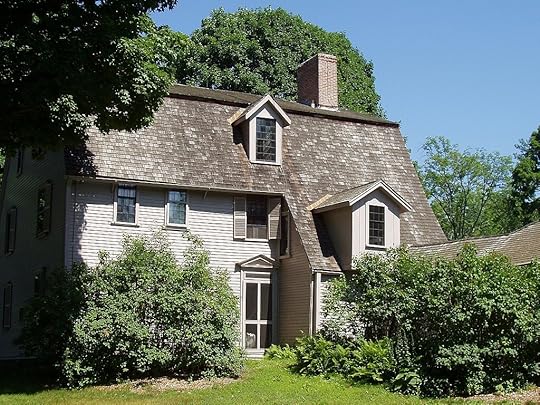
Hawthorne's talent for descriptive writings was never exercised on a happier theme than the Old Manse in Concord, Massachusetts. Built in 1765 by Ralph Waldo Emerson's grandfather, it was Emerson's temporary home for three different periods. Emerson wrote his Nature in the small back room on the second story, looking out upon the river, the North Bridge and the battlefield. When Hawthorne married Sophia Peabody in July 1842, they took up their abode in the Old Manse. Here they passed three years in idyllic happiness.

89 pages, Paperback

First published January 1, 1863

44 people want to read

About the author

Nathaniel Hawthorne

5,464 books3,585 followers
Nathaniel Hawthorne was a 19th century American novelist and short story writer. He is seen as a key figure in the development of American literature for his tales of the nation's colonial history.

Shortly after graduating from Bowdoin College, Hathorne changed his name to Hawthorne. Hawthorne anonymously published his first work, a novel titled Fanshawe, in 1828. In 1837, he published Twice-Told Tales and became engaged to painter and illustrator Sophia Peabody the next year. He worked at a Custom House and joined a Transcendentalist Utopian community, before marrying Peabody in 1842. The couple moved to The Old Manse in Concord, Massachusetts, later moving to Salem, the Berkshires, then to The Wayside in Concord. The Scarlet Letter was published in 1850, followed by a succession of other novels. A political appointment took Hawthorne and family to Europe before returning to The Wayside in 1860. Hawthorne died on May 19, 1864, leaving behind his wife and their three children.

Much of Hawthorne's writing centers around New England and many feature moral allegories with a Puritan inspiration. His work is considered part of the Romantic movement and includes novels, short stories, and a biography of his friend, the United States President Franklin Pierce.

Ratings & Reviews

What do you think?
Rate this book

Friends & Following

Create a free account to discover what your friends think of this book!

Community Reviews

5 stars
13 (30%)
4 stars
11 (25%)
3 stars
16 (37%)
2 stars
3 (6%)
1 star
0 (0%)
Displaying 1 - 8 of 8 reviews
Profile Image for Bill Kerwin.
Author 2 books84.5k followers
December 31, 2019

“The Old Manse”—originally published as the introduction to Hawthorne’s short story collection Mosses from the Old Manse—is probably the best of Hawthorne’s familiar essays. Reminiscent of many of the sketches included in his earlier Twice Told Tales (first intended as frame stories for an abandoned youthful project, The Story Teller), it shares with them an easy conversational style markedly different from the more serious tone of the tales. “The Old Manse” differs from these earlier pieces, however, in that it is thoroughly finished work, intended to stand on its own, and that it benefits from a particular weight and depth derived from the fact that it is a semi-biographical utterance from a notable—if not yet famous—public man.

Also central to the value of the essay is that it was written at his home “The Old Manse,” a notable building in a notable neighborhood. The neighborhood was Concord, Massachusetts—not far the legendary Revolutionary War battlefield, and “the old manse” “The old manse” (a venerable Scots term meaning “formerly the minister’s house”) was once the residence of William Emerson, Ralph Waldo Emerson’s grandfather. (Emerson, in fact, from whom Hawthorne rented the house in 1842, had composed the first draft of “Nature” in one of the manse’s upstairs room eight years earlier.)

Hawthorne takes his readers on a tour of the grounds, as if we were his highly valued guests, showing us the garden, the river, the old battlefield, the even older ruins of a native American village. Later, it begins to rain, and he takes us inside, where he shows us library, and tells us a little something about the manses’ two ghosts. It is a memorable visit, well worth the reader’s time.

Here are a few highlights of the tour.

On the old battlefield:
On the farther shore, overhung by a clump of elder-bushes, we discern the stone abutment of the bridge. . . . The stream has here about the breadth of twenty strokes of a swimmer’s arm — a space not too wide when the bullets were whistling across. Old people who dwell hereabouts will point out, the very spots on the western bank where our countrymen fell down and died; and on this side of the river an obelisk of granite has grown up from the soil that was fertilized with British blood. The monument, not more than twenty feet in height, is such as it befitted the inhabitants of a village to erect in illustration of a matter of local interest rather than what was suitable to commemorate an epoch of national history. . . A humbler token of the fight, yet a more interesting one than the granite obelisk, may be seen close under the stone wall which separates the battle-ground from the precincts of the parsonage. It is the grave — marked by a small, mossgrown fragment of stone at the head and another at the foot — the grave of two British soldiers who were slain in the skirmish . . . Soon was their warfare ended; a weary night-march from Boston, a rattling volley of musketry across the river, and then these many years of rest.
The Native American village:
Here, in some unknown age, before the white man came, stood an Indian village . . . . The site is identified by the spear and arrow-heads, the chisels, and other implements of war, labor, and the chase, which the plough turns up from the soil. You see a splinter of stone, half hidden beneath a sod; it looks like nothing worthy of note; but, if you have faith enough to pick it up, behold a relic! Thoreau, who has a strange faculty of finding what the Indians have left behind them, first set me on the search; and I afterwards enriched myself with some very perfect specimens . . .
Hawthorne’s impressions of Emerson, and his very different opinion of Emerson’s followers:
It was good . . . to meet him in the woodpaths, or sometimes in our avenue, with that pure, intellectual gleam diffused about his presence like the garment of a shining one; and be, so quiet, so simple, so without pretension, encountering each man alive as if expecting to receive more than he could impart. And, in truth, the heart of many an ordinary man had, perchance, inscriptions which he could not read. But it was impossible to dwell in his vicinity without inhaling more or less the mountain atmosphere of his lofty thought, which, in the brains of some people, wrought a singular giddiness — new truth being as heady as new wine. Never was a poor little country village infested with such a variety of queer, strangely dressed, oddly behaved mortals, most of whom took upon themselves to be important agents of the world’s destiny, yet were simply bores of a very intense water.
Profile Image for Peter.
405 reviews240 followers
August 18, 2022
Diese Geschichte habe ich als Lesung von Max Volkert Martens gehört, die ich im Radio mitgeschnitten hatte. Es war mein erstes Werk von Nathaniel Hawthorne. Zuerst bin ich mit der romantischen Beschreibung des Pfarrhauses, seiner Geschichte und Umgebung nicht warm geworden. Im letzten Teil aber wird der Autor etwas zeitkritischer. Noch reizvoller hat den Roman die Internetrecherche gemacht.

„The Old Manse“, wie das Pfarrhaus im Original heißt, existiert bis heute in der Stadt Concord am Fluss Concord in unmittelbarer Nähe zur „Old North Bridge“, einem zentralen der ersten Gefechte des Amerikanischen Unabhängigkeitskriegs bekannt unter „Battles of Lexington and Concord“. Der Autor und seine Frau lebten 1842 – 45 hier zur Miete. Zugleich ist das Haus die Geburtsstätte des amerikanischen Dichters und Philosophen Ralph Waldo Emerson, der in dieser Zeit auch in Concord lebte und in der Geschichte als eine Art Guru dargestellt wird, dessen überdrehte Adepten die Stadt heimsuchen.


Die literarisch schönsten Teile betreffen Hawthornes Gespräche mit seinem Freund Ellery Channing während ihrer Angeltouren auf dem Nebenfluss Assabet. Sie stehen im Kontrast zu den puritan-religiösen Büchern der frühen Bewohner des Pfarrhauses: Doch der größte Gewinn dieser wilden Tage lag für ihn und mich … in der Freiheit von allen Gepflogenheiten, Konventionen und fesselnden Einflüssen, die der Mensch auf den Menschen ausübt.

Die Geschichte hat mich erstmals mit der amerikanischen philosophisch-literarischen Bewegung der Transzentendalisten in Kontakt gebracht, die auf der „inherent goodness of people and nature“ (Wikipedia) aufbaute. Diese Überzeugung teilt auch Hawthorne, wenn er schreibt: Wären wir nicht für die Unsterblichkeit bestimmt, hätte unser Schöpfer niemals so bezaubernde Tage geschaffen und uns so tiefe Herzen geschenkt, um sie weit über alles denkbare hinaus zu genießen. Ich hoffe in meinem Leben liegen viele solche Tage noch vor mir.

PS: Eine Anekdote zum Abschluss. Den Grund seines Wegzugs von The Old Manse beschreibt Hawthorne als Eigenbedarf des Vermieters. Bei der Internetrecherche trat jedoch zu Tage, dass ausstehende Mietzahlungen die eigentliche Ursache waren.

Profile Image for John Anthony.
953 reviews172 followers
April 29, 2020
Hawthorne’s home for a while and the one time home of Emerson. It is at Concord, close by a battlefield of the War of Independence. Evocative writing, the author is clearly affected by the house and its environs. I was too, although I found it a little laboured by the end.
Profile Image for David.
403 reviews4 followers
January 26, 2025
I reread this on the way to see the Old Manse today. It was a little unsettling how little I’d retained from my first reading just four months ago. In any case, it’s really such an incredible sketch.

And it’s all still there! Just as Hawthorne described it—though the orchard was smaller than I imagined, the driveway shorter, and the view of the Old North Bridge, where the “shot heard round the world” was fired, and America born, startlingly close. (I was also a little shocked how the author’s wife kept carving messages into the window panes with a diamond. They were renters there). My view of the bridge, by the way, was from the study where Mosses from an Old Manse was written, and where Emerson penned Nature. The garden that Thoreau started for Hawthorne was covered in snow.

Hawthorne “ventured to hope that wisdom would descend” upon him from his stay there, and that he would complete a novel. He didn’t write that novel but now that I read this after the story collection I can attest that he achieved his first goal.

Marginalia:

Also left out of the sketch was the stuffed owl under glass that Hawthorne called Longfellow. I asked why and the guide said some visiting Longfellow scholars suggested it was because the poet liked to say “stupid as owls” a lot. Which supposedly meant drunk.
Profile Image for Kathy.
3,910 reviews291 followers
October 9, 2017
Idyllic prose describing the early home of young Hawthorne and his wife.
"All the sky glows downward at our feet; the rich clouds float through the unruffled bosom of the stream like heavenly thoughts through a peaceful heart."
Profile Image for Marissa.
522 reviews13 followers
October 31, 2024
I took a real-life tour of The Old Manse a couple weeks ago, and to read Hawthorne's version of the same was delightful. I also re-read "The Birthmark," and it struck me as something Anne Shirley of Green Gables would have found delicious. Now that Hawthorne has become a real person in my imagination, his work seems so much more personable, and I rather suspect he was a Kindred Spirit. In skimming through his Mosses from an Old Manse, I could see that he and his wife Sophia really permeated those stories of his which were written during their "honeymoon" phase at the Old Manse.
Profile Image for Sean Harding.
5,852 reviews33 followers
September 13, 2024
Hawthorne Hawks #56
another interesting yarn from Hawthorne, a bit longer than some of his other short tales, but almost mesmerising in its prose.
I'm not sure how to describe it, except to say that this was a master at work on his craft.
Displaying 1 - 8 of 8 reviews

Can't find what you're looking for?

Get help and learn more about the design.