
What do you think?
Rate this book

342 pages, Paperback
Published March 1, 2012


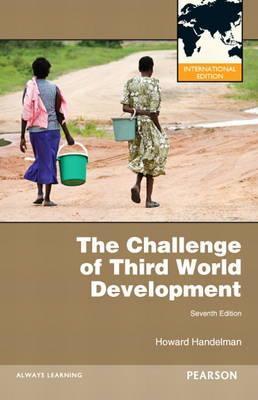
This book is a good read for anyone interested in the many problems accompanying third-world development. While each country is unique, an important fact to remember, we can learn many general lessons from the history of development in the third world. In particular, there are three main categories explored in the book: politics, culture, and economics of third-world countries.
First, the political systems of third-world countries are obviously central to its development. The Least Developed Countries (LDCs) have been continually plagued by ineffective and corrupt governments. This is more likely to occur in non-democratic countries where it is difficult to hold leaders accountable, but these problems are not exclusive to non-democracies (and they, too, occur in democracies). In general, democracy has seemed to be the most effective form of governance, but being a true democracy requires time and constituent commitment. Democracy in countries like the U.S., Canada, and those in the EU have endured because of a democratic commitment by those with political power -- political leaders, the military (military coups are ubiquitous in the LDCs but much rarer in developed countries), and, perhaps most importantly, the citizens. Without a commitment from all of these groups, democracy will falter, and the protection of civil liberties is no longer guaranteed (nor is it in a democracy, but a transition from democracy to authoritarianism will usually lead to a repression of civil liberties).
Second, like the world as a whole, the LDCs have vastly different cultural norms, a fact sometimes ignored by academics or policymakers. There is no panacea for all LDCs to develop, nor is the development of LDCs inevitable. Furthermore, "development" is a subjective term that will mean different things to different countries and peoples. In particular, a country's religions, ethnic groups and diversity, urbanization, and gender inequality all have significant effects on the growth that can be achieved. While this is not to say that cultural norms should always be accepted, it is necessary to consider these norms when proposing development solutions -- it is not realistic to simply say that Iran should immediately adopt a secular democratic governing system, unless one wishes to see a 1979 repeat. But, like all things, nuance is required in determining how development should be approached. Perhaps the only constant across all cultures is that everyone wants to have better standards of living.
Third, the economies of LDCs are also important to study when seriously proposing development solutions. When most people refer to development, they usually refer to a country's wealth and economy. While there is obviously more that goes into a country's development, it is hard to argue that economic development is not among the most important instruments for a country's development. It is again hard to draw over-arching conclusions about how a country should plan its economy when there is not even a consensus among the developed countries. Rather, it seems clear that there needs to be an economic balance, though what constitutes an optimal balance will differ between LDCs. To elaborate, the study of economics as a whole is, in part, a study of trade-offs. For each country's political system, there is a series of continuums they must place themselves on with poles on each end. Most importantly, countries must decide where they want to be between, first, a total laissez-faire economy vs. a pure command economy; in other words, the level of state intervention. Second, countries must decide how reliant on imports and exports they want to be -- the question of trade budget or trade openness. Third, countries must decide its time-discounting, the trade-off of now vs. the future. These questions do not always have to be either or (for example, many economic growth strategies entail present and future benefits), but a country will often have to make important decisions that prioritize one thing/group over another; most decisions have winners and losers. And, to return to the original point, being on the "poles" on any of these questions is usually unwise. A complete laissez-faire economy, pure command economy, completely trade-reliant country, completely closed off country, a myopic country, and a present-ignoring country all are doomed to fail. Finding the precise point on each continuum is not an easily answerable question, but it is one that can be better understood on a case-by-case basis.
Overall, a great read and one likely to be important for years to come (especially because environmental problems usually accompany development in LDCs, and the "environment problem" is one of increasing importance).

