Jump to ratings and reviews
Rate this book

The Mountain Poems of Hsieh Ling-Yun

Rate this book
In our own time the "wilderness" has emerged as a source of spiritual renewal, both as idea and in actual practice. But Hsieh Ling-yün (385-433 C. E.) was there before us.  During the last decade of his life, living as a recluse high in the mountains of southeast China, he initiated a tradition of "rivers-and-mountains" (shan-shui) poetry that stretches across the millennia in China, a tradition that represents the earliest and most extensive literary engagement with "the wild" in human history. These poems were hugely popular in Hsieh's own time and established him as one of the most innovative and influential poets in the history of Chinese poetry as well as a founder of Ch'an (Zen) Buddhism. Once again David Hinton, a recipient of fellowships from The National Endowment for the Arts and The National Endowment for the Humanities and the winner of a Harold Morton Landon Translation Award from The Academy of American Poets, has produced a fluid and supple translation that does full justice to the rivers-and-mountains of Hsieh Ling-yün's inspiration.

128 pages, Paperback

First published November 1, 2001

2 people are currently reading
123 people want to read

About the author

Ratings & Reviews

What do you think?
Rate this book

Friends & Following

Create a free account to discover what your friends think of this book!

Community Reviews

5 stars
18 (25%)
4 stars
36 (51%)
3 stars
9 (12%)
2 stars
4 (5%)
1 star
3 (4%)
Displaying 1 - 13 of 13 reviews
Profile Image for Steve.
442 reviews591 followers
July 26, 2013


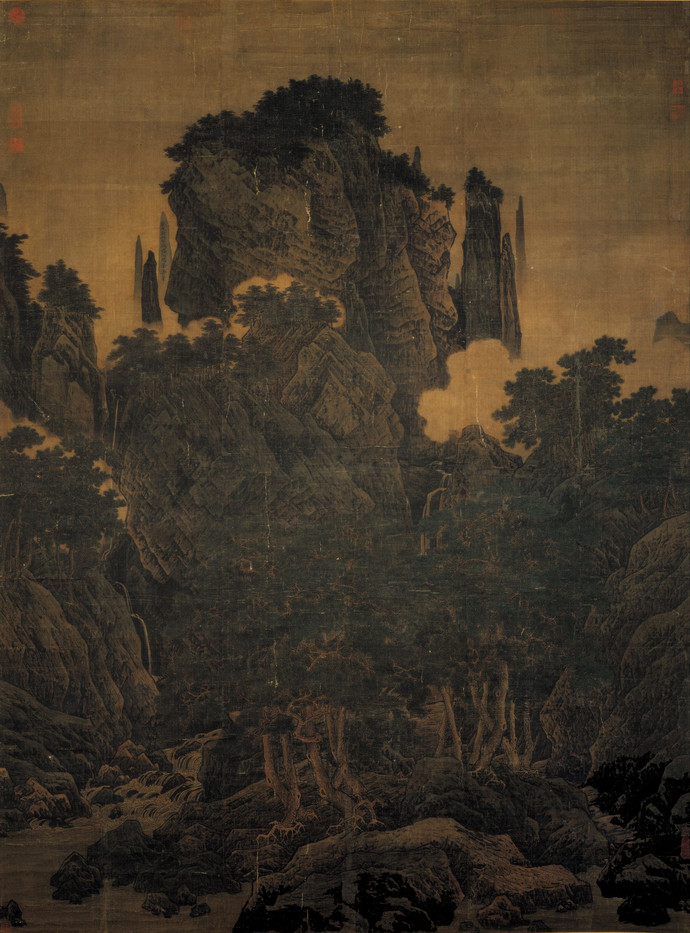
Li T'ang (c. 1050 – 1130)

Hsieh Ling-yün (385–433), also romanized as Xie Lingyun, is apparently considered to be the founder of Nature (or landscape) poetry in China, particularly of shan-shui (rivers and mountains) poetry. This is not to be confused with pastoral poetry; Nature poetry is verse inspired by a mystic philosophy (in Hsieh's case, Taoism and Ch'an Buddhism) which sees all natural phenomena as symbols charged with a mysterious and cathartic power (to use Frodsham's definition). A Western analogue was formulated some 14 centuries later in Romanticism, though the Romantic sublime was, it seems to me, primarily an aesthetic notion, whereas in the shan-shui tradition beginning with Hsieh, there is an additional component (and for some in that tradition the primary/sole component) of using the awesome mountain landscapes with plunging rivers at their sides and swirling clouds at their peaks, all experienced as a single ecological whole, to draw the reader's mind to contemplate li , the inner law (or inner pattern) of existence. But this is not the place to try to explain difficult/profound notions central to Chinese philosophy.

Even though Hsieh's poetry was very highly regarded by the Chinese elite, somehow most of his work was lost. David Hinton offers a selection of what is left in an English translation which works very well in English, though I have no idea how accurate it is. In fact, I've read complaints that Hinton takes too many liberties in turning classic Chinese poems into rather contemporary sounding poems in English.

Although some of these poems cannot be appreciated without a good grasp of the philosophical/religious background in which they were written (Hinton does try to explain a bit of it in an introduction and endnotes), it would appear that Hinton generally selected poems which avoid that problem. Here is a sample:


In the transformations of dusk and dawn, skies
fill rivers and mountains with crystalline light,

crystalline light bringing such effortless joy
a wanderer rests content, all return forgotten.

The sun was rising when I left my valley home,
and daylight faint before I started back, sailing

past forested canyons gathering dusky colors
and twilight mist mingling into flushed cloud,

past lotus and chestnut a lavish luster woven
through reeds and rice-grass toppled together.

Then ashore, I hurry south on overgrown paths,
and settle into my eastern home, enchanted still.

When worry ends, things take themselves lightly,
and when thoughts lull, the inner pattern abides.

I offer this to the adepts come refining their lives:
try this old Way of mine, make it search enough.


I haven't yet found any other translations of Hsieh's poetry in any of the languages I read, except for one more poem in Hinton's anthology Classical Chinese Poetry and three in Anthologie de la poésie chinoise classique , so (1) I am grateful to Hinton for providing this glimpse into Hsieh's art and (2) if anybody knows of other translations, please let me know.
Profile Image for Jenna.
Author 12 books369 followers
February 23, 2017
Hsieh Ling-yun (385-433 C.E.) is an undeniably important cultural figure, credited with virtually inventing the art form we call nature poetry. Or, as translator David Hinton more circumspectly phrases it in his introduction to this book, Hsieh Ling-yun "inaugurated" a "tradition" that "represents the earliest...literary engagement with wilderness in human history." (Hsieh was a prolific innovator: his inventions also included a "special cleated hiking shoe.")

When I read and review a book of poetry, I try my best to approach the reading experience as an encounter between one living poetic mind and another. As I read, I ask myself what a contemporary poet could learn from this book, what tricks or techniques he/she might fruitfully borrow from it to further his/her own poetic projects. I instinctively recoil from book reviews that treat a poetry book as if it were merely a historical or sociological artifact of another culture, reviews that stick closely to the biographical mode, describing a book as if it were a dead object, an exhibit in a trial. I'm talking about those reviews that intone "So-and-so was a product of the Russian Revolution" or "Such-and-such was a product of her upbringing in a low-income Chicago neighborhood," full stop, with no attempt to engage the poet's poetic strategies, what he was trying to say and how he was trying to say it.

Due to the vast time gap separating Hsieh's century from ours, I found it challenging to put my principles into practice in this case, to meet Hsieh's poetry on the idealistic aesthetic grounds on which I aspired to meet it. As Hinton warns, Hsieh's poetry can be hard for a contemporary reader to stomach because it is "nearly devoid of the human stories and poetic strategies that normally make poems compelling." To an uncharitable-minded reader, what poetic strategies Hsieh does use could seem passé, inapplicable to contemporary poetic problems. Evading the lyric and narrative modes of poetry as we know them, Hsieh applies language toward various non-lyric, non-narrative aims, using words in some instances to draw maps, compressing a three-dimensional space into the linear space of poetry--

Tracing the way back home here,
I might round North Mountain

on roads built along cliff-walls....

or I could take the watercourse
way winding and circling back....

Gazing on and on in reverence
across realms so boundless away,

I come to the twin rivers that flow through together


In other instances, he puts language to work objectively listing, cataloguing, documenting the little-explored surroundings in which he found himself on becoming a political exile--

There are birds like
junglefowl and swan, osprey, snow-goose,
crane and egret, bustard and kingfisher,


And on and on. Like Franklin compiling his "Almanack," Hsieh strings together poetic lines to make a calendar of practical chores useful for those who would wish to follow in his footsteps and seek out a Walden-esque/Innisfree-like independence--

(honey gathered in the sixth month
and grain threshed in the eighth,)


Though a patchwork of pragmatic-minded calendars, maps, and lists may sound common, there is an elegance in Hsieh's frequent use of anaphora, of parallel structure, of chiasmus--

silence boundless, distances empty

The end goal seems to be affirmation of Buddhist and Taoist principles that readers well-versed in those religious traditions will find familiar. There is an apparent sincerity to these spiritual epiphanies of Hsieh's, though -- the accumulation of concrete details in these poems proves the poet has not just talked the talk but walked the walk -- which many readers may well find compelling in the end.
Profile Image for Eddie Watkins.
Author 11 books5,558 followers
August 2, 2018
Sprawling, excessive poems of natural wonder and wildness. Though the surface of these poems seem to be the opposite of what one typically expects of old Chinese poetry, in their essence they are very simple: wild descriptions of wild landscapes (content mirroring subject) punctuated quite nakedly with a Taoist philosophy of submission to the natural forces animating the landscape and the poetry. Wild stuff with echoes of Wordsworth 1300 years before Wordsworth.

Returning Across The Lake From Our Monastery At Stone-Screen Cliff

In the transformations of dusk and dawn, skies
fill rivers and mountains with crystalline light,

crystalline light bringing such effortless joy
a wanderer rests content, all return forgotten.

The sun was rising when I left my valley home,
and daylight faint before I started back, sailing

past forested canyons gathering dusky colors
and twilight mist mingling into flushed cloud,

past lotus and chestnut a lavish luster woven
though reeds and rice-grass toppled together.

Then ashore, I hurry south on overgrown paths,
and settle into my eastern home, enchanted still.

When worry ends, things take themselves lightly,
and when thoughts lull, the inner pattern abides.

I offer this to adepts come refining their lives:
try this old Way of mine, make it search enough.
Profile Image for Jimmy.
Author 6 books287 followers
July 15, 2016
In ancient China, mountains were considered sacred objects where heaven and earth met. Rivers and mountains were experienced together as fundamental manifestations of earth's ch'iyang, and rivers yin.

Hsieh Ling-yun (385 to 433 CE) initiated the tradition of "rivers-and-mountains" (shan-shui) poetry that has gone on over the millennia. It mixes nature with our spiritual relationship to it.

His influence extended beyond poetry as the wild became central to all of the arts. Others were inspired to live as recluses in the wilderness. In our age, where we are on the verge of destroying the planet, it is as significant as ever.

Chinese poetry is traditionally divided into two modes, both of which began at this time: the "fields-and-gardens" of T'ao Ch'ien (365 to 427 CE) and "rivers-and-mountains" of Hsieh Ling-yun. The former is peopled and the latter is unpeopled.

The Hsieh family was perhaps the most prominent aristocratic family of the time. It was heavily involved in contemporary political struggles. Many of its prominent leaders were lost in the struggles. Hsieh entered the government before he was even 20. In 422, at the age of 37, he was exiled to Yung-chia on the southeast coast. He then began writing his famous nature poems. He spent the next ten years in the mountains. But he had a comfortable home with an enormous library. A smaller retreat was a long hike away. He maintained a monastic center where monks visited from far away.

In 431, he was exiled a second time and forced to leave his retreat. He could have been executed for a foolish insurrection he started. Instead he lived until 433 when he was indeed executed.

Sometimes his loneliness shows:

. . . where thinking of loved ones lost to me forever now,
I can look forward to the evanescent visits of cloud guests.


He found cures for his ailments in the plants.

He categorized many of the flora and fauna he observed. Some are no longer there, such as tigers. But he speaks of never killing any of the animals.

Sometimes he got lost:

. . . I'm soon

lost in thick forests, the nature of dusk and dawn in full view,
and for bearings, I trust myself to the star-filled night skies.


He sometimes went to market, bought animals, and set them free.

He misses someone:

We'll never meet again now. I sit beside
a stream, sun drying my hair for nothing.


And here:

in this regret no one here's kindred enough
to climb this ladder of azure clouds with me.


But he deals with it:

I have no regrets this far from humankind.
It's true there are no kindred spirits here,

but wondering alone I feel only adoration,
and without it, who plumbs the inner pattern?


His final hope as he approaches death:

and now my lone hope turns to some future life
where friend and foe share that mind together.


OTHER NOTES:

Ch'u Yuan (340 t0 278 BCE) was China's first major poet. When he was unjustly exiled, he threw himself into a river and drowned.

Pan Szu or Master Pan (around first century BCE to first century CE) was a Taoist recluse known for his profound sayings.

Humanity (jen) is the touchstone of Confucian virtue. It means to act with a selfless and reverent concern for the wellbeing of others.

An uncarved block of wood is an analogy for Taoist nonbeing before it emerges into particular forms in the realm of being.

Hsu Hsun (320 to 365 CE) was a recluse poet and immediate predecessor to Hsieh Ling-yun.
Author 6 books257 followers
February 3, 2018
These are a little weightier and thus a tad more repetitive than other poetries of its ilk. Although usually the density of form in shan-shui poetry is part of its charm, the reader being steeped in the wilderness aspect of the work, here it seems a little clunkier than usual. I can't fault Hinton, since he seems to be a faultless and thoughtful translator. The subtlety of Hsieh's work just might be buried a little too deeply. Or I'm a goddamn idiot. Or both? Hard to say. Let me compare it to the shaggy perambulations of a defecating yak:
Profile Image for Chloe.
529 reviews5 followers
March 18, 2021
4.5

Oh to be a 5th century Chinese nature poet
Profile Image for Mark Mullee.
61 reviews8 followers
March 25, 2008

Hsieh Ling-Yun invented hiking boots. A great gift to the world.
Profile Image for Alarie.
Author 13 books92 followers
July 26, 2025
Before I headed off to college, I knew I loved to write. When I was a senior in high school, I discovered my first Chinese love poems in translation in my public library. I was smitten. Occasionally, I found other translated poems I’ve loved. However, this book did not excite me. I can understand that a poet for some reason frowned upon by the authorities and exiled would have a miserable, lonely time and not much to write about (not safe enough to write about at least) would not be creating his best work.
People did not appear in these poems. He may have found old friends or family to talk to, but likely didn’t think it safe to take any risk. That’s why I found this collection too much alike, mere discriptions of the mountains, animals and plants he saw through lonely eyes.
Profile Image for Bill Shultz .
36 reviews2 followers
December 4, 2025
Funny to rate 2,000 year-old poems by a poet that created a sub-genre that persists to this day. There are better poems in this lineage but that seems inevitable and obvious. If you like mountains-and-rivers poetry, you should read it.
Profile Image for Chuck.
74 reviews1 follower
January 18, 2023
Perhaps, a bit was lost in the translation of the poems.
Profile Image for Taylor Swift Scholar.
445 reviews10 followers
July 22, 2024
I truly loved the last book of ancient Chinese poetry that I read, but this was so boring. One of the poems is just a list of fish. Another is a list of birds. Cool.

Go read Tao Qian instead.
Profile Image for David Gorgone.
40 reviews1 follower
May 9, 2008
The only reason why I didn't give this book five stars is that it got a tad repetitive. Not so much that it made the book boring, but enough to make it not worth five stars. What is sad is that with all the guy had written only a small amount of it survived. He is considered the father of Mountain And Stream Poetry. Not having read much on the subject I am not sure what that exactly means except that he writes a lot about the mountain and streams near his home.
Displaying 1 - 13 of 13 reviews

Can't find what you're looking for?

Get help and learn more about the design.