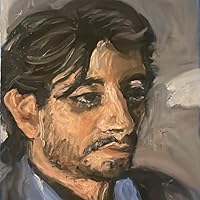
David Ignatow was an American poet. He was born in Brooklyn on February 7, 1914, and spent most of his life in the New York City area. He died on November 17, 1997, at his home in East Hampton, New York. His papers are held at University of California, San Diego.
Early in his career he worked in a butcher shop. He also helped out in a bindery in Brooklyn, New York, which he later owned and managed. During the Great Depression in the 1930s, he sought employment with the Works Progress Administration (WPA) as a journalist. His father helped him with the funding to produce his first book, Poems, in 1948. Although the volume was well received, he had to continue working various jobs and find time in between to pursue writing. These jobs included work as a messenger, hospital admitting clerk, vegetable market night clerk, and paper salesman. After committing wholly to poetry, Ignatow worked as an editor of American Poetry Review, Analytic, Beloit Poetry Journal, and Chelsea Magazine, and as poetry editor of The Nation.
He taught at the New School for Social Research, the University of Kentucky, the University of Kansas, Vassar College, York College, City University of New York, New York University, and Columbia University. He was president of the Poetry Society of America from 1980 to 1984 and poet-in-residence at the Walt Whitman Birthplace Association in 1987.
Ignatow's many honors include a Bollingen Prize, two Guggenheim fellowships, the John Steinbeck Award, and a National Institute of Arts and Letters award "for a lifetime of creative effort." He received the Shelley Memorial Award (1966), the Frost Medal (1992), and the William Carlos Williams Award (1997) of the Poetry Society of America.
David Ignatow is remembered as a poet who wrote popular verse about the common man and the issues encountered in daily life. In all, he wrote or edited more than twenty-five books. Direct statement and clarity were two of Ignatow's primary objectives in crafting a poem. Fidelity to the details and issues of daily life in Ignatow's poetry won him a reputation for being "the most autobiographical of writers." Ignatow once told Contemporary Authors: "My avocation is to stay alive; my vocation is to write about it; my motivation embraces both intentions, and my viewpoint is gained from a study and activity in both ambitions.
3 stars because the simple, colloquial language is not enough for me. There are so many beautiful treasures buried in the English language and various ways to make it sing. Although the subject matter can be delicate and beautiful, the simple language is not enough to convey this in my opinion. Its like trying to paint with mittens on.
The extra 0.49 stars is because I did find some of the poems moving, especially the ones about nature. It was the subject matter and the ideas that I found moving, not the language itself. I do appreciate the honesty and the simplicity of the language but to me it just felt a bit too flat.