

What do you think?

Less Than Zero: The Case for a Falling Price Level in a Growing Economy
This book sets out to explain the complexity of why increased production does not that always bring with it lower prices. According to the book, those who look upon monetary expansion as a way to eradicate almost all unemployment fail to appreciate that persistent unemployment is a non-monetary or 'natural' economic condition, which no mount of monetary medicine can cure. Selgin explores the differences between these monetary and natural conditions, and proposes solutions of his own.
82 pages, Paperback
First published August 1, 1997
Ratings & Reviews
Friends & Following
Create a free account to discover what your friends think of this book!
Community Reviews
Displaying 1 - 9 of 9 reviews

November 29, 2017
The title of this book doesn't do it justice. Instead of merely being a pitch for gradual deflation, this is a lucid, clear-eyed explanation of why our economy would benefit from switching from a steady "inflation target" to a constant "productivity norm." Selgin points out that since the economy in most situations is growing (or, in other words, is becoming more productive), goods are in reality becoming cheaper most of the time. Yet with even a 0% inflation target, central banks have to constantly inject more money into the economy to undo productivity gains and keep a steady price level. This creates real distortions in the signals given by prices.
Selgin points out that a decline in the prices of goods provides real information to producers and purchasers. It demonstrates how much productivity has changed overall as well as in different markets. He compares it to allowing the different dynamic levels of a symphony to express themselves in a recording. The goal for a good recording isn't the same steady volume of all instruments throughout, but to allow changes in volume to be clearly communicated to the listener. The same goes for changes in prices.
Selgin points out that the problems with inflation targeting are more severe in the face of negative supply shocks, or negative changes in productivity. Here the productivity norm says that central banks should allow price levels to rise higher temporarily and inject more money into the economy. Say an oil shortage raises prices throughout the economy, so real production and productivity shrink. To keep inflation steady under an anti-inflation regime, the government would have to cut back money even more, leading to more falling demand to "roll back" higher prices. Thus the productivity norm price level changes both ways with changes to the economy, creating more flexibility.
Selgin also shows that creditors and debtors of fixed money contracts benefit with a productivity norm. Since interest rates reflect not just inflation expectations but expectations about economic growth, productivity norm price adjustments do equal justice to both sides of a contract. If productivity is unexpectedly high, debtors have to pay more to reflect their better ability to repay. If productivity is unexpectedly low, however, debtors have to pay back less. Thus during a recession or depression, debtors aren't squeezed excessively for funds they don't have. Again, the flexibility benefits are enormous.
Although I don't agree with everything in this book (I'm less sanguine about the ability of wages to adjust downward), this is a great overview of monetary policy and a positive proposal for the future. It should be an economics staple.
Selgin points out that a decline in the prices of goods provides real information to producers and purchasers. It demonstrates how much productivity has changed overall as well as in different markets. He compares it to allowing the different dynamic levels of a symphony to express themselves in a recording. The goal for a good recording isn't the same steady volume of all instruments throughout, but to allow changes in volume to be clearly communicated to the listener. The same goes for changes in prices.
Selgin points out that the problems with inflation targeting are more severe in the face of negative supply shocks, or negative changes in productivity. Here the productivity norm says that central banks should allow price levels to rise higher temporarily and inject more money into the economy. Say an oil shortage raises prices throughout the economy, so real production and productivity shrink. To keep inflation steady under an anti-inflation regime, the government would have to cut back money even more, leading to more falling demand to "roll back" higher prices. Thus the productivity norm price level changes both ways with changes to the economy, creating more flexibility.
Selgin also shows that creditors and debtors of fixed money contracts benefit with a productivity norm. Since interest rates reflect not just inflation expectations but expectations about economic growth, productivity norm price adjustments do equal justice to both sides of a contract. If productivity is unexpectedly high, debtors have to pay more to reflect their better ability to repay. If productivity is unexpectedly low, however, debtors have to pay back less. Thus during a recession or depression, debtors aren't squeezed excessively for funds they don't have. Again, the flexibility benefits are enormous.
Although I don't agree with everything in this book (I'm less sanguine about the ability of wages to adjust downward), this is a great overview of monetary policy and a positive proposal for the future. It should be an economics staple.

June 15, 2013
Interesting Quote:
"Using monetary policy to stabilise the price level is not at all like making the weather more predictable...Stabilising the price level is more like making barometric readings (nominal indicators of meteorological conditions) predictable, while leaving the weather itself as uncertain as ever...Just as it is desirable for barometer readings to be unpredictable if the weather itself changes randomly, it is desirable for the price level- a useful 'barometer' of changing unit costs - to be unpredictable to the extent that aggregate productivity changes randomly."
-George Selgin, Less than Zero
"Using monetary policy to stabilise the price level is not at all like making the weather more predictable...Stabilising the price level is more like making barometric readings (nominal indicators of meteorological conditions) predictable, while leaving the weather itself as uncertain as ever...Just as it is desirable for barometer readings to be unpredictable if the weather itself changes randomly, it is desirable for the price level- a useful 'barometer' of changing unit costs - to be unpredictable to the extent that aggregate productivity changes randomly."
-George Selgin, Less than Zero

September 20, 2026
The depths of my personal failures were evident from my reading of this classic book. I am now an aged warrior. I fear that 2 years of fixing clerical errors in a funky LOS, solving pointless bureaucratic problems, pushing against the bureaucracy, trying to rationalize the nature of bureaucracy and failing, chasing after administrative cul-de-sacs, formatting tables and getting approvals for common-sense requests, arguing with credit over semantic nonsense, pampering credit, have indeed atrophied a certain corner of my brain - that of my capacity for higher reasoning. At the peak of my abstract reasoning faculties, i.e. when I was but a callow econ student at UCL, I would have eaten this book for breakfast and asked for seconds, for it contains no difficult math and only uses economic concepts found in A-level econ; but now, in the post-HLB intellectual state that I find myself in, I wrestled with it.
That being said, Less than zero connected a very important dot for me. I went into it thinking that it would mostly discuss the concept of good deflation, and rescue good deflation from the bogeyman that the econ profession has built around all kinds of deflation. I've already been pondering good deflation for a year now, being the economic heretic that I am. But this book achieves much more than showing that deflation is not all bad. In this book, Selgin's key achievement is laying out the theoretical justifications for a productivity norm, which is the intellectual foundation for NGDP targeting. Selgin does not even mention NGDP targeting in this book, in fact he goes on to recommend free banking as a good monetary regime to achieve good targeting of the productivity norm. Hence, those of us who are fans of market monetarism can feel NGDP targeting's looming presence in this book.
I sheepishly admit that, even after more than 2 years of listening to Macro Musings religiously, I do not even fully understand what NGDP targeting is all about. This book finally made it click for me, because it contained a mathematical appendix. It was hard to follow David Beckworth's verbal arguments in podcast format. I'll hereby note some basic equations that Selgin didn't bother to include in his appendix, yet I finally sat down to differentiate myself, that helped me organize my understanding about NGDP targeting.
A key exercise that I never even bothered to do was to recognize that:
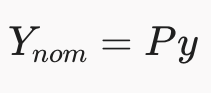
where
 : Nominal income
P: the general price level
y: real output
To find the growth rate of nominal income, I must take the logarithmic differential of this equation. Recall that the growth rate of a variable X is given by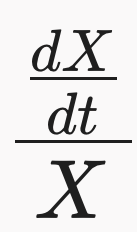 . I must take the logarithmic differential of this equation because the chain rule automatically divides the differential by the variable itself, spitting out the growth rate directly.
So, taking the natural logarithm:

Differentiating (with respect to time):
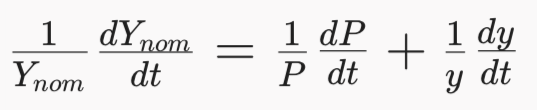
Growth rate of nominal income = Growth rate of price level + Real output growth rate
Nominal income growth = Inflation rate + Real output growth
It took my dumbass years to sit down and run this simple equation and see why nominal GDP mathematically equals inflation + real GDP.
When I lay it out like this, I can see why targeting nominal GDP growth solves many tricky problems that the Fed faces. What should the Fed do in a negative supply shock that pushes prices higher? An inflation-targeting Fed would be forced to hike rates to bring down prices. But tightening under a supply contraction makes a recession worse! In fact this is arguably what the Fed was forced to do this Wednesday, in the Sep 16 meeting. The Fed knew hot inflation was largely caused by negative supply shocks by the Middle East conflict, and further aggregate supply disruptions from tariffs, but they had no choice but to hike. Were the Fed to target nominal GDP growth, they would tolerate transitory inflation (a cursed word now lmao). It's a 2-for-1 deal: stabilizing medium-run inflation over time while ignoring temporary supply shocks.
What about the flip side of the script, when a productivity boom causes a secular decline in unit production costs and real output growth? NGDP targeting would allow this benign state of affairs! But a traditional inflation-targeting, deflation-hating Fed would bring out their monetary guns whenever they see a falling price level regardless of whether it's caused by falling aggregate demand or increasing aggregate supply.
Without Selgin's Less than zero, we wouldn't have the intellectual groundwork to argue for NGDP targeting to tolerate a falling price level. That's the central achievement of this book.The meat of this book is its argument, with surgical precision, for why a falling price level isn't all bad. Since an A-level econ student literally knows that aggregate demand falling = bad deflation; aggregate supply rising = good deflation, I have little more to add here. Selgin's productivity norm was also ahead of its time: while the TFP norm may be practically impossible to implement and communicate to the public, the labour productivity norm anticipated future discourse regarding NGDP targeting to adjust for the size of the labour force. Imo this is a fascinating research area given the demographic declines and the potential disruptions to the labour force by AI that we face, which leads me to another great organizing principle from this book.
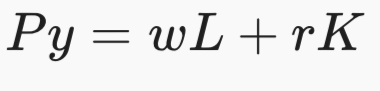
So the base equation for nominal income is given by:
where
P: the price level
y: real output
w: price of a unit of average-quality labour
L: labour input
r: rental price of average-quality capital
K: capital input
The differentiation of this equation is tedious to type because I cannot simply take the natural logarithm of the right term, but anyway it simplifies to
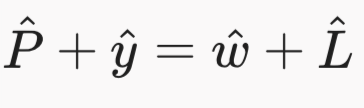
(where the 'hats' mean growth rates of the variables)
or,
nominal GDP growth = wage growth + labour growth
So if the labour force truly shrinks over time, that would call for lower nominal income.
Interestingly, under a labour productivity norm where nominal income is targeted to grow at the same rate as labour growth,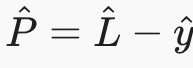 , substituting that into the equation for nominal income growth, we would get
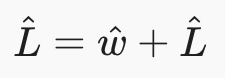
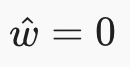
I ruminated on the philosophical implications of a labour productivity norm. Would workers be content with a nominal wage growth target of 0? Delivering gains to workers with a decline in the price level instead of growth in nominal wages would be a radical change to society. We've been ingrained for generations, by the mainstream positive-inflation-targeting regime, for better or worse, to expect positive inflation but positive nominal wage growth. The thought of delivering gains via the price level instead of nominal wages is an exciting one.
I wish more economists read this book, as more dialogue on the drastic erosion of our purchasing power over the past 100 years seems to me to be in dire need. The reality remains that the Fed is currently nowhere near to taking up the policy recommendations outlined in this book. We can thank the complexity of measuring GDP for that. In its latest framework review, the Fed officially abandoned FAIT to return to FIT. So we find ourselves back to square one, in a world where the simple ideas of Less than zero are not considered by our monetary authorities.
That being said, Less than zero connected a very important dot for me. I went into it thinking that it would mostly discuss the concept of good deflation, and rescue good deflation from the bogeyman that the econ profession has built around all kinds of deflation. I've already been pondering good deflation for a year now, being the economic heretic that I am. But this book achieves much more than showing that deflation is not all bad. In this book, Selgin's key achievement is laying out the theoretical justifications for a productivity norm, which is the intellectual foundation for NGDP targeting. Selgin does not even mention NGDP targeting in this book, in fact he goes on to recommend free banking as a good monetary regime to achieve good targeting of the productivity norm. Hence, those of us who are fans of market monetarism can feel NGDP targeting's looming presence in this book.
I sheepishly admit that, even after more than 2 years of listening to Macro Musings religiously, I do not even fully understand what NGDP targeting is all about. This book finally made it click for me, because it contained a mathematical appendix. It was hard to follow David Beckworth's verbal arguments in podcast format. I'll hereby note some basic equations that Selgin didn't bother to include in his appendix, yet I finally sat down to differentiate myself, that helped me organize my understanding about NGDP targeting.
A key exercise that I never even bothered to do was to recognize that:
where
: Nominal incomeP: the general price level
y: real output
To find the growth rate of nominal income, I must take the logarithmic differential of this equation. Recall that the growth rate of a variable X is given by
. I must take the logarithmic differential of this equation because the chain rule automatically divides the differential by the variable itself, spitting out the growth rate directly.So, taking the natural logarithm:
Differentiating (with respect to time):
Growth rate of nominal income = Growth rate of price level + Real output growth rate
Nominal income growth = Inflation rate + Real output growth
It took my dumbass years to sit down and run this simple equation and see why nominal GDP mathematically equals inflation + real GDP.
When I lay it out like this, I can see why targeting nominal GDP growth solves many tricky problems that the Fed faces. What should the Fed do in a negative supply shock that pushes prices higher? An inflation-targeting Fed would be forced to hike rates to bring down prices. But tightening under a supply contraction makes a recession worse! In fact this is arguably what the Fed was forced to do this Wednesday, in the Sep 16 meeting. The Fed knew hot inflation was largely caused by negative supply shocks by the Middle East conflict, and further aggregate supply disruptions from tariffs, but they had no choice but to hike. Were the Fed to target nominal GDP growth, they would tolerate transitory inflation (a cursed word now lmao). It's a 2-for-1 deal: stabilizing medium-run inflation over time while ignoring temporary supply shocks.
What about the flip side of the script, when a productivity boom causes a secular decline in unit production costs and real output growth? NGDP targeting would allow this benign state of affairs! But a traditional inflation-targeting, deflation-hating Fed would bring out their monetary guns whenever they see a falling price level regardless of whether it's caused by falling aggregate demand or increasing aggregate supply.
Without Selgin's Less than zero, we wouldn't have the intellectual groundwork to argue for NGDP targeting to tolerate a falling price level. That's the central achievement of this book.The meat of this book is its argument, with surgical precision, for why a falling price level isn't all bad. Since an A-level econ student literally knows that aggregate demand falling = bad deflation; aggregate supply rising = good deflation, I have little more to add here. Selgin's productivity norm was also ahead of its time: while the TFP norm may be practically impossible to implement and communicate to the public, the labour productivity norm anticipated future discourse regarding NGDP targeting to adjust for the size of the labour force. Imo this is a fascinating research area given the demographic declines and the potential disruptions to the labour force by AI that we face, which leads me to another great organizing principle from this book.
So the base equation for nominal income is given by:
where
P: the price level
y: real output
w: price of a unit of average-quality labour
L: labour input
r: rental price of average-quality capital
K: capital input
The differentiation of this equation is tedious to type because I cannot simply take the natural logarithm of the right term, but anyway it simplifies to
(where the 'hats' mean growth rates of the variables)
or,
nominal GDP growth = wage growth + labour growth
So if the labour force truly shrinks over time, that would call for lower nominal income.
Interestingly, under a labour productivity norm where nominal income is targeted to grow at the same rate as labour growth,
, substituting that into the equation for nominal income growth, we would getI ruminated on the philosophical implications of a labour productivity norm. Would workers be content with a nominal wage growth target of 0? Delivering gains to workers with a decline in the price level instead of growth in nominal wages would be a radical change to society. We've been ingrained for generations, by the mainstream positive-inflation-targeting regime, for better or worse, to expect positive inflation but positive nominal wage growth. The thought of delivering gains via the price level instead of nominal wages is an exciting one.
I wish more economists read this book, as more dialogue on the drastic erosion of our purchasing power over the past 100 years seems to me to be in dire need. The reality remains that the Fed is currently nowhere near to taking up the policy recommendations outlined in this book. We can thank the complexity of measuring GDP for that. In its latest framework review, the Fed officially abandoned FAIT to return to FIT. So we find ourselves back to square one, in a world where the simple ideas of Less than zero are not considered by our monetary authorities.

November 30, 2025
Thought-provoking little monograph on the advantages of a “productivity norm” versus price stability. The arguments on menu costs and monetary misperceptions are illuminating and well-presented (although they would have benefitted from more formal treatment with a simple model), but I found the discussion of debt contracts less convincing. I am still a bit hazy as to the rationale for *secular* deflation following productivity improvements vs just “seeing through” supply shocks (the latter being a common enough position among New Keynesian economists, so not particularly controversial in my view). Surely if private agents fully anticipate the trend deflation, it would be neutral, so I don’t quite see the gain vis a vis price stability. Interesting discussion in any case!

May 6, 2023
Selgin does a good job of making his case for price level targeting whereby there can be inflation and deflation over time. This then is connected with his overview of nominal GDP targeting. There is more structure and validity to it then I thought before reading the book. Check it out for yourself.
December 22, 2017
I read some other articles by Selgin before. I looked into this book specifically to figure out how 'free banking' can stabilise nominal GDP.
April 12, 2023
Only a pure academic could come up with this idea this bad

November 3, 2012
I almost gave this 4 stars, but I feel that would be unfair. The only reason that I would have thought to give it 4 stars is because of all the econ jargon. It's really unnecessary and prevalent with writers like Keynes. That being said, Selgin doesn't deserve to be knocked by this because it seems most economists do this. This book is not for someone who is new to economics or knows nothing about macroeconomics. If you know microeconomics, I'd suggest reading some macro before reading this book.
Selgin suggests that the zero inflationists are onto something, but do not go far enough. He suggests that PRODUCTION driven deflation be allowed rather than avoided. He suggests that producers are aware of this deflation because that's precisely what they are trying to do. All in all, great econ book!
Selgin suggests that the zero inflationists are onto something, but do not go far enough. He suggests that PRODUCTION driven deflation be allowed rather than avoided. He suggests that producers are aware of this deflation because that's precisely what they are trying to do. All in all, great econ book!
August 9, 2012
An awesome book, using mainstream AD-AS diagram to show why deflation is not always bad. However, more importantly, the author uses words to describe why a market economy should experience steady, but expected deflation when prices and interest rates are at their "natural" or "full information" levels - that is, when the price system is allowed to operate. The author also offers a way "from here to there" by advocating a productivity norm in monetary policy.
The book is not a long read, but is packed with info and is very useful in understanding the macroeconomy. I highly recommend this book to anyone interested in economics.
The book is not a long read, but is packed with info and is very useful in understanding the macroeconomy. I highly recommend this book to anyone interested in economics.
Displaying 1 - 9 of 9 reviews